B2B Buying Committee: Who’s Involved and What Each Role Needs
You can win over the person who found you and still lose the deal. That’s because B2B software isn’t bought by one person. It’s bought by a B2B buying committee: a group of people with different jobs, different worries and the power to say no.
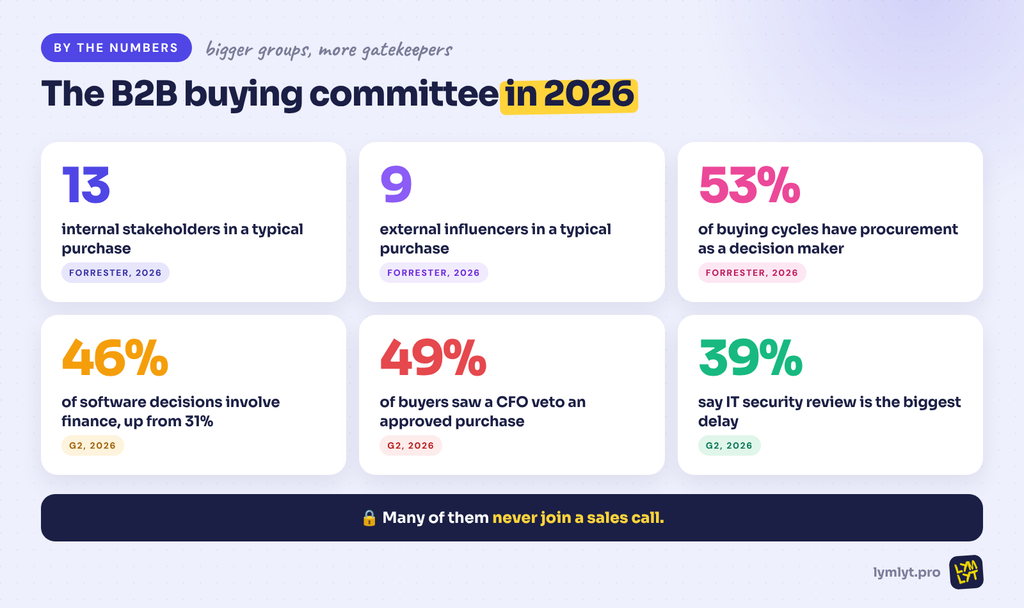
That group keeps growing. Forrester’s State of Business Buying 2026 found a typical purchase involves 13 internal stakeholders and nine external influencers, and procurement is a decision maker in 53% of buying cycles (Forrester). Many of them will never join a sales call.
This guide covers who’s on the committee, what each role needs before they say yes, the content that reaches them and how to help your champion get the deal over the line.
What is a B2B buying committee?
A B2B buying committee (also called a buying group) is everyone who influences a purchase decision. Some have formal authority, like the budget owner. Others have informal power, like the IT lead who can delay a deal for months with one security question.
The committee isn’t a fixed list. It changes with deal size, risk and industry. A $5,000 tool might involve three people. A company-wide platform can involve twenty.
The B2B buying committee in numbers
The latest research points the same way: bigger groups, more finance and more gatekeepers.
| Finding | Number | Source |
|---|---|---|
| Internal stakeholders in a typical purchase | 13 | Forrester, 2026 |
| External influencers in a typical purchase | 9 | Forrester, 2026 |
| Buying cycles where procurement is a decision maker | 53% | Forrester, 2026 |
| Software decisions with finance involved | 46%, up from 31% a year earlier | G2, 2026 |
| Buyers whose CFO vetoed an approved purchase in the past year | 49% | G2, 2026 |
| Buyers citing IT security review as the biggest delay after selection | 39% (50% at enterprises) | G2, 2026 |
| Deals that stall because of misalignment inside the buying group | More than 40% | Edelman-LinkedIn, 2025 |
Bain and LinkedIn call the people in procurement, finance and IT “hidden buyers.” In a February 2026 survey of 750 buyers, Bain found these hidden buyers hold about half of the influence over the purchase decision (Bain).
The 8 roles on a B2B buying committee
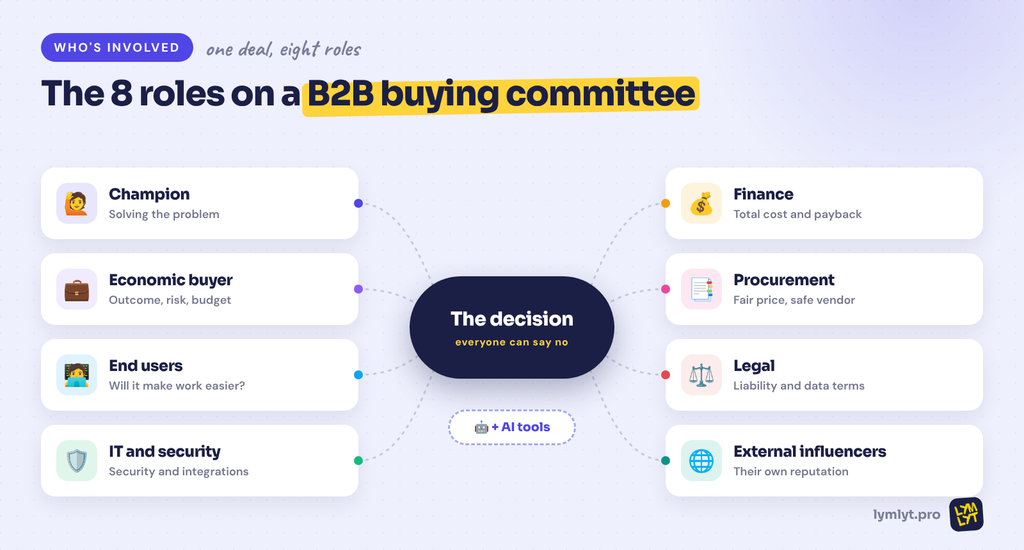
Titles vary, but the same eight roles show up in most software deals. One person can play more than one role, especially at smaller companies.
1. The champion
The person who found you, believes in you and pushes the deal internally. Often a manager or director who feels the problem every day.
- Cares about: solving the problem, and looking good for picking the right tool.
- Asks: “How do I convince my boss and the rest of the team?”
- Needs from you: a business case they can forward, answers to tough questions and proof from similar companies.
2. The economic buyer
The person who owns the budget and signs off. Usually a VP, C-level leader or founder.
- Cares about: business outcomes, risk and priorities competing for the same budget.
- Asks: “Why this, why now, and what happens if we wait?”
- Needs from you: a one-page summary of the outcome, cost and timeline. Not a feature list.
3. End users
The people who’ll use the product every day. They rarely sign, but they can quietly kill a deal by refusing to adopt.
- Cares about: whether it makes their job easier or adds work.
- Asks: “How long will it take to learn? Will it break what already works?”
- Needs from you: a hands-on trial, short demos and honest answers about the learning curve. Forrester found more than 60% of buyers use a trial before purchasing (Forrester).
4. IT and security
The technical reviewers who check integrations, data handling and security. They can’t usually approve a deal, but they can stop one.
- Cares about: security, compliance, integrations and support load.
- Asks: “Where is our data stored? Who can access it? What breaks if you go down?”
- Needs from you: a security page, certifications, a pre-filled security questionnaire and clear integration docs.
5. Finance
The CFO or finance team checks total cost and return. Finance is showing up in more software deals than it used to.
- Cares about: total cost of ownership, payback period and contract terms.
- Asks: “What will this really cost in year two? When do we see a return?”
- Needs from you: transparent pricing, an ROI model with stated assumptions and flexible terms. Our pricing prompts research shows what AI tools tell buyers about your costs when your site doesn’t.
6. Procurement
The team that runs vendor selection, negotiates price and makes sure the process is followed.
- Cares about: fair price, vendor risk and process compliance.
- Asks: “Have we compared at least three options? Is this vendor financially stable?”
- Needs from you: clear pricing, standard contract terms, vendor forms completed quickly and honest comparisons. Our guide to B2B SaaS comparison pages shows how to build those, and why an honest vs page builds more trust than a one-sided one.
7. Legal
Legal reviews the contract, data processing terms and liability. They usually join late, which is exactly why they cause delays.
- Cares about: liability, data protection and contract risk.
- Asks: “What happens if there’s a breach? Can we exit the contract?”
- Needs from you: a standard DPA, clear terms and someone who can answer redlines fast.
8. External influencers
Consultants, analysts, peers at other companies and review sites. Forrester counts nine of them in a typical purchase.
- Cares about: their own reputation for giving good advice.
- Asks: “Who else uses this, and would they buy it again?”
- Needs from you: strong reviews, referenceable customers and a presence in the communities your buyers trust. Much of this influence never shows up in your CRM, as we covered in the recommendation that never appears in your CRM.
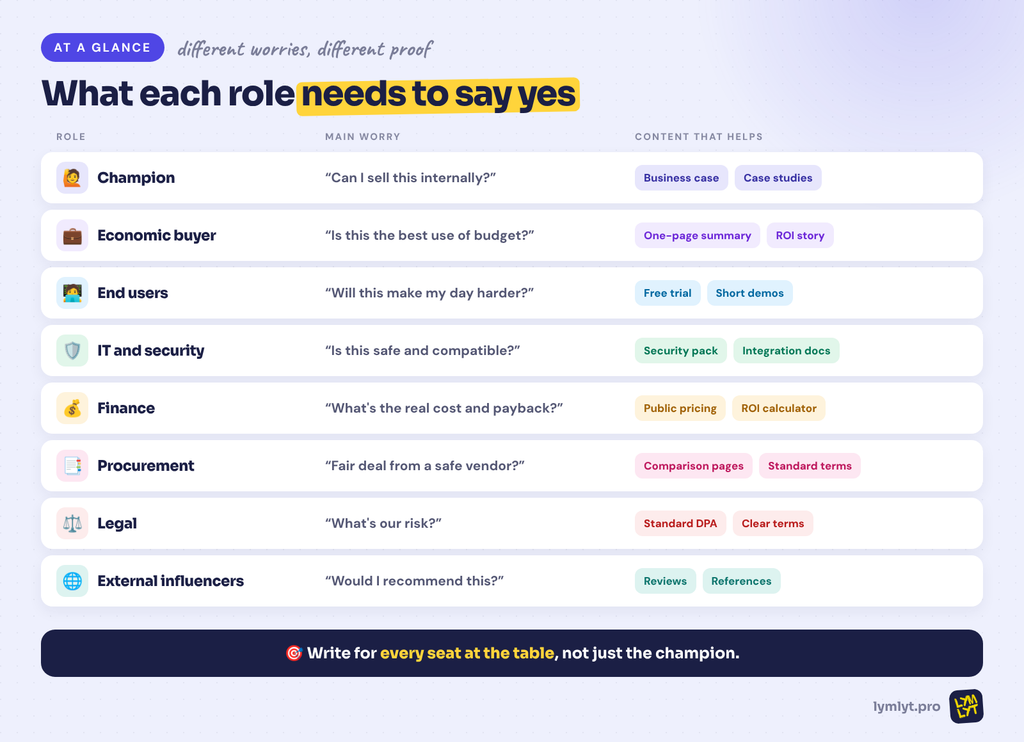
What each B2B buying committee role needs: at a glance
| Role | Main worry | Content that helps |
|---|---|---|
| Champion | “Can I sell this internally?” | Business case template, case studies, internal pitch deck |
| Economic buyer | “Is this the best use of budget?” | One-page summary, ROI story, executive briefing |
| End users | “Will this make my day harder?” | Free trial, short demos, onboarding guide |
| IT and security | “Is this safe and compatible?” | Security page, questionnaire pack, integration docs |
| Finance | “What’s the real cost and payback?” | Public pricing, ROI calculator, TCO breakdown |
| Procurement | “Is this a fair deal from a safe vendor?” | Comparison pages, standard terms, vendor info pack |
| Legal | “What’s our risk?” | Standard DPA, clear contract terms |
| External influencers | “Would I recommend this?” | Reviews, references, original research |
When each role gets involved
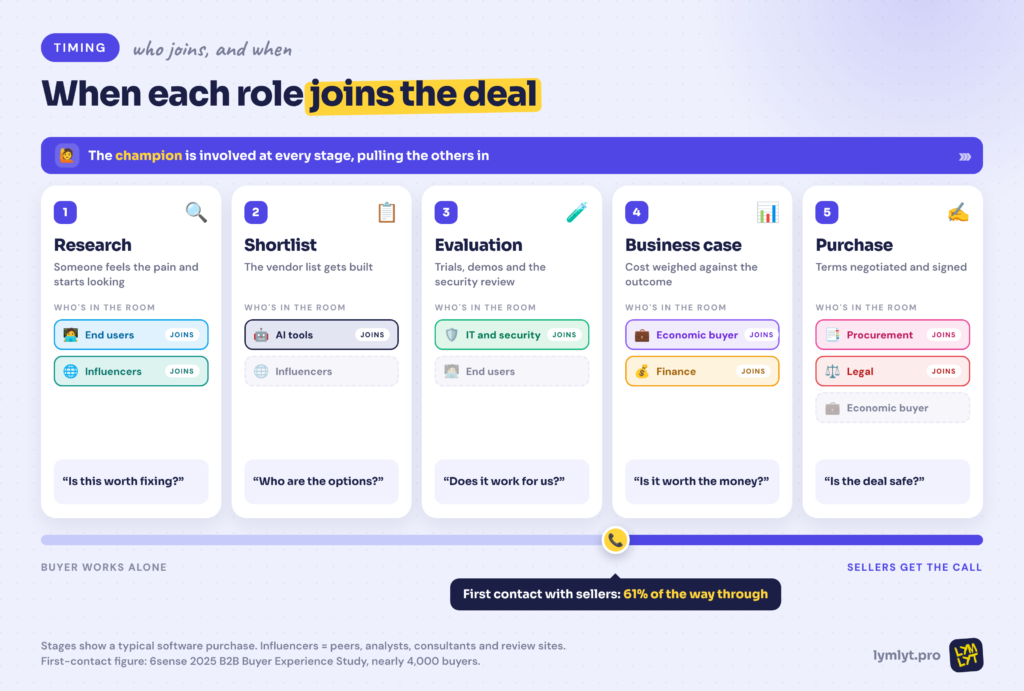
Roles don’t all show up at once. Here’s the typical pattern across a software purchase:
- Research: the champion and end users feel the pain and start looking. External influencers shape the early list.
- Shortlist: the champion builds the list, often with help from AI tools and peers.
- Evaluation: end users trial the product. IT and security start their review.
- Business case: the economic buyer and finance weigh cost against the outcome.
- Purchase: procurement and legal negotiate terms and sign.
The catch: most of this happens before you’re invited in. In 6sense’s 2025 B2B Buyer Experience Study, buyers made first contact with sellers 61% of the way through the process on average, and bought from their top-ranked vendor 77% of the time (CustomerThink). We covered that early phase in the B2B buying journey starts before your marketing funnel does.
How to help your champion win the deal
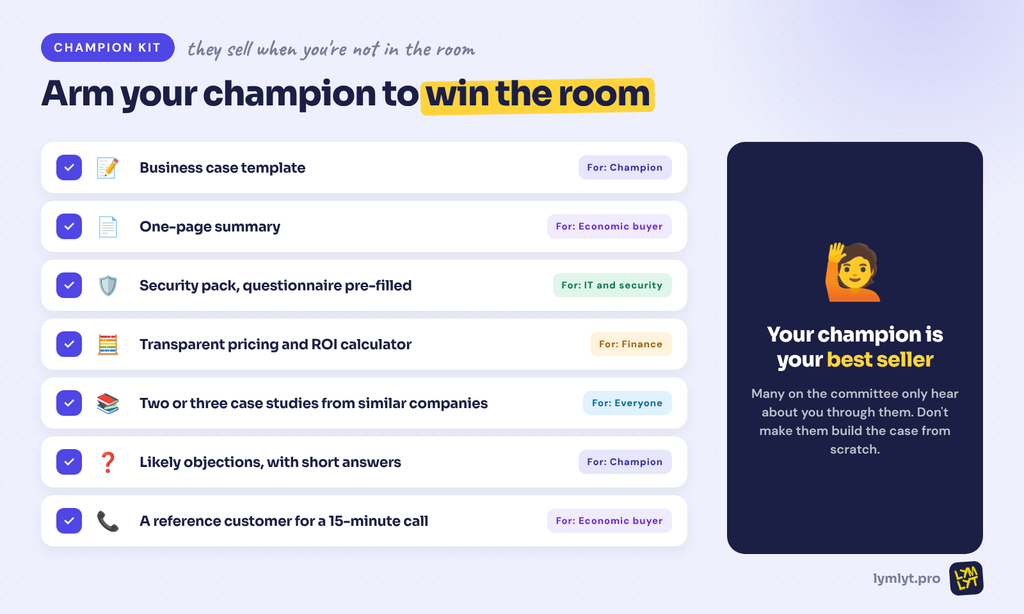
Your champion does the selling when you’re not in the room, which is most of the time. Give them a kit so they don’t have to build the case from scratch:
- A business case template they can fill in with their own numbers
- A one-page summary for the economic buyer
- A security pack for IT, with your questionnaire already answered
- Transparent pricing and an ROI calculator for finance (calculators are also one of the B2B lead magnets that still work)
- Two or three case studies from companies like theirs (our B2B SaaS case studies guide shows how to write ones that persuade, even anonymous ones when customers can’t be named)
- A list of likely objections, with short answers
- A reference customer who’ll take a 15-minute call
How to reach the roles you never meet
Much of the committee will never talk to sales. They’ll read your site, ask AI tools and check what peers say. Three things help:
- Publish the answers they look for. Pricing, security, integrations and limitations. If it isn’t public, AI tools will guess.
- Write for each role, not just the champion. A post for finance reads differently from one for end users. Start with a clear ideal customer profile and sharp B2B positioning, then map content to each role.
- Build trust before the shortlist. Thought leadership reaches hidden buyers early. Here’s how to create thought leadership content that AI can’t copy.
AI is now part of the buying committee
There’s a new member at the table. G2’s 2026 report found 82% of software buyers sourced recommendations from an AI chatbot in the last 24 months, and 61% use or plan to use AI agents in software buying (G2 via Webull). Every role on the committee can now ask an AI tool about you before they ask your sales team.
That changes what you publish. Facts need to be specific, current and easy to check. We go deeper on this in AI has entered the buying committee, and you can see the questions buyers actually ask in our shortlist prompts research.
The bottom line
A B2B buying committee isn’t one buyer. It’s a champion, a budget owner, end users, IT, finance, procurement, legal and outside influencers, and now AI tools too. Each one needs different proof before they say yes. Map who’s involved in your deals, publish the answers each role looks for and give your champion everything they need to win when you’re not in the room.
Need content for every seat at the table? Our team writes case studies, comparison pages and landing pages that answer each role’s questions.

Jay is the co-founder of LymLyt and an AI partnership consultant helping B2B SaaS companies grow through content strategy, SEO, and AI integration. He writes about content marketing, what makes B2B content convert, and how SaaS teams can build content systems that drive real pipeline.