Most “founder-led” posts are (actually) marketer-led
In November 2025, a founder named Sam Udotong posted on LinkedIn that his company had lied to its first customers for over a year.
In March 2026, a founder named Roy Lee posted on X that a growth number he gave a journalist was made up.
Both the posts got immense engagement – split the room. Some called it inspiring. Some called it fraud.
Those two stories are the hook for me start a conversation around the reality of “founder-led” marketing. Anything coming from a founder has more value, right? And that’s why…
… the “founder-led” label is a half-truth!
Call something “founder-led marketing” and you’re telling the reader that this person built the company, and this is them, talking to you directly, no filter in between.
That filter exists in most cases now. It has a name, a price list, and its own trade press.
Search for LinkedIn ghostwriting and you’ll find dozens of agencies advertising openly: Windmill Growth, Understory, StartupCookie, Media Engine, and many more.
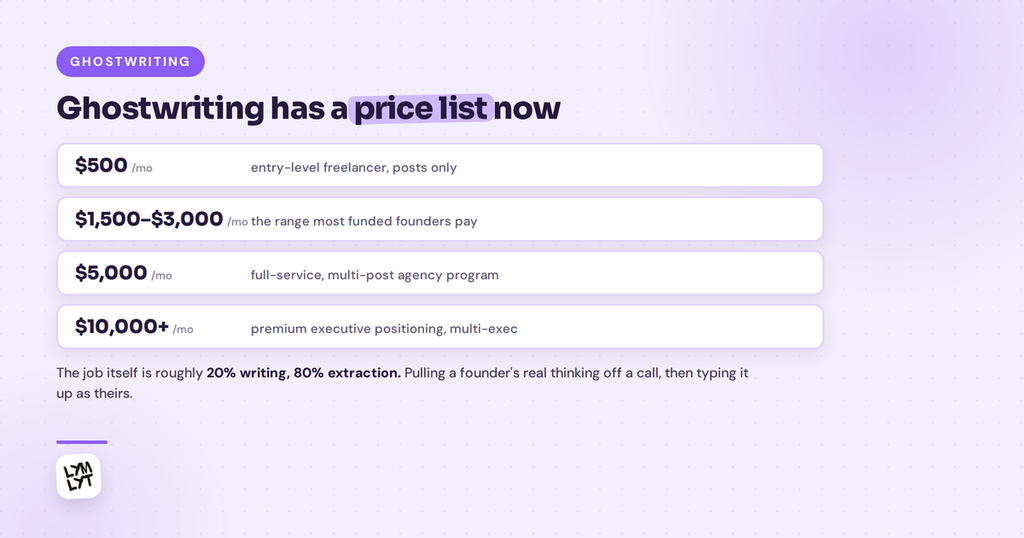
Rates run from $500 a month for basic posts to $10,000 a month for a full executive program. One practitioner benchmark puts the actual job at about 20% writing and 80% pulling the founder’s real opinions out of their head so the post still sounds like them.
That’s the whole business model. Not writing for founders. Sounding like founders.
So when you read a post that says
- “I learned this the hard way”
- or “here’s what nobody tells you about scaling,”
the honest question isn’t whether it’s true. It’s who typed it. Increasingly the answer is a person the founder is paying by the month, working from a call transcript, shipping three to five drafts a week under someone else’s name.
Let’s go back to the confessions again…
Fireflies.ai is worth over a billion dollars today. In 2017, before it had built any real AI, a customer who needed meeting notes got a founder on mute, typing by hand, sending the notes ten minutes later under the name “Fred.” Udotong told the whole story himself: “We told our customers there’s an ‘AI that’ll join a meeting.’ In reality it was just me and my co-founder calling in to the meeting sitting there silently and taking notes by hand.” The post got nearly 3,000 reactions, split between “super inspirational story” and “blatant fraud.”
Roy Lee runs Cluely. In summer 2025 he told TechCrunch his company was doing close to $7 million in ARR. That October, on stage, he said: “What I’ve learned is you should never share revenue numbers.” Five months after that, he admitted the $7 million was made up, breaking his own rule about revenue numbers in the same post where he confessed to lying about one.
Neither man lost much. Fireflies kept its billion-dollar valuation. Cluely had already raised $15 million from Andreessen Horowitz.
These examples are important because it teaches that you can lie and get away with it. And if you confess later, it will get more engagement.
Let’s talk about engagement pods.
The pods aren’t bots anymore. They’re real people, on a subscription.
Engagement pods used to mean bots. But for LinkedIn, bots were easy to detect and removed from the platform.
But the pod tools still in business are real accounts with probably way more followers than the founder they are selling to.
HyperClapper is one of the biggest. It sells access to “channels,” its own word for pods, made up of over 5,000 real professionals who like and comment on each other’s posts inside the first hour after publishing, the exact window LinkedIn’s algorithm weighs most.
Its FAQ says it straight: “Every engagement comes from one of 5,000+ real professionals, founders, marketers, engineers, with real careers and real networks. No bots, no fake accounts, ever.” The company claims over 30 million engagements delivered across 350,000+ boosted posts.
It’s not a one-off purchase either. It’s a subscription, priced in tiers: $39 a month for a small creator, up to $499 a month for an enterprise plan with 300 boosted posts.
This is likely why LinkedIn’s team cannot do anything about this. LinkedIn’s VP of Product, Gyanda Sachdeva, said the platform will act against tools “automating any kind of manipulation by commenting on a bunch of posts at the same time,” and named auto-scripts and browser plugins “without any human oversight or review.”
A network of real people manually clicking like and typing a comment doesn’t match that description, even when the entire point of the arrangement is to game the same algorithm a bot would. Lempod got pulled for the automation. A paid network of real humans coordinating the same outcome is a much harder thing to write a rule against, because technically nobody’s faking who’s behind the click.
Search “LinkedIn pod crackdown” and you find that LinkedIn has 97% detection accuracy, accounts dropping from thousands of impressions to a few hundred overnight, detection up several hundred percent in two years.
A site called BossFeed actually tried to trace those numbers to a source and found nothing: “a circular citation loop, a dozen blogs quoting the same figures, every citation pointing at another blog, and nothing at the center.” The bot-and-fake-account enforcement is real, LinkedIn stopped roughly 83 million fake accounts in the first half of 2025 alone. The real-account subscription pod business sits right next to that enforcement, priced, marketed, and still running.
Why LinkedIn doesn’t (or can’t) stop the part that matters?
LinkedIn goes hard after bots and coordinated fake accounts. Tens of millions stopped a year. A whole reporting button for AI slop, shipped in 2026.
But nothing around a ghostwriter publishing under a founder’s name, or a company faking its product for a year, or an invented ARR number. None of that threatens LinkedIn’s own numbers, the ones it reports to advertisers and investors.
A viral confession post, real or staged, just means more time on the platform. LinkedIn has no reason to referee the fight between the founder writing their own posts and the founder paying an agency $3,000 a month to sound like they are. Both keep people scrolling.
What’s still true.
Founder content genuinely works when a founder actually writes it. Employee and founder posts get several times the engagement of brand accounts, across most studies that have looked at it. Edelman’s research with LinkedIn found most B2B decision-makers trust a person’s thought leadership over a company’s marketing material.
None of that requires a ghostwriter, a pod, or a fake number.
But there are founders writing their own posts.
A founder writing their own posts needs real hours every week. Researching what to say, drafting it, editing it, deciding if it’s worth publishing. There’s no shortcut through that if the words are actually yours.
A founder paying a ghostwriting agency spends about an hour a week, by one agency’s own published estimate, reviewing drafts someone else pulled from a recorded call. The rest of the week comes back to them.
Stack a pod subscription on top of that, and the same founder’s post also gets several thousand real professionals liking and commenting inside the first hour, the exact window the algorithm weighs most, for a flat monthly fee.
So the honest founder is up against the army of:
- better writers,
- engagement pods,
- and time itself.
One person with a laptop and their own two hands cannot out-produce.
So, why won’t they pay for ghostwriter and pods?
Picture the founder writing their own posts, no agency, no pod, no invented number. It costs them hours a week they don’t have.
Then they watch a competitor close a deal because competitor’s founder had a good following that a $3,000-a-month agency built.
Any honest founder would start considering buying the same service.
Book publishing already solved this problem.!
Novels and memoirs have run on ghostwriters for decades, and publishing found a fix LinkedIn can copy: put the second name on the cover.
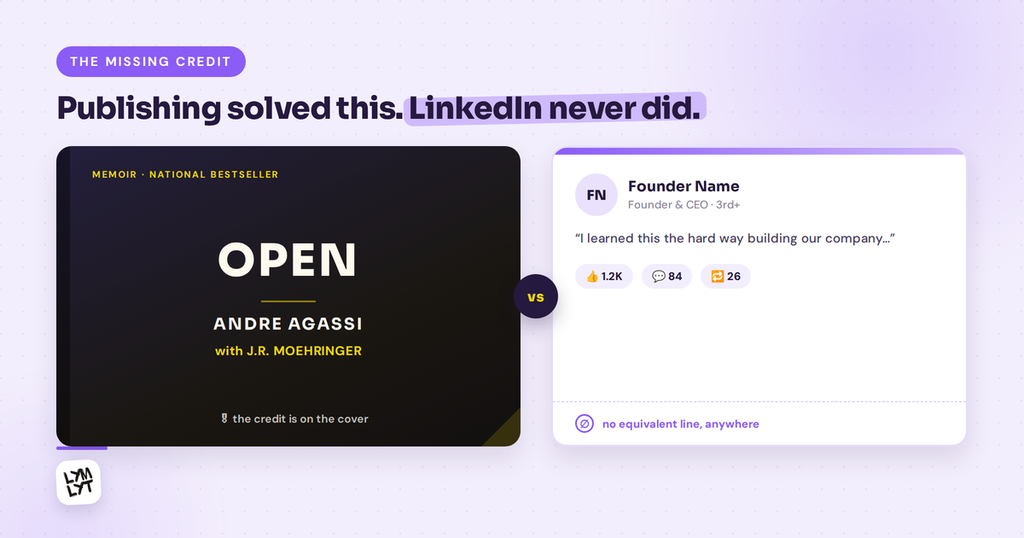
- Andre Agassi’s memoir Open was written with J.R. Moehringer. His name is on it.
- Prince Harry’s Spare was written with the same J.R. Moehringer, credited again.
- Lee Iacocca’s famous autobiography carries co-writer William Novak’s name right there next to his.
- Jessica Simpson talked openly about working with ghostwriter Kevin Carr O’Leary during the press tour for her memoir Open Book.
The credit was part of the sale from day one: “with,” or “as told to,” small type, right on the cover. Readers bought the book knowing exactly whose sentences they were reading and whose life they were reading about.
LinkedIn has no version of that convention. A founder’s name on a post is presented as if it certifies the founder wrote it, every single time, even on the accounts where a ghostwriter has been filing three drafts a week for a year.
Steal this…
Borrow the book industry’s fix. Say it plainly, once, somewhere permanent: “I work with a writer on this.” Publishing has run on that line for decades and it has never stopped a book from selling. It won’t stop your posts from landing either.
If you hire a ghostwriter, hand them the thinking, not just the topic. The posts that read like a real person still sound like one. A thirty-minute call every week works and compounds over months.
Post the smaller, true number. A fake one only works until someone checks your Stripe account, and someone always eventually does.
Don’t steal this…
Don’t hire the loudest agency because a competitor did. The competitor’s growth might be the agency’s growth, not theirs. Copying the tactic without checking whether it’s actually working is how an entire industry gets built on nothing.
Don’t confess for the reaction. Both Udotong and Lee got attention out of admitting what they’d done. That’s not proof it was smart. Those were childish mistakes made by young founders, that’s it.
Don’t assume LinkedIn’s never going to penalise pods. For now, they may not a have a system to flag this, but soon they will. So, the pod enviroment is short-lived, invest at your own risk.

Rashmita is content marketer with 8 years of experience building and growing SaaS brands. Now she tests various AI tools for marketers and shares her feedback on this blog, LinkedIn, Instagram, and YouTube.