How AI changed marketing jobs and titles: roles, salaries, and hierarchy in 2026
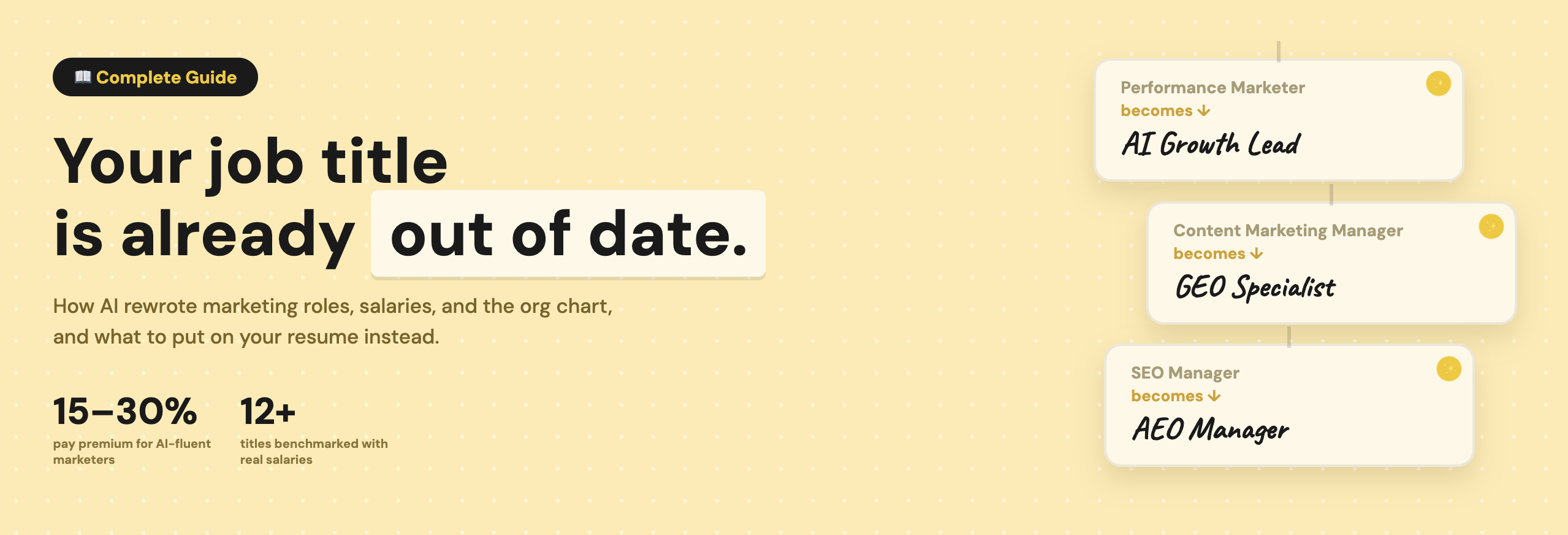
6 months ago your title was accurate. It might not be anymore. And yeah, it is because of AI.
The performance marketer who used to hand-build every ad set now supervises a system that builds hundreds and picks the winners. The content marketer who used to write every word now edits AI drafts and decides which ones are worth publishing. Same title on LinkedIn, different job description underneath it, and most people haven’t updated either one.
Companies are paying 15 to 25% more for AI-literate candidates in the same roles, and a growing set of titles didn’t exist three years ago and now clear six figures on day one. This piece breaks down what actually changed, what the new titles pay, how the standard roles (product, performance, lifecycle, content, growth) got rewritten from the inside, and what to put on a resume so a hiring manager reads “AI-fluent” instead of “used ChatGPT once.”
What actually changed in the org chart
The old marketing org was built around a constraint that no longer exists: humans are slow at execution, so you hire more humans. A content team scaled by adding writers. A performance team scaled by adding media buyers. More output meant more headcount, full stop.
Between 2024 and 2026, marketing job postings grew about 6% a year while marketing output grew 24%. Teams are producing more with fewer people, not because anyone got fired, but because AI agents absorbed the repetitive middle of the job: first drafts, ad variant testing, basic segmentation, routine reporting.
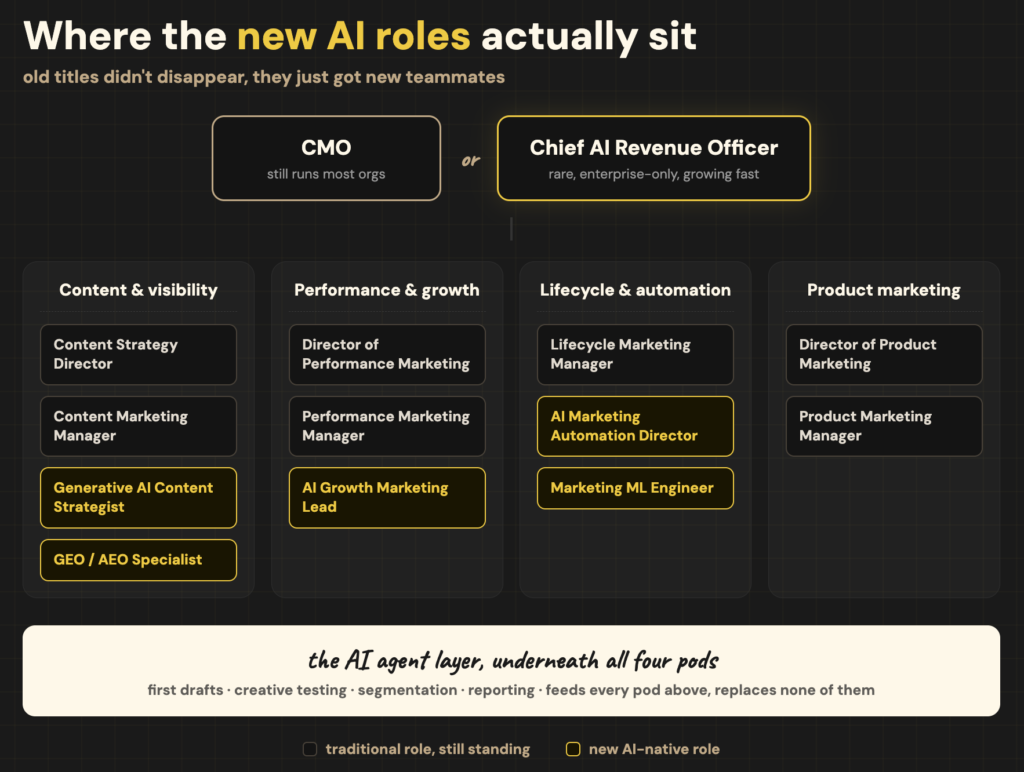
What’s left is judgment. One operator working with AI agents can now do what used to take a small team, and the org chart is compressing around three roles instead of six: a strategist who sets direction, an operator who runs the system, and a specialist who owns a channel or craft. Every company we’ve researched for this piece describes some version of this shift.
“This is the model that’s winning right now.”
– GrowthMarketer, on the strategist-operator-specialist structure
The roles that survive cannot be fully delegated to an agent. Judgment, relationships, taste, accountability. Everything else is execution, and execution increasingly belongs to the machines.
The new AI-native titles
A handful of titles didn’t exist in a typical org chart two years ago. Some are still rare (you won’t see a Chief AI Revenue Officer at a 40-person startup), but they set the ceiling the rest of the market is pricing against.
| Title | US salary range | What it actually owns |
|---|---|---|
| AI Marketing Specialist / Junior AI Marketer | $55K – $100K | Runs AI tools inside an existing team, no strategic ownership yet |
| Generative AI Content Strategist | $100K – $155K | Builds content systems and briefs that keep AI output on-brand at scale |
| AI Growth Marketing Lead | $130K – $190K | Growth experiments run through an AI-native toolkit: segmentation, testing, channel mix |
| Marketing Machine Learning Engineer | $135K – $200K | Builds and deploys the models behind targeting, scoring, and personalization |
| AI Marketing Automation Director | $140K – $200K | Owns the automation layer: predictive scoring, dynamic content, autonomous campaign optimization |
| Senior AI Marketer / Senior Marketing Manager (AI specialization) | $150K – $260K+ | Senior IC or manager scope with AI systems as the core deliverable |
| Chief AI Revenue Officer (CAIRO) | $200K – $300K+ | C-suite, owns AI strategy across marketing and sales, still rare outside enterprise |
One title worth watching that isn’t priced consistently yet: the GEO Specialist (Generative Engine Optimization) or AEO Manager, focused on getting content surfaced inside AI answers rather than ranked on a results page.
Reliable salary aggregator data doesn’t exist for it yet since the title is too new, but postings track it close to a senior SEO or content strategist band, roughly $90K to $150K depending on scope. Prospeo’s research calls it “the newest title in this category” and notes companies building 2026 content teams are adding it fast. Worth a closer look, since it’s the title most likely to land on your resume next.
GEO vs SEO: what’s actually different
Every SEO on LinkedIn added “GEO” or “AEO” to their headline this year. Before writing that off as title inflation, it’s worth understanding what actually changed, because the two disciplines aren’t the same job wearing a new hat.
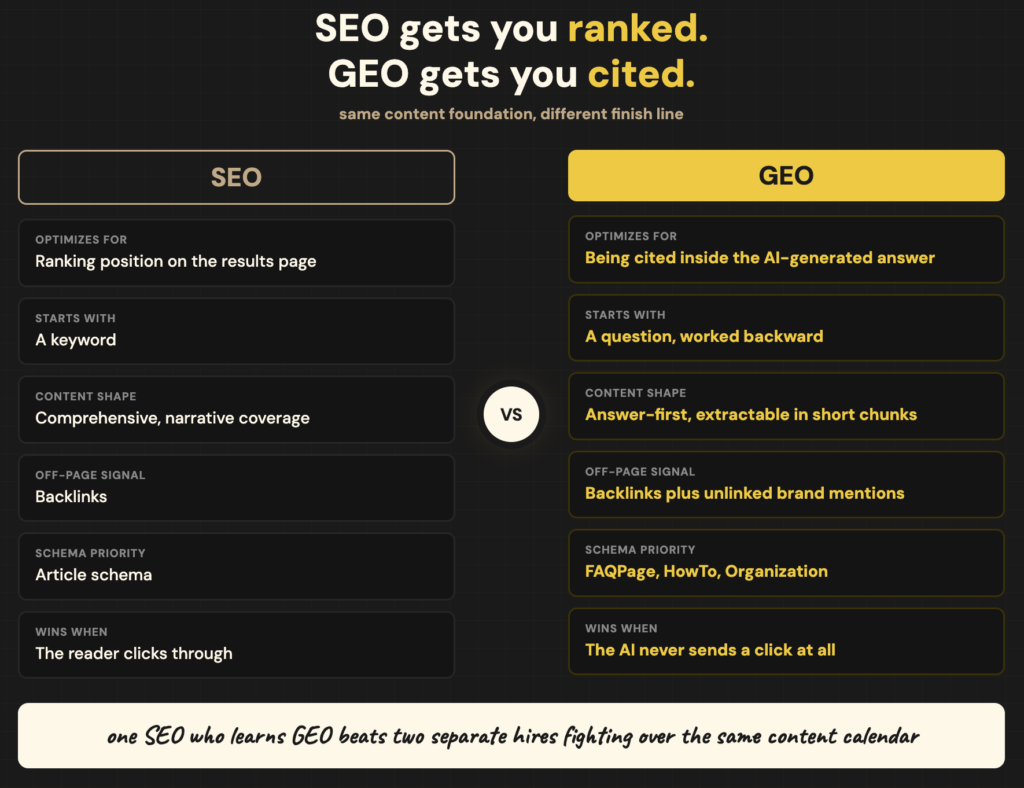
SEO optimizes for a ranked list. You research a keyword, build a page around it, earn links, and Google slots you into position one through ten. The reader decides which link to click. GEO optimizes for something else entirely: being the sentence an AI system pulls into its answer, with no click required at all. Google AI Overviews went from showing up on 6 to 8% of US searches in early 2024 to 50 to 60% by early 2026, and a citation inside that answer doesn’t care where you rank on the page below it.
That difference runs deeper than the surface metric:
| SEO | GEO | |
|---|---|---|
| Optimizes for | Ranking position | Being cited in the generated answer |
| Starting point | A keyword | A question, worked backward into a standalone answer |
| Content shape | Comprehensive, narrative coverage | Answer-first, extractable in short self-contained chunks |
| Off-page signal | Backlinks | Backlinks plus brand mentions, even unlinked ones |
| Schema priority | Article schema | FAQPage, HowTo, Organization |
| Success metric | Rankings, clicks, traffic | Citations, share of voice inside AI answers |
| Freshness impact | Moderate | Large: recently updated pages get cited disproportionately more |
The overlap is bigger than the differences, though. Both disciplines still depend on structured content, E-E-A-T, and technical hygiene. A page that’s well-organized, clearly written, and backed by real expertise tends to perform in both places at once, since GEO is built on top of the same foundation SEO already established, not a separate discipline competing for the same budget.
Why SEOs are rebranding themselves, not just their content. The skill overlap explains the title overlap. A technical SEO who already understands schema, crawlability, and content structure is most of the way to doing GEO well; the gap is smaller than the “SEO is dead” headlines suggest. Adding GEO or AEO to a title is partly a defensive move against that narrative, and partly an accurate reflection that the day-to-day work barely changed shape. It’s less a career pivot and more a relabeling of work SEOs were already halfway doing.
Why pairing SEO and GEO in one role beats hiring a dedicated GEO specialist. Splitting them into two hires sounds thorough. In practice it tends to slow everything down.
Agencies working across both disciplines describe the same pattern: teams that split GEO off as its own initiative end up, in the words of one practitioner, “doubling their work for half the result.”
A standalone GEO hire without SEO context is optimizing the top of a funnel that doesn’t exist yet: there’s nothing to get cited if the underlying pages aren’t crawlable, structured, and authoritative in the first place. SEO builds the ranking authority that GEO citations draw from, so a person who owns both can make one editorial calendar do both jobs instead of running two content strategies that fight over the same writer’s time. For most B2B SaaS teams, one senior SEO with real GEO fluency outperforms an SEO and a GEO specialist working from separate briefs.
How standard roles got rewritten
Most marketers won’t chase a brand-new title. They’ll stay a product marketer, a performance marketer, a lifecycle marketer, and the job will keep changing under them. Here’s what changed in each, what it pays now, and what actually moves a resume to the top of the pile.
Product marketing
AI didn’t replace positioning work. It compressed the research and drafting that used to eat a launch cycle, and it blurred the line between PMM and PM. Gartner’s 2026 report on product marketing leaders calls AI “the defining force” reshaping team structure and go-to-market strategy, and PMMs are now expected to move at product-shipping speed, not campaign-calendar speed.
US salary benchmarks (base):
| Level | Salary range |
|---|---|
| Entry / Associate PMM | $78K – $115K |
| PMM (standard) | $113K – $180K |
| Senior PMM | $150K – $240K |
| Director / VP Product Marketing | $200K – $300K+ |
What to talk about: don’t describe AI as a shortcut you took. Describe it as a research and speed advantage. Talk about how you used AI to compress competitive analysis from weeks to days, or how you ran messaging tests across more variants than a manual process would allow. Interviewers in this role are listening for a before-and-after number, not a tool name.
“Product marketing is one of the messiest titles I price.”
– Gregg Flecke, KORE1
That messiness is your opening. A PMM who can point to AI-assisted positioning work with a clear before and after (win rate, sales cycle length, a segment cut in favor of a better one) reads as the strategic version of the title, not the “wrote the one-pager” version.
Tools worth naming: HubSpot AI, Salesforce Einstein, Clay for competitive research, Gong or Chorus for AI-surfaced call insights that inform messaging, Claude or ChatGPT for positioning drafts and message testing.
Performance marketing
This is the role AI changed fastest and most visibly. Platforms now test hundreds of creative combinations automatically and shift budget to whatever wins in real time. The manual media buyer job, picking bids and refreshing dashboards, is mostly gone. What’s left is strategy: which audiences to feed the system, which creative angles to test, when to override the algorithm.
US salary benchmarks (base):
| Level | Salary range |
|---|---|
| Junior / Associate | $76K – $137K |
| Performance Marketing Manager | $82K – $160K |
| Senior Performance Marketing Manager | $127K – $220K |
| Director / Head of Performance Marketing | $167K – $310K |
What to talk about: name the automation you supervised, not the automation you avoided. “Ran Performance Max and Advantage+ campaigns, set the guardrails, caught and fixed a budget misallocation the algorithm made” is a stronger line than “used AI to save time.” Hiring managers in this role want proof you can catch when the system is wrong, since that’s the part still worth paying a human for.
Tools worth naming: Google Performance Max, Meta Advantage+, Madgicx, AdCreative.ai, Smartly.io.
Lifecycle and CRM marketing
Lifecycle work moved from batch-and-blast to individually adaptive. AI now generates message variants, flags churn risk early, and surfaces expansion opportunities before a human would catch them in a report. The job shifted from building campaigns to building the logic that lets journeys adjust themselves.
US salary benchmarks (base):
| Level | Salary range |
|---|---|
| Lifecycle Marketing Manager | $85K – $182K |
| Senior Lifecycle Marketing Manager | $93K – $202K |
| Marketing automation / CRM systems owner | median around $163K, higher at scale |
“The same title can be a $95K job or a $180K job.”
The gap in that quote is almost always scope, not negotiation skill. Lifecycle managers who own the full revenue lifecycle (activation, retention, expansion) instead of just the newsletter calendar sit in the upper band, and lifecycle managers who can self-serve analysis and build journeys without waiting on engineering get pulled into that higher-paying scope fastest.
What to talk about: talk in terms of predictive signal, not send volume. “Built a churn model that flagged at-risk accounts two weeks before the CS team’s manual process did” beats “sent more personalized emails.” Naming a specific data signal you acted on (usage drop-off, support ticket pattern, expansion trigger) signals systems thinking, which is what this role increasingly pays for.
Tools worth naming: Klaviyo AI, Braze, Customer.io, Iterable, Movable Ink for dynamic content, HubSpot Breeze.
Content marketing and SEO
This is your lane, so the stakes are personal, not academic. AI content production is now the baseline, not the differentiator. Roughly 85 to 88% of marketers already use AI in content creation, so “I use AI to write” no longer separates a candidate from anyone else in the pile. What separates candidates is judgment: knowing which draft to kill, which angle to sharpen, and increasingly, how to get content surfaced inside AI answers rather than just ranked on a page.
US salary benchmarks (base):
| Role | Salary range |
|---|---|
| Content Strategist | ~$93K midpoint, up to $130K senior |
| SEO Specialist / Manager | tracks close to the content strategist band |
| Generative AI Content Strategist | $100K – $155K |
| GEO / AEO Specialist (data still thin, treat as estimate) | roughly $90K – $150K |
“Human authenticity becomes the competitive edge.”
– Content Marketing Institute expert panel, cited in Whitehat’s 2026 AI in marketing report
The data backs that up in a concrete way: AI as co-creator with human editorial oversight performs 4.1 times better than fully automated output. That’s the entire pitch for a content marketer’s resume in one stat: you’re not the person who runs the prompt, you’re the person who knows when the prompt’s output is wrong.
What to talk about: be specific about where the human judgment sat. “Used AI for first-draft generation on a roundup series, rewrote openers and honest-limitation sections myself, traffic up X%” is a real claim. “AI-assisted content production” with nothing after it reads as a euphemism for “I don’t actually know what I did differently.”
Tools worth naming: Claude or ChatGPT for drafting and research synthesis, Surfer or Clearscope for on-page optimization, Profound or Conductor for AEO tracking, and if you build your own briefing workflow, name it. A tool like a brief generator that turns a topic into a writer-ready brief is a concrete example of the kind of workflow tooling that reads as real AI fluency, not resume filler.
Growth marketing
Growth roles absorbed the most cross-functional AI shift: paid acquisition, lifecycle, and conversion optimization increasingly sit under one person running experiments through an AI-native toolkit rather than three separate specialists. Pay reflects that consolidation, and it reflects company stage more than almost any other role on this list.
US salary benchmarks (base, plus equity at startups):
| Level | Salary range |
|---|---|
| Growth Marketing Manager | $98K – $230K |
| Senior / Head of Growth (startup, Seed–Series A) | $130K – $180K + 0.5–1.5% equity |
| Senior / Head of Growth (Series B–D) | $180K – $280K + equity refresh |
What to talk about: growth hiring managers want evidence you understand the business, not just the channel. Talk about how each experiment connected to pipeline, retention, or revenue, and be ready to explain why you prioritized one experiment over another. Senior growth candidates are expected to reason about the whole funnel, not optimize one metric in isolation.
Tools worth naming: Amplitude or Mixpanel for behavioral analysis, GA4’s AI-driven insights, Madgicx for paid, n8n or Zapier for building the AI-agent workflows that stitch channels together.
Career paths: how the ladder actually runs now
The rungs on the ladder didn’t disappear. They just got faster to climb if you can prove AI fluency early.
Content ladder: Content Coordinator to Content Marketing Manager to Content Strategy Director to VP of Content. GEO and AEO skill now shows up as an expectation at the Manager rung, not just the Director rung.
SEO ladder: SEO Specialist to SEO Manager to SEO Director to Global SEO Director, with GEO understanding increasingly expected as AI search eats into traditional organic traffic rather than treated as a bonus skill.
General stages: entry, mid-career, strategist, leadership. The CXL career guide frames it as two viable tracks: a pivot path for early or mid-career marketers building broad foundational skills, and a specialization path for people deepening into analytics, management, or operations to reach leadership.
Speed matters more than it used to. Marketers who build real AI tool fluency can reach director-level pay in four to six years, against eight to twelve years on the traditional path. The compression isn’t universal, and it isn’t guaranteed. It’s available to people who can point at outcomes, not just tool names.
That said, tenure at the top is getting shorter, not longer. CMO tenure at S&P 500 firms fell to 4.1 years in 2025, though most departing leaders moved into equal or larger roles elsewhere. The ladder is real. It’s just a faster-moving one, in both directions.
How to write your resume and bio so it actually signals AI fluency
Skip the title chase. A hiring manager doesn’t care whether you call yourself an “AI Marketing Strategist” if your resume can’t back it up, and plenty of “AI Marketing Manager” postings are doing entry-level work under an inflated name. What moves you up the pile is a repeatable formula in your bullets:
tool + task + measurable outcome
Not: “Used AI tools to improve content output.” Instead: “Used Claude for first-draft SEO content, cut turnaround from 5 days to 2, organic traffic up 34% over two quarters.”
Apply that formula across your resume, your LinkedIn headline, and your bio:
- Resume bullet: name the specific tool, the task it replaced or sped up, and a number.
- Skills line: list the actual AI tools and workflows you run, not “AI” as a standalone skill. “AI-assisted content ops, GEO/AEO, Claude, HubSpot AI” reads as real. “AI” alone reads as filler.
- LinkedIn headline or bio: one line that names your function and your AI-native edge. “B2B content strategist, AI-augmented workflows, focused on GEO and organic pipeline” works for almost any content-adjacent role with the specifics swapped in.
The same formula holds whether you’re a product marketer, a performance marketer, or a lifecycle marketer. Swap the tool and the metric, keep the shape.
FAQs
Q: Do I need a new job title to get hired for AI marketing roles?
No. Most AI-native titles (AI Marketing Strategist, AI Growth Lead) are still rare outside large companies. A standard title with AI-fluent bullet points on the resume gets you into the same interview pool, and it’s a more honest signal than a title you gave yourself.
Q: Will AI replace product marketers, performance marketers, or content marketers?
No credible research says the roles disappear. What’s shrinking is the entry-level execution layer inside each role: manual bid adjustments, basic content drafting, routine reporting. The strategic core of each role (positioning judgment, budget strategy, editorial judgment) is what’s commanding the pay premium now.
Q: How much more do AI-skilled marketers actually earn?
Estimates cluster around a 15 to 30% premium depending on role and seniority, with some senior specialist roles seeing bigger jumps. The premium tracks with how directly the role touches AI systems, not with whether “AI” appears in the job title.
Q: Is GEO or AEO a real job, or a fad title?
It’s real, but young. Companies are actively hiring for AEO/GEO Manager roles right now, and SEO leadership is folding GEO expectations into existing roles rather than always spinning up a brand-new title. Learn the skill regardless of what it ends up being called on your business card.
Q: Do I need to learn to code to be considered AI-fluent in marketing?
For most roles, no. Product, performance, lifecycle, and content marketers are expected to run AI tools and interpret their output, not build models. The exception is roles like Marketing Machine Learning Engineer, which explicitly require engineering skill and pay accordingly.
Q: How is the CMO role itself changing?
CMOs are increasingly evaluated on revenue tie-back and AI governance, not campaign output alone. Tenure is shortening, but most departing CMOs are moving into equal or larger roles, which suggests the shorter tenure reflects faster career movement, not career risk.
Q: Should I ask for a title change if I’m already doing AI-driven work?
Ask for the resume line first. Documented outcomes from AI-driven work carry more weight in a promotion or external job search than a title change alone, and they’re the evidence you’ll need to justify the title change anyway.
Q: What’s the single fastest way to stand out with limited AI experience?
Build one real project. A content brief workflow, a small segmentation model, an AI-assisted campaign with a documented before-and-after. One real example with a number attached beats a resume full of tool names with nothing behind them.
Let’s finish this, now
None of this changes what actually made content or campaigns work in the first place. AI shortened the distance between an idea and a draft. It didn’t shorten the distance between a mediocre idea and a good one. The marketers pulling ahead right now are the ones who can still tell the difference, and who can prove it with a number instead of a tool name.
If you’re a content marketer reading the SEO and GEO section above and wondering how to actually operationalize it without hiring a full team, that’s the exact gap we built LymLyt to close. We write the researched, structured content that ranks on Google and shows up in AI answers, and if visibility inside ChatGPT, Claude, Gemini, and Perplexity is the part of your resume story you’re still missing, our AI visibility work is built for exactly that gap. We’ve written before about why AI didn’t cause content blindness, marketers did, and the same logic applies here: the tool isn’t the differentiator. What you do with it is.
See what we do or book a 30-minute call if you’d rather talk it through than read another guide.

Rashmita is content marketer with 8 years of experience building and growing SaaS brands. Now she tests various AI tools for marketers and shares her feedback on this blog, LinkedIn, Instagram, and YouTube.