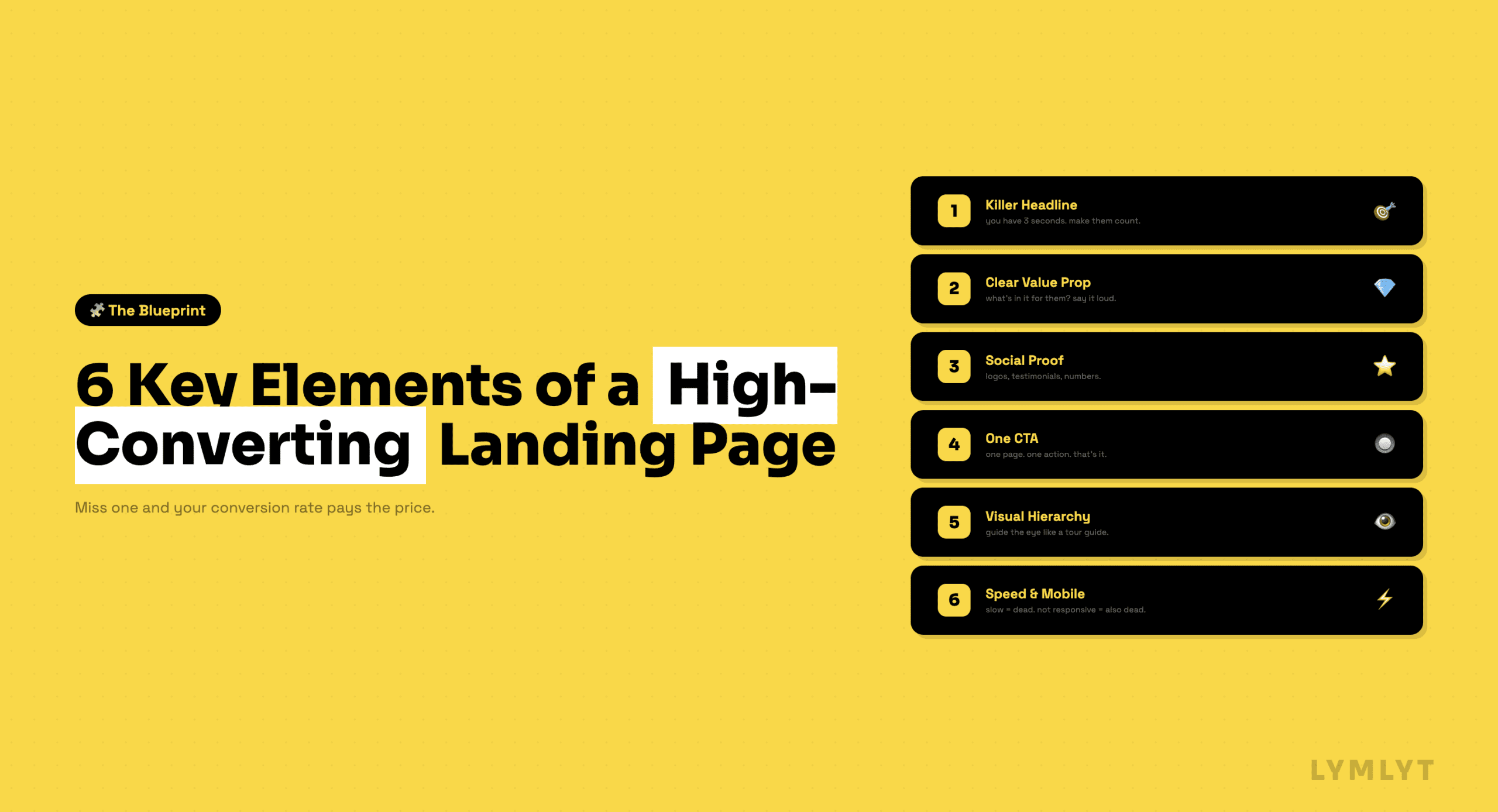
6 Key Elements of a High-Converting Landing Page
Most landing pages fail not because the product is bad, but because the page does not do its job. The offer is buried. The headline is vague. The CTA shows up once at the bottom. The visitor arrives, scans for two seconds, and leaves.
A high-converting landing page is not complicated. But every element has to earn its place. Here are the six that matter most, and what separates a version that works from one that wastes your ad spend.
1. A Headline That Communicates the Offer Immediately
Your headline is the first thing a visitor reads. It has roughly three seconds to answer one question: what is this and why should I care?
Most headlines fail because they describe the product instead of the outcome. “Our software is powerful and easy to use” tells the visitor nothing about what changes for them. A headline that converts leads with the specific benefit the visitor actually wants.
What works:
- Under 10 words
- Benefit-led, not feature-led
- Matches the language of the ad or email that brought the visitor here
Weak: “Our Platform Helps Teams Work Better” Strong: “Cut Your Content Review Time in Half, Without Hiring More People”
The second one names a specific outcome for a specific person. The visitor immediately knows if they are in the right place.
2. A Subheadline That Handles the Next Question
Once the headline earns attention, the subheadline has one job: give the visitor enough context to keep reading. It should expand on the headline, address the most obvious follow-up question, or reinforce why this offer is different from the alternatives.
What works:
- Under 20 words
- Speaks directly to a pain point or desire
- Adds information the headline could not fit
Weak: “Our software is easy to use and works for any team.” Strong: “Built for B2B SaaS marketing teams who are tired of content that takes three weeks to approve and still misses the brief.”
The subheadline is also where you start narrowing the audience. A page that tries to speak to everyone converts nobody. This connects directly to writing for your ICP. The more specifically your subheadline speaks to one person’s reality, the higher your conversion rate.
3. A CTA That Is Specific and Impossible to Miss
A vague CTA kills conversions. “Submit,” “Learn More,” and “Click Here” tell the visitor nothing about what happens next. A strong CTA names the action and sets the expectation for what comes after clicking.
What works:
- Action verb that names the outcome (“Start,” “Get,” “Book,” “Download”)
- Removes friction (“No credit card required,” “Takes 2 minutes”)
- Placed above the fold and repeated at the natural close of each section
- Visually distinct: contrasting colour, ample whitespace around it
Weak: “Submit” Strong: “Book a 30-Minute Strategy Call (Free)”
One CTA per page. Not three different actions competing for attention. The page has one goal and the CTA reflects it. This is the same principle that applies to homepage content writing. Too many CTAs create decision paralysis and reduce all of them.
4. Visuals That Support the Message, Not Decorate It
Every image, video, or graphic on a high-converting landing page should do one of three things: show the product in use, demonstrate the result, or reinforce the credibility of the offer. Anything else is visual clutter that slows the page and distracts the visitor.
What works:
- A hero image or short video showing the product or outcome in context
- Screenshots of the dashboard, the deliverable, or the result
- A clean, consistent visual hierarchy that guides the eye toward the CTA
- Whitespace used deliberately to separate sections and reduce cognitive load
What to avoid:
- Stock photos of people shaking hands or sitting in front of laptops
- Decorative illustrations that have no connection to the offer
- Auto-playing videos with sound
The design of a landing page should feel different from a homepage. A landing page versus a homepage have fundamentally different jobs, and the visual design should reflect that. The landing page is not a brand showcase. It is a conversion machine.
5. Social Proof That Is Specific and Relevant
Generic testimonials do not convert. “Great product, highly recommend!” could be about anything. What actually moves a visitor toward action is proof from someone who looks like them, with a specific result they can picture for themselves.
What works:
- Testimonials that name a specific outcome (“We reduced our content production time by 40%”)
- Client logos from companies your target buyer recognises or aspires to
- Case study snippets with real numbers. Not “improved performance” but “went from 200 to 1,400 monthly organic visits in 90 days”
- Trust badges relevant to the offer (security certifications, money-back guarantees, satisfaction ratings)
The more your prospect can see themselves in the proof you show, the more it works. A B2B SaaS founder reading a testimonial from another B2B SaaS founder will convert at a higher rate than one from a generic “business owner.”
This is also why competitor comparison pages are so powerful at the bottom of the funnel. They combine specificity, proof, and positioning in a format that speaks directly to a buyer who is already comparing options.
6. A Clean Layout With No Exit Paths
A landing page is not a website. It should not have a full navigation bar. It should not link to your blog, your about page, or your other services. Every link that takes a visitor off the page is a conversion you just lost.
What works:
- Single-column layout that guides the eye naturally downward
- Navigation removed or stripped to just the logo
- One focused message throughout. No tangents, no secondary offers
- Whitespace used to make the CTA the most prominent element on the page
What kills conversions:
- Multiple CTAs asking for different things
- Navigation links that give visitors an easy exit before they convert
- Walls of text that slow momentum
- Pop-ups that interrupt the conversion flow
The elements of a high-converting landing page all point in the same direction: reduce friction, focus the visitor, and make the next step obvious. A cluttered layout is the fastest way to undo every other element on this list.
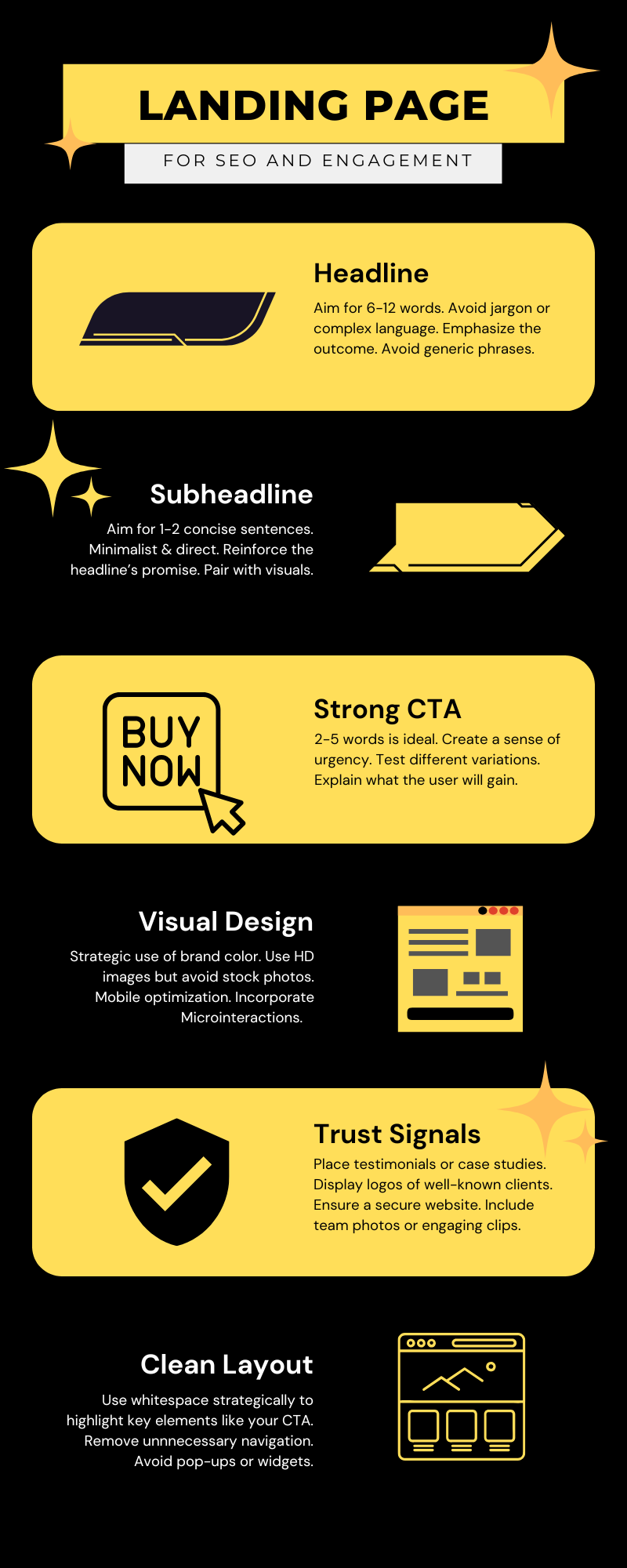
Putting It Together
A high-converting landing page is not the result of one great element. It is the result of all six working together. The headline earns attention. The subheadline holds it. The CTA gives direction. The visuals build confidence. The proof removes doubt. The layout removes friction.
Miss one and the others compensate for it poorly. Get all six right and the page does exactly what it is supposed to do: turn the right visitor into a lead.
If you need a landing page written and structured to convert, let’s talk.

Jay is the co-founder of LymLyt and an AI partnership consultant helping B2B SaaS companies grow through content strategy, SEO, and AI integration. He writes about content marketing, what makes B2B content convert, and how SaaS teams can build content systems that drive real pipeline.