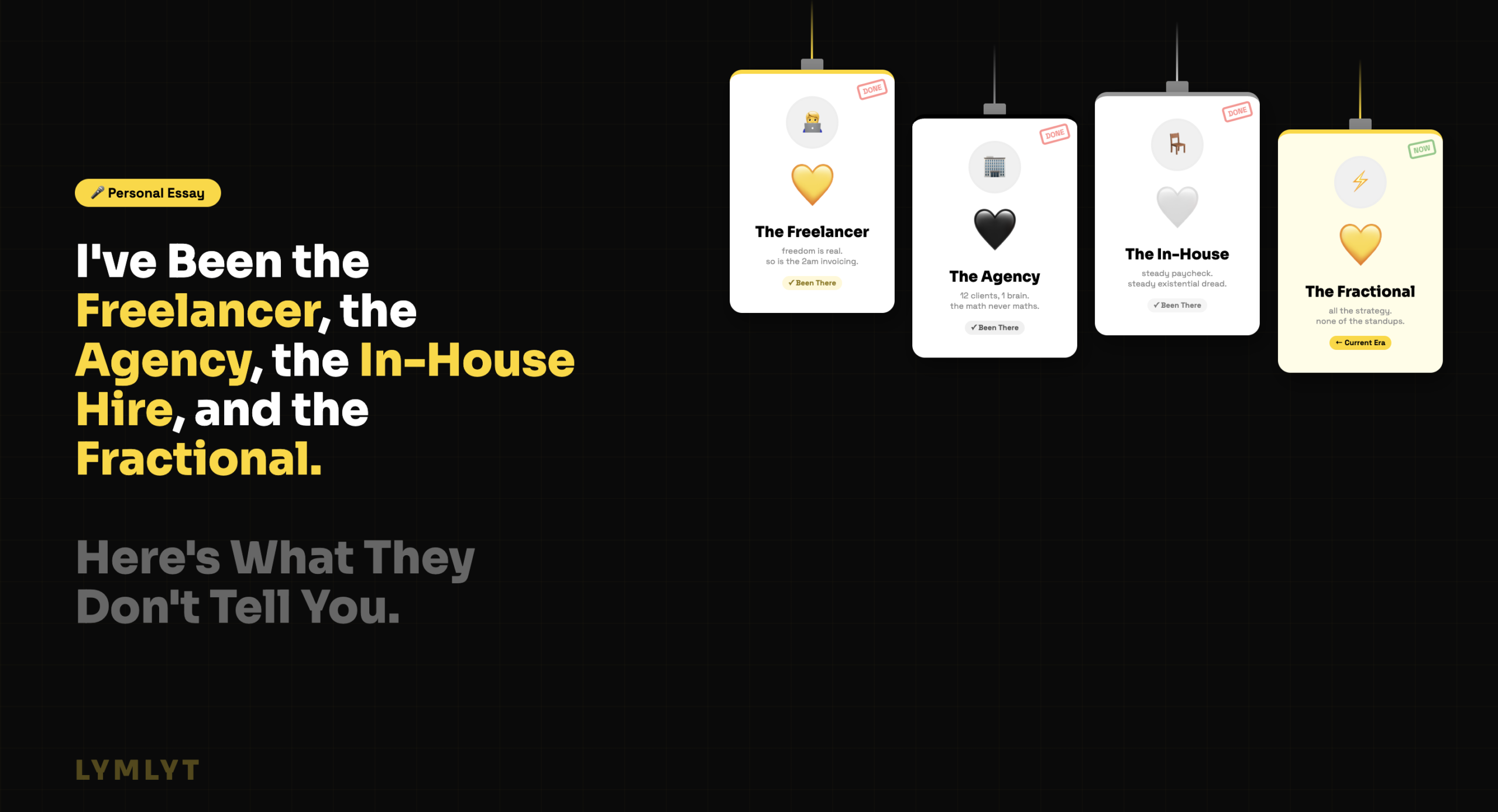
I’ve Been the Freelancer, the Agency, the In-House Hire, and the Fractional. Here’s What They Don’t Tell You.
Every B2B founder and VP of Marketing hits the same wall eventually.
You know content matters. You’ve seen the LinkedIn posts, the case studies, the agency decks promising “results-driven content.” But when it’s time to actually hire someone, whether that’s a freelancer, an agency, an in-house marketer, or a fractional content marketer, the advice you get is circular: “It depends on your stage.” “Consider your budget.” “Think about your goals.”
Cool. Still no idea who to hire.
I’ve sat in all four seats. I’ve been the freelancer taking project briefs from five different clients at once. I’ve been the agency person managing accounts while pretending I had more bandwidth than I did. I’ve been the in-house hire who knew the product inside out but kept getting pulled into things that had nothing to do with content. And now, through LymLyt, I work as an extension of B2B SaaS marketing teams as their content execution partner.
So let me tell you what each of those actually looked like from the inside.
The Freelancer
When I was freelancing, I was good at the work. That’s not false modesty. I could write, I understood SEO, I could turn a brief into a decent article.
But here’s what I also knew: I didn’t know your product. Not really. I knew what was in the brief. I knew what the website said. I knew just enough to make the content sound credible. But I didn’t know the objections your sales team kept hearing. I didn’t know which customer segment was converting and which was wasting everyone’s time. I didn’t know that the feature you were most proud of wasn’t actually what your buyers cared about.
That gap shows up in how I write. I had to constantly ask for feedback on drafts: if sales used it, if it was generating MQLs, and so on. That disconnect is a big part of why B2B SaaS content isn’t converting at companies that hand off strategy along with execution.
The other thing nobody mentions: managing freelancers is work. Good freelancers are fast and professional, but you’re still the one holding the strategy. If you haven’t figured out what to say, they’re going to execute the wrong thing really efficiently. If you’re still in that phase, our free Brief Generator is a good place to start, and our guide on what makes a strong content brief covers what that thinking should actually include.
Best for: You have a clear content strategy, you know your ICP, and you need execution support. Freelancers are production capacity, not strategic ownership.
The Agency
I’ve worked inside agencies and I’ve been on the client side dealing with them. Both sides taught me things I couldn’t have learned otherwise.
The pitch is compelling. You’re getting a full team: strategist, writer, designer, SEO specialist. One retainer, multiple skill sets. No hiring, no benefits, no managing individuals.
What the pitch doesn’t mention is that you are one of eight clients. Sometimes twelve. The person on your strategy call is not the person writing your content. The senior strategist who sold you the retainer might touch your account for two hours a month. The rest of the time, you’re working with someone who’s talented but stretched thin and learning your industry on the job.
That’s not always the case. There are agencies that genuinely run lean and stay close to their clients. If you’re evaluating that route, our breakdowns of the best SaaS content marketing agencies and the best B2B SEO agencies are a good place to compare real options rather than pitch decks.
The other honest thing: agencies optimize for delivery. They’ll hit deadlines. They’ll produce the asset. Whether that asset was the right one, whether it actually moved anything, is sometimes a harder conversation to have because everyone is busy producing the next deliverable. That’s the same gap covered in SaaS content marketing metrics that actually matter: production volume and pipeline contribution are not the same number.
Best for: You need broad execution across multiple content types, you have a strong internal point of contact who can keep them close to the business, or you need a specific channel built out as a defined workstream.
The In-House Hire
Being in-house is the most complete version of the job. You know the product. You’re in the Slack channels where the real conversations happen. You sit next to sales. You hear customers talk. You understand the positioning arguments that never make it into official documents.
That depth is real and it matters. The content that comes out of a strong in-house marketer who’s been in the company for 18 months is almost always better than anything an agency produces at month three.
But there’s a tax that comes with being in-house. You get pulled into everything. The rebrand. The event. The CEO’s LinkedIn. The board deck. The thing that wasn’t your job until it was. Content strategy, the real kind, requires focus and thinking time. Both are scarce when you’re the only marketer and everything is urgent, which is exactly why your ICP doesn’t read your blog even when the person writing it genuinely knows the product cold.
And then there’s the cost. For most B2B companies, a good senior content hire is $100K to $150K-plus fully loaded. That’s before you factor in that hiring well takes four to six months, onboarding takes another three, and if they leave, the whole process starts again.
Best for: Content is a primary, ongoing growth channel. You’re at a stage where you need someone embedded full-time, you have the budget to compete for good talent, and you can protect their focus enough for them to actually do the work.
The Fractional
This is the model I understand best now, because it’s what LymLyt is built around, at least in how we think about client relationships.
A fractional content marketer is embedded but not full-time. They work within your team, toward your goals, with access to your actual business, not just the brief you hand them. They know your ICP because they’ve helped you think through it. They know your positioning because they were in the room when it shifted, the same kind of embedded thinking behind a real B2B SaaS content calendar instead of a list of topics assigned from the outside.
The practical benefit is obvious: senior-level thinking at significantly lower cost than a full-time hire. But the part that actually matters is the ownership. A good fractional doesn’t just execute. They bring the point of view that keeps the whole content effort coherent, the same topical authority thinking that turns a pile of blog posts into an actual body of work.
What it’s not: a magic fix for a company that hasn’t figured out what they’re trying to say. And it’s not a substitute for volume. If you need eight pieces of content per week, one fractional person can’t produce all of it. The model works best when the fractional person owns the strategy and direction, and pulls in execution support underneath that. You can see how we price this model at LymLyt if you want a concrete sense of what it looks like.
Best for: You’re between Series A and Series B, or you’re a small SaaS marketing team that needs a strategic partner, not just a vendor. Also the right call when you’re between full-time marketing leaders and can’t afford to let the function go dark.
Side by Side: How the Four Models Actually Compare
| Freelancer | Agency | In-House | Fractional | |
|---|---|---|---|---|
| Monthly cost (approx.) | $500 to $5K | $3K to $15K | $9K to $13K | $2.5K to $8K |
| Owns the strategy? | No | Sometimes | Yes | Yes |
| Product knowledge | Low | Low to Medium | High | Medium to High |
| Speed to start | Fast | Fast | Slow (hiring) | Medium |
| Commitment level | Project | Retainer | Full-time | Part-time |
| Best stage fit | Any | Series A+ | Series B+ | Seed to Series A |
| Biggest risk | Wrong execution | Split attention | Turnover | Volume limits |
Where Each Model Fits by Company Stage
The honest answer most people won’t give you: the right model has less to do with preference and more to do with where you are.
| Stage | What you actually need | Best fit |
|---|---|---|
| Pre-seed / bootstrapped | Founder-led content + light execution help | Freelancer for production |
| Seed | Strategy + some consistent output | Fractional content marketer |
| Series A | Strategy + higher volume | Fractional + freelancer network, or agency |
| Series B+ | Full content function | In-house hire(s) + agency for overflow |
| $50M+ ARR | Multiple channels, dedicated team | In-house team + agency support |
The Question Nobody Is Asking
Most companies spend weeks debating which model to pick. The hiring model matters, but it’s the second question.
The first question is: who owns the strategy?
If nobody owns it, the model doesn’t matter. Freelancers will execute the wrong brief efficiently. Agencies will produce polished content that doesn’t connect to your ICP. In-house hires will get overwhelmed and default to whatever content type feels most manageable. Fractionals will try to fill the gap but won’t be able to do it alone.
The companies that get real results from content, not vanity traffic but actual pipeline, always have someone with a clear mandate, real access to the business, and accountability for what happens after the content goes live. That accountability is the whole argument behind building a real SaaS content engine instead of a rotating cast of vendors.
Once that person exists, everything else is a resource decision.
What This Looks Like in Practice
If you’re pre-seed or very early stage: don’t hire anyone yet. Founder-led content is underrated. You know the customer. You have the story. Hire a freelancer to help you produce and edit, but don’t outsource the thinking. A content brief is a good starting point for keeping that thinking structured.
If you’re seed to Series A: a fractional content marketer is almost always the right move. You need someone who can set the direction and build the engine. You don’t yet need, or can’t yet afford, the full-time senior hire.
If you’re Series B and beyond: the in-house hire makes sense, potentially alongside an agency for channel-specific execution. Now you have the volume and the budget to justify both. Our guide to the best AI marketing agencies is worth a look once you’re at the stage of layering an agency on top of an in-house team rather than replacing one.
At every stage, a freelancer can be a useful part of the mix. They’re just not the whole answer.
The decision isn’t really about which model is better. It’s about being honest about what you actually need right now: production, strategy, or ownership. Those are three different problems, and they don’t all have the same solution.
I’ve been on all four sides of this. The model matters less than most people think. The person you put in the seat matters more than any org chart.
Not Sure Which Model Fits Where You Are?
Every company’s content situation is a little different. What’s working at a 10-person SaaS is probably not what a 100-person company needs, and vice versa.
If you’ve read this and you’re still not sure what’s right for your stage, that’s exactly what a consultation is for. We’ll look at your goals, your internal bandwidth, and your budget, and tell you what we’d actually recommend.
No deck. No pitch. Just a straight conversation.

Rashmita is content marketer with 8 years of experience building and growing SaaS brands. Now she tests various AI tools for marketers and shares her feedback on this blog, LinkedIn, Instagram, and YouTube.