B2B Lead Magnets That Still Work in 2026 (and the Ones That Don’t)
The 40-page ebook had a good run. For a decade, B2B lead magnets meant a PDF behind a form, an email to sales and a nurture sequence nobody opened. That playbook is now mostly broken.
Buyers do the work on their own. In 6sense’s 2024 Buyer Experience Report, buyers were nearly 70% through their purchasing process before engaging sellers, and 81% already had a preferred vendor at first contact (Demand Gen Report). A Gartner survey of 632 buyers found 61% prefer a rep-free buying experience (Gartner). People who do not want to talk to sales are not going to hand over a work email for a generic guide.
But some B2B lead magnets work better than ever. The difference is simple: the ones that work do a job for the buyer. The ones that fail just describe the job. This guide covers both, plus when to gate and how to measure what you get.
Why most lead magnets stopped working
A lead magnet is anything you offer in exchange for contact details. The exchange is the problem. Four things changed the math on it.
Buyers stay anonymous longer. As we covered in the B2B buying journey, most research now happens in communities, peer chats and AI answers your forms never see. Back in 2022, 6sense survey respondents reported that only 3.5% of their web visitors filled out forms (Demand Gen Report).
AI made generic content worthless. If ChatGPT can write your ebook in a minute, nobody needs to download it. A lead magnet has to contain something AI cannot produce: your data, your tool or your hard-won method.
Gated content is invisible. Search engines and AI assistants cannot read what sits behind a form. Our AI visibility guide explains why ungated, citable content now does more for pipeline than a PDF nobody can find.
Form fills are not pipeline. A download from a student researching an essay counts the same as one from your ideal buyer. That is how teams end up with more MQLs and less pipeline.
The test every lead magnet has to pass
Before you build anything, run it through four questions. If the answer to any of them is no, rethink the asset.
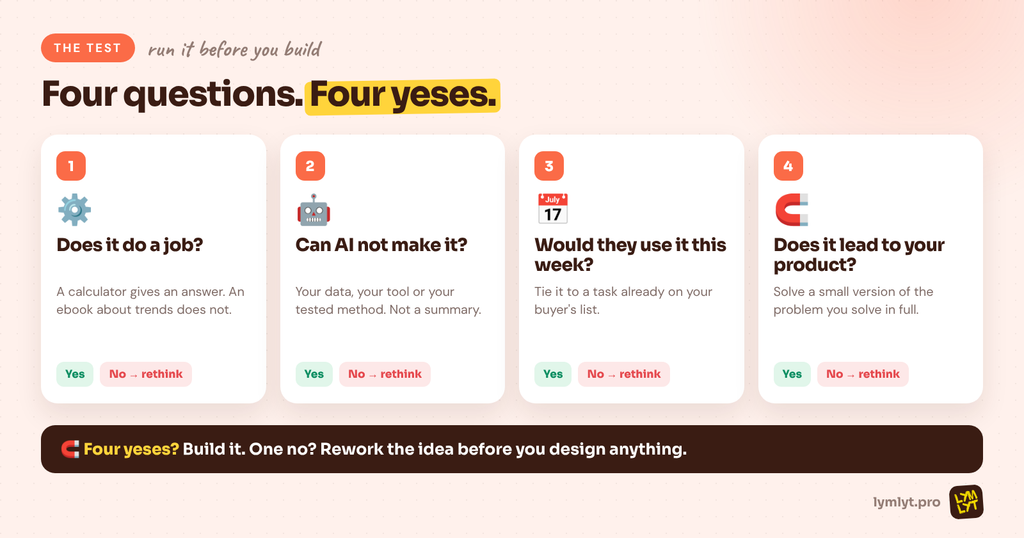
1. Does it do a job? A calculator gives an answer. A template saves an afternoon. An ebook about “the future of procurement” does neither.
2. Is it something AI cannot make? Proprietary data, a working tool or a method you have tested on real accounts. Not a summary of what is already online.
3. Would your ideal buyer use it this week? Not “find it interesting.” Use it. Tie it to a task already on their list.
4. Does it lead to your product? The best B2B lead magnets solve a small version of the problem your product solves in full. Our guide to product-led content covers how to make that link natural.
B2B lead magnets that still work
1. Free tools and graders
A free tool is the strongest lead magnet there is, because it does real work every time someone uses it. HubSpot’s Website Grader grades a site on speed, mobile readiness, search optimization and security. Ahrefs offers a long list of free SEO tools, from a keyword generator to a backlink checker, and points users to its paid product for more.
Why it works: People come back, share it and link to it. Each use is a reminder of the problem your product solves.
Gate it? Let people use it free. Ask for an email to save results, export a report or unlock more runs.
2. Calculators
ROI calculators, cost calculators and pricing estimators turn a vague question into a number the buyer can take to their boss. They work best at the bottom of the funnel, when a buyer is building a business case.
Why it works: The buyer puts in their own data, so the output feels personal and credible. It also tells you exactly what problem they are sizing.
Gate it? Show the headline number on the page. Gate the detailed breakdown or the shareable PDF for their CFO.
3. Templates and swipe files
A template that saves three hours is worth more than a guide that explains how to spend them. Content briefs, campaign plans, RFP checklists, email sequences and board-report decks all work if they are specific to your buyer’s job. Our own content brief guide is built around exactly that kind of reusable structure.
Why it works: It drops straight into the buyer’s workflow, often with your brand on it.
Gate it? Show a preview on the page, gate the editable file. A light gate here is fair because the value is obvious.
4. Original research and benchmarks
Data nobody else has is the one asset AI cannot fake. Gong publishes Gong Labs findings from its data research team, based on analysis of sales conversations and deals. That kind of original research earns links, press and AI citations for years.
Why it works: Buyers use benchmarks to argue for budget, and journalists and AI assistants cite them. Our study on original statistics and AI citations looks at how far that reach goes.
Gate it? Publish the headline findings openly so they can be cited. Gate the full dataset or the segment-level cut.
5. Assessments and scorecards
A 10-question assessment that ends in a maturity score and three recommendations does two jobs at once. The buyer gets a diagnosis. You get qualification data you could never ask for on a form.
Why it works: People love a score, especially one they can compare with peers. The answers tell sales exactly where the buyer is stuck.
Gate it? Show the score on screen. Email the full report with recommendations.
6. Short email courses
A five-day email course on one narrow skill beats a 60-page guide on a broad topic. Each email is short, practical and ends with one action. It also builds the habit of opening your emails.
Why it works: It is easier to finish than a PDF, and it spreads your expertise across a week instead of one forgotten download. Our B2B newsletter guide covers how to turn that habit into a long-term channel.
Gate it? It needs an email by design, which makes the exchange feel fair.
7. Checklists for high-stakes tasks
Generic checklists are filler. A checklist for a task that is risky, rare and expensive to get wrong is gold: a site migration, a security review, a pricing change. We use this format ourselves with our AI visibility checklist, because most teams have never audited it before and do not know where to start.
Why it works: The stakes make people want a second opinion, and a checklist is the cheapest one available.
Gate it? A light gate works if the task is high-stakes enough.
Lead magnets to retire
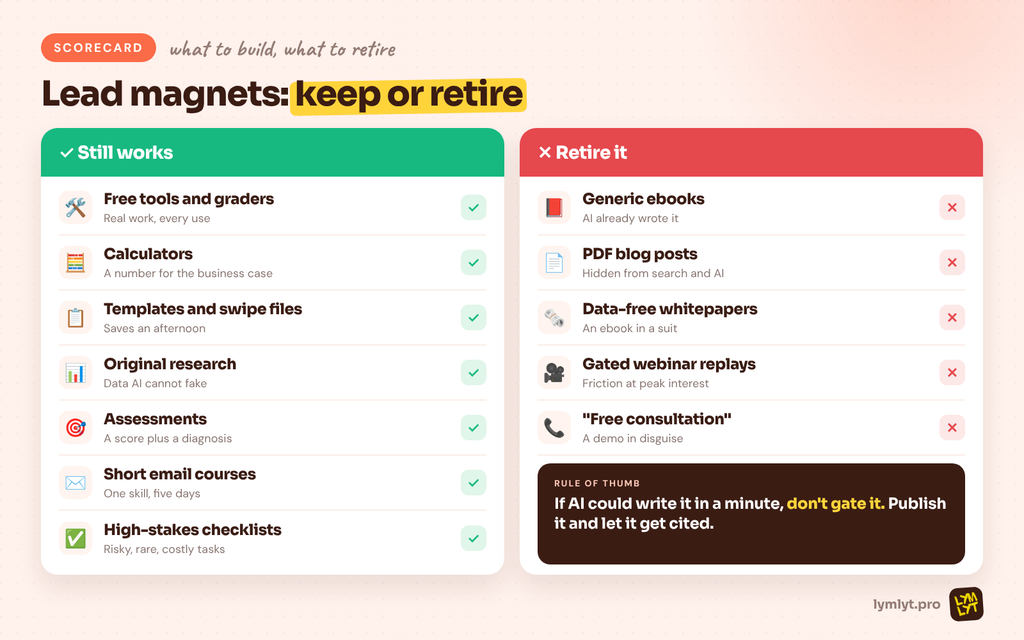
Generic “ultimate guide” ebooks
If the topic is broad and the content could be written by anyone, AI has already written it for free. Retire it, or cut it down into ungated blog content that can rank and be cited.
PDF versions of blog posts
Putting a blog post in a PDF and gating it insults the reader and hides the content from search. Publish it openly instead. Our SaaS content distribution playbook shows how to get more from the same piece.
Whitepapers with no data
A whitepaper that restates industry trends without original evidence is an ebook in a suit. If you cannot add data, interviews or a tested framework, do not gate it.
Gated webinar replays
Asking people to register again to watch a recording they missed adds friction at the exact moment interest is highest. Publish the replay, then use the clips and takeaways as content. Our list of content repurposing agencies covers teams that do this well.
“Free consultation” as a magnet
A sales call is not a lead magnet. Buyers know a free consultation is a demo in disguise. Offer something useful first and let them ask for the call.
When to gate and when to set it free
Gating is not good or bad. It depends on whether the asset is useful without the gate and how far along the buyer is.
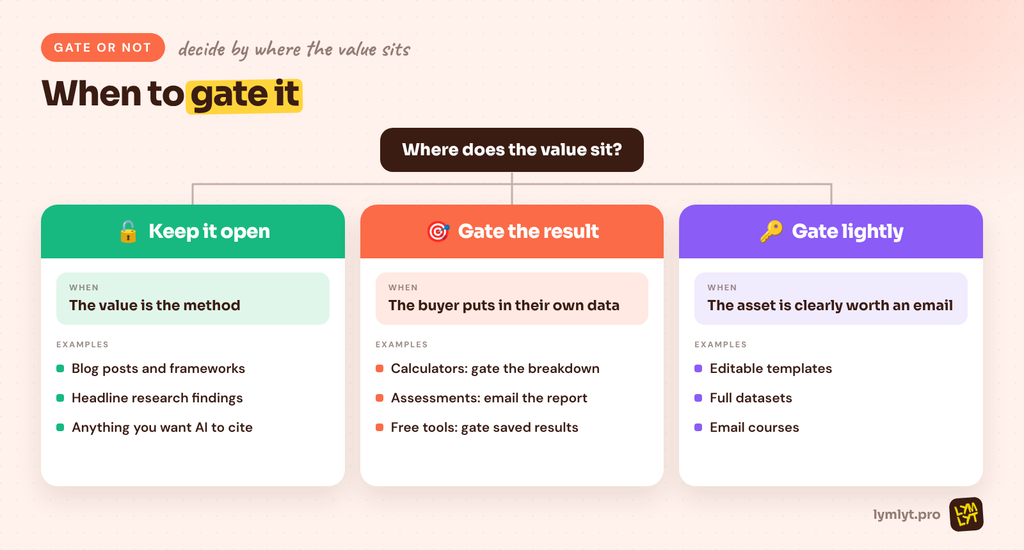
Keep it open when the value is the idea or the method. Blog content, frameworks, headline research findings and anything you want cited by AI or linked to by others should be ungated.
Gate the result, not the tool when the buyer puts in their own data. Let them use the calculator or assessment freely, and ask for an email to send the personal report.
Gate lightly when the asset is clearly worth it: an editable template, a full dataset, an email course. Ask for an email and nothing else. Every extra form field costs you completions.
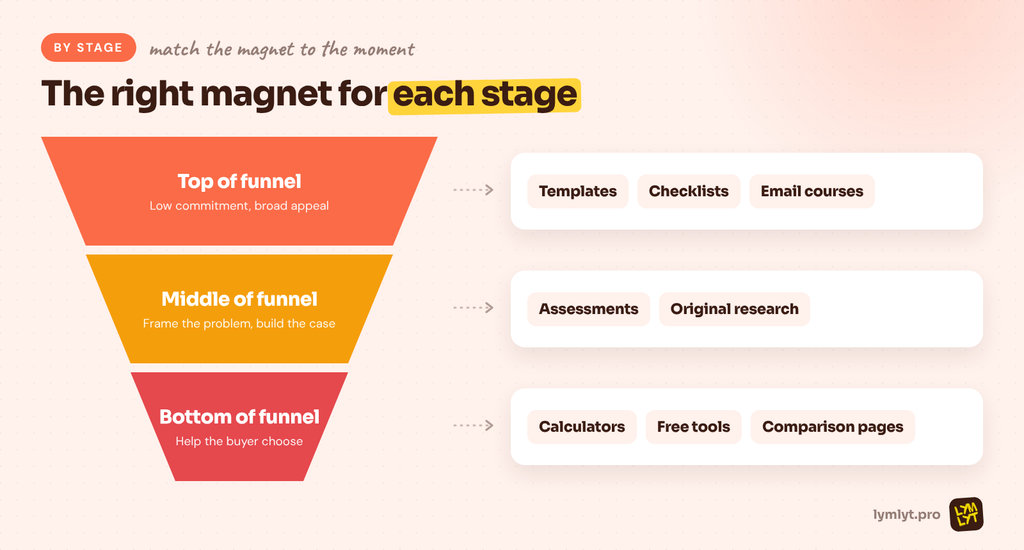
Match the magnet to the funnel stage
Top of funnel: templates, checklists and email courses. Low commitment and broad appeal.
Middle of funnel: assessments and original research. They help buyers frame the problem and build the case. See our MOFU content definition for more.
Bottom of funnel: calculators, free tools and honest comparison pages. They help a buyer choose. Our B2B SaaS comparison pages guide shows how to build the last of those.
How to measure B2B lead magnets
Downloads are a vanity metric. Track these instead.
Lead-to-opportunity rate. What share of people who used the asset became a sales opportunity within 90 days?
Pipeline influenced. How much open pipeline includes a contact who used it?
Return usage. For tools and calculators, how many people come back? Repeat use is the strongest signal of value.
Citations and links. For research and ungated assets, how often do other sites and AI answers reference it?
Our guide to SaaS content marketing metrics that actually matter covers how to set this up in your reporting.
The bottom line
The B2B lead magnets that still work all do the same thing: they help a buyer get a real job done, using something only you can offer. Free tools, calculators, templates, original research, assessments, email courses and high-stakes checklists pass that test. Generic ebooks, gated blog posts and data-free whitepapers do not.
Start by auditing what you have. Retire anything that fails the four-question test, set your best ideas free so they can be found and cited, and put your effort into one asset that does real work. If you want help building it, our lead-gen resource service researches, writes and designs B2B lead magnets with a landing page and email sequence, at $799 per asset. For outside options, see our list of the best lead magnet creation services.

Jay is the co-founder of LymLyt and an AI partnership consultant helping B2B SaaS companies grow through content strategy, SEO, and AI integration. He writes about content marketing, what makes B2B content convert, and how SaaS teams can build content systems that drive real pipeline.