Alternatives Page or Vs Page: Which One to Build First
An alternatives page and a vs page usually get written by the same person, in the same week, off the same template. Both land in the calendar as bottom-of-funnel coverage, get ticked off, and nobody looks again.
They answer different searches, from different buyers, at different distances from a decision. Getting the format wrong is the most common reason an alternatives page sits on page two while the listicle above it, written by someone who has used neither product, takes the traffic.
Here is what separates them, what the conversion data says, and how to decide which one to build first.
Two searches, two buyers
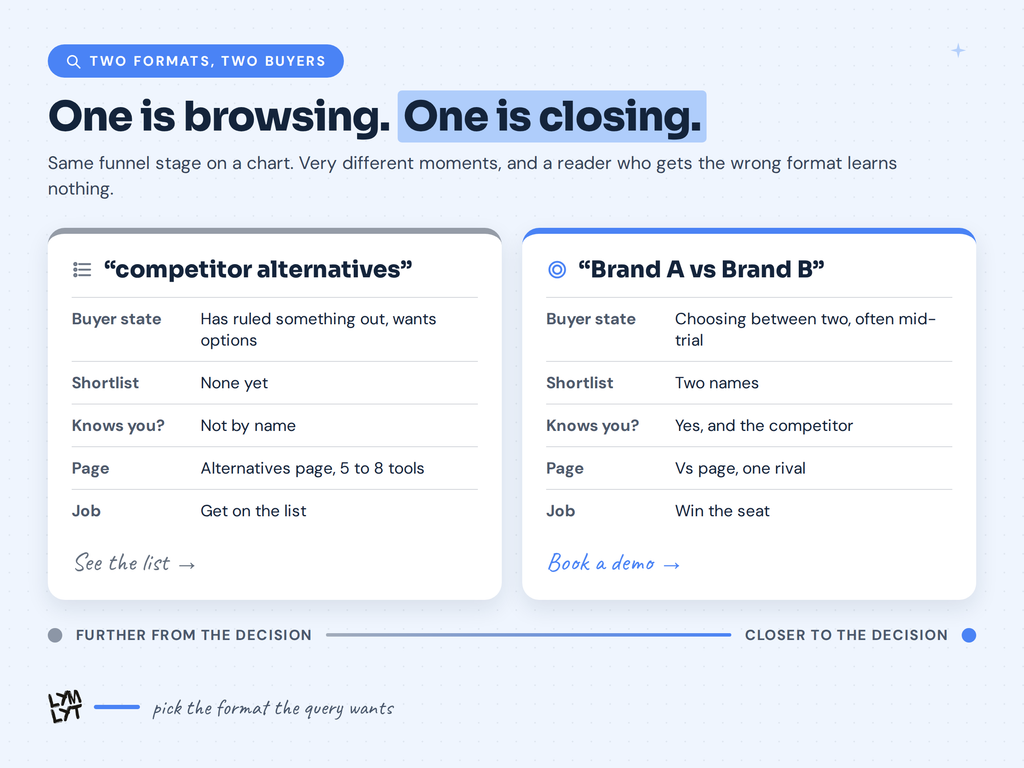
“Competitor alternatives” is a browsing search. The buyer has ruled something out, or fears they are about to, and wants a field of options. They do not know your name yet. They are not deciding today. They want a shortlist they can trust and a reason to believe whoever wrote it.
“Brand A vs Brand B” is a closing search. The shortlist already exists and has two names on it. The buyer is trying to eliminate one. They know both products, often have a trial open, and want the specific difference that decides it.
Same funnel stage on a chart. Very different moments.
That difference shows up in what the reader tolerates. An alternatives page that only argues for you gets closed, because a buyer who asked for options and received a sales pitch has learned nothing. A vs page that hedges across six competitors gets closed too, because a buyer who asked about two products and got a survey has learned nothing either.
It also shows up in the CTA. “See the list” or “read the comparison” fits a browsing reader. “Book a demo” fits a closing one. Putting a demo CTA at the top of an alternatives page is asking someone to marry you on a first date, which is the same mistake as burying the demo link on a vs page. The usual landing page rules still apply to both, but the offer has to match the moment.
The comparison pages pillar covers all three formats, including third-party comparisons where neither product is yours.
The conversion data, and what it hides
The best public numbers on this come from Grow and Convert, who analysed 95 blog posts across clients and found competitor comparison and alternatives keywords converting at 7.5% or better, the highest of the three bottom-of-funnel buckets they track. Category keywords managed 4.85%. Informational keywords converted at a fraction of a percent.
So the commercial case is settled. This is the highest-converting content a B2B SaaS team can publish, and most teams still spend their budget on explainer posts.
But look closely at how that number is reported. Comparison and alternatives are one bucket. Two formats, two intents, one blended conversion rate.
That bundling is the industry norm, and it is exactly the habit this post argues against. A 7.5% average across both tells you the category is worth investing in. It does not tell you which format to build for which competitor, and a blended number can hide a vs page converting at 12% next to an alternatives page converting at 3%.
Segment your own reporting by format from day one. Nobody else’s benchmark will do it for you.
One more thing from that analysis worth stealing: they target these keywords even when the search volume looks like zero, because SEO tools chronically undercount comparison queries. That matches what we see. A keyword tool showing 10 searches a month for “yourbrand vs competitor” is not evidence the query is rare, only that the tool cannot see it. Worth remembering the next time a keyword research tool is the only thing deciding your roadmap.
What the SERP is telling you
Run both searches and the difference is visible before you read a word.
“Competitor alternatives” returns listicles. Third-party roundups, affiliate posts, the occasional vendor page buried at position seven. Ahrefs found “best X” lists were the most prominent page type in the sources ChatGPT cites for software prompts, and the organic SERP behaves the same way. You are entering a crowded format against publishers who do it full time.
“Brand A vs Brand B” returns a thin field. One or both vendors’ own pages, a review site, and frequently a two-year-old affiliate post nobody has updated. The candidate pool is small because almost nobody bothers.
That asymmetry should drive your build order more than any keyword tool does. On the alternatives query you are one of thirty options fighting for a slot. On the two-brand query you are one of maybe four.
It also changes what a good page looks like. Winning an alternatives SERP means out-researching a listicle, which means real depth on tools that are not yours. Winning a vs SERP means knowing two products better than anyone else writing about them, which you already do. Neither is a one-post job, which is why both belong inside a topic cluster rather than a keyword list.
What our AI test found
We ran twenty comparison prompts through ChatGPT, Claude and Google AI Mode, including five “best alternative to [vendor]” prompts as a control. Three findings bear on this directly.
The alternatives answer and the vs answer resolved to the same rivalry. Every single time we asked for the best alternative to a vendor, the top recommendation was the competitor from our original pair. Salesforce returned HubSpot, Zapier returned Make, Semrush returned Ahrefs. Five for five. If a buyer asks either way, they arrive at the same two names.
Roundups did not get cited. Where ChatGPT cited anything on the alternatives prompts, it cited vendor pricing pages. Not a single listicle. That is one snapshot on a small sample, and it cuts against the SERP picture above, which is why it is worth watching rather than acting on.
The shortlists ran six or seven names deep. Salesforce alternatives returned Dynamics, Zoho, Pipedrive, Freshsales, Close and Monday. Being absent from that list is being absent at the exact moment the shortlist forms, and getting into it is a different problem from ranking.
Read together: the alternatives query is where you get onto a list, and the vs query is where you win a seat on it. Both matter. They are not the same job.
The two pages are built differently
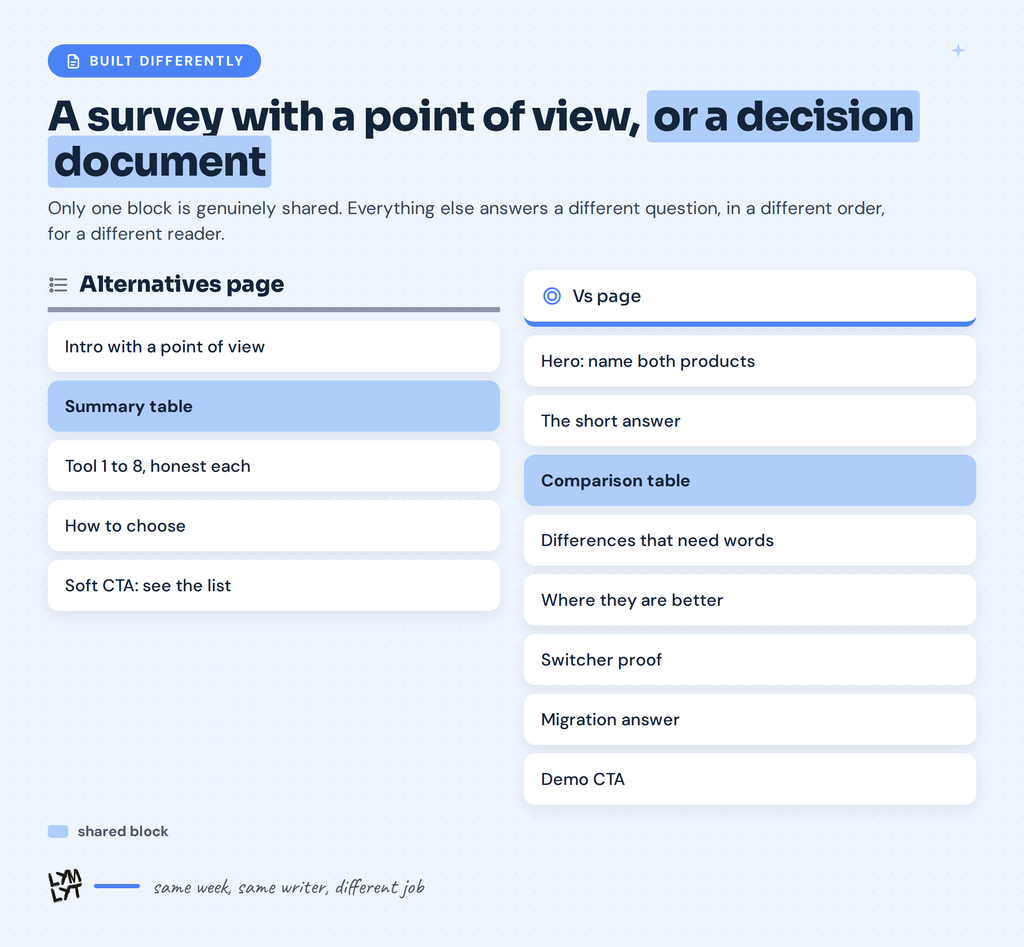
An alternatives page is a survey with a point of view. Five to eight tools including yours, each covered honestly enough that a reader learns something, with a clear statement of who each one suits. Your entry is not first by default. The page earns trust by being useful about the other seven, and the sale comes from the reader recognising themselves in one description.
Yours needs: a summary table, one section per tool with a real “best for” line, pricing where public, and a closing section on how to choose. It reads like editorial because it has to, and the depth it demands is what builds topical authority rather than another thin post.
A vs page is a decision document. Two products, one table, dimension-by-dimension differences, a section naming where the competitor is the better buy, switcher proof, and a migration answer. It reads like an assessment, not a survey, and it ends in a demo.
The overlap is the honesty requirement, which the vs page post covers in detail. Neither format survives a reader discovering you shaded a fact, and the alternatives format is more exposed, because you are making claims about six companies instead of one.
We hold our own alternatives posts to that rule, whether the subject is a tool or an agency, opening each entry with what the subject genuinely does well. Our Siege Media alternatives post is the clearest example of the format.
Which one to build first
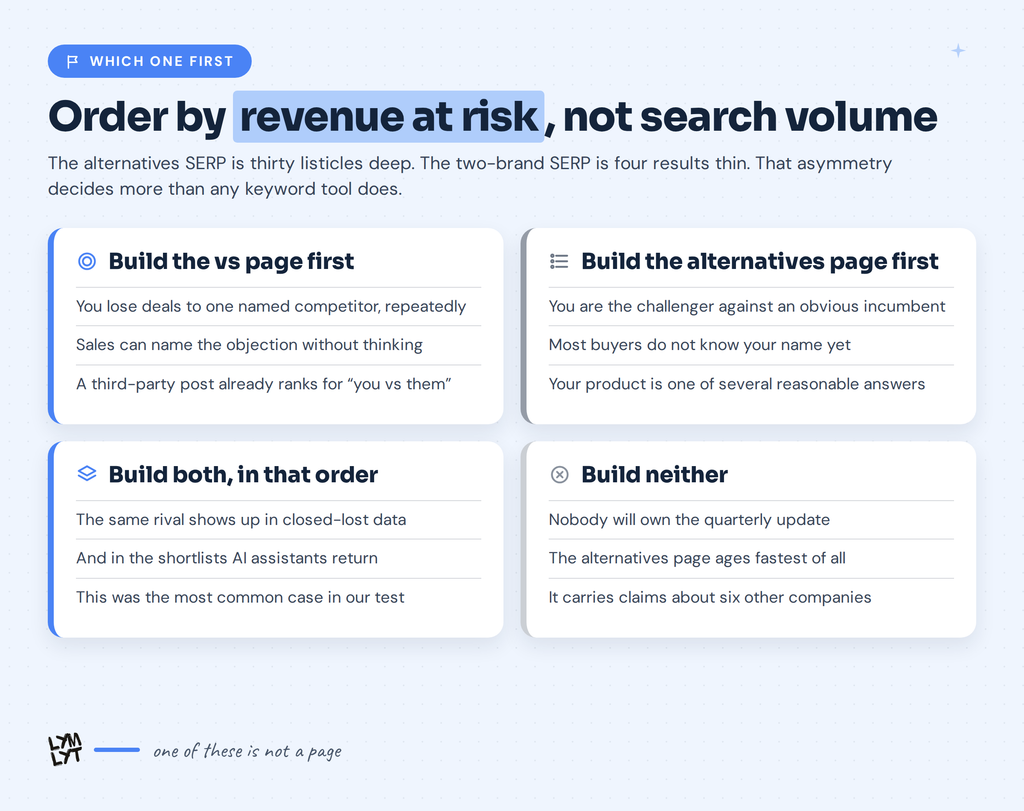
Build the vs page first if you lose deals repeatedly to one named competitor, sales can name the objection without thinking, or a third-party post already ranks for “you vs them”. The candidate pool is small, the intent is closing, and you know the material.
Build the alternatives page first if you are the challenger in a category with an obvious incumbent, most buyers do not know your name yet, or your own product is genuinely one of several reasonable answers. You need to be on the list before you can win a two-name comparison.
Build both, in that order, when the same competitor shows up in closed-lost data and in the shortlists AI assistants return. That is the case our test found most often.
Build neither if nobody will own the quarterly update. Both formats go stale without you touching them, and the alternatives page goes stale faster because it carries claims about six other companies.
Order by revenue at risk rather than search volume, the same way the pillar prioritises which competitor gets a page. Our brief generator turns whichever you pick into something a writer can start on.
The cannibalisation trap
Here is the failure mode nobody warns about.
You build “Acme alternatives” and “Yourbrand vs Acme”. Both target the same competitor. Both use the same title tag pattern, the same H1 shape, and the same table. Google now has two pages from your domain that look like answers to overlapping queries, and it picks one, usually not the one you wanted.
Three rules prevent it.
Keep the titles structurally different. “The 7 best Acme alternatives in 2026” and “Yourbrand vs Acme: which is right for your team” are not competing for the same click.
Link them deliberately. The alternatives page links to the vs page from your own entry. The vs page links to the alternatives page from the migration section, for readers who are not sold on either option. One link each way, contextual, not a related-posts widget.
Check your own search results quarterly with a site: query on the competitor’s name, and keep the cannibalisation definition handy for whoever inherits the pages. If both pages surface for the same term, one of them needs rewriting, and it is usually the alternatives page, because that is the one with fuzzier intent.
Measuring them differently
The mistake is holding both to the same number.
An alternatives page is judged on assisted pipeline and on whether it introduces you to buyers who did not know you. Watch new-visitor share, watch how many readers go on to a product page, and expect a longer lag before anything closes. Sessions on their own tell you almost nothing, as HubSpot demonstrated at scale.
A vs page is judged on conversion and on win rate against the named competitor. It should convert several times harder, because the traffic is closer to a decision.
If the alternatives page brings traffic that never progresses, the problem is usually that your own entry reads like the ad in the middle of the editorial, which is a conversion problem rather than a traffic one.
And track what AI assistants return for both query types monthly, since the alternatives shortlist is where inclusion is decided. G2 and Capterra carry more weight in that answer than most vendors expect, and our AI visibility checklist scores the rest of the surface.
FAQ
Can one page target both queries? Rarely well. Google usually ranks different pages for “X alternatives” and “A vs B”, which is the signal that the intents are distinct. If it is a close call, publish one, check what it ranks for after a month, then add the second.
Should our own product be first on our alternatives page? No. Put it where an honest reading puts it, and be specific about who each other tool suits. A roundup that crowns its publisher gets discounted the same way a comparison table with no losing rows does.
Is it worth writing an alternatives page for a competitor we rarely lose to? Only if their brand has real search demand and yours does not. That is the one case where borrowing attention beats defending deals.
What about “A vs B” where we are neither product? Worth doing when your product is a genuine third option. Grow and Convert report targeting those and adding their client as the third name, and that those posts rank and convert well.
How often do these need updating? Quarterly at minimum. The alternatives page carries pricing and feature claims about six companies, so it ages six times faster than a vs page does.
An alternatives page gets you onto the shortlist. A vs page wins the seat. Building one and calling it coverage leaves the other half of the decision to somebody else.
That is the job we do. See how we write comparison and alternatives pages, look at our work, check pricing, or book a 30-minute call.
Think B2B is boring?
That's coz you are not subscribed to ours newsletter. We share a 100 bad days (of B2B marketing) made a 100 good stories. A 100 good stories make YOU interesting at parties.
Almost there. Check your inbox and click the confirmation link.

Jay is the co-founder of LymLyt and an AI partnership consultant helping B2B SaaS companies grow through content strategy, SEO, and AI integration. He writes about content marketing, what makes B2B content convert, and how SaaS teams can build content systems that drive real pipeline.