B2B Newsletter Ideas and Samples: What People Still Want to Read
Open the last five B2B newsletters in your inbox. I will guess what they look like.
A logo. A greeting. Then five or six blog links with a headline and a fifteen-word blurb. A webinar you did not register for. A “featured customer story”. A footer with four social icons and an unsubscribe link.
You did not read it. You will not read the next one either. We have written about why your ICP does not read your blog, and the newsletter version of that problem is worse, because you paid for the send.
Meanwhile there are newsletters people wait for.
So I went and pulled apart 10 of them. Real issues, real screenshots, taken in August 2026. 4 are consumer newsletters that have nothing to do with what you sell. 2 sit somewhere in the middle. 4 are B2B.
If you are new to newsletters, start with the complete guide to B2B newsletter success and come back here for the teardowns.
What the data says before we start
Email newsletters are the 2nd most effective channel B2B marketers have for thought leadership. 54% put it in their top three. Only LinkedIn beats it, at 76%. That is from the Content Marketing Institute and MarketingProfs annual B2B study, 1,015 B2B marketers surveyed between June and August 2025.
And 59% of those same marketers describe their personalisation as basic. One or two channels, minimal integration. The channel is the most used and the least developed thing they own. There is more of this in our roundup of content marketing statistics for 2026.
You will also see benchmark numbers floating around: roughly 42% open rate for B2B email, 2% click-through, 0.08% unsubscribe. Treat the open rate as decoration. Apple’s Mail Privacy Protection pre-loads images, which means a chunk of those opens are a machine, not a person. If you want to know whether your newsletter works, count replies and forwards. Same argument we make about the content metrics that actually matter.
Part 1: 4 consumer newsletters that should embarrass B2B
1. Finshots (India): one story a day, and only one
Finshots publishes a single business or finance story every weekday. Three to six minutes. That is the whole product, and half a million people read it.
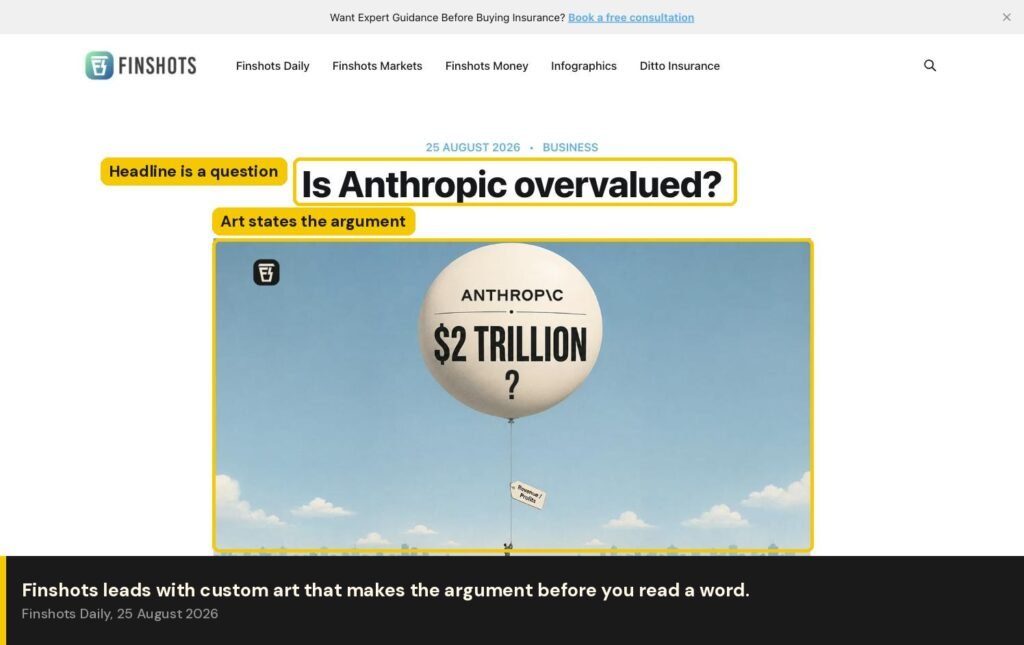
The balloon is labelled ANTHROPIC, $2 TRILLION, with a question mark. A tiny tag reading “Revenue / Profits” hangs off the string. You understand the argument of the entire issue before you read a sentence. That illustration is made for one issue and never used again.
Then the structure comes in, and it is identical every single day.
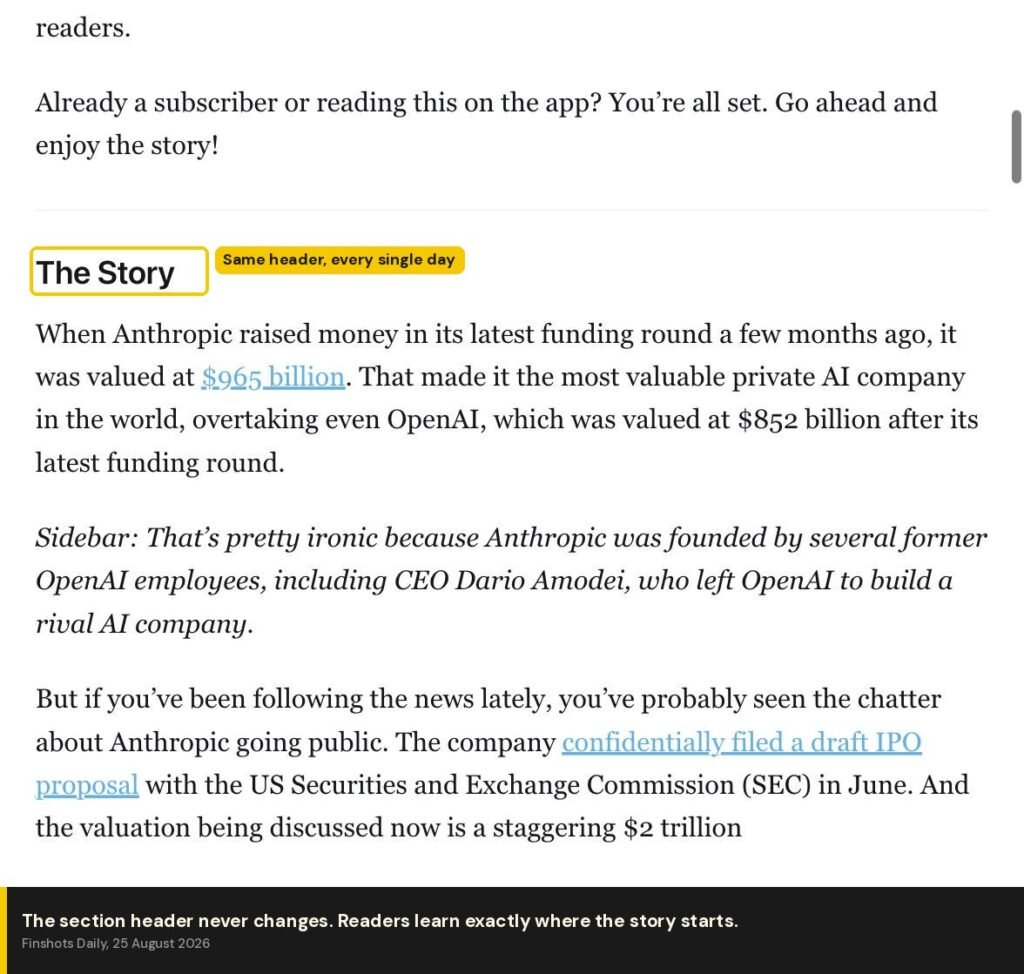
An italic setup paragraph explains why this story, today. Then a header that says The Story. Same two words, every issue, forever. Your eye learns to skip to it in a week.
Then they also have ads.
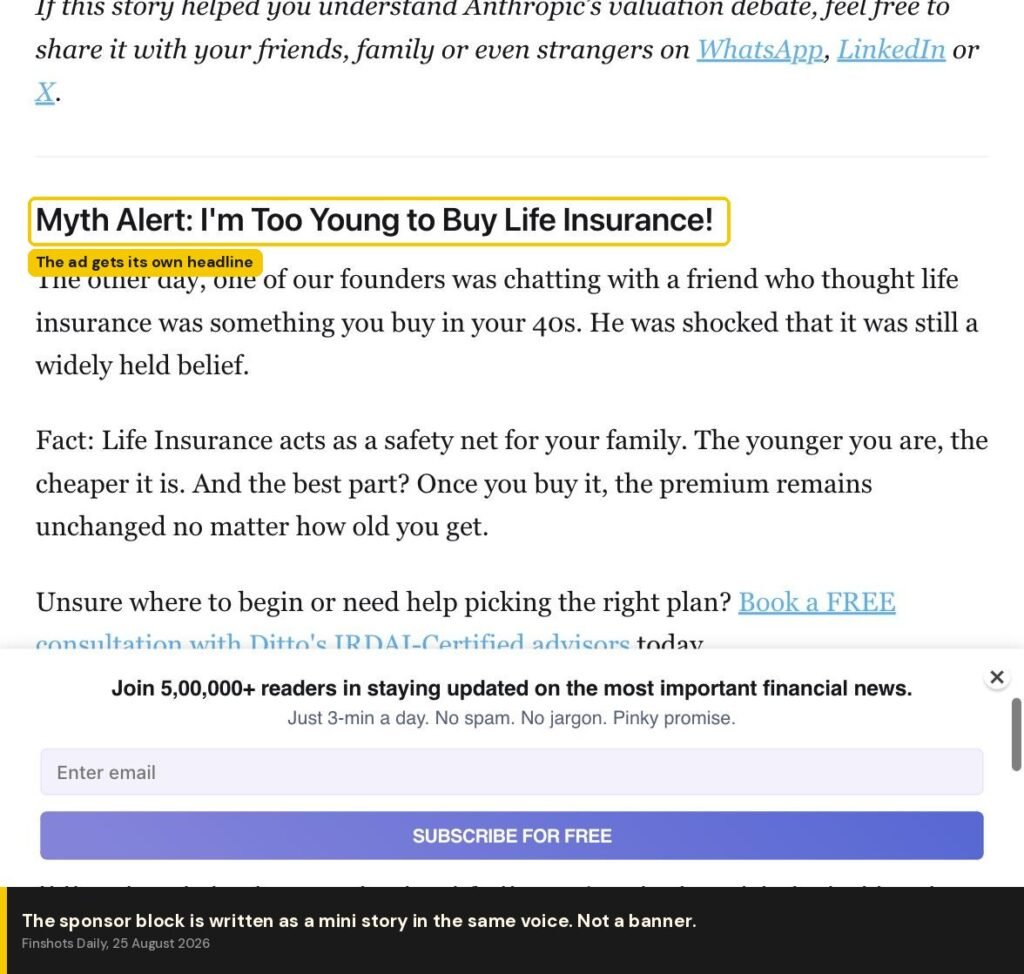
Finshots is owned by an insurance business. So the pitch is a block called “Myth Alert: I’m Too Young to Buy Life Insurance!” written in the same voice, with a story about one of the founders talking to a friend. Then a soft CTA. You can skip it in two seconds, and if you do not skip it, it is actually readable.
Take this to B2B: pick one thing that happened in your buyer’s world this week and explain it properly. One thing. Use the same section header every issue so people can skim to it. Put your pitch in a labelled block at the bottom, written by the same person in the same voice, and let it be skippable. If you want a starting structure, this is close to the explainer format in our 7 B2B newsletter templates.
2. The Nutgraf, by The Ken (India): the sixteen-minute read nobody complains about
The Nutgraf is a weekly essay about one shift in business or tech. It is long. It is paywalled after the header. And people pay for it.
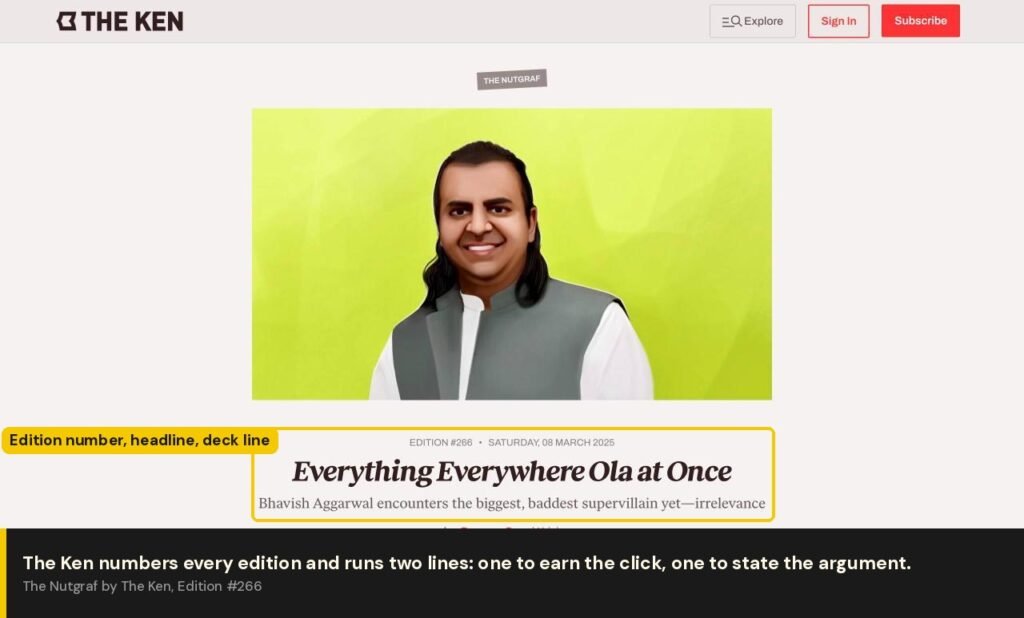
Three things stacked in a specific order.
Edition #266, and the full date. It reads like an issue of a magazine, so you treat it like one.
Then the headline: Everything Everywhere Ola at Once. A pun. It exists to make you curious and nothing else.
Then a deck line underneath doing the real work: Bhavish Aggarwal encounters the biggest, baddest supervillain yet, irrelevance. Now you know the argument. Two lines, two different jobs. Most B2B subject lines try to do both and end up doing neither.
And then this.
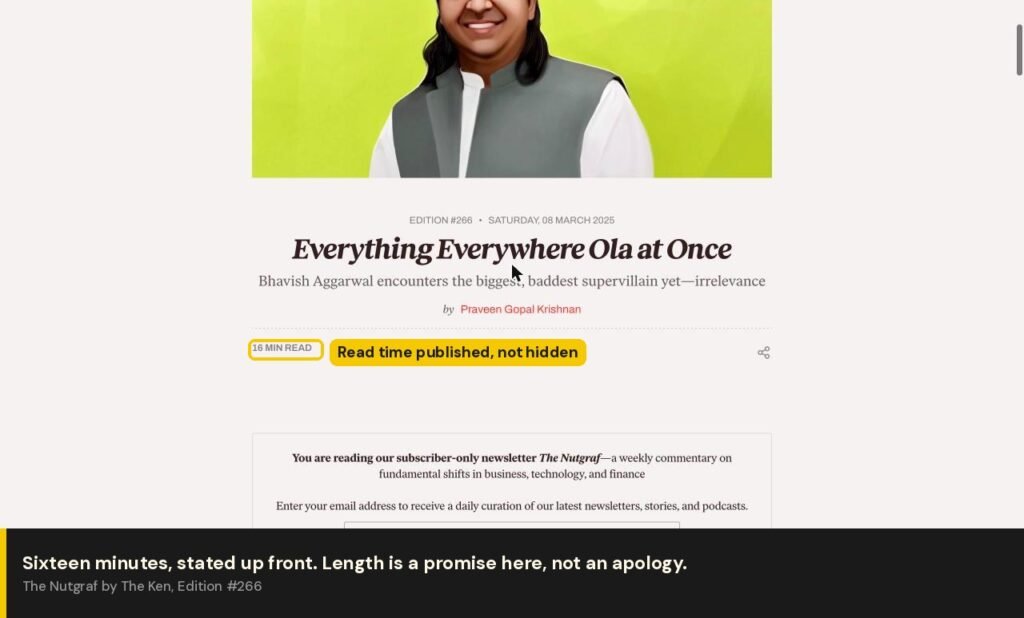
16 minutes. Printed on the page. No apology, no “quick read” fib.
Take this to B2B: name your newsletter and number the editions. Write two lines at the top, one to earn the click and one to state the argument. Put a real person’s byline on it. And say how long it takes. Nobody has ever unsubscribed because a newsletter was honest about its length.
3. Morning Brew (US): the mechanics behind “good voice”
Everyone says Morning Brew has great voice. Great voice is not a thing you can copy. The mechanics under it are.
Mechanic one: the issue opens on a joke tied to today’s date.
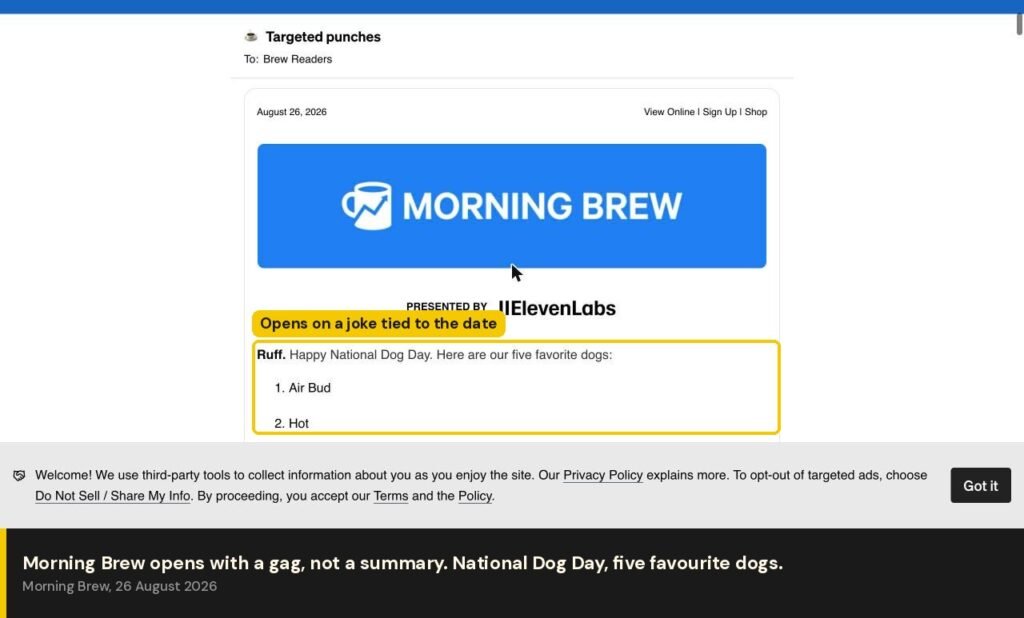
26 August is National Dog Day, so the issue opens with “Ruff.” and a list of their five favourite dogs. It has nothing to do with the news. It is there to make you smile before you read about tariffs.
Mechanic two…
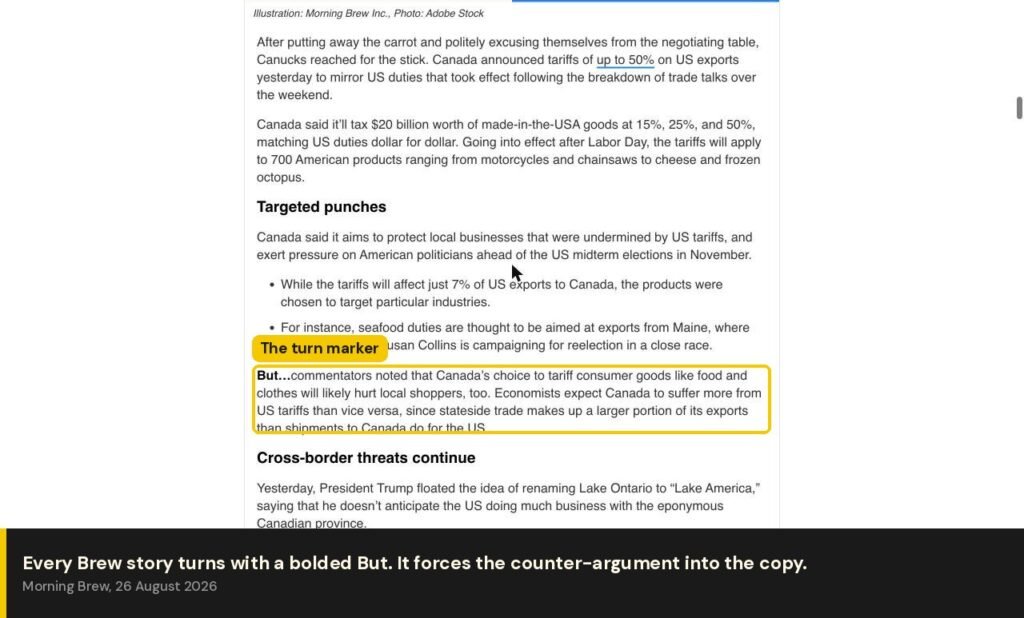
Every story states the facts, then turns with a bolded But…. Sometimes it lands with a bolded Still… after that. Same two words, every issue. Your eye finds the argument without reading the whole block.
More importantly, it forces the writer to include the counter-argument. That is the exact thing B2B content skips, because we are all writing to make our company look correct. It is also the fastest cure for the flat, agreeable prose we complained about in drowning in AI slop.
Mechanic three: the structure inside a story, and the signature at the end.
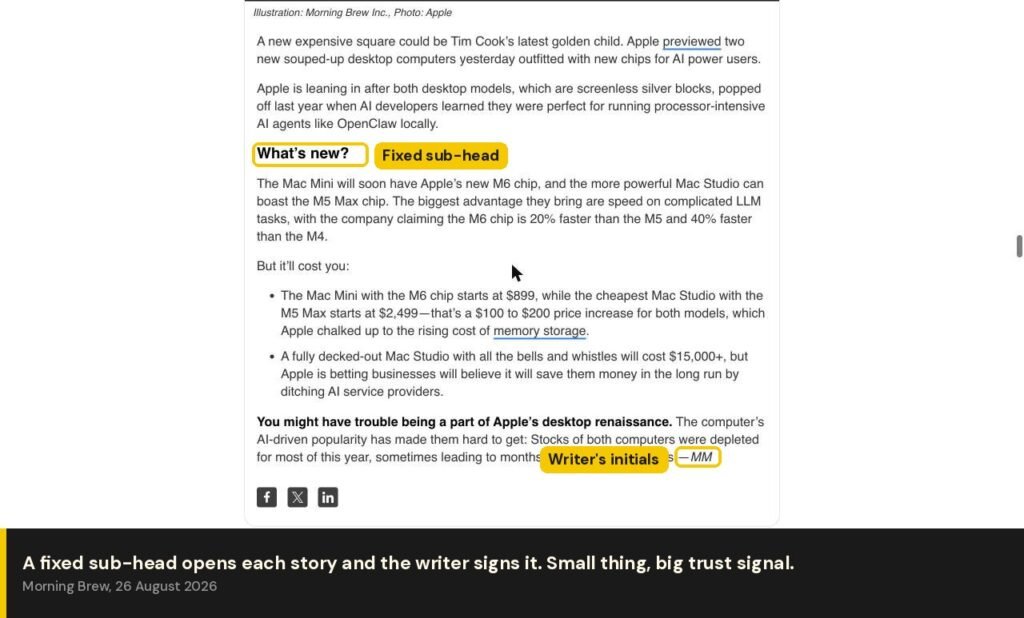
Scene-setting line. Bolded sub-head, usually What’s new?. Facts in bullets with numbers. Then the writer’s initials. Two letters. Costs nothing. Tells you a human wrote it and is willing to own it.
Mechanic four: the ad has a headline.
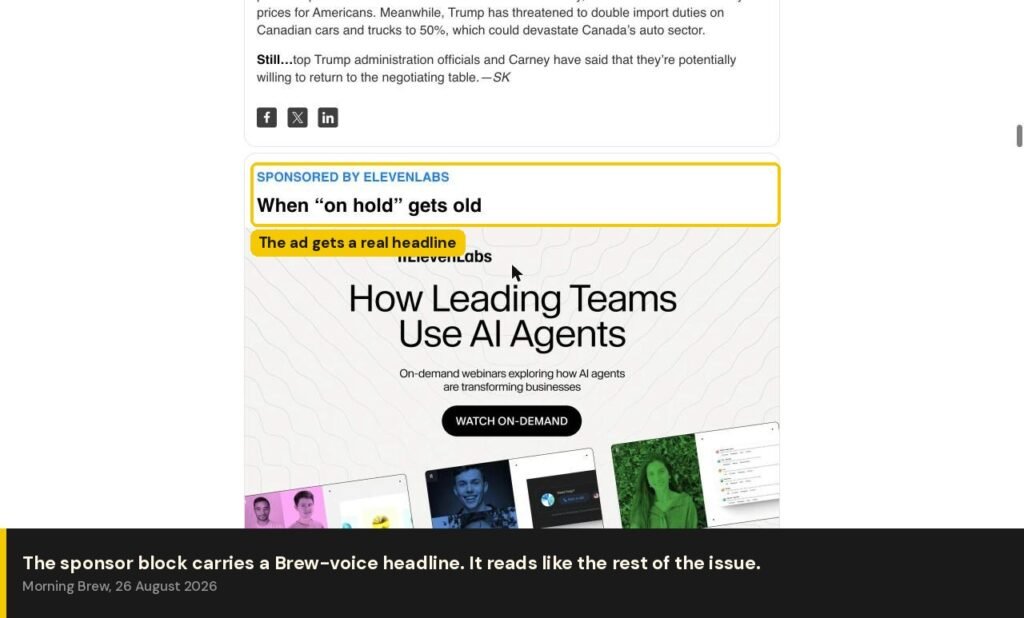
“SPONSORED BY ELEVENLABS” is labelled clearly, then the block gets its own Brew-voice headline: When “on hold” gets old. It is honest about being an ad and still worth reading.
Mechanic five, and this one settles the link-dump argument.
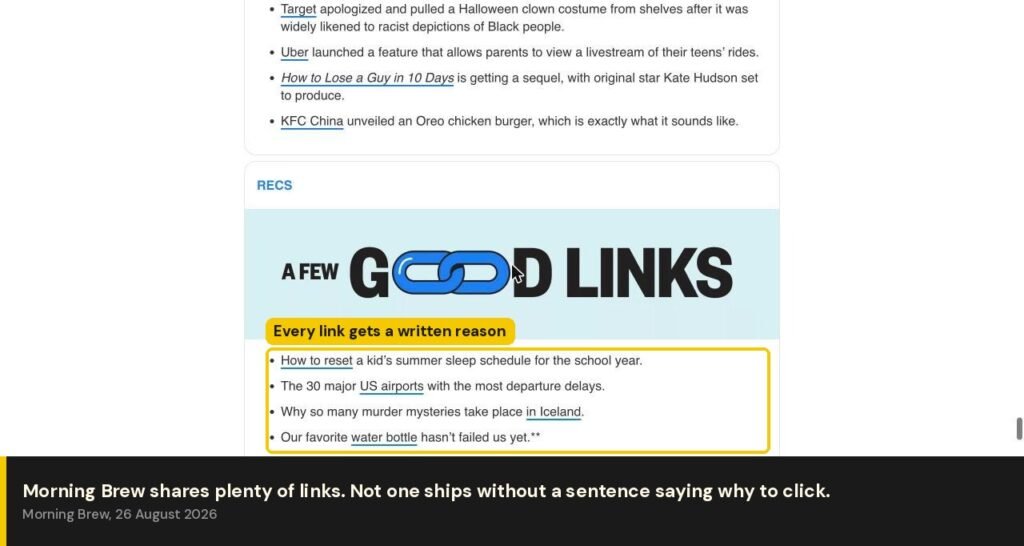
Morning Brew shares a lot of links. More than your newsletter does. The section is literally called “A Few Good Links”.
Look at what surrounds each one.
- How to reset a kid’s summer sleep schedule for the school year.
- The 30 major US airports with the most departure delays.
- Why so many murder mysteries take place in Iceland.
Every link sits inside a written sentence that gives you a reason. The affiliate ones get an asterisk and a disclosure line at the bottom of the block.
That is the difference between curation and a dump. It was never about the number of links.
Take this to B2B: steal But… and Still… literally, this week. Steal the writer initials. Make the rule that no link ships without a written reason, and hold it.
4. Snacks by Sherwood: the takeaway machine
Snacks is a daily finance newsletter.
First, the naming.
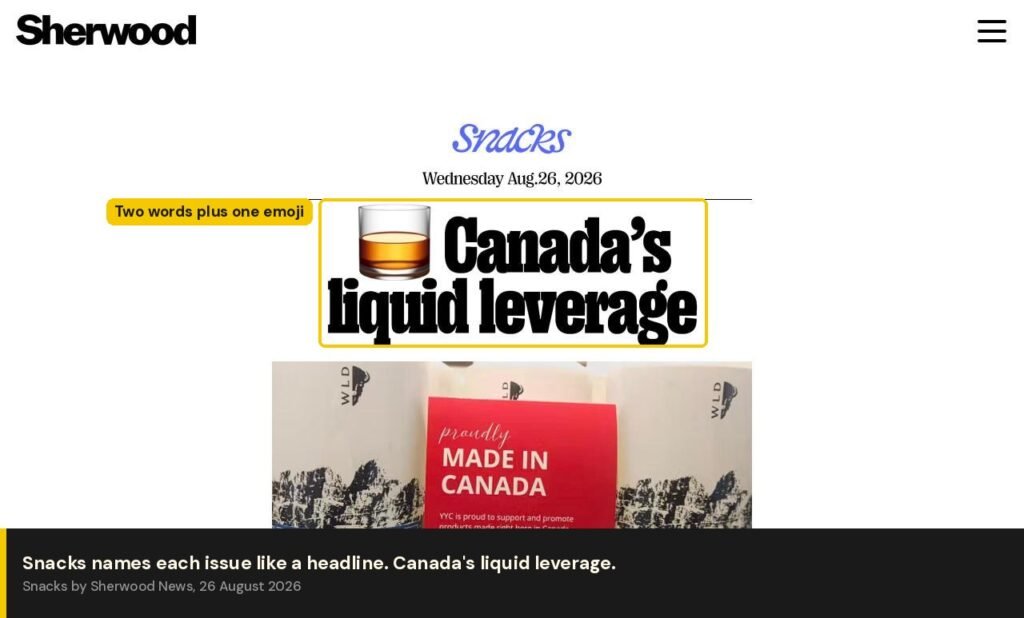
Every issue gets a title of two or three words plus one emoji. Not a subject line. A title.
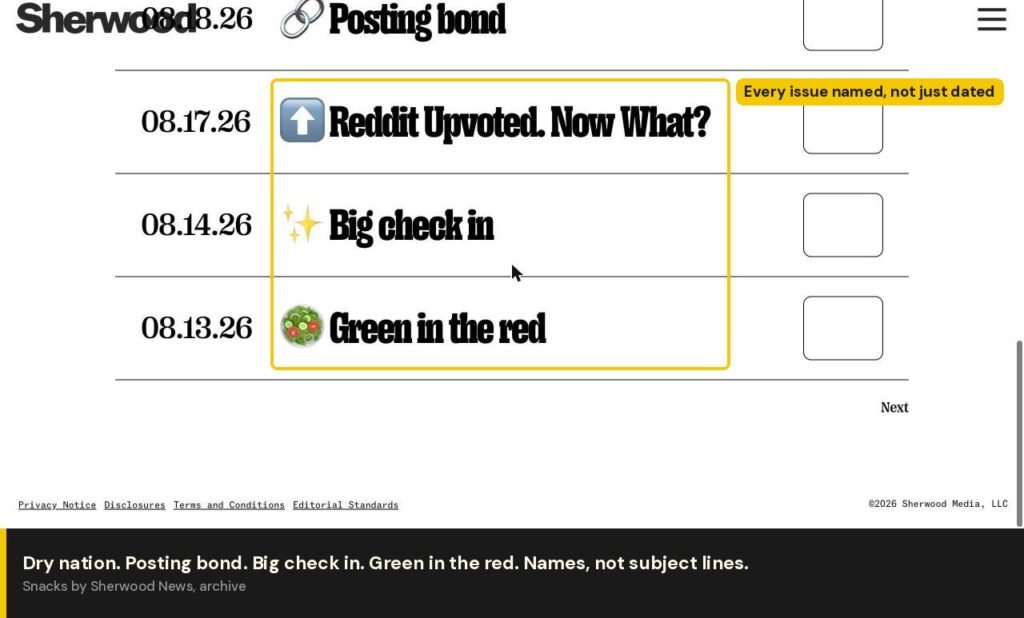
Dry nation. Posting bond. Reddit Upvoted. Now What? Big check in. Green in the red. Canada’s liquid leverage.
They read like magazine covers. Compare that to “Your November Product Update”.
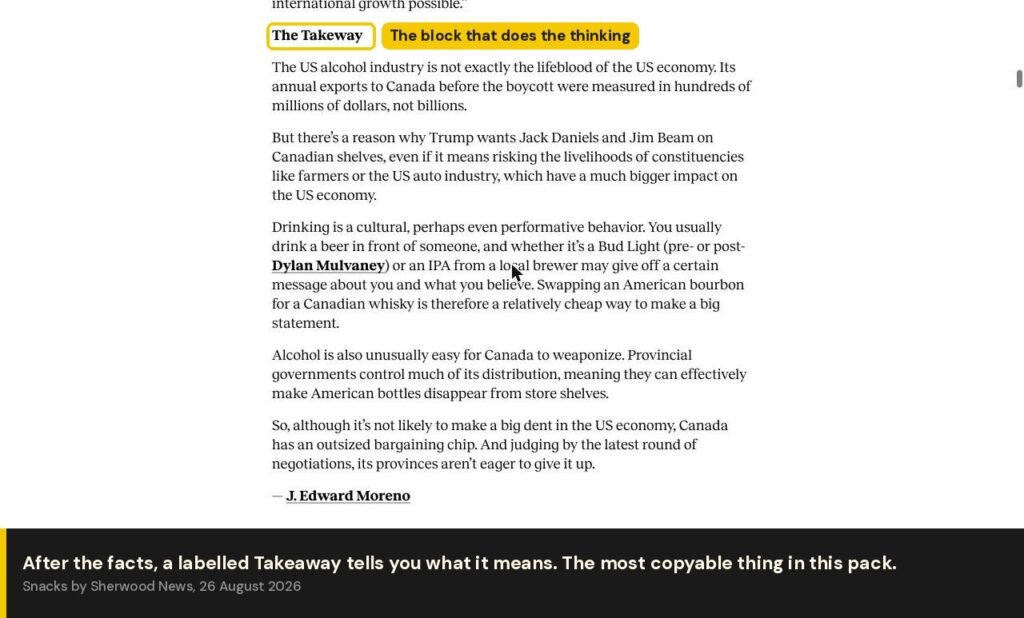
After the facts of every story, there is a bolded block called The Takeway. It steps back and tells you what it means. It is not a recap. It is an opinion, with reasoning, that the writer signs.
That block is a contract with the reader. You give me four minutes, I will tell you what to think about it. It is the entire reason someone reads a newsletter instead of a news app.
Their link section follows the same rule as Morning Brew’s.
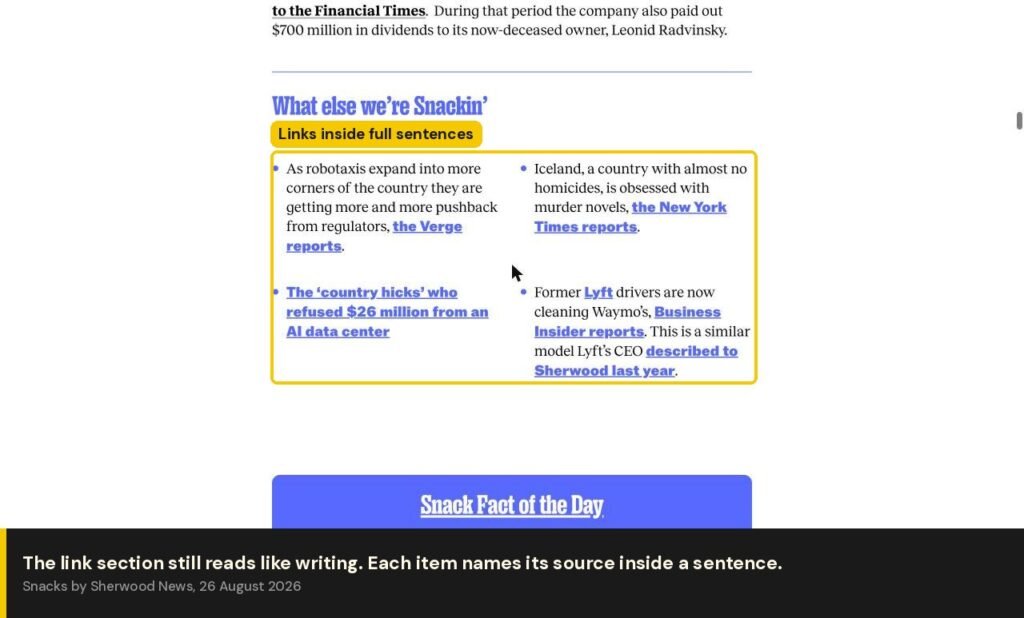
Two columns, every link inside a sentence, source named. As robotaxis expand into more corners of the country they are getting more pushback from regulators, the Verge reports.
Take this to B2B: add a fixed What this means for you block after every story. Two or three sentences. Take a position. If you cannot write the takeaway, that story does not belong in the issue.
Part 2: Two formats that sit between consumer and B2B
5. Marketing Examples: the fixed shape
Harry Dry’s Marketing Examples signup box explains the whole product in about twenty words.
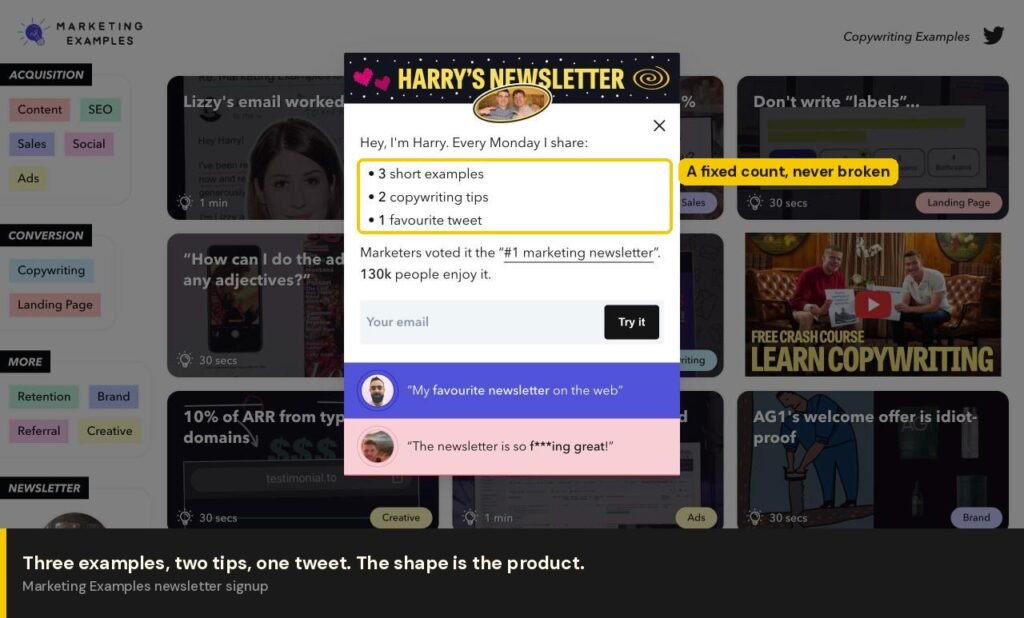
Every Monday I share: 3 short examples 2 copywriting tips 1 favourite tweet
That is it. 130,000 people subscribe to a number.
A fixed count is a promise you can actually keep. It is also a constraint that stops a lazy issue. Three examples never quietly becomes nine links, because the shape would break and readers would notice.
On the site, the same discipline shows up again.
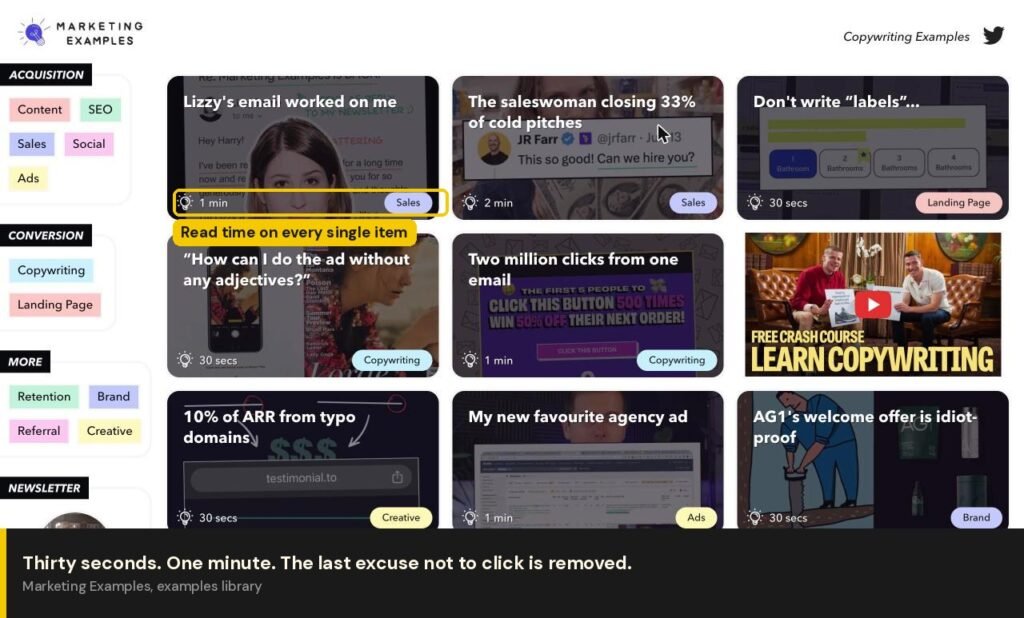
Every example carries a read-time badge. 30 secs. 1 min. 2 min. Plus a category chip: Sales, Copywriting, Landing Page, Ads, Brand, Referral.
Thirty seconds removes the last excuse anyone has not to click.
Take this to B2B: give your newsletter a numeric shape and never break it. Something like 1 teardown, 2 numbers, 1 thing to steal. Print the read time. A shape is what turns an email into a product, and it makes your content calendar a filling exercise instead of a blank page every week.
6. Justin Welsh: the headline system
Justin Welsh writes one short essay a week. 240-odd issues in, the archive shows a system that never wobbles.
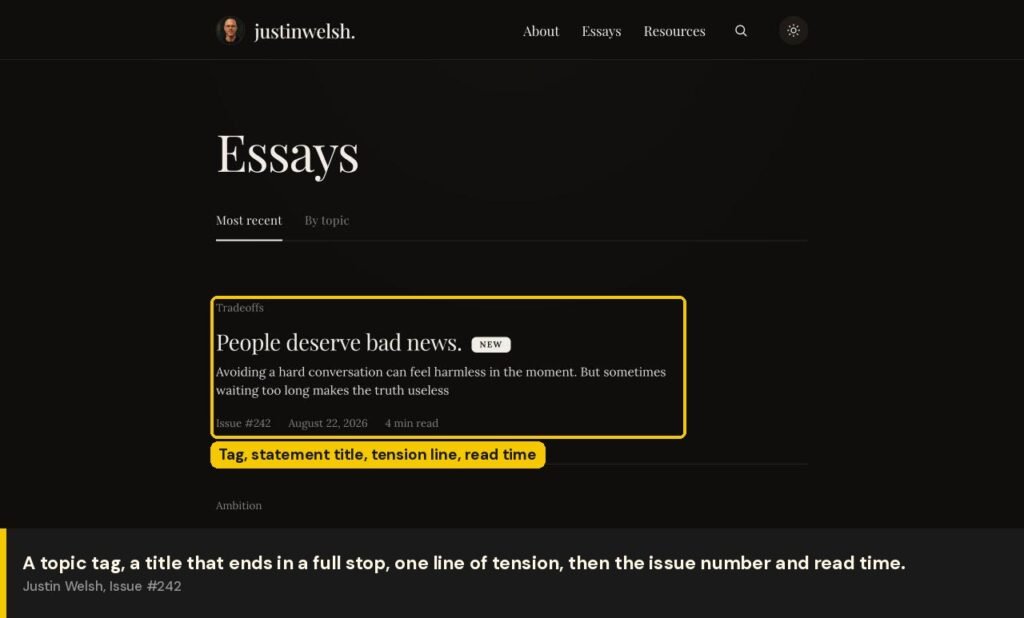
Four parts, in order.
A topic tag: Tradeoffs. Mindset. Freedom. Work. Ambition. Five or six of them, reused forever, so a long-time reader can spot the ones they care about.
A title that is a statement and ends in a full stop. People deserve bad news. Mediocrity at scale. The machine is a mirror. Having fun is the new moat. The full stop is doing quiet work. It makes the title read like a belief, not an article.
One line underneath that adds the tension: Avoiding a hard conversation can feel harmless in the moment. But sometimes waiting too long makes the truth useless.
Then issue number, date, read time. Always three or four minutes.
Take this to B2B: build a set of four or five recurring themes and tag every issue. Write titles as statements. Cap the length and publish the number. Do it 200 times. The themes are the same thing as content pillars, and we walk through picking them in topical authority for B2B SaaS.
Part 3: Four B2B newsletters that already figured it out
7. MKT1, by Emily Kramer: the framework issue
MKT1 is a deep dive on one B2B startup marketing topic. Long, dense, and structured so you can decide early whether to read it now.
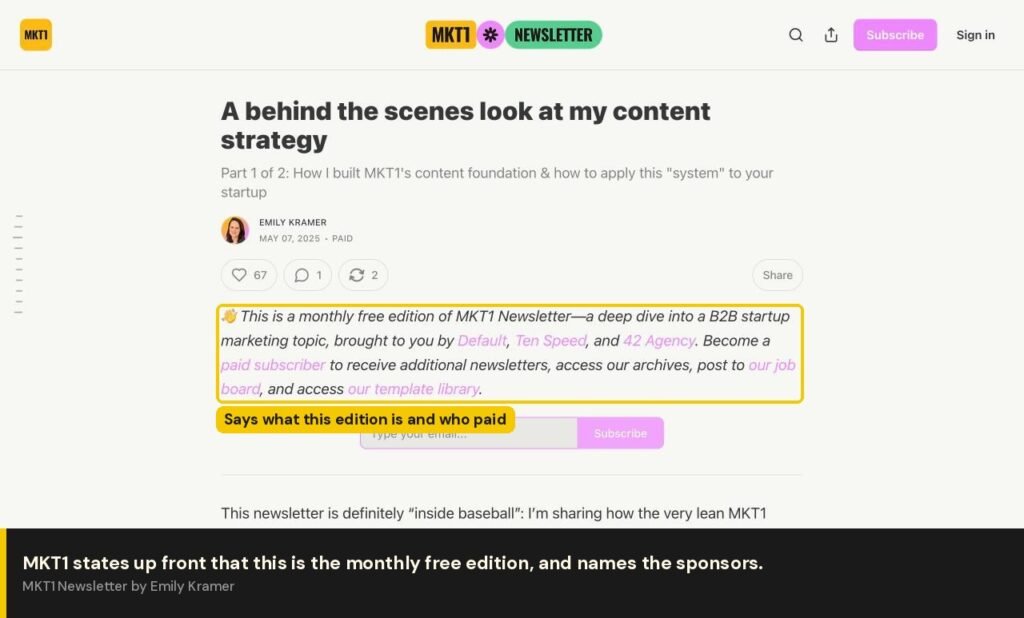
The first thing in the body is an italic note telling you exactly what you are holding. This is the monthly free edition. Here are the three sponsors. Here is what paid subscribers get instead.
Nobody minds a sponsor. They mind finding out about one halfway down.
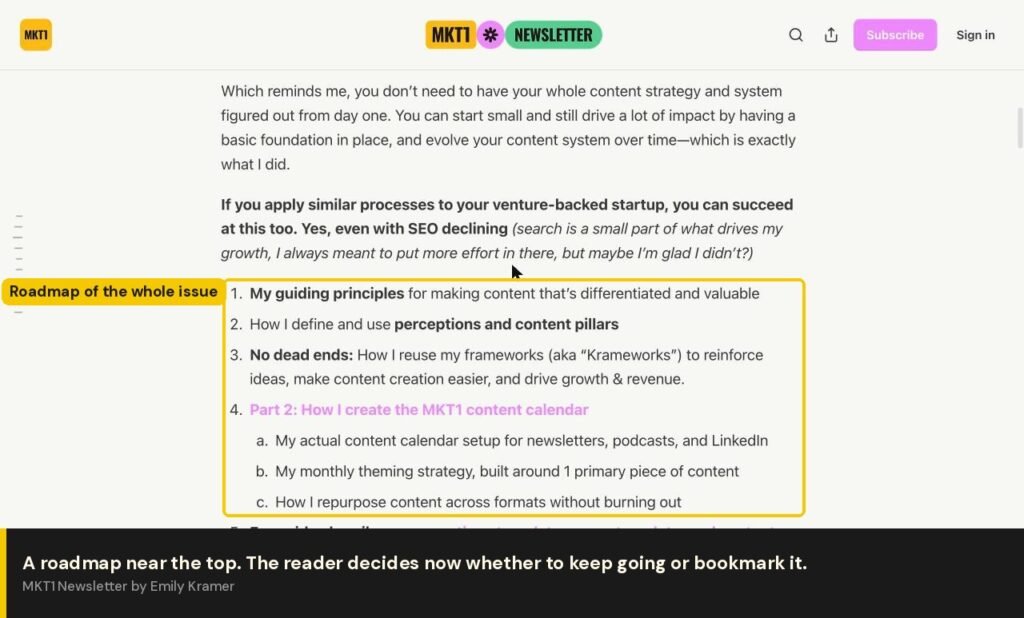
Then a roadmap. Everything in this issue, plus what is coming in Part 2, with links. The reader chooses to keep going or bookmark it.
And then the pattern that repeats for every idea in the piece.
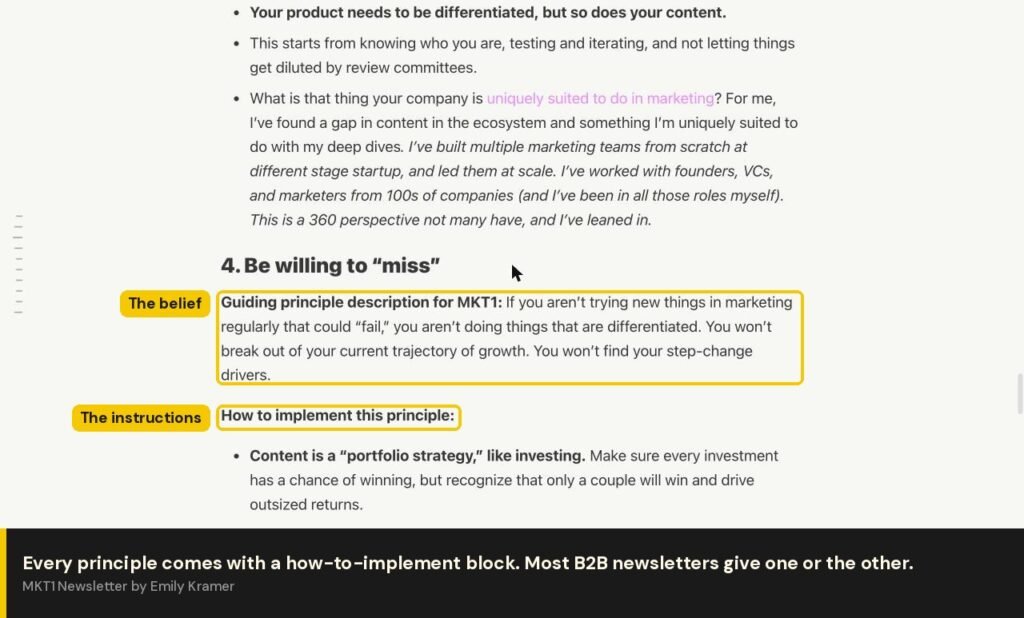
Guiding principle description for MKT1: what she believes and why.
How to implement this principle: what you actually do about it.
Two blocks, every time. Most B2B newsletters give you one or the other. A philosophy with no instructions, or a checklist with no reasoning.
She also names her frameworks. “Krameworks”. “No dead ends”. “Perceptions and content pillars”. Named things get repeated to a boss, which is how ideas travel inside companies.
Take this to B2B: for every claim, write the how-to bullets directly underneath. Name your frameworks. Say up front what is free, what is sponsored and what is paid. This is the newsletter version of the systems thinking in how to build a SaaS content engine.
8. Lenny’s Newsletter: let the readers write it
This is the cheapest high-value format in B2B.
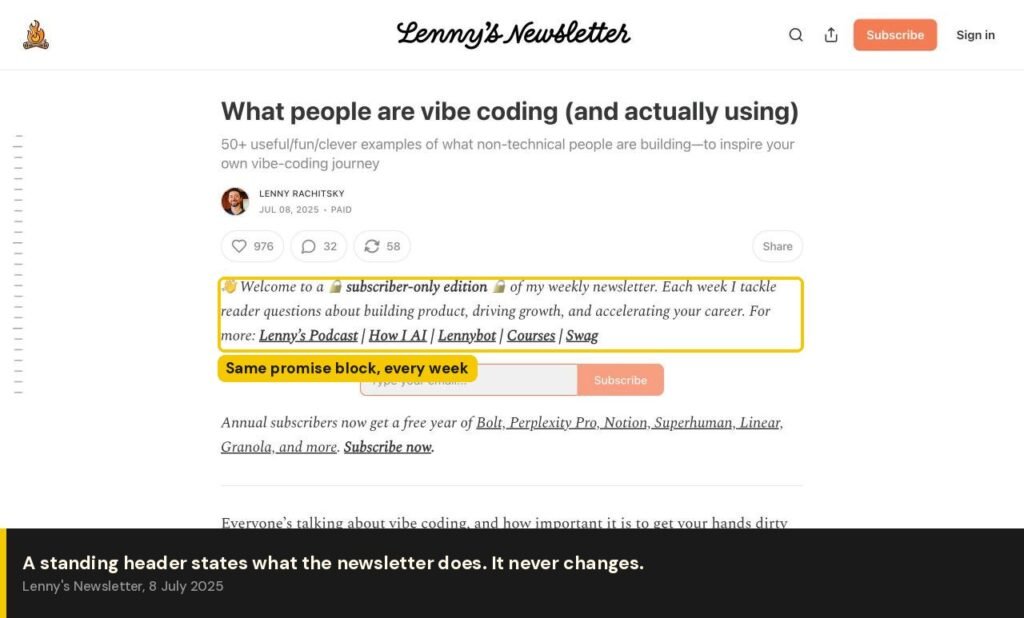
A standing header block opens every issue of Lenny’s Newsletter. Same words every week: he tackles reader questions about building product, driving growth and accelerating your career. The reader never has to re-learn what this thing is.
Now look at where the issue came from.
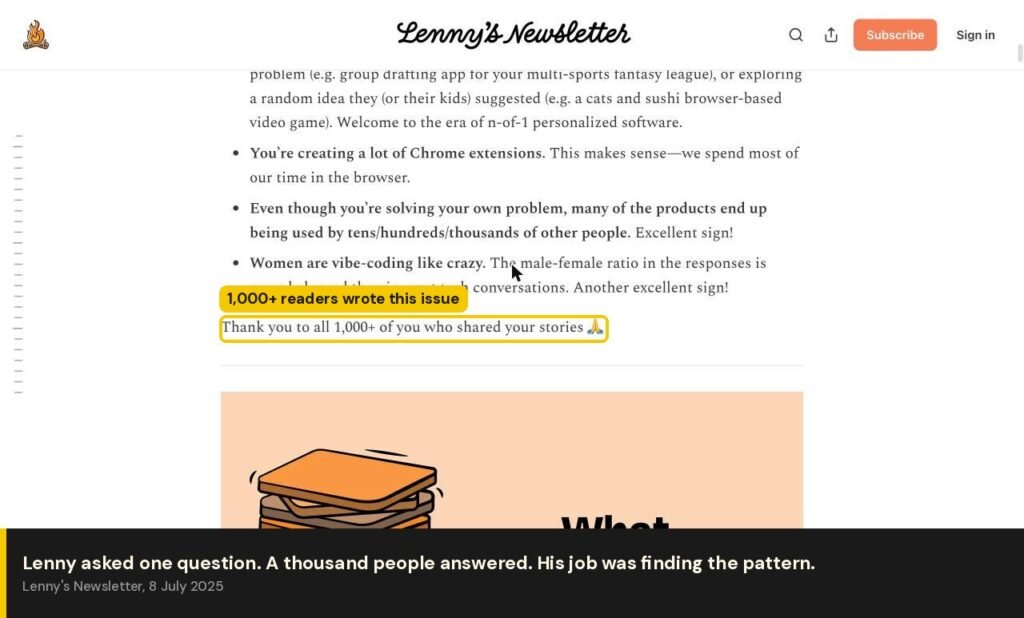
He asked his list one question: what have you built with AI that you actually use? Over a thousand people replied. The issue is their answers.
His job was not being the expert. His job was asking a good question and then reading the pattern out loud. You’re creating a lot of Chrome extensions. Even though you’re solving your own problem, many of the products end up being used by thousands of other people. Women are vibe-coding like crazy, the male-female ratio here is more balanced than in most tech conversations.
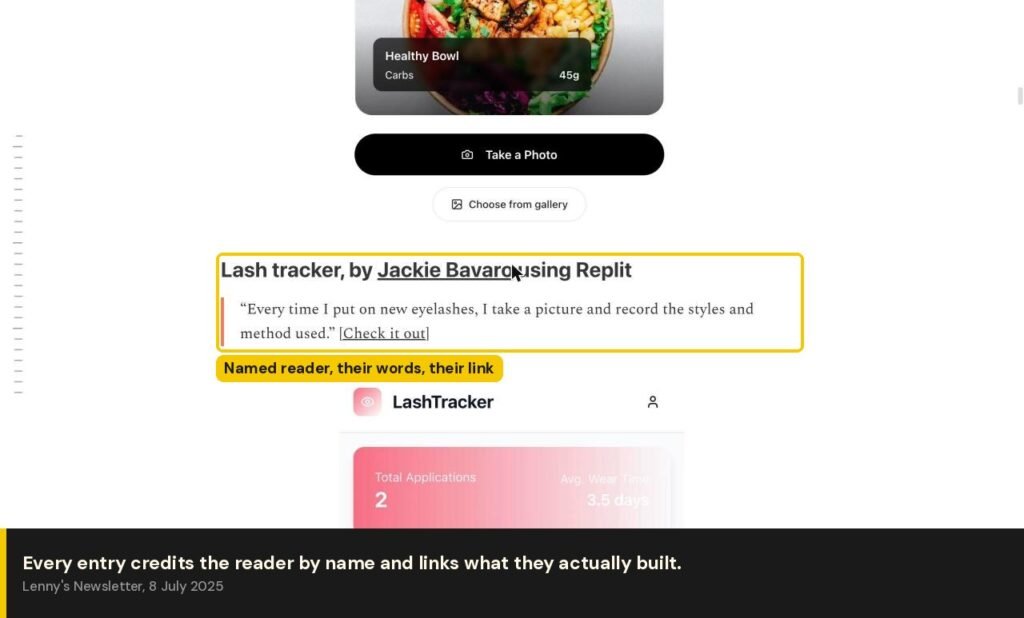
Every entry credits the reader by name, quotes them, and links what they built.
Think about what that one issue produced. Content he did not write. A thousand replies, which is a deliverability gift. Hundreds of people who now feel part-owner of the newsletter and will forward it.
Take this to B2B: once a month, ask your list one real question. Publish the answers with names and companies. Add your read of the pattern on top.
9. Exit Five, by Dave Gerhardt: the play breakdown
Exit Five sends twice a week to B2B marketers. The promise on the signup page is the best line in this whole post.
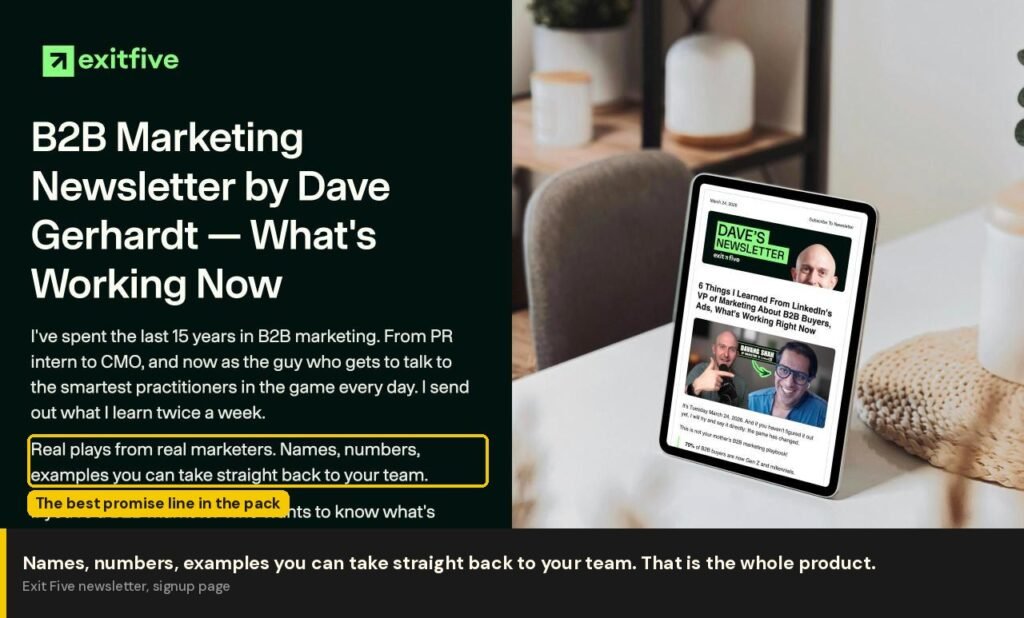
Real plays from real marketers. Names, numbers, examples you can take straight back to your team.
Every word there is a constraint on what they are allowed to publish.
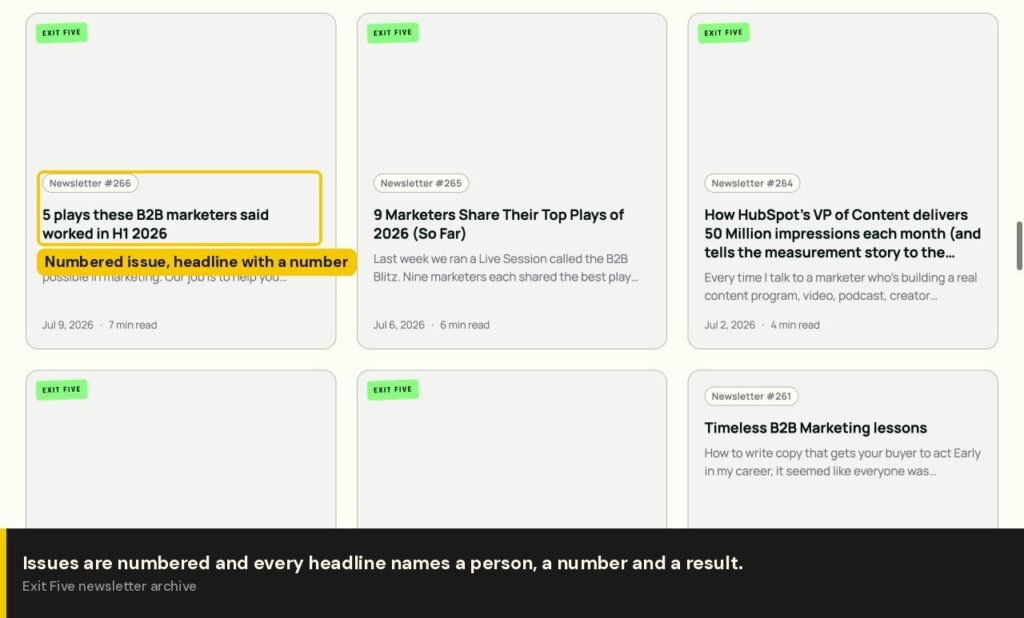
Issues are numbered. #264, #266, #273. Headlines put a person, a number and a result in the same line. How HubSpot’s VP of Content delivers 50 Million impressions each month. 9 Marketers Share Their Top Plays of 2026 (So Far). 5 plays these B2B marketers said worked in H1 2026.
Inside, every play runs on the same skeleton.
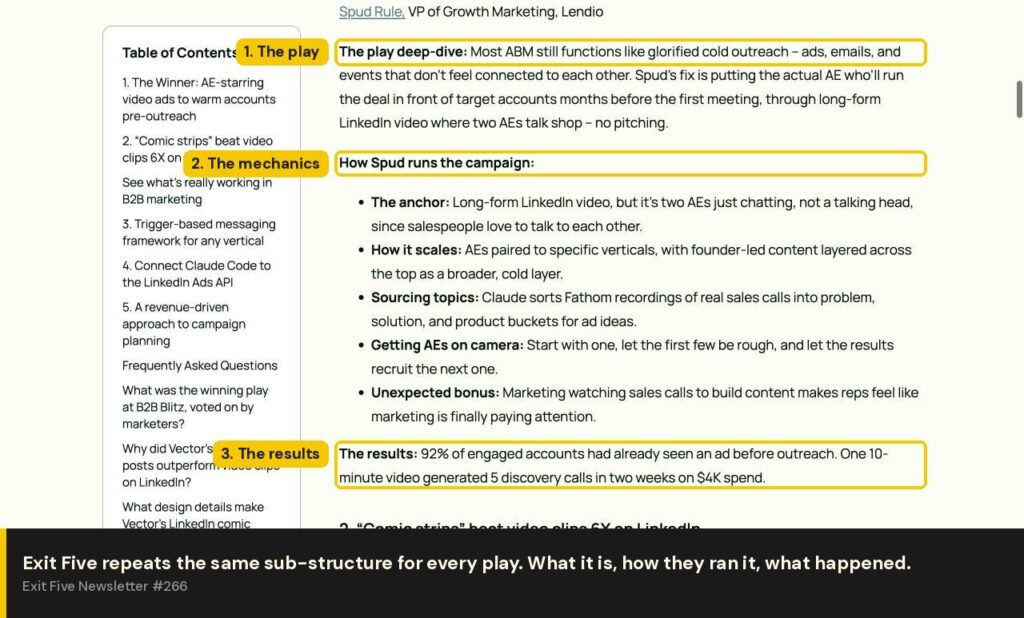
- Who did it. Named, with title and company, hyperlinked. Spud Rule, VP of Growth Marketing, Lendio.
- The play deep-dive. What the play is and why it is different from the usual version.
- How they ran it. Bulleted mechanics with their own labels: The anchor. How it scales. Sourcing topics. Getting AEs on camera. Unexpected bonus.
- The results. With real numbers. 92% of engaged accounts had already seen an ad before outreach. One 10-minute video generated 5 discovery calls in two weeks on $4K spend.
And sometimes a fifth block.
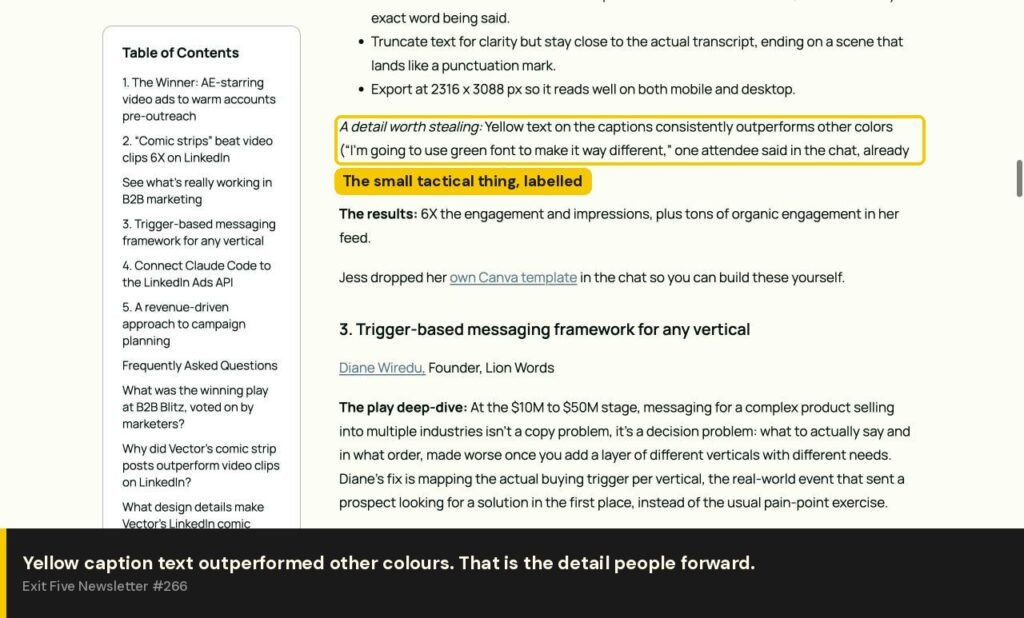
In one play it was that yellow caption text beat every other colour, and an attendee said in the chat she was already planning her own version.
That is the bit people screenshot and send to a colleague.
The other thing worth noticing: they never run out of material, because they are interviewing one person per section instead of producing original research.
Take this to B2B: copy that five-part skeleton exactly. Run it as a recurring section. Get one practitioner on a twenty-minute call and you have an issue. The interview technique is the same one we use for customer stories, and it is written up in how to run a case study interview that gets real answers.
10. CB Insights: the chart that argues
I am including CB Insights because it is the closest thing here to a link dump, and it still mostly works. Understanding why is useful.
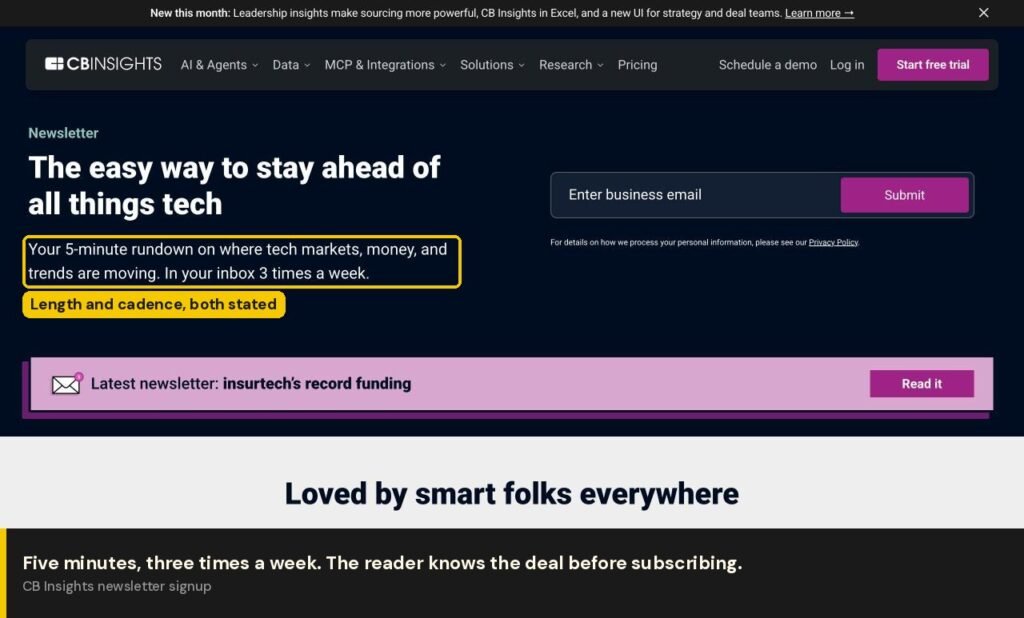
The promise states length and cadence together. Your 5-minute rundown on where tech markets, money, and trends are moving. In your inbox 3 times a week.
The body is honestly a list of their own reports, under a header that says ICYMI. That is the part I would criticise anywhere else.
Two things save it.
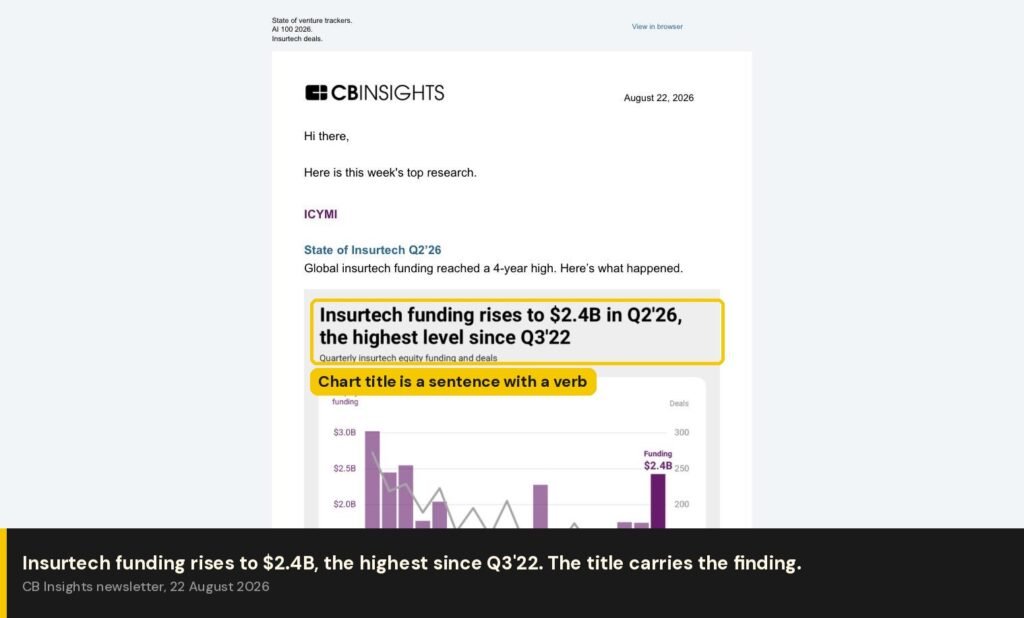
First, every link gets a one-line finding, so the email teaches you something even if you click nothing. Global insurtech funding reached a 4-year high. Here’s what happened.
Second, this.
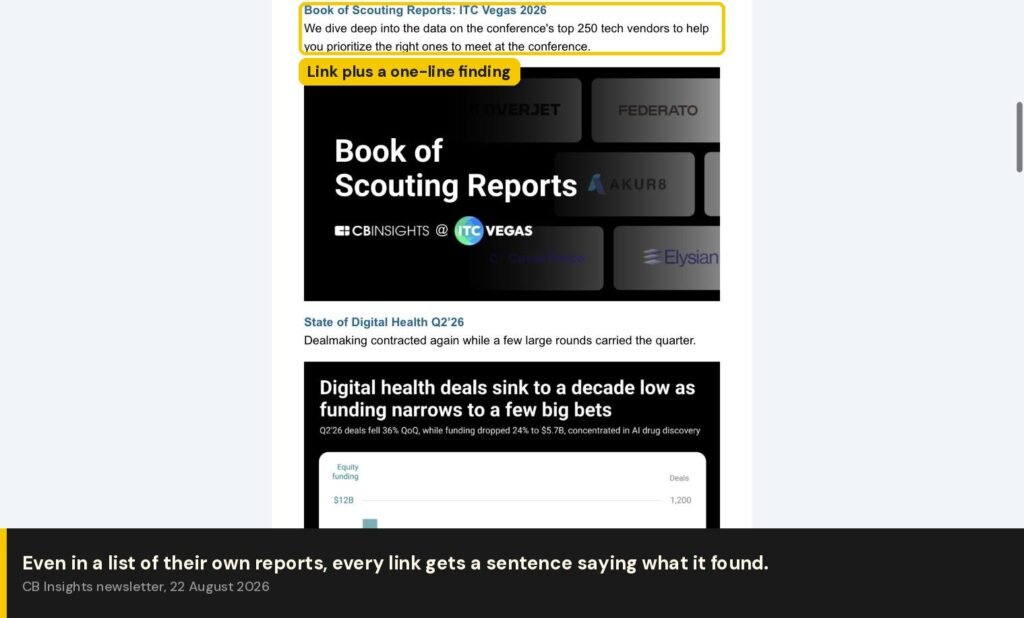
Look at the chart title. Insurtech funding rises to $2.4B in Q2’26, the highest level since Q3’22.
That is a complete sentence with a verb and a conclusion. Another one in the same issue: Digital health deals sink to a decade low as funding narrows to a few big bets.
Now compare it to how your team titles charts. “Q2 funding by sector.” “Revenue trend.” Those titles teach nothing. You are making the reader do the analysis you were supposed to do.
Take this to B2B: never title a chart with a noun phrase. Write it as a sentence with a verb and a finding. And if your product generates data nobody else has, aggregate it, anonymise it, and you have a newsletter section forever. We did a small version of this ourselves with an AI citation study on B2B SaaS buying queries, and it earns more links than anything else we publish.
The warning: if you do not have data nobody else has, this format collapses straight back into the link dump we started with.
8 patterns that showed up in all newsletters above
1. A stated shape and structure. Five minutes. 3 examples, 2 tips, 1 tweet. One story a day. Three times a week. Every single one of these tells you what you are getting before you open.
2. Somebody has an opinion and signs their name. Writer initials at Morning Brew. A named author at The Ken. The Takeaway at Snacks. Emily Kramer’s principles. Dave Gerhardt’s face. None of these are from “the marketing team”.
3. Links are fine. Bare links are not. Morning Brew, Snacks and CB Insights all share plenty of links. Every one sits inside a written sentence with a reason.
4. One fixed block does the thinking. The Takeaway. But… / Still…. How to implement this principle. The results. The reader always knows where the payoff lives.
5. Read time is published. 16 min. 30 secs. 5 minutes. 4 min read. Nobody is hidding the length.
6. Specificity is the product. 92% of engaged accounts had already seen an ad. 6X the engagement. $4K spend, 5 discovery calls. Real numbers with a named person attached beats “significant lift” every time. This is also the main reason B2B SaaS content stops converting: it is true, it is inoffensive, and it says nothing.
7. The best issues are written by readers. Lenny asked one question and got a thousand answers. Exit Five publishes practitioners talking. Your list will write your newsletter if you ask them properly.
8. The ad is written in the newsletter’s voice. Finshots writes its insurance pitch as a Myth Alert story. Morning Brew writes ElevenLabs a headline. Both are labelled honestly and both are readable.
20 things to actually do
10 formats for a whole newsletter
- The play breakdown. One practitioner, one campaign, the mechanics, the numbers, the detail worth stealing.
- The one-thing explainer. One thing that happened in your buyer’s world, explained properly, with a takeaway.
- The reader survey issue. Ask one question, publish the answers with names, add your pattern read.
- The teardown. A real buying flow, screenshotted step by step, annotated with what each step was doing to you.
- The number-shape digest. A fixed count you never break. 1 teardown, 2 numbers, 1 template.
- The proprietary data brief. Aggregated anonymised data from your product. One chart per issue. Chart title states the finding.
- The argument essay. One belief per issue, titled as a statement, four minutes, tagged by theme.
- The framework issue. One framework, named, with principle plus implementation for each part.
- The internal memo made public. Publish the actual doc you wrote for your team, lightly redacted, with a note on what happened next.
- The failure log. What you tried, what it cost, what broke. Rare in B2B, which is exactly why it gets forwarded. Our own most-read piece is close to this: I’ve been the freelancer, the agency, the in-house hire and the fractional.
If you want these as fill-in structures rather than descriptions, we broke seven of them down in 7 B2B newsletter templates (and when to use them).
10 recurring blocks to drop into any of them
- What this means for you. Two sentences after every story. Non-negotiable.
- But… / Still… Force the counter-argument into the copy.
- A detail worth stealing. The small tactical thing, pulled out and labelled.
- One reader question, answered. Straight from your replies.
- The number. One statistic, the source, and why it changes what you do on Monday.
- Steal this. An actual template, sheet or prompt. Linked, not gated.
- Someone else’s homework. A competitor’s or an adjacent brand’s move, broken down with screenshots.
- What I got wrong last issue. A correction block. Builds more trust than anything else on this list.
- Read time on every section, not just the issue.
- Writer initials at the end of every section.
If you are starting from a link dump on Monday
You do not need a redesign. Do these five in order.
Week 1. Add a What this means for you block under every item you already send. Change nothing else. Watch what happens to replies.
Week 2. Delete half the items. Whichever half you cannot write a takeaway for.
Week 3. Put a person’s name and face on it. Add their initials to each section.
Week 4. Name the newsletter and start numbering the issues. Print the read time.
Week 5. Ask your list one question and publish the answers.
5 weeks, no new budget, no new tool. If your current tool is fighting you on any of this, there are cheaper options in our list of free email marketing tools and the AI-native email automation tools roundup.

Rashmita is content marketer with 8 years of experience building and growing SaaS brands. Now she tests various AI tools for marketers and shares her feedback on this blog, LinkedIn, Instagram, and YouTube.