Content Marketing Statistics for 2026
A lot is changing in content marketing. Thanks to AI and everything it influences, looking at the stats has become more important than ever.
The 10 numbers to remember
- 97% of B2B marketers now have a content strategy. Only 3% do not. (CMI/MarketingProfs)
- Only 21% of content marketers report “strong results.” (Orbit Media)
- 96.55% of web pages get zero traffic from Google. (Ahrefs, ~14 billion pages)
- 94% of B2B buying groups had a favourite vendor before they ever contacted sales. They bought from that favourite 77% of the time. (6sense)
- Website, blog and SEO is still the #1 ROI channel at 27%, ahead of paid social. (HubSpot State of Marketing 2026)
- Posts over 2,000 words hit “strong results” 39% of the time, against a 21% benchmark. (Orbit Media)
- Marketers who never use AI report the worst results of any group (15% strong results vs the 21% benchmark). So do the ones who let AI write whole articles. (Orbit Media)
- The #1 Google result is 8x more likely to be human-written than AI-generated. (Semrush, 42,000 blog pages)
- AI referral visitors convert 3x better than other organic traffic, but make up 0.5% of visits. (Orbit Media, 97 B2B sites, 28.9M sessions)
- 95% of “hidden buyers” say strong thought leadership makes them more receptive to your outreach. (Edelman-LinkedIn)
Does content marketing actually work?
Adoption is settled. Results are not.
- 97% of B2B marketers have a content strategy. (CMI)
- 61% say their content strategy got more effective this year. 13% say significantly, 48% say somewhat. (CMI)
- 74% credit strategy refinement for that improvement. New technology came second at 51%. Budget increases came in at 16%.
- Only 12% of B2B marketers rate their marketing as highly effective. Another 47% say somewhat effective. The remaining 41% sit at neutral or worse.
- 65% of effective teams point to content relevance and quality as the reason. Team skills came second at 53%. Budget allocation came in at 20%.
- Only 21% of content marketers report strong results from their blog. 60% report “some results.” (Orbit Media)
What that gap tells you: teams stopped arguing about whether to do content and started struggling to make it perform. If your traffic is fine and your pipeline is not, the problem is usually downstream of the click.
The three challenges that will not go away
- Creating content that prompts action: 40%
- Resource constraints (time, people, budget): 39%
- Measuring content effectiveness: 33% (CMI)
These were the top three last year too. Tools changed. The problems did not.
Budgets: where the money is going
- Marketing budgets sit at 7.8% of company revenue. Flat since 2022 and about 18% below the pre-pandemic average. (Gartner 2026 CMO Spend Survey)
- The CMO Survey puts the same figure at 9.0%. The gap is sampling. Gartner surveys mostly $1B+ companies. Quote whichever matches your peer group, and name the source.
- CMOs allocate 15.3% of marketing budget to AI initiatives. Only 30% say they have the maturity to scale it.
- Martech dropped to 19.4% of marketing budget, down from 26.6% in 2021, a five-year low. (Chief Marketer, on Gartner data)
Where B2B teams say they will increase spend in 2026
- AI-powered marketing tools: 45%
- Events and experiential: 33%
- Owned media (content, website, blog, email): 32%
- Paid media: 25%
- Human resources (salaries, training): 9%, dead last (CMI)
That last one deserves a pause. The same survey says the biggest driver of effectiveness is team skills, and teams are funding it least. If you are trying to work out what a real content budget looks like, we broke down what content marketing actually costs for B2B SaaS.
How B2B buyers actually use content
This is the section to send to your CEO.
- The buying journey shifted from a 70/30 split to 60/40 between independent research and seller engagement. (6sense 2025 Buyer Experience Report)
- 94% of buying groups ranked their preferred vendors before first contact.
- They bought from that pre-contact favourite 77% of the time.
- Buyers initiate contact themselves over 80% of the time, and usually reach out first to the vendor they already intend to buy from. (6sense)
- Average buying cycles shortened from about 11 months to 10 months.
- 96% of prospects research on their own before speaking to a sales rep. (HubSpot State of Sales)
- Nearly 70% of marketers say leads now arrive later in the buying process because they did more AI-assisted research first. (HubSpot 2026)
What this means for you: your content is not warming up the funnel. It is the shortlist. By the time a demo request lands, most of the decision already happened on pages you cannot attribute. That is the case for treating comparison and alternatives pages as pipeline assets rather than SEO filler.
Thought leadership: the buyers you never meet
Edelman and LinkedIn surveyed 1,934 management-level professionals across seven markets, including “hidden buyers” in finance, legal, compliance and procurement who influence deals without ever talking to your sales team.
- 71% of hidden buyers have little or no interaction with sales teams. (Edelman-LinkedIn 2025)
- 95% say strong thought leadership makes them more receptive to sales and marketing outreach.
- 79% are more likely to advocate for your proposal during an RFP if you publish consistent, high-quality thought leadership.
- 81% say quality thought leadership helped them see a challenge they had not recognised.
- 71% say thought leadership beats traditional marketing materials at demonstrating value.
- 64% trust it more than product sheets and brochures.
- 53% say strong content can outweigh brand recognition. That is the whole opening for challenger brands.
- 57% prefer quick takeaways over dense reports. Depth still matters, packaging matters more.
- 63% spend more than an hour a week consuming thought leadership.
What marketers are doing about it
- 96% of B2B organisations create thought leadership content. (CMI)
- 37% say fewer than 5% of their expert employees actually contribute. Another 30% say 5% to 15%.
- The three most effective channels: LinkedIn (76%), email newsletters (54%), speaking events and webinars (52%).
- 80% measure thought leadership by engagement. Only 63% measure business impact.
Nearly universal adoption, minimal internal participation. That is a content team trying to look smart on LinkedIn. Fixing it usually means pulling real expertise out of the people who have it, which is exactly what executive ghostwriting is for.
Blogging: length, frequency, and time
Orbit Media has run the same survey for 12 years. This is the 2025 edition, 808 content marketers, fielded August 2025.
- The average blog post is 1,333 words. Down for the second year running. The word-count arms race is over. (Orbit Media)
- The average post takes 3 hours 25 minutes to produce. Down from a 4:10 peak in 2022, likely because of AI.
- About half of marketers publish two to four times a month. High-volume publishing has declined every year.
- Only 9% publish posts longer than 2,000 words.
What correlates with results
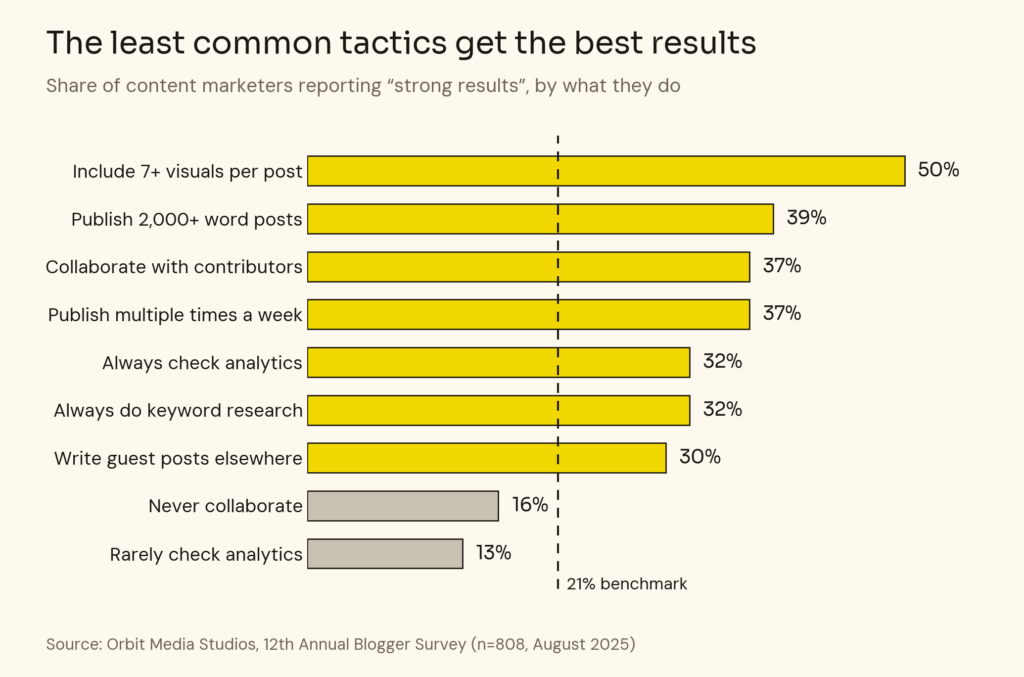
This is the most useful chart in content marketing, and almost nobody acts on it. Benchmark for “strong results” is 21%.
| What you do | Report strong results |
|---|---|
| Publish 2,000+ word posts | 39% |
| Collaborate with influencers regularly | 37% |
| Publish multiple times per week | 37% |
| Always check analytics | 32% |
| Always do keyword research | 32% |
| Include 7+ visuals per post | 50% |
| Write guest posts elsewhere | 30% |
| Never collaborate with influencers | 16% |
| Never or rarely check analytics | 13% |
- Only 4% of marketers include seven or more visuals per post. They are the single highest-performing group in the dataset at 50%.
- 45% never collaborate with influencers or contributors. Those who usually or always do report strong results more than twice as often.
- 49% now publish original research, up from 25% in 2018.
- 63% name “attracting visitors from search” as their top challenge, up sharply. Reader engagement is second at 56%.
What this means for you: the highest-performing tactics are the least common ones. Long posts, expert quotes, heavy visuals, guest posting, checking your analytics. None of it is a secret. It is just harder than publishing another 900-word how-to. A tight content brief is where most of this gets decided.
AI in content production
Adoption is basically complete. Results are not.
- 95% of B2B organisations use AI-powered marketing applications. (CMI)
- 89% of those use AI for generating or optimising written content. Creative assets follow at 53%, SEO tools at 41%.
- The share of content marketers using no AI at all fell from 65% to 5% in 24 months. (Orbit Media)
- 80% of marketers use AI for content creation, 75% for media production. (HubSpot 2026)
What AI is and is not improving
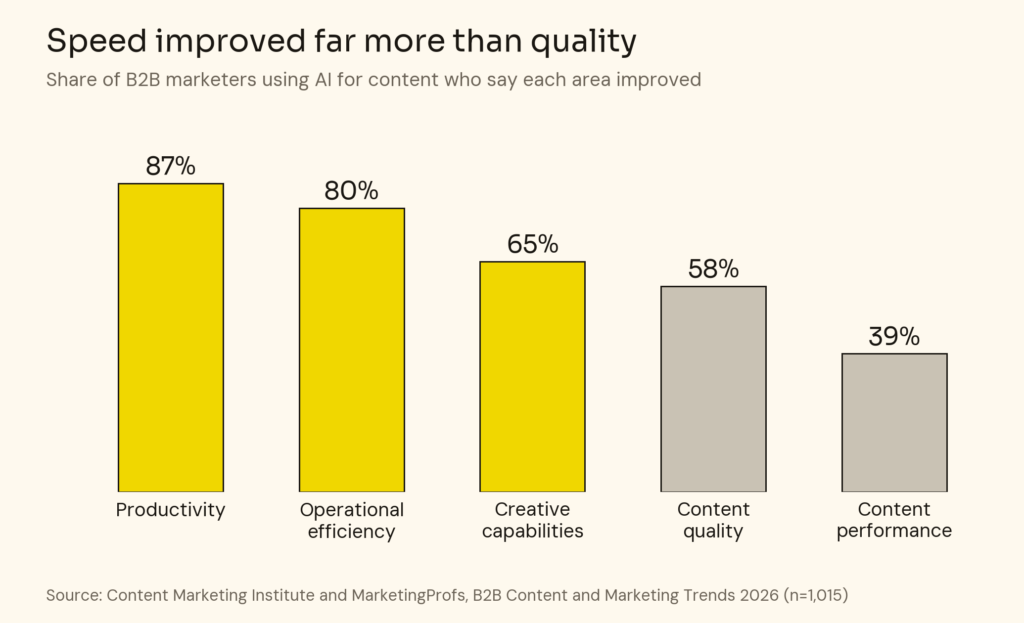
Among B2B marketers using AI for content creation (CMI):
| Area | Say it improved |
|---|---|
| Productivity | 87% |
| Operational efficiency | 80% |
| Creative capabilities | 65% |
| Content quality | 58% |
| Content performance | 39% |
- 12% say AI made their content quality worse.
- Only 39% report better content performance, and 22% still say it is too early to tell.
- Just one in ten marketers use AI to write complete articles, and that group reports the weakest results of any AI use case. (Orbit Media)
- Marketers who use no AI at all report strong results only 15% of the time, below the 21% benchmark. The answer sits in the middle.
- Position 1 on Google is 80.5% likely to be human-written and 10% likely to be AI-generated. From position 5 down, the gap narrows a lot. (Semrush, 42,000 blog pages, GPTZero classification)
- 72% of SEOs believe AI content ranks as well as or better than human content. The ranking data disagrees only at the very top.
- 28% of B2B marketers are experimenting with AI agents. Only 3% call agents core to their strategy.
What this means for you: AI helps you type faster. It does not help you think better, and the data at position one says the difference still shows. If you are picking tools, we compared the AI writing tools that actually work for B2B SaaS.
Search, AI search, and where traffic went
- 96.55% of pages get zero traffic from Google. Ahrefs studied roughly 14 billion pages in its Content Explorer index. (Ahrefs)
- Around 30% of marketers report declining search traffic as buyers shift to AI tools. (HubSpot 2026)
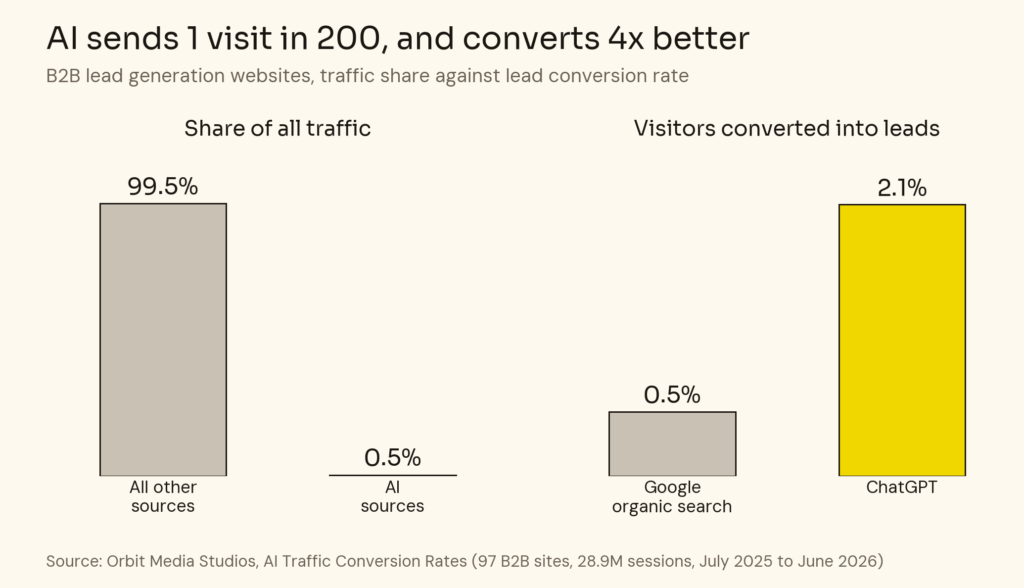
- AI referrals make up 0.5% of traffic to B2B sites. One visit in 200. (Orbit Media, 97 sites, 28.9M sessions, July 2025 to June 2026)
- Those visitors convert into leads 3x more often than other organic traffic. On a per-site median basis, 7x.
- ChatGPT converts 2.1% of its referred visitors into leads. Google organic converts 0.5%. Google still sends about 100x more traffic.
- ChatGPT accounts for 82.3% of AI-referred sessions to B2B sites.
- Case study pages had the highest conversion rate from AI traffic. Blog posts drew the most AI traffic.
- 92% of marketers already do or plan to optimise for both traditional and AI search. (HubSpot 2026)
For the deeper cut on zero-click search, AI Overviews and citation behaviour, we keep a separate set of verified AI SEO statistics. This section only covers the content-side numbers.
Formats: video, email, and case studies
- The top three ROI-driving content formats are all video: short-form (49%), long-form (29%), live-streaming (25%). (HubSpot 2026)
- Blog posts were the third most-used format at 38%, up from fourth place last year.
- Small businesses are 23% more likely than average to see ROI from blog posts.
- 91% of businesses use video as a marketing tool. 93% call it important to their strategy. (Wyzowl 2026)
- 82% of video marketers say video gives good ROI, down 11 points year over year.
- 51% say the optimal video length is 30 to 60 seconds. 91% say under two minutes.
- Email marketing returns around $36 for every $1 spent, the highest of any channel Litmus benchmarks. (Litmus)
- 35% of marketing leaders report a return between $10 and $36 per dollar. Treat the average as directional, since these are self-reported.
- 22% of marketers name email a top ROI channel, placing it fifth behind website/blog/SEO, paid social, organic social and social shopping. (HubSpot 2026)
- Email newsletters are the second most effective thought leadership channel at 54%. (CMI)
If newsletters are where you want to put that effort, our B2B newsletter templates cover which format fits which goal.
Personalisation and ABM
- 89% of B2B organisations personalise content. 59% describe it as basic, meaning one or two channels with minimal integration. (CMI)
- Only 6% call their personalisation extensive or comprehensive.
- 85% personalise email. Only 28% personalise content marketing. Video sits at 15%.
- 93% of marketers say personalisation improves leads or purchases. (HubSpot 2026)
- 51% of B2B marketers use neither ABM nor ABX. 30% use ABM only. 19% use both. (CMI)
- 65% of ABM users say it outperforms traditional campaigns.
Content marketing teams and roles
- “Writing” as a listed requirement fell 28% in execution-level content roles since 2023. “Content creation” rose 209%. (Semrush, 8,000 US job listings)
- Storytelling now appears in 29% of senior content postings, up from 8% in 2023.
- SEO appears in 20% of senior listings and 28% of non-senior roles. It stopped being a specialist skill.
- Analytics appears in 40% of leadership listings.
- “Content producer” listings grew 1,261%. “Content creator” grew 410%. Together they make up 34% of the market Semrush analysed.
What this means for you: the job is splitting into hands-on multimedia production and senior ownership of visibility and revenue. The middle, where “writer” used to sit, is thinning out.
How to actually use these numbers
Five moves, ordered by how fast they pay off.
1. Stop reporting on volume. 40% of B2B marketers name “creating content that prompts action” as their top challenge, and 33% cannot measure effectiveness at all. Those are the same problem. Pick one business metric per content type before your next planning cycle.
2. Do the uncommon things. Long posts, seven or more visuals, contributor quotes, guest posts, original research. Every one of them beats the 21% benchmark. Every one of them is used by a minority of teams. That is not a coincidence.
3. Write for the shortlist, not the funnel. 94% of buying groups picked a favourite before contacting you. Comparison pages, case studies and pricing content do more work than another top-of-funnel explainer. Case studies had the highest AI-referral conversion rate in Orbit’s dataset.
4. Use AI in the middle of the workflow. Full-AI and no-AI are the two worst-performing groups in the Orbit data, and human-written pages are 8x more likely to hold position one. Use it for ideation, outlines and editing. Keep the thinking.
5. Get more of your company into the content. 37% of organisations have fewer than 5% of their experts contributing. Buyers say thought leadership beats your marketing materials at demonstrating value. Your subject-matter experts are the asset you are not using.
If you would rather turn this into a repeatable system than a one-off push, we wrote up how to build a SaaS content engine and a content calendar that maps to pipeline. Unfamiliar terms in this piece are defined in our content marketing glossary.
A note on the data
Read this before you screenshot anything.
- Most of these are self-reported surveys. Marketers reporting their own effectiveness is not the same as measured effectiveness. Treat CMI, HubSpot, Orbit Media and Litmus figures as sentiment with a number attached.
- Sample bases differ a lot. Orbit Media’s 808 respondents skew toward the author’s LinkedIn network and US B2B marketers. CMI’s 1,015 skew North American. 6sense surveyed buyers, not marketers, which is why its numbers feel less flattering.
- Correlation is not causation. Orbit Media’s “strong results” correlations show what successful marketers do. They do not prove that doing it makes you successful. Teams with more budget can afford long posts and lots of visuals.
- AI detection is imperfect. Semrush used GPTZero to classify 42,000 pages. AI detectors misclassify in both directions. The direction of the finding is more reliable than the exact percentage.
- Several of these studies come from companies selling the thing they measured. Semrush sells SEO software. HubSpot sells marketing software. Litmus sells email tools. The samples are disclosed, which is why they are here, but the framing serves the vendor.
- When two sources disagree, quote the range and name both. Gartner says 7.8% of revenue on marketing. The CMO Survey says 9.0%. Neither is wrong. They surveyed different companies.
Sources
- Content Marketing Institute and MarketingProfs, B2B Content and Marketing Trends: Insights for 2026 (16th annual survey, fielded June to August 2025, n=1,015 B2B marketers)
- Orbit Media Studios, 12th Annual Blogger Survey (fielded August 2025, n=808 content marketers)
- Orbit Media Studios, AI Traffic Conversion Rates (97 B2B sites, 28.9M sessions, July 2025 to June 2026)
- HubSpot, State of Marketing Report 2026 (n=3,400+ marketers globally)
- 6sense, 2025 B2B Buyer Experience Report (n=4,000+ buyers across North America, EMEA and APAC)
- Edelman and LinkedIn, 2025 B2B Thought Leadership Impact Report (n=1,934 management-level professionals, 7 markets, fielded March to April 2025)
- Edelman, The Rise of the Hidden Buyer (analysis of the 2025 report)
- Semrush, Does AI content rank well in search? (42,000 blog pages from 20,000 keywords, November 2025)
- Semrush, 8,000 Content Marketing Job Listings analysis (US listings, 2026)
- Ahrefs, 96.55% of Content Gets No Traffic From Google (~14 billion pages)
- Gartner, 2026 CMO Spend Survey (n=401 CMOs, fielded January to March 2026)
- Chief Marketer coverage of the Gartner 2026 CMO Spend Survey
- Litmus, The ROI of Email Marketing (State of Email survey)
- Wyzowl, State of Video Marketing 2026

Rashmita is content marketer with 8 years of experience building and growing SaaS brands. Now she tests various AI tools for marketers and shares her feedback on this blog, LinkedIn, Instagram, and YouTube.