What is GEO and Does It Matter for SaaS?
Someone searches Google, gets an AI Overview summarizing the answer, and never clicks through to a single website. Someone else asks ChatGPT to compare project management tools, gets three recommendations, and books a demo with one of them without ever typing a query into Google. Neither of these buyers showed up in your analytics. Neither clicked an ad. Neither saw your carefully optimized blog post rank in position three. Both are the reason marketing teams keep asking the same question: what is GEO, and does it deserve any of next quarter’s budget?
This is the gap GEO for SaaS is built to close. Search has not disappeared. It has split into two systems running in parallel: the search engine results page most SEO strategy was built for, and an answer layer sitting on top of it that increasingly decides what buyers see before they ever reach a results page at all.
This article covers what GEO actually is, how it differs from SEO, and whether it deserves a place in your content strategy this year, not as theory, but as a practical answer for a B2B SaaS team deciding where to put the next quarter of budget.
What is GEO actually?
Generative Engine Optimization, or GEO, is the practice of structuring content so AI systems like ChatGPT, Claude, Perplexity, and Google AI Overviews actually retrieve, cite, and recommend your brand when they answer a question.
The term comes from a 2024 academic paper by researchers at Princeton, Georgia Tech, and IIT Delhi, who tested optimization strategies across 10,000 queries and measured the visibility lift. It has since become standard vocabulary in B2B marketing, alongside near-synonyms like AEO (answer engine optimization) and LLMO (large language model optimization). The industry has not settled on one term yet. All of them point at the same goal: getting an AI system to mention your brand in its answer, though the distinctions people draw between GEO, AEO and SEO are thinner than most explainers make them sound.
Here is what actually changes mechanically when you move from traditional search to an AI engine:
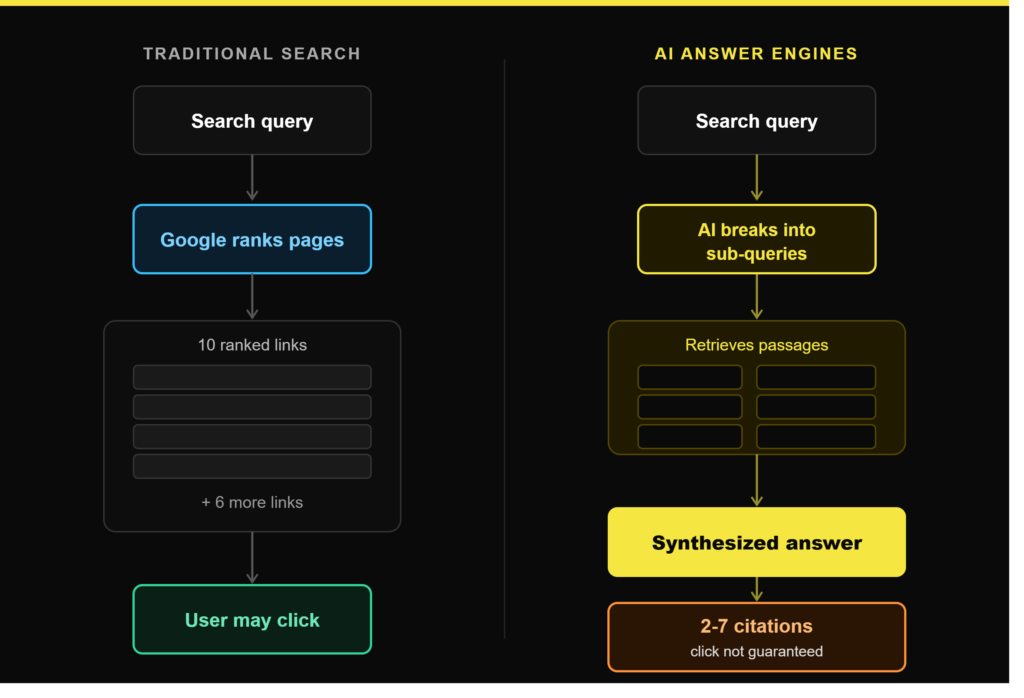
- Traditional search (Google): ranks full pages and hands you a list of links to choose from.
- AI answer engines: break your question into smaller sub-questions, pull relevant passages from multiple sources, stitch those passages into one written answer, and cite two to seven sources inside that answer.
The practical shift is this: your content is no longer competing to be the single best page on a topic. It is competing to be one well-structured passage an AI model finds useful enough to quote or paraphrase.
That is also why the old SEO playbook, keyword density and backlink volume, does not automatically transfer here. Different retrieval mechanism, different target to optimize for.
GEO versus SEO: where they overlap and where they diverge
GEO is not a replacement for SEO. It is a layer built on top of strong SEO fundamentals, and the two share more DNA than most framing suggests.
What still matters for both: technical crawlability, fast load times, mobile responsiveness, genuine topical authority, and content quality that goes beyond surface-level coverage of a subject. A site with thin content and a weak technical foundation will struggle in both systems for the same underlying reason. AI engines, like search engines, still favor sites that demonstrate real expertise through a connected body of work, not a single keyword-stuffed page.
What diverges:
- SEO optimizes for ranking position and click-through. GEO optimizes for inclusion in a generated answer, where the user may never click at all.
- SEO rewards comprehensive long-form pages. GEO rewards content broken into self-contained passages, each one able to stand alone as a complete answer to a specific question, because that is the unit AI retrieval systems actually pull from.
- SEO has one dominant gatekeeper in Google. GEO has at least four meaningfully different ones, ChatGPT, Perplexity, Google AI Overviews, and Claude, each with different retrieval behavior and different content preferences.
That last point is the one most SaaS teams underestimate. Optimizing only for Google AI Overviews while ignoring how Perplexity or ChatGPT actually retrieve content is a half-strategy dressed up as a complete one.
Does GEO actually matter for SaaS specifically?
Three numbers make the case more concretely than any general framing about the future of search.
- Search volume itself is shrinking, on a dated timeline. Gartner predicts traditional search engine volume will drop 25% by 2026 as AI chatbots and virtual agents become substitute answer engines. That is not a distant trend. It is the current year.
- AI-referred buyers convert differently. AI-referred visitors have been documented converting at meaningfully higher rates than standard organic traffic across multiple SaaS case studies, largely because someone who asked an AI to compare vendors has already moved past the awareness stage. They are not browsing. They are evaluating a shortlist.
- Ranking on Google no longer guarantees AI visibility. Research from GEO firm Brandlight found the overlap between top Google links and AI-cited sources has fallen from roughly 70% to below 20%. These are increasingly separate competitions with separate winners.
For a B2B SaaS company specifically, the practical risk is sharper than for most industries. SaaS buying decisions involve comparison by nature, alternatives, integrations, pricing tiers, feature trade-offs, exactly the kind of structured, comparative query an AI engine is built to answer well. If your brand does not appear when an AI tool is asked to shortlist options in your category, a real share of in-market buyers will form their first impression of the market without ever knowing you exist.
What GEO actually looks like in practice
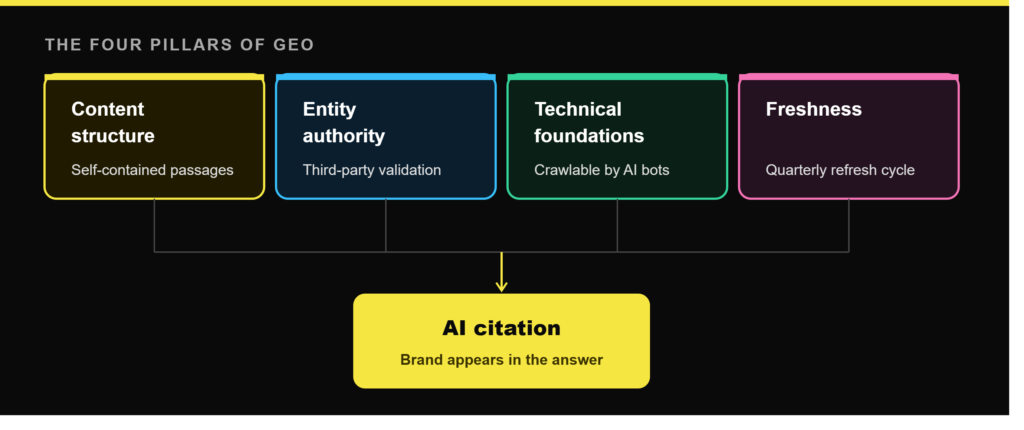
Four areas carry most of the weight: content structure, entity authority, technical foundations, and freshness.
Content structured for retrieval, not just reading
AI engines break pages into passages and evaluate each one independently. A page with one strong introduction and a weak middle does not survive that process the way it might survive a human skimming for the gist. Every section needs to function as a self-contained answer: a direct response to a specific question near the top of the section, followed by supporting detail. This is a structural discipline, not a stylistic preference, and it connects directly to how a proper content brief should be built before a word gets written: knowing the specific question a section answers, not just the broad topic it covers. The questions worth answering still start with real keyword and intent research; the best keyword research tools remain useful here, just pointed at conversational and comparative phrasing rather than short head terms.
Entity authority and third-party validation
AI systems triangulate. They do not rely on your own site as the only signal of whether your brand is a credible answer to a category question. Consistent, accurate information about your brand across third-party sources strengthens the case that an AI model should trust and cite you, though the weighting is far from even: Reddit, LinkedIn and YouTube rank among the most-cited domains, while G2 and Capterra earn fewer citations than the standard advice implies. A brand that only exists on its own blog, with no outside validation, gives an AI system little reason to recommend it over a competitor with a denser footprint across the web.
Technical foundations AI crawlers actually need
This is the most common and most fixable failure point. Many sites unknowingly block AI crawlers in their robots.txt file, sometimes without realizing a CDN or hosting default changed at some point and started rejecting bot traffic that used to be allowed through. If GPTBot or similar crawlers cannot reach your content, no amount of editorial quality matters. This is worth a direct technical check before investing in content structure changes: confirm your robots.txt file is not silently blocking the systems you are trying to get cited by. Access is only half of it, though. Even on pages a crawler can reach, AI crawlers render JavaScript far less than Google does, so content that loads client-side can be invisible to ChatGPT while looking perfectly fine to you.
Freshness, more aggressively than SEO ever demanded
AI retrieval systems weight recency more heavily than traditional search ranking does, particularly for fast-moving categories like SaaS tooling. A guide last updated two years ago loses ground to a competitor’s version updated last month, even if the original was originally more comprehensive. A quarterly refresh cycle on cornerstone content is closer to the minimum than the ideal.
How GEO connects to what your content strategy is already doing
If your team has already invested in topical authority, structured around clusters rather than scattered keyword targets, you are closer to GEO-ready than a team starting from zero. The underlying logic is the same: depth and connected coverage of a subject signal real expertise, to a search algorithm and to an AI retrieval system alike.
The same is true of a well-built B2B SaaS content calendar that maps content to buyer questions at specific funnel stages rather than publishing on a generic schedule. AI engines retrieve content because it answers a specific question well. A content program already built around answering specific buyer questions, rather than chasing keyword volume, has a structural head start.
This is also where a documented SaaS content engine earns its keep. A team publishing without a repeatable system tends to produce content in bursts, which works against the freshness signal GEO weighs heavily. A real engine, with defined workflows for research, drafting, and refresh cycles, makes the quarterly update cadence GEO demands sustainable instead of aspirational. The same discipline shows up in executive ghostwriting programs built around search intent: founder content written to answer a real buyer question, not just to fill a publishing slot, is already structured closer to what AI retrieval systems reward.
What changes is the execution layer on top: passage-level structure, freshness discipline, and a wider definition of where your brand needs to show up beyond your own domain.
Where teams get GEO wrong
A few mistakes show up repeatedly across SaaS teams starting GEO work.
- Treating GEO as a separate initiative from SEO, run by a different person with a different content plan, rather than a layer added to existing fundamentals. The two should run from the same content strategy, not compete for separate budget lines.
- Optimizing for one AI platform and assuming the work transfers. Google AI Overviews, ChatGPT, Perplexity, and Claude each have meaningfully different retrieval behavior. A strategy built entirely around ranking well in Google’s AI Overview will not automatically translate into Perplexity citations, which rely more heavily on live web retrieval and tend to reward different signals.
- Publishing once and treating the page as finished. Set-it-and-forget-it content underperforms in GEO more severely than it does in traditional SEO, because freshness is weighted more heavily in how AI retrieval systems select sources.
- Treating every third-party platform as equally valuable. A content strategy that lives only on your own domain, with no presence on review sites or community platforms where your category gets discussed, is missing the validation signals AI systems use to decide whether to trust a source. The opposite error is just as common, though: spreading effort evenly across every platform when the citation data splits sharply between them, by engine and by query type.
So, does it matter for SaaS in 2026?
Yes, with a caveat worth being honest about. GEO is not a replacement strategy. It does not mean abandoning SEO fundamentals or chasing AI citations instead of search rankings. It means recognizing that the buyer journey now includes a layer most content strategies were not originally built for, and that layer is growing while traditional search volume is documented as shrinking.
For a SaaS company with strong existing SEO fundamentals, topical authority, technical health, genuine expertise, GEO is largely an extension of work already underway: restructure for passage-level retrieval, strengthen third-party presence, tighten the freshness cycle. For a company starting from a thin or scattered content base, the honest answer is to fix the SEO foundation first. GEO built on top of weak fundamentals does not solve the underlying problem; it just adds a second optimization target to a content strategy that was not working in the first place.
The buyers asking AI tools to shortlist vendors in your category are not a future hypothetical. They are doing it this quarter. The only real question is whether your brand is one of the names that comes back.
Want a content strategy built for both search engines and AI answer engines?

Jay is the co-founder of LymLyt and an AI partnership consultant helping B2B SaaS companies grow through content strategy, SEO, and AI integration. He writes about content marketing, what makes B2B content convert, and how SaaS teams can build content systems that drive real pipeline.