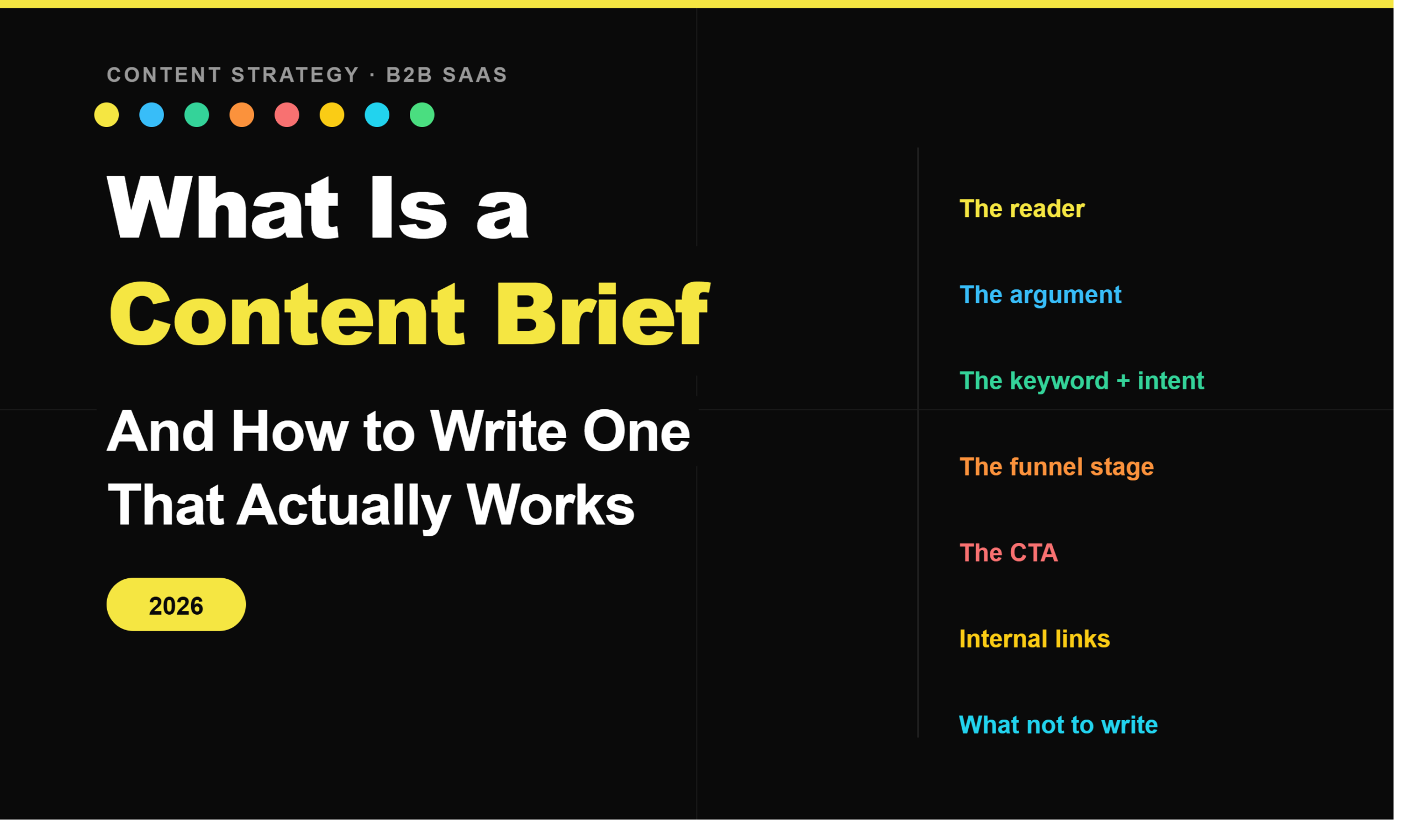
What Is a Content Brief (And How to Write One That Doesn’t Waste Your Writer’s Time)
A content brief is the document that determines whether your writer nails the piece or misses it entirely. Most marketers write bad ones without realising it, not because they are careless, but because no one ever showed them what a good content brief actually contains. The result is a draft that comes back wrong, a round of revisions that should not have been necessary, and a slow creeping suspicion that the writer is the problem.
They probably were not.
The brief was.
This is not a knock on marketers. Most people writing content briefs were never taught how. They were handed a template, told to fill it in, and left to figure out the rest. The result is a document that looks complete but transfers almost nothing. The writer gets a keyword, a word count, and a vague reader description. They fill in the rest with assumptions. And assumptions are exactly where B2B content goes wrong, which is part of why most B2B blogs miss the mark even when the writing itself is technically fine.
Here is what a content brief actually is, why most of them do not work, and how to write one that gives your writer what they actually need.
What a Content Brief Actually Is (and What It Isn’t)
A content brief is a document that transfers context from the person who knows the goal to the person who has to execute it.
That’s it. Not a creative constraint. Not a word-count cage. Not a checklist that proves you planned ahead. A transfer of context.
The marketer commissioning a piece of content knows things the writer doesn’t. They know who the reader is, what the company has already said about this topic, what the sales team is hearing on calls, what the CTA needs to be, and what angle would be wrong for the brand even if it’s technically accurate. None of that information lives in the writer’s head. The brief is how it gets there.
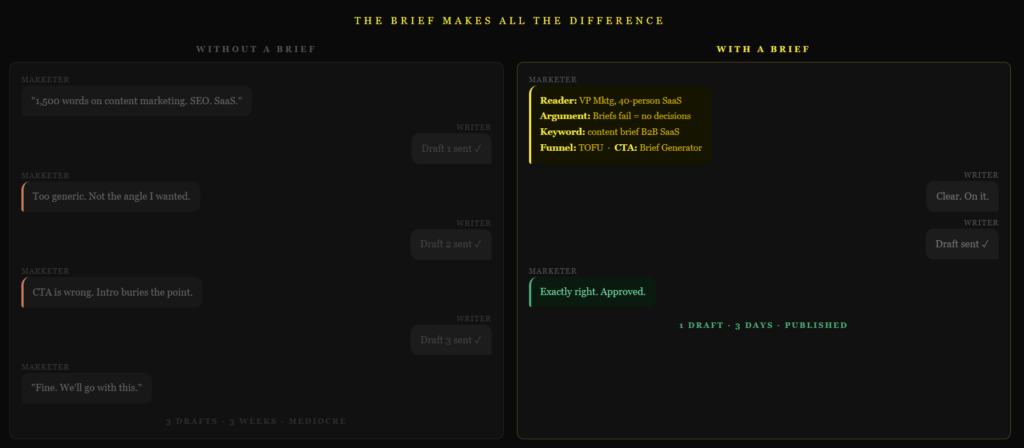
Without a brief, the writer makes decisions about all of those things by default. Some of those decisions will be fine. Some won’t. And you won’t know which until the draft lands.
There’s also a confusion worth clearing up: a content brief is not an outline. An outline tells the writer what to say and in what order. A brief tells the writer why this piece exists at all: who it’s for, what it’s trying to do, and what it needs to believe to be worth reading. The outline comes after the brief. If you’re writing both, the brief is still doing the more important job.
Why Most Content Briefs Do Not Work
There are a few patterns that show up constantly in a bad content brief. They do not look like problems until the draft comes back wrong.
1. The brief is too short
“Topic: email marketing best practices, 1500 words, SEO-optimized” is a topic, not a brief. There is no reader, no argument, no context about what makes this piece different from the 200 other posts on email marketing that already exist. The writer will produce something technically correct and completely generic. That is not a failure of craft. It is a predictable outcome of the information they were given.
2. The brief is too long, but the important parts are missing
Four pages of brand voice guidelines, formatting rules, and tone examples. And somehow no clear sense of who the reader is or what the post is trying to argue. Length creates the impression of thoroughness. It is not the same thing. A brief that runs long on process and short on strategy will produce content that is on-brand and off-point.
3. The brief lists fields but does not fill them with decisions
“Target audience: B2B SaaS marketers” is a segment. It is not a reader. It tells the writer nothing about what this particular person is struggling with, what they already know, or what would make them feel like this post was written specifically for them. Weak briefs use labels. Strong briefs use specifics. This is probably the most common content marketing mistake that teams do not realise they are making. Not that the content is bad, but that the brief never gave it a chance.
4. The brief is written for the search engine, not for a human
The keyword is there. The word count is there. The H2s are sometimes there. But there is no argument. No point of view. No answer to the question: why would someone read this specific post instead of the forty others ranking for the same term? If the brief does not answer that, the content cannot. It will rank for a while, maybe, and convert nobody.
What a Good Content Brief Actually Includes
The fields matter less than the decisions inside them. Here’s what should be in every content brief, and what separates a weak version from one that actually works.
1. The reader: specific, not a label
A reader description should let the writer picture a person: their role, their company size, what they are struggling with right now, and why they searched for this topic today. “B2B SaaS marketers” is a segment. “The marketing manager at a 40-person SaaS company who just got burned by their first freelance writer and is trying to figure out what they did wrong” is a reader. When the writer can picture that person, they write to them. When they cannot, they write to everyone, which means no one. This is the same logic behind writing for your ICP rather than a broad audience. The brief is where that specificity has to start.
2. The argument: not the topic, the thesis
The brief should include one sentence that states the claim the post is making. If you cannot write that sentence, the post does not have an argument yet. A post about content briefs that just explains what goes in one is not arguing anything. A post that argues “most briefs fail because they transfer information instead of decisions” has a thesis, and a thesis gives the writer something to build toward instead of just fill space around.
3. The keyword: and what it tells you about intent
The primary keyword is not just for SEO. It is a signal about what the reader thinks they are looking for. Someone searching “content brief template” wants something to download. Someone searching “why is my content not converting” is in a different mindset entirely. The brief should include the keyword and a note on what it tells you about where the reader is, because that shapes the tone, the depth, and how quickly the post needs to get to the point. Good SEO writing starts with understanding intent, not just inserting terms.
4. The funnel stage
TOFU, MOFU, BOFU. It sounds like jargon but it determines a lot: the CTA, how much the post should pitch versus educate, and what a win looks like for this piece. A TOFU post that ends with “book a demo” is jarring. A BOFU post that spends three sections defining basic concepts is wasting the reader’s time. The funnel stage tells the writer how close the reader is to buying and how much to press. If you are not sure how to think about this, the SaaS content funnel guide breaks down exactly what content belongs at each stage and why.
5. The CTA: specific, not decorative
“Learn more” is not a CTA. “Download the brief template” is a CTA. “Book a 30-minute call to talk through your content strategy” is a CTA. It should be one thing, not three. Writers cannot make this decision for you. They do not know whether you are trying to grow an email list, drive demo requests, or push traffic to a specific service page. You do. Put it in the brief.
6. Internal links to include
Most briefs skip this entirely, which is one of the main reasons building a real SaaS content engine is harder than it should be. Every new post is an opportunity to pass authority to existing posts, but only if the writer knows which ones exist and where they fit. Include 3 to 5 URLs with notes on where they should appear naturally. This is also how you build topical authority over time: not by publishing more, but by connecting what you publish into a coherent cluster. A well-planned B2B SaaS content calendar makes this step significantly easier because the internal link structure is mapped before writing begins.
7. What not to write
What angle are you deliberately avoiding? What has a competitor already covered so thoroughly that you are not trying to beat it? What would feel off-brand even if it is technically on-topic? This field saves revision cycles. The writer cannot avoid a direction they do not know you have ruled out.
8. Competing posts to reference
Not to copy. To understand the landscape. Include 2 to 3 URLs that currently rank for your target keyword, with a note on what they do well and where they fall short. The writer’s job is to fill the gap, not duplicate what already exists.
Agency vs. Freelancer: How the Brief Changes
If you are working with an agency, you do not need to write a complete brief from scratch. A good agency will handle the structural pieces: keyword research, H2 structure, competitive analysis, word count guidance. What you need to bring is the strategic context they cannot research: who the reader is, what the company’s position on this topic is, what the CTA should be, and what would feel wrong even if it looked right on paper.
The brief you write for an agency is a strategy handoff. The brief you write for a freelancer is more operational. It needs to be complete, because there is no account manager translating between you. Every assumption that stays in your head becomes a decision the freelancer makes alone.
Either way, one thing stays true: the brief is yours. The writer executes it. If the content comes back wrong, the brief missed something first. That is not blame. It is just a cleaner way to diagnose the problem and fix it faster.
How to Write a Content Brief in Under 20 Minutes
A brief should be one page. Two at most. If it is running longer than that, something is being described that should have been decided. Long briefs often mean the person writing them has not fully figured out what they want yet. They are using the brief to think, which is fine as a drafting process, but the writer should not receive that draft.
Here is the order that works:
Start with the keyword. Not because SEO comes first, but because the keyword forces you to be specific about the question this post is answering. Write down the primary term and two or three secondary terms. Then write one sentence about what someone who searches that term is actually trying to figure out.
Then write the reader. One specific person. Role, company size, what is frustrating them right now.
Then write the argument. One sentence. What does this post believe?
Then funnel stage, CTA, internal links, what not to write. In that order.
The whole thing should take 15 to 20 minutes if you know your content strategy. If it takes longer, the delay is usually in the argument, which means the post is not ready to be written yet. Tracking which posts you have briefed, at which funnel stage, and for which keyword cluster is exactly what a B2B SaaS content calendar is built to handle. If that system does not exist yet, the brief process will always feel harder than it should.
If you want to skip the blank page entirely, LymLyt’s free Brief Generator walks you through every field and assembles the document as you go. It takes a few minutes and gives you something a writer can actually use. Try it before the next piece you commission.
The next time a piece of content comes back wrong, do one thing before you leave a comment in the doc: read the brief you sent.
The answer is usually there. Or rather, the gap is.
LymLyt is a blog, SEO content, and landing page writing agency for B2B SaaS. If you are working with writers and tired of content that almost lands, let’s talk.

Jay is the co-founder of LymLyt and an AI partnership consultant helping B2B SaaS companies grow through content strategy, SEO, and AI integration. He writes about content marketing, what makes B2B content convert, and how SaaS teams can build content systems that drive real pipeline.