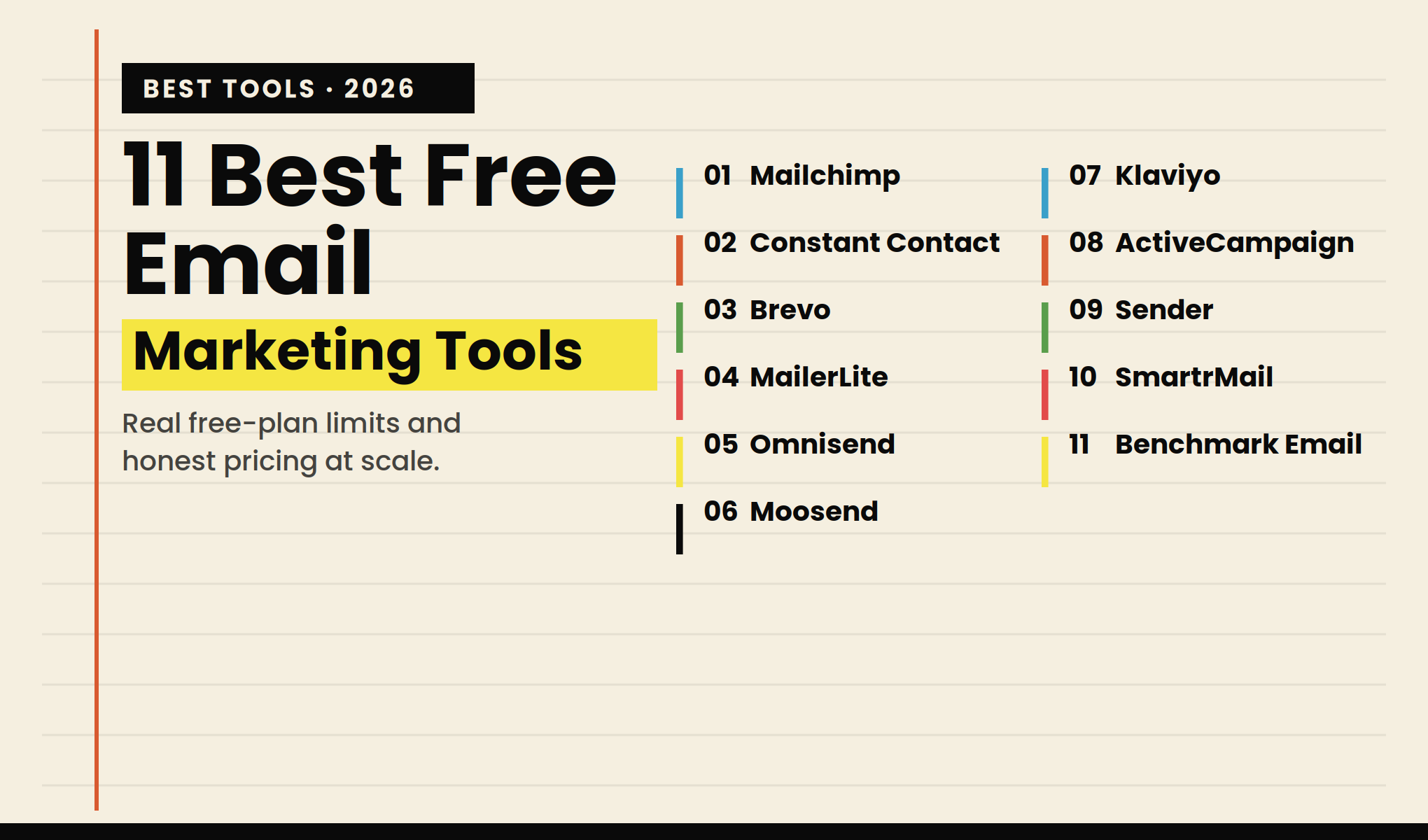
11 Best Free Email Marketing Tools in 2026
Email still returns more per dollar than almost any other marketing channel, and free email marketing tools are the cheapest way to prove that out before committing real budget. The catch is that “free” has gotten stingier across the board this year. Several of the biggest names cut their free-tier limits in 2026, so the plan that looked generous a year ago may not be anymore.
This guide covers 11 free email marketing tools worth testing in 2026, what the free plan actually includes once you read past the marketing page, and what it costs the moment you outgrow it. Every limit and price below was checked against each vendor’s current pricing page.
What to check before you pick one
Free plans in this category vary more than the marketing pages let on. Get clear on three things before you build your list on any of them.
- Contact limit versus send limit. Some tools cap how many contacts you can store. Others cap how many emails you can send each month, regardless of list size. A few cap both. Know which constraint you will hit first.
- What disappears when you upgrade. Branding removal, automation, and support windows are the most common things locked behind a paid plan. A free plan with no automation and 30 days of support is a trial with a permanent badge, not a real free tier.
- How the price scales past the free tier. The free plan tells you almost nothing about what you will pay once your list grows. Check the price at 1,000 contacts and 5,000 contacts before you commit your workflow to any one platform.
The 11 best free email marketing tools
1. Mailchimp
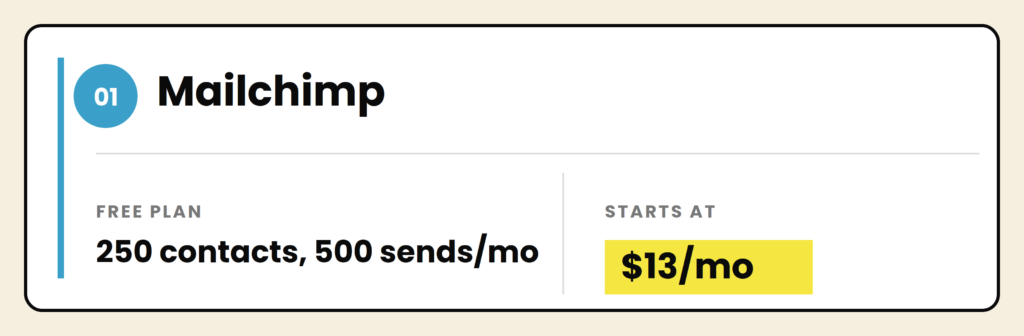
Mailchimp is still the most recognized name in email marketing, and its drag-and-drop editor remains genuinely easy for a first-time user. The free plan is not what it used to be. Mailchimp cut it twice in early 2026, and it now covers 250 contacts and 500 sends a month, down from 2,000 contacts as recently as 2022.
- Intuitive drag-and-drop editor with a wide template library
- Free plan support ends after the first 30 days, and Mailchimp branding stays on every free-tier email
- No multi-step automation on the free plan; that unlocks starting at Standard
- Bills for unsubscribed and non-subscribed contacts, so your real contact count is often higher than expected
Price: Free plan covers 250 contacts and 500 monthly sends, no automation. Essentials starts at $13 a month for 500 contacts, Standard at $20 a month, and Premium at $350 a month for 10,000 contacts.
Best for: Freelancers and very small teams sending occasional newsletters who want the most recognizable interface to start with.
Skip it if: You need real automation on a free budget, or a list past a few hundred contacts. The free tier no longer supports either.
2. Constant Contact
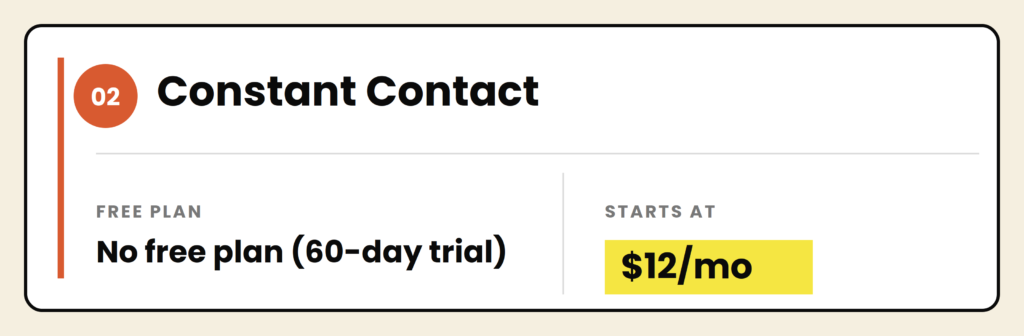
Constant Contact is one of the oldest names in email marketing, built around step-by-step guidance and strong live support rather than advanced automation. There is no permanent free plan, only a 60-day trial capped at 100 contacts, so budget for a paid plan from day one if you go this route.
- Beginner-friendly interface with genuinely helpful onboarding
- Built-in event management, RSVP tools, and social media posting
- Strong live chat and phone support, unusual for this price range
- Automation and advanced segmentation stay basic until the Standard tier and above
Price: No free plan. 60-day trial with up to 100 contacts. Lite starts at $12 a month for 500 contacts, Standard at $35 a month, Premium at $80 a month with custom pricing above that.
Best for: Small local businesses, nonprofits, and community organizations that value support over advanced automation.
Skip it if: You want to test the platform without a time limit. Every other tool on this list has a real free tier; Constant Contact does not.
3. Brevo
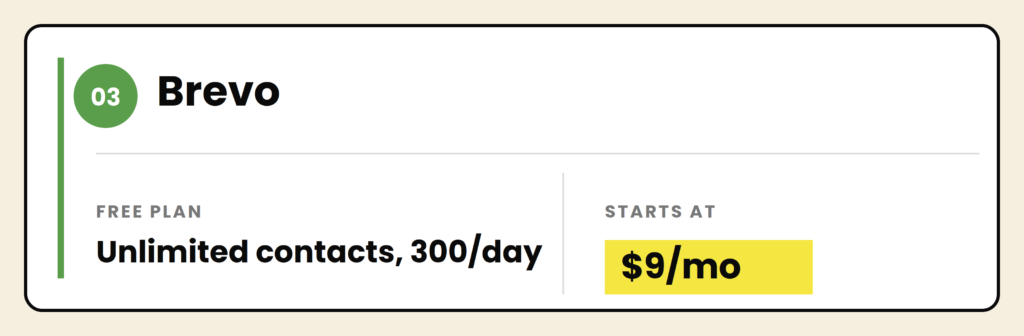
Brevo, formerly Sendinblue, prices by email volume sent rather than contacts stored, which makes its free plan genuinely useful for a large list that emails infrequently. It bundles email, SMS, chat, and a basic CRM into one platform, and the free tier includes unlimited contacts with a 300-email-a-day cap.
- Unlimited contact storage on every plan, including free, since pricing is volume-based
- Transactional email support for receipts and order confirmations built in
- Marketing automation available starting on the entry paid tier, not locked to the top
- Template editor feels less polished than Mailchimp’s, and reporting is basic on lower plans
Price: Free plan includes unlimited contacts with 300 emails a day. Starter runs about $9 a month for 5,000 emails, Business about $18 a month. Enterprise is custom priced.
Best for: Teams with a large contact list who send infrequently, or anyone who wants email, SMS, and CRM in one platform.
Skip it if: You need polished templates and advanced reporting out of the box. Both are stronger on Mailchimp or MailerLite.
4. MailerLite
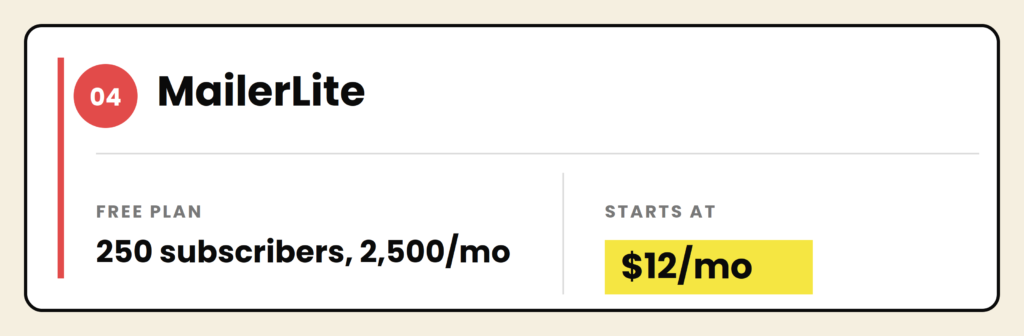
MailerLite built its reputation on a clean editor and a genuinely generous free plan, though that plan shrank in 2026 along with most of the category. It now covers 250 subscribers, 2,500 emails a month, and two user seats, down from the 1,000-subscriber tier it offered a year earlier. What it gained in the same update: custom templates, blogs, and the HTML editor moved onto the free tier.
- Clean, minimal editor that most first-time users pick up without a tutorial
- Built-in landing pages, websites, and signup forms on every plan, including free
- Automation ships on the free plan, which most competitors reserve for paid tiers
- Paid tiers (renamed Comfort and Power in mid-2026) scale by subscriber count, so a growing list raises the bill even if sending volume stays flat
Price: Free plan covers 250 subscribers, 2,500 emails a month, and 2 seats. Comfort starts at $12 a month for 500 subscribers, Power at $25 a month, with Enterprise custom above 200,000 subscribers.
Best for: Creators and small businesses who want automation and landing pages included on a free plan, not gated behind a paid one.
Skip it if: Your list is already past a few hundred contacts. The 2026 free-tier cut hit MailerLite harder than most competitors on this list.
5. Omnisend
Omnisend is built specifically for ecommerce, with deep integrations into Shopify, WooCommerce, and BigCommerce, and automation templates for cart recovery and browse abandonment out of the box. Every plan, including free, includes the full feature set; what changes between tiers is send volume and contact count, not what you can access.
- Full automation, segmentation, and reporting available even on the free plan
- Native ecommerce integrations that trigger on real store events, not just email opens
- SMS is billed separately from the core plan, so factor that in if SMS is part of your plan
- Less useful outside ecommerce; the automation library assumes a storefront behind it
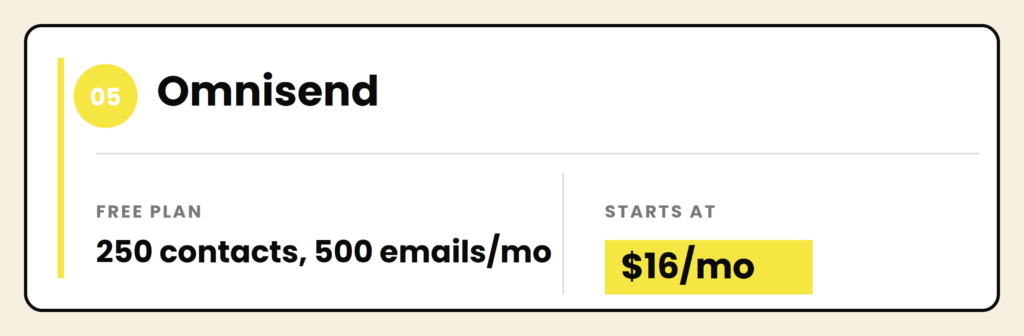
Price: Free plan covers 250 contacts and 500 emails a month. Standard starts at $16 a month for 500 contacts, Pro at $59 a month with SMS credits included.
Best for: Ecommerce brands on Shopify or WooCommerce that want cart recovery and product-recommendation automation without a separate tool.
Skip it if: You are not running an online store. Omnisend’s strongest features are wasted on a non-ecommerce newsletter.
6. Moosend
Moosend positions itself as the budget pick for teams that want real automation without Mailchimp-level pricing. Paid plans include unlimited sends regardless of tier, and the automation and segmentation tools are more capable than the price suggests, though the template library and third-party integrations are thinner than the bigger names.
- Unlimited email sends on every paid plan, not metered by volume
- Advanced automation and segmentation available even on the entry paid tier
- AI-powered product recommendations built in for ecommerce use cases
- Smaller template library and fewer integrations than Mailchimp or Brevo
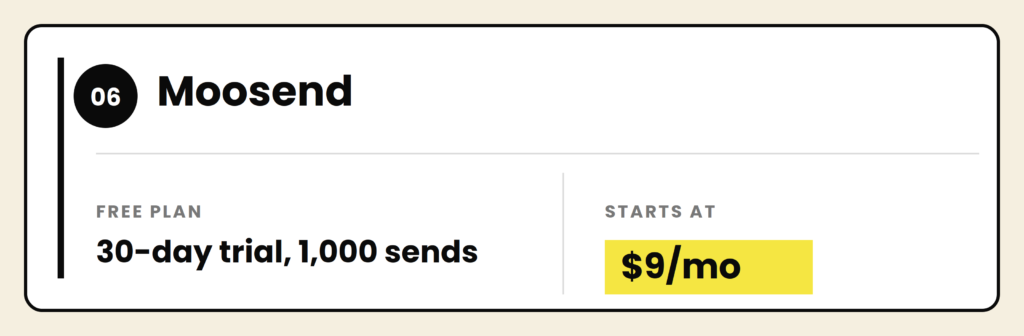
Price: 30-day free trial with full feature access and up to 1,000 sends. Pro starts around $9 a month for up to 500 subscribers with unlimited sends. Moosend+ is custom priced for larger organizations.
Best for: Budget-conscious startups that want automation depth without paying Mailchimp or ActiveCampaign prices.
Skip it if: You want a permanent free plan rather than a 30-day trial, or need a large template library to start from.
7. Klaviyo
Klaviyo is the default choice for fast-growing ecommerce and DTC brands that need deep segmentation built on real-time purchase and browsing data. Its free plan covers 250 profiles with 500 emails and 150 SMS credits a month, enough to properly test its automation before paying.
- Best-in-class Shopify, BigCommerce, and WooCommerce integrations with real-time data sync
- Unified email and SMS marketing with revenue attribution reporting built in
- Advanced automation for cart abandonment, browse abandonment, and product recommendations
- Pricing scales quickly with contact count, and the feature depth can overwhelm a first-time user
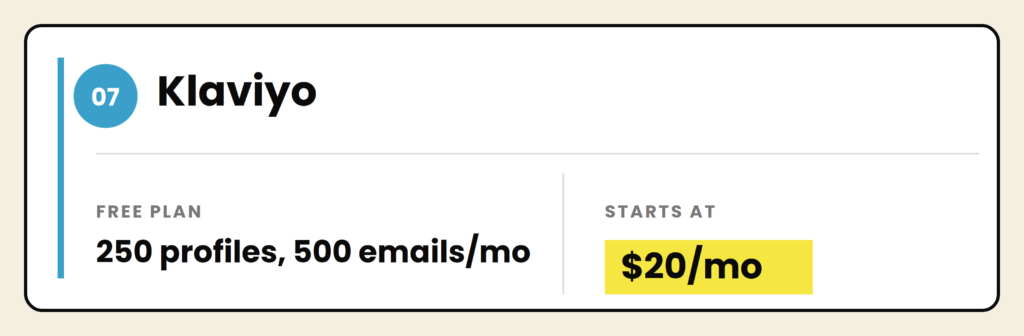
Price: Free plan covers 250 profiles, 500 emails, and 150 SMS or MMS credits a month. The Email plan starts at $20 a month for 500 contacts, Email & SMS at $35 a month, with custom Enterprise pricing above that.
Best for: Ecommerce and DTC brands that want data-driven personalization and are willing to pay for the depth that comes with it.
Skip it if: You are not ecommerce, or you want a simple tool. Klaviyo’s power is wasted on a basic newsletter program.
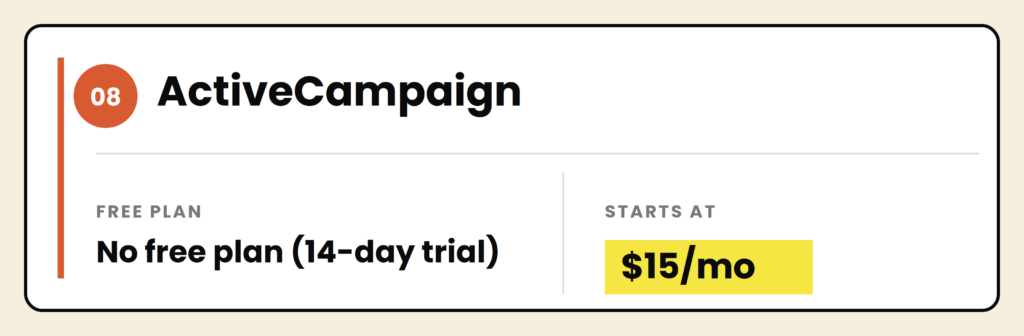
8. ActiveCampaign
ActiveCampaign pairs email marketing with a genuine CRM and sales automation, which makes it the strongest pick on this list for teams that need lead scoring and pipeline tracking alongside their campaigns. There is no permanent free plan, just a 14-day trial, but the automation builder is deep enough that B2B teams often outgrow simpler tools and land here anyway.
- Advanced automation builder that handles branching logic most competitors cannot
- Built-in CRM with sales automation and lead scoring, not a bolt-on
- Extensive integrations across ecommerce, CRM, and productivity tools
- Real learning curve, and cost climbs quickly as your contact list grows
Price: 14-day free trial, no permanent free plan. Starter begins at $15 a month for 1,000 contacts, Plus at $49 a month, Professional at $79 a month, and Enterprise from $145 a month.
Best for: B2B teams that want email marketing and a real CRM in one platform instead of stitching two tools together.
Skip it if: You want a genuinely free tier to start on, or your needs are simple newsletters without sales automation.
9. Sender
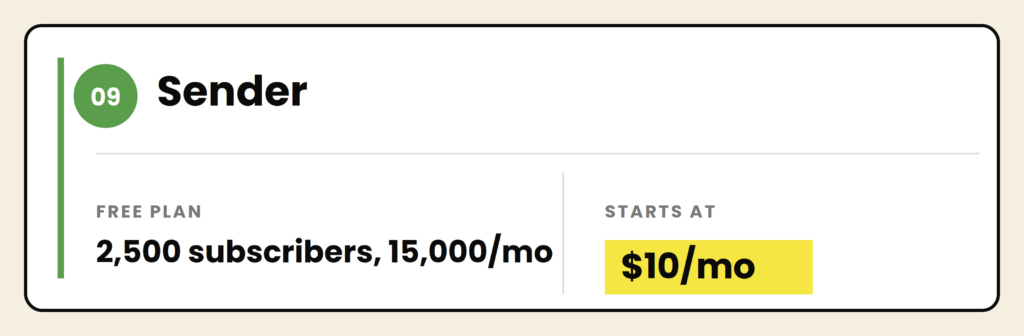
Sender is a budget email and SMS platform aimed at small businesses that want automation and segmentation without paying for features they will not use. The free plan is unusually generous for its price point, covering 2,500 subscribers and 15,000 monthly sends with automation included.
- Free plan includes automation and segmentation, not just basic sending
- SMS and web push notifications available alongside email on every tier
- Solid deliverability for the price, with a straightforward drag-and-drop editor
- Fewer integrations than the larger platforms, and reporting stays basic on entry tiers
Price: Free plan covers 2,500 subscribers and 15,000 monthly sends. Standard starts around $10 a month for 2,500 subscribers, Professional around $20 a month, with custom Enterprise pricing above that.
Best for: Freelancers and very small businesses that want automation on a genuinely free plan, not a trial with a deadline.
Skip it if: You need a wide integration library. Sender’s value is the price-to-feature ratio, not breadth of connections.
10. SmartrMail
SmartrMail is a narrower, ecommerce-only tool built for Shopify, BigCommerce, and WooCommerce stores that want product-recommendation emails and abandoned-cart flows without a steep learning curve. It lets you pick a plan tier by subscriber count from the start, rather than forcing everyone through the same free-plan funnel.
- Pre-built automations for abandoned cart, product recommendations, and post-purchase follow-ups
- Editor built around product feeds, not generic drag-and-drop blocks
- Straightforward integration with the major ecommerce platforms
- Narrower feature set outside ecommerce, and reporting is simpler than Klaviyo or Omnisend
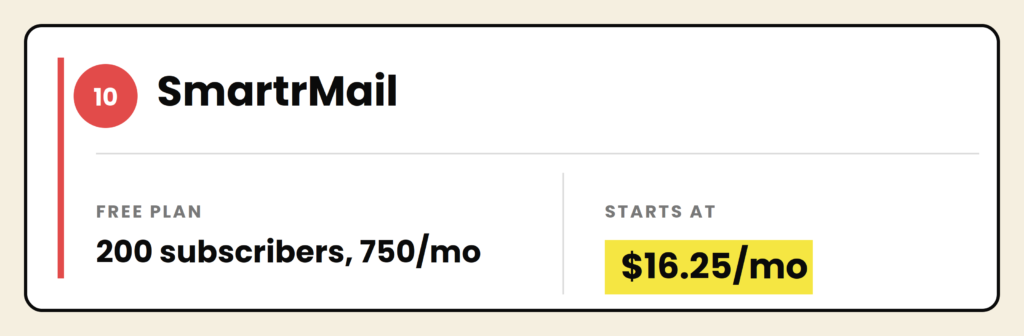
Price: Free plan covers up to 200 subscribers and 750 monthly emails. Essential starts around $16.25 a month for 500 subscribers, Pro around $54 a month for 1,000 subscribers, with custom Enterprise pricing above that.
Best for: Small ecommerce stores that want cart recovery and product-recommendation emails without Klaviyo-level complexity.
Skip it if: You are not running an online store, or your list has already outgrown a few hundred subscribers.
11. Benchmark Email
Benchmark Email keeps things simple: a clean drag-and-drop editor, responsive templates, and built-in surveys and polls, without the depth (or the complexity) of ActiveCampaign or Klaviyo. Its multilingual support makes it a solid pick for teams with a global audience.
- Intuitive editor with responsive templates that render well across devices
- Surveys, polls, and signup forms included for audience engagement beyond email
- Real-time reporting with genuinely easy-to-read analytics
- Automation stays basic compared to ActiveCampaign or Klaviyo, and the integration library is smaller
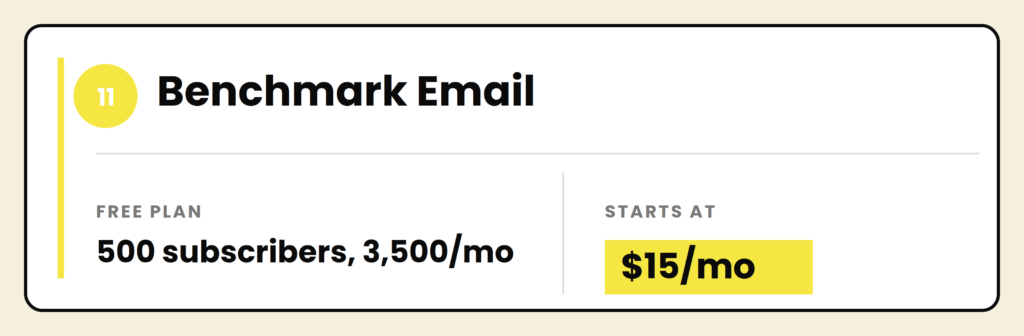
Price: Free plan covers 500 subscribers and 3,500 monthly emails. Pro starts around $15 a month for 500 subscribers, with custom Enterprise pricing above that.
Best for: Small-to-medium businesses and nonprofits that want simple, reliable campaigns without a steep learning curve.
Skip it if: You need advanced automation. Benchmark is built for straightforward sending, not complex branching workflows.
How the 11 tools compare
| Tool | Free plan | Best for | Paid starting price |
|---|---|---|---|
| Mailchimp | 250 contacts, 500 sends/mo | Recognizable interface for occasional newsletters | $13/mo |
| Constant Contact | No free plan, 60-day trial | Support-heavy small businesses and nonprofits | $12/mo |
| Brevo | Unlimited contacts, 300 emails/day | Large lists that send infrequently | $9/mo |
| MailerLite | 250 subscribers, 2,500 emails/mo | Automation included on the free tier | $12/mo |
| Omnisend | 250 contacts, 500 emails/mo | Shopify and WooCommerce cart recovery | $16/mo |
| Moosend | 30-day trial, 1,000 sends | Budget automation without a free tier | $9/mo |
| Klaviyo | 250 profiles, 500 emails/mo | Ecommerce personalization at scale | $20/mo |
| ActiveCampaign | 14-day trial, no free plan | Email marketing plus a real CRM | $15/mo |
| Sender | 2,500 subscribers, 15,000 emails/mo | Automation on a genuinely free plan | $10/mo |
| SmartrMail | 200 subscribers, 750 emails/mo | Small ecommerce stores | $16.25/mo |
| Benchmark Email | 500 subscribers, 3,500 emails/mo | Simple sending with surveys built in | $15/mo |
Which one should you actually pick
Start with what you are selling, or whether you are selling anything at all. Ecommerce brands should look at Omnisend, Klaviyo, or SmartrMail first, since their automation is built around store events, not generic newsletter sends. Everyone else gets more value from Brevo, MailerLite, or Sender, all of which include real automation on their free tier without an ecommerce assumption baked in.
If a CRM and sales pipeline matter as much as the emails themselves, ActiveCampaign is the only tool on this list built for that from the ground up, and it is worth the missing free tier if that is genuinely your use case. If you just want the most recognizable name to start with and your list is small, Mailchimp still works, with the caveat that its free plan is thinner than it used to be. Whatever you land on, it is worth modeling the real cost at your target list size the same way you would any other line item in a content marketing budget, not just the free-plan headline.
Whichever tool you land on, it is one piece of a larger content and distribution system, not the whole thing. Our breakdown of marketing automation software tools covers the platforms built for broader lifecycle marketing beyond email alone, and AI-native email automation tools covers the newer wave of AI-driven senders if a free tier is not the deciding factor for your team.
The list is only half the job
A free email marketing tool solves the sending problem. It does not solve the harder problem: what you say once you have someone’s inbox, and whether that content earns the next open. SaaS content marketing metrics that actually matter covers how to tell whether your email program is actually working, not just sending on schedule.
If email is one piece of a bigger content system that still needs a strategy behind it, our SaaS content engine breakdown and content distribution playbook cover what to build once the tooling stops being the bottleneck, and our roundup of best AI marketing agencies covers what to look for if you decide the strategy work needs outside help. And if you want to keep track of how fast this category keeps changing, one of the best AI newsletters is worth following, since three of the tools on this list cut their free-tier limits in the first half of 2026 alone.
Want a second opinion on your current email and content stack before you commit to a new tool? Book a slot convenient to you and we will walk through what is actually worth fixing first.

Jay is the co-founder of LymLyt and an AI partnership consultant helping B2B SaaS companies grow through content strategy, SEO, and AI integration. He writes about content marketing, what makes B2B content convert, and how SaaS teams can build content systems that drive real pipeline.