The 11 Best AI Newsletters in 2026 for Marketers and Content Teams
AI news is easy to find and hard to filter.
The biggest newsletters often cover the same model launches and tools, while specialist newsletters explain what those changes mean for your work. That distinction is becoming more important as SEO and AI search reshape how audiences discover content.
For most B2B marketers, the right setup is not a folder full of unread subscriptions. It is one short newsletter for current news and one specialist newsletter for marketing, content, SEO, or strategy.
If email is not your preferred format, see these AI communities and Slack groups for marketers instead.
If you want the short answer:
- Best overall for marketers: This Week in AI from Marketing AI Institute
- Best daily AI newsletter: The Rundown AI
- Best three-minute update: Superhuman AI
- Best for marketing leaders: AI-Ready CMO
- Best for SEO and AI search: SEOFOMO
- Best for content, analytics, and advanced applications: Almost Timely
- Best for evidence-based AI strategy: One Useful Thing
- Best for technical context: The Batch or TLDR AI
The best AI newsletters at a glance
| Newsletter | Best for | Frequency | Reading style | Price |
|---|---|---|---|---|
| This Week in AI | Marketing teams that want useful business context | Weekly | Analysis and practical implications | Free |
| The Rundown AI | A practical daily overview | Weekdays | News, why it matters, and applications | Free |
| Superhuman AI | Busy professionals who want a fast scan | Daily | Short news, tools, and tutorials | Free |
| AI-Ready CMO | CMOs and senior B2B marketers | Frequent | Marketing strategy, frameworks, and implementation | Free with paid options |
| SEOFOMO | SEO, content, and AI-search professionals | Weekly | Curated news, guides, tools, and events | Free |
| Almost Timely | Data-minded marketers and advanced practitioners | Weekly | Long-form analysis and tutorials | Free with paid options |
| The AI Report | Business teams looking for use cases | Daily | Plain-English news and playbooks | Free |
| One Useful Thing | Leaders thinking about AI and work | Several times a month | Research-informed essays | Free |
| The Batch | Readers who want research explained clearly | Weekly | News, research, and expert context | Free |
| TLDR AI | Technical marketers, product marketers, and developers | Weekdays | Dense, link-heavy summaries | Free |
| The Neuron | Non-technical readers who prefer an informal voice | Daily | Accessible news and explainers | Free |
How these newsletters were selected
This is a research-based comparison. The list was evaluated using publicly available editions and publisher information current in September 2026.
Each newsletter was assessed on:
- Audience fit, especially for B2B marketers and content teams
- Editorial focus and how clearly it differs from similar newsletters
- Publishing consistency
- Practical usefulness beyond repeating headlines
- Access to recent public editions
- Price and reading commitment
Subscriber totals were not used as the main ranking factor. A large audience can indicate consistency, but it does not tell you whether a newsletter fits your role or deserves space in your inbox.
The same principle applies when evaluating AI software: a large audience is not a substitute for a clear use case. If tools are your priority, use this separate directory of the top 100 AI tools rather than expecting a newsletter list to do both jobs.
1. This Week in AI: best overall for marketers
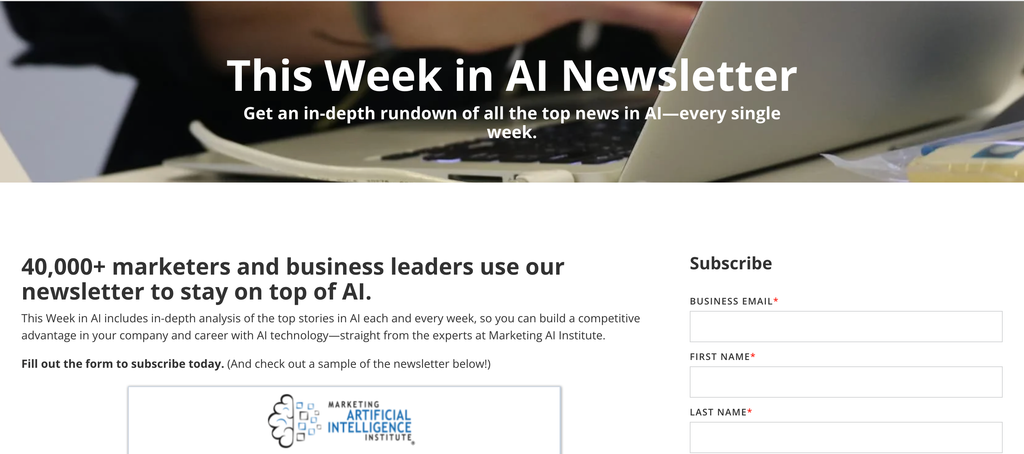
This Week in AI is the strongest starting point for marketers who want AI news connected to business decisions. Marketing AI Institute publishes the newsletter for marketers and business leaders rather than engineers, so the coverage emphasizes adoption, competitive implications, and how AI changes marketing work.
The weekly schedule also gives stories time to develop. That makes it more useful for a marketing team deciding what deserves attention than a daily list of every new tool or model.
Best for: B2B marketers, marketing operations teams, content leaders, and managers responsible for AI adoption.
Skip it if: You want breaking news every morning or detailed coverage of AI research papers.
2. The Rundown AI: best daily AI newsletter
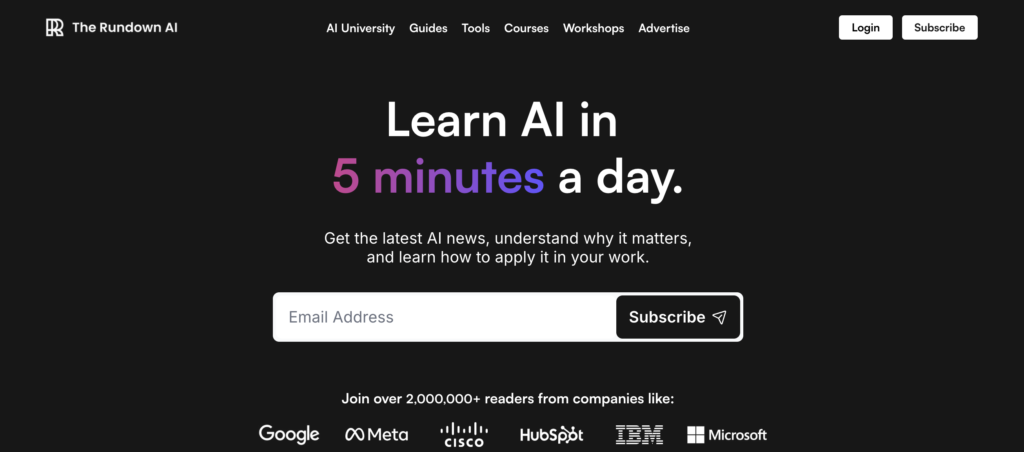
The Rundown AI combines major AI news with explanations of why it matters and examples of how people can apply new tools at work. It is broader than a marketing newsletter, but the practical framing makes it useful for marketers who need to turn developments into campaign, workflow, or content ideas.
It is a sensible daily choice for general awareness. Pair it with one specialist weekly newsletter rather than subscribing to several similar daily digests.
Best for: Marketers, founders, product teams, and operators who want one general AI briefing.
Skip it if: You already read another daily AI newsletter or want deeper technical analysis.
3. Superhuman AI: best for a fast daily scan
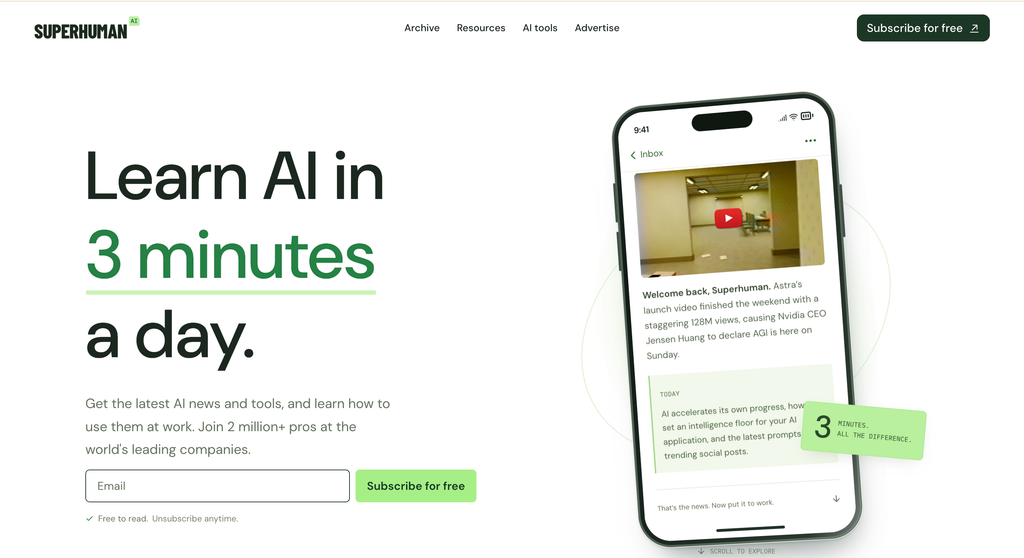
Superhuman AI packages AI news, tools, prompts, and short tutorials into a quick daily read. Its advantage is speed. A reader can understand the main stories and take away one practical idea without committing to a long analysis.
For content professionals, the tutorials and prompt examples can be useful starting points. The trade-off is depth: it is designed to keep readers current, not provide a complete understanding of every development.
Best for: Busy marketers and knowledge workers who want a short daily briefing.
Skip it if: You prefer original analysis over news summaries and tool recommendations.
4. AI-Ready CMO: best for marketing leaders
AI-Ready CMO focuses specifically on the decisions marketing leaders face when adopting AI. Its coverage includes AI-search visibility, marketing workflows, team adoption, vendor evaluation, ROI, and changes to marketing roles.
This makes it more relevant to a B2B marketing leader than a general newsletter that treats marketing as one use case among many. It is particularly useful when you need frameworks that can be discussed with a team or leadership group.
Best for: CMOs, heads of marketing, senior content leaders, and agency owners.
Skip it if: You only want general AI news or highly technical model coverage.
5. SEOFOMO: best for SEO and AI search
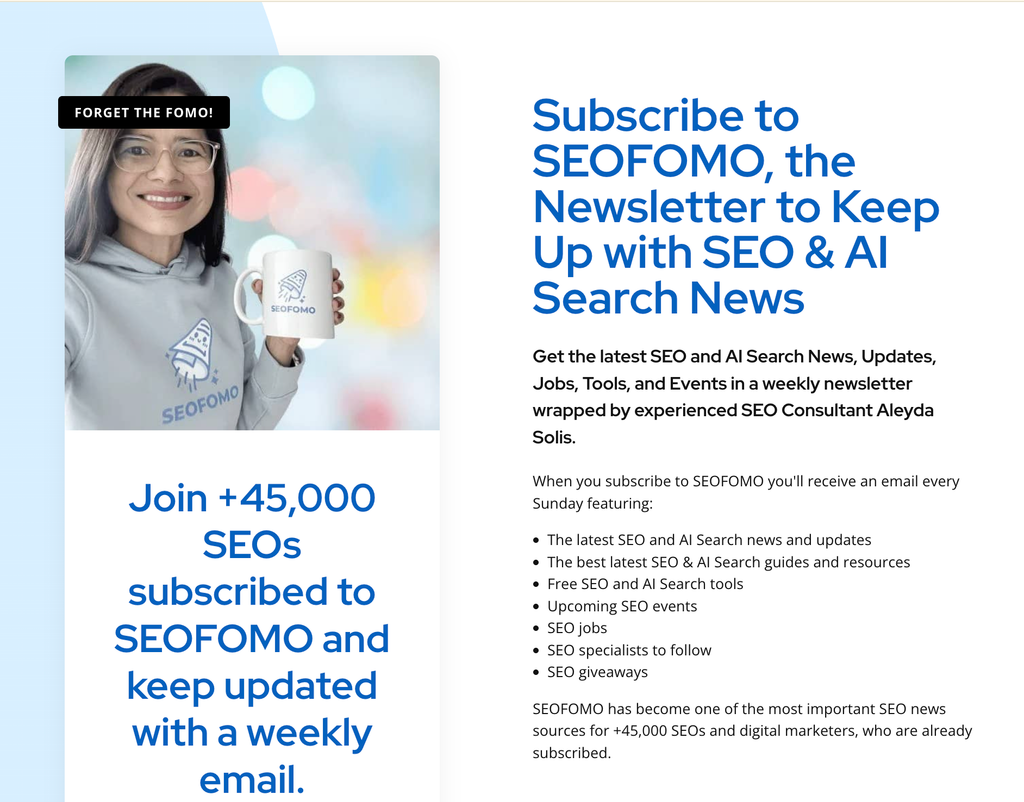
SEOFOMO is a weekly newsletter covering SEO, AI search, tools, guides, events, and industry changes. Aleyda Solis curates each edition, which gives it a clear editorial filter instead of presenting an undifferentiated feed of links.
It is not a general AI newsletter. That is precisely why it is useful for content marketers. It connects AI developments to search visibility, discovery, and the practical work of earning traffic. That specialist context also helps teams understand how topical authority works for B2B SaaS as search expands beyond traditional blue links.
Best for: SEO professionals, content strategists, and marketers responsible for organic search or AI-search visibility.
Skip it if: SEO is not part of your role.
6. Almost Timely: best for advanced marketing applications
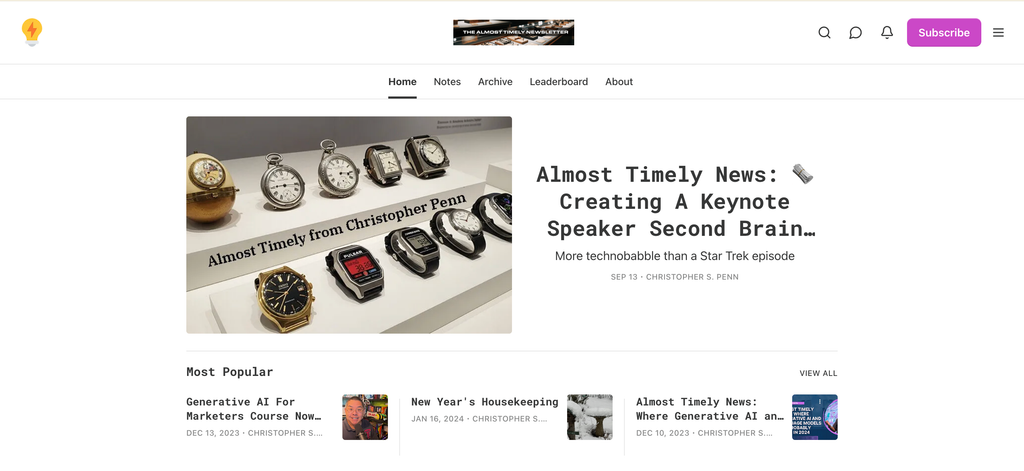
Almost Timely is Christopher Penn’s weekly newsletter about AI, analytics, data science, marketing, and related topics. Issues are often longer and more technical than the typical five-minute newsletter, with detailed explanations and practical walkthroughs.
The depth is the advantage. It can help experienced marketers understand how systems and methods work rather than simply learn that a new tool exists.
Best for: Analytics-focused marketers, content professionals experimenting with AI workflows, and readers who enjoy long-form tutorials.
Skip it if: You want a quick roundup or have little interest in implementation details.
7. The AI Report: best for business use cases
The AI Report publishes a daily briefing for business leaders, including use-case playbooks across marketing, operations, HR, and product. The tone is designed for non-technical professionals and focuses on organizational applications rather than model architecture.
For B2B marketers, it is useful when AI adoption extends beyond the content team and needs to connect with sales, operations, or product.
Best for: Business leaders and cross-functional teams looking for practical use cases.
Skip it if: You want independent research analysis or deep technical reporting.
8. One Useful Thing: best for evidence-based AI strategy
One Useful Thing is written by Wharton professor Ethan Mollick and examines how AI changes work, education, organizations, and decision-making. It does not follow a strict daily-news format. Instead, each issue develops an argument or explores a meaningful change in how people use AI.
Marketers will get fewer tool lists and more help thinking clearly about adoption, experimentation, and the limits of current systems.
Best for: Marketing leaders, strategists, and anyone responsible for setting AI policy or working practices.
Skip it if: You mainly want product launches and prompt collections.
9. The Batch: best for understanding AI research
The Batch is DeepLearning.AI’s weekly newsletter. It combines AI news, accessible research summaries, business developments, and a recurring letter from Andrew Ng.
It is a good bridge for marketers who work closely with technical products or AI companies. The writing explains technical developments without requiring the reader to follow the research literature independently.
Best for: Product marketers, AI-company marketers, technical content teams, and readers who want more depth than a general digest.
Skip it if: You only care about marketing workflows and tools you can use immediately.
10. TLDR AI: best for technical readers
TLDR AI is a free weekday newsletter covering AI news, research, models, developer tools, and product launches. Its format is dense and link-heavy: a short summary followed by the source for readers who want to go deeper.
It is more technical than most general AI newsletters. That makes it valuable for marketers working with developers, AI infrastructure companies, or highly technical buyers.
Best for: Technical content marketers, developer marketers, product marketers, engineers, and researchers.
Skip it if: You want marketing-specific advice or a conversational explanation of every story.
11. The Neuron: best for approachable AI news
The Neuron explains daily AI developments in an informal, accessible style. It is designed for readers who want to remain current without learning the technical vocabulary behind every model release.
The conversational voice is its main differentiator. For non-technical marketers, that can make the habit easier to maintain than a denser technical digest.
Best for: General marketers, beginners, and non-technical professionals.
Skip it if: You prefer a restrained tone or need technical depth.
Which AI newsletter should a B2B marketer choose?
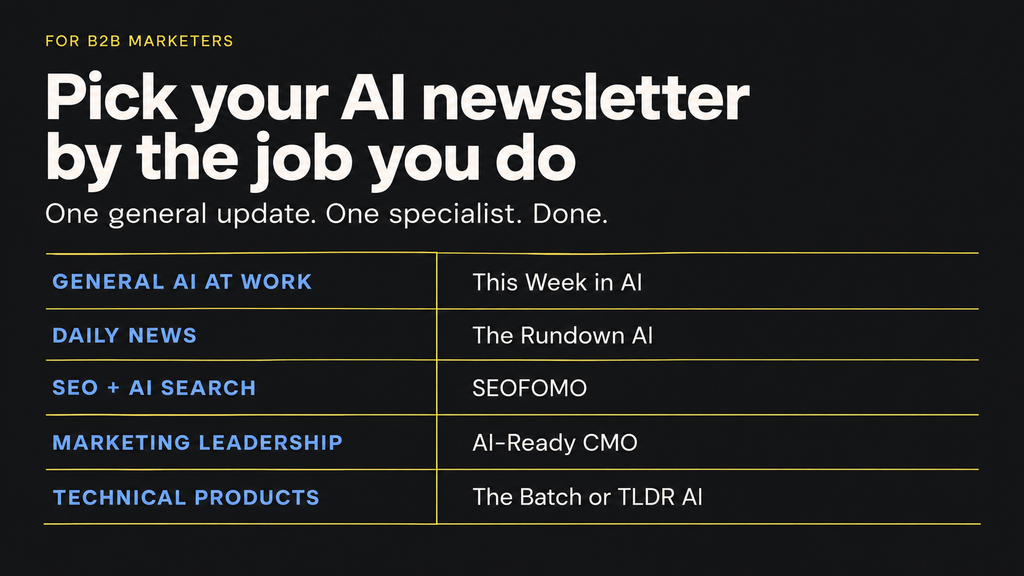
Choose according to the decisions you make at work:
- General B2B marketer: The Rundown AI plus This Week in AI
- Content or SEO professional: Superhuman AI plus SEOFOMO
- Marketing leader: This Week in AI plus AI-Ready CMO or One Useful Thing
- Marketing an AI or developer product: TLDR AI plus The Batch
- Analytics-focused marketer: The Rundown AI plus Almost Timely
- Non-technical beginner: Superhuman AI or The Neuron, plus one weekly specialist
Avoid subscribing to three or four general daily newsletters. Their largest stories will overlap. One daily source for awareness and one specialist source for judgment is enough for most people.
If you plan to publish a newsletter rather than only read one, use this guide to building a successful B2B newsletter to choose the format, promise, and distribution strategy. These B2B newsletter templates can then help you structure individual editions.
Daily versus weekly AI newsletters
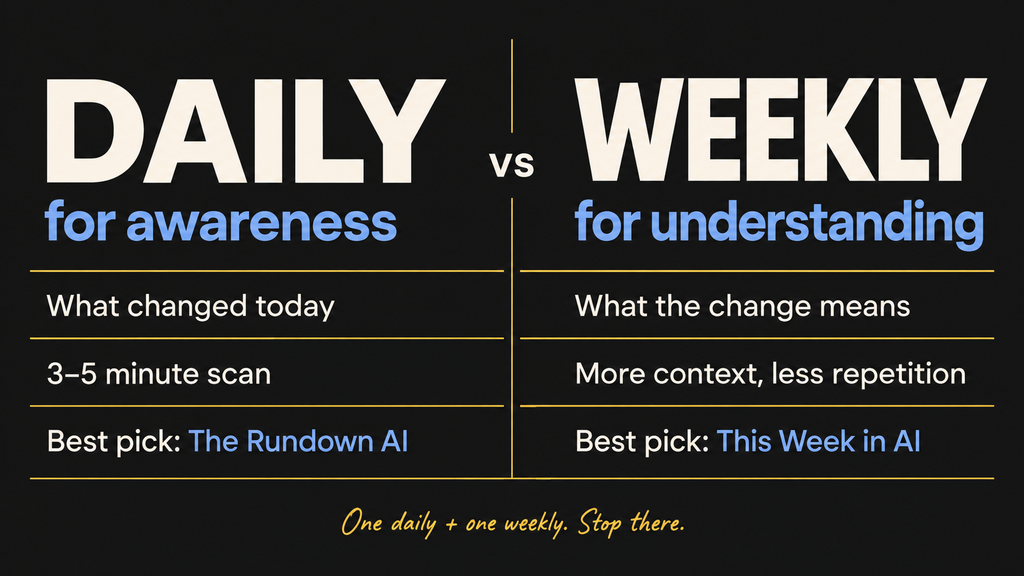
Daily newsletters are useful when your work depends on current references. Social media managers, AI-product marketers, journalists, and content teams publishing timely articles may need that pace.
Weekly newsletters are better for interpretation. They have more time to separate a meaningful development from a launch that generated attention for only a day.
For most B2B marketers, the practical combination is:
- One daily newsletter for awareness
- One weekly newsletter aligned with your role
If you can only maintain one subscription, choose the specialist weekly newsletter. Relevance usually matters more than frequency.
The same cadence decision matters when planning your own editorial program. A sustainable content marketing strategy for a SaaS startup should match the team’s ability to research, publish, and distribute useful work consistently.
Frequently asked questions
What is the best AI newsletter for marketers?
This Week in AI from Marketing AI Institute is the strongest all-round choice for marketers because it connects AI developments to marketing and business decisions. The Rundown AI is a better choice if you want a daily general briefing.
What is the best daily AI newsletter?
The Rundown AI is the best balanced daily option for most professionals. Superhuman AI is better for a shorter scan, TLDR AI for technical readers, and The Neuron for an informal beginner-friendly explanation.
What is the best AI newsletter for content marketers?
Content marketers should combine a general newsletter such as Superhuman AI with a specialist publication such as SEOFOMO or Almost Timely. This provides both current awareness and deeper advice about search, content, analytics, and workflow changes.
Are AI newsletters free?
Most major AI newsletters offer a free edition. Some publishers also sell courses, communities, memberships, or paid newsletter tiers. Check the publisher’s current subscription page before signing up because offers can change.
If you are choosing software for your own list, compare the best free email marketing tools separately. Newsletter quality and sending-platform quality are different decisions.
How many AI newsletters should I subscribe to?
Two is enough for most people: one daily newsletter and one weekly specialist. Adding more general daily newsletters usually increases repetition more than useful coverage.
The bottom line
The best AI newsletter is the one that helps you make better decisions, not the one with the largest subscriber count.
For most B2B marketers, start with This Week in AI or The Rundown AI. Add SEOFOMO if search and content are central to your work, AI-Ready CMO if you lead a marketing team, Almost Timely if you want implementation depth, or The Batch if you market a technical AI product.
Give the combination four weeks. If you repeatedly skip one of the newsletters, remove it. A short reading list you use is more valuable than an impressive collection you ignore.
The same filter should apply to the content your company publishes. If useful articles are still being ignored, start with why your ideal customers may not be reading your blog.
Want LymLyt to build content like this for your company?
We create research-led blog posts, comparison pages, and AI-visibility content for B2B SaaS teams.

Rashmita is content marketer with 8 years of experience building and growing SaaS brands. Now she tests various AI tools for marketers and shares her feedback on this blog, LinkedIn, Instagram, and YouTube.