5 Best AI Agent Builders for B2B SaaS Marketing Teams
Your marketing team does the same research every Monday.
Someone checks competitor updates. Someone pulls campaign numbers. Someone reads sales notes and wonders whether the content calendar reflects anything customers actually ask.
An AI agent builder can connect parts of that work. Give it access to the right sources, explain the job, and decide what it can do without asking.
The difficult part is getting a result you can trust when the inputs change, a connection fails, or the answer is missing.
For B2B SaaS teams, the best builder depends on who will maintain it, which systems it needs to use, and how much judgment the work requires.
Here are five worth evaluating, with current pricing, practical use cases, and what building an alternative in-house would involve.
Which AI agent builder should a marketing team choose?
Start with Gumloop for shared marketing agents, Lindy for recurring work managed through conversation, and n8n when someone on the team can own the technical details.
Dify is worth considering for agents built around an organized knowledge base. Relevance AI belongs on the shortlist when several teams need coordinated agents and broader administrative controls.
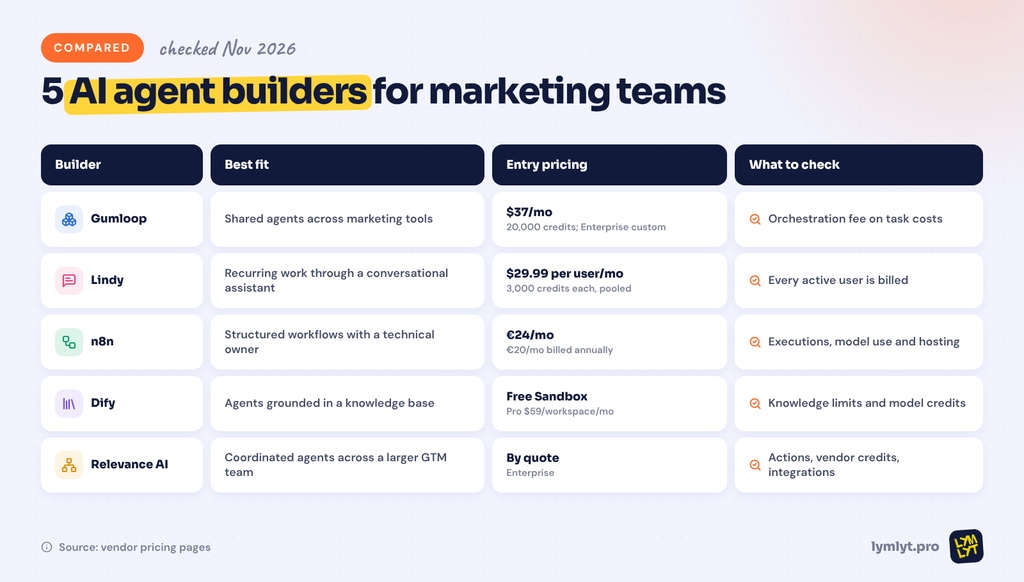
| Builder | Best fit | Current pricing | What to check |
|---|---|---|---|
| Gumloop | Shared agents working across marketing tools and company information | Pro $37/month, including 20,000 monthly credits; Enterprise custom | An 8% orchestration fee applies to task costs, rising to 16% when using your own model API keys. Pricing |
| Lindy | Recurring research, reporting, and coordination through a conversational assistant | Team starts at $29.99 per active user/month for 3,000 credits each; Enterprise custom | Credits are pooled, but active users are billed individually. Free trial credits expire after seven days. Pricing |
| n8n | Agents combined with structured workflows, custom connections, and technical control | Starter €24/month, or €20/month billed annually; Pro €60/month, or €50/month billed annually, at the displayed execution tiers | Workflow executions, model usage, and hosting are different cost considerations. Pricing |
| Dify | Knowledge-based agents and internal AI applications | Free Sandbox; Professional $59/workspace/month or $590/year; Team $159/workspace/month or $1,590/year | Knowledge limits, trigger allowances, included model credits, and additional model usage. Pricing |
| Relevance AI | Coordinated agents across a larger go-to-market operation | The current public pricing page presents Enterprise pricing by quotation | Ask for costs based on actions, vendor credits, integrations, and your intended agent setup. Pricing |
These products approach the job differently. Some emphasize a conversational assistant. Others give you a visual process builder or an application platform.
Choose around the work you need completed and the person who will own it.
If the job is answering visitors on your website rather than internal research, our comparison of AI chatbot builders for SaaS websites covers that category.
What makes an agent useful for marketing?

A useful marketing agent has a bounded job, access to relevant information, and a clear stopping point.
For example:
Review this week’s approved customer-call notes. Identify recurring implementation questions, attach the supporting passages, and suggest additions to our content backlog. Save the result for editorial review.
That is specific enough to evaluate.
“Run our content marketing” leaves too many decisions undefined.
Start by writing down:
- The input: Which records, documents, or events start the work?
- The decision: What must the AI interpret?
- The output: What should someone receive?
- The boundary: Which actions require review?
- The exception: What happens when information is missing or a tool fails?
Some jobs need very little AI. Copying a completed form into a spreadsheet is a straightforward automation. Interpreting the request, identifying missing context, and deciding which research to gather introduces judgment. For the first kind, standard marketing automation software is usually enough.
Our guide to building a SaaS content engine covers the wider process. An agent should improve a defined part of that system.
1. Gumloop: for shared agents across marketing tools
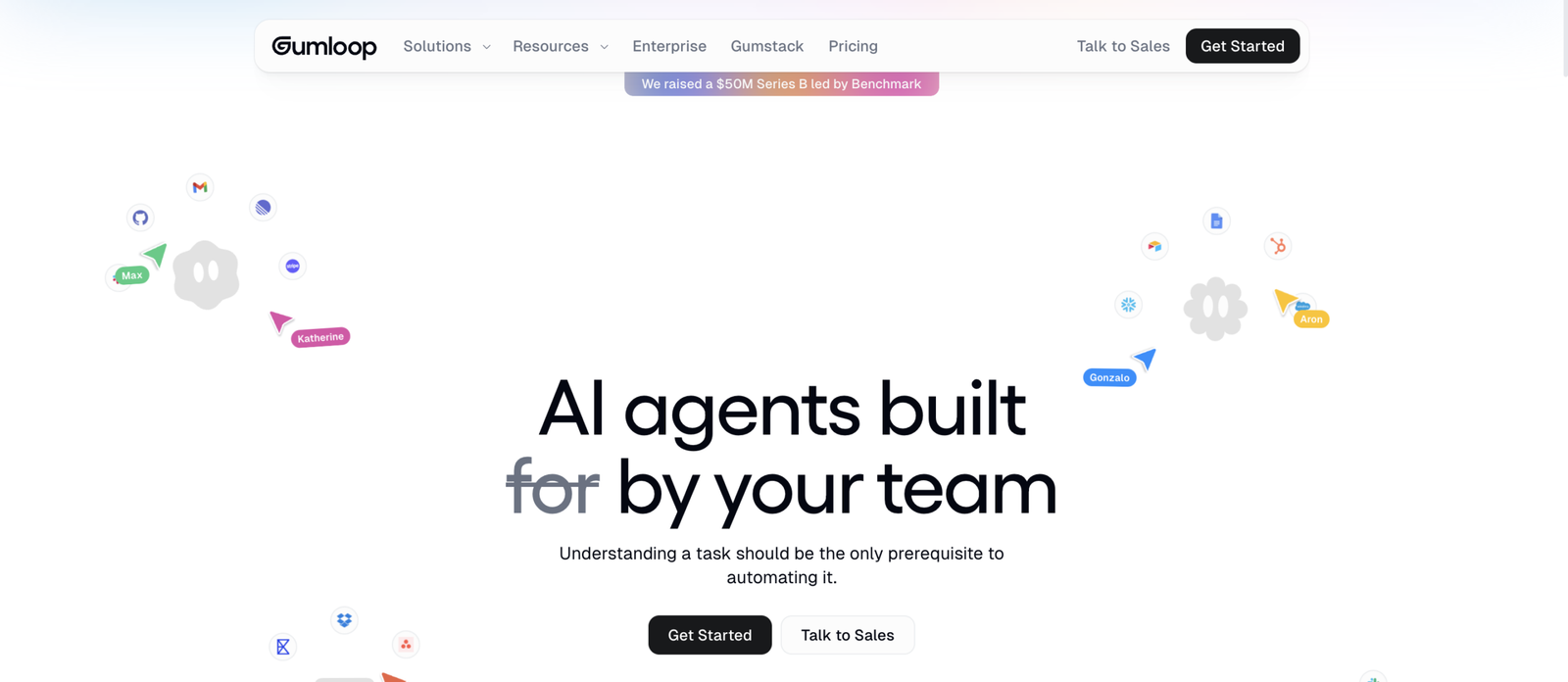
Gumloop is a practical starting point for teams that want agents to work with information spread across their existing tools.
Its platform supports connected agents, shared company context, and skills. Its public examples show connections with services including Slack, HubSpot, Gong, Gmail, Salesforce, and Notion. Explore Gumloop.
A practical B2B SaaS use case
Build a weekly content-opportunity review.
The agent reviews an approved set of sales notes, compares recurring questions with your existing article inventory, and prepares a research memo.
Ask for three outputs:
- Questions already answered by existing content.
- Questions that need a clearer or updated answer.
- Potential new topics, with supporting evidence.
The editor decides what deserves production. The agent reduces the work of finding and organizing the evidence.
Pricing
Pro is listed at $37/month, with 20,000 monthly credits, unlimited agents, and unlimited seats.
Gumloop bills task costs including model tokens, compute, and paid tool calls. Its pricing FAQ specifies an 8% orchestration fee, increasing to 16% when you bring your own model API keys. Enterprise pricing is custom. Review Gumloop’s pricing and usage explanation.
What to watch
Unlimited agents does not mean unlimited work.
Test the cost of a complete research task, including source collection and retries. Also check which administrative controls your team needs; several organization-wide controls sit on Enterprise.
A useful output should preserve the source behind each recommendation. Otherwise, your editor inherits a second research job.
2. Lindy: for recurring work managed through conversation
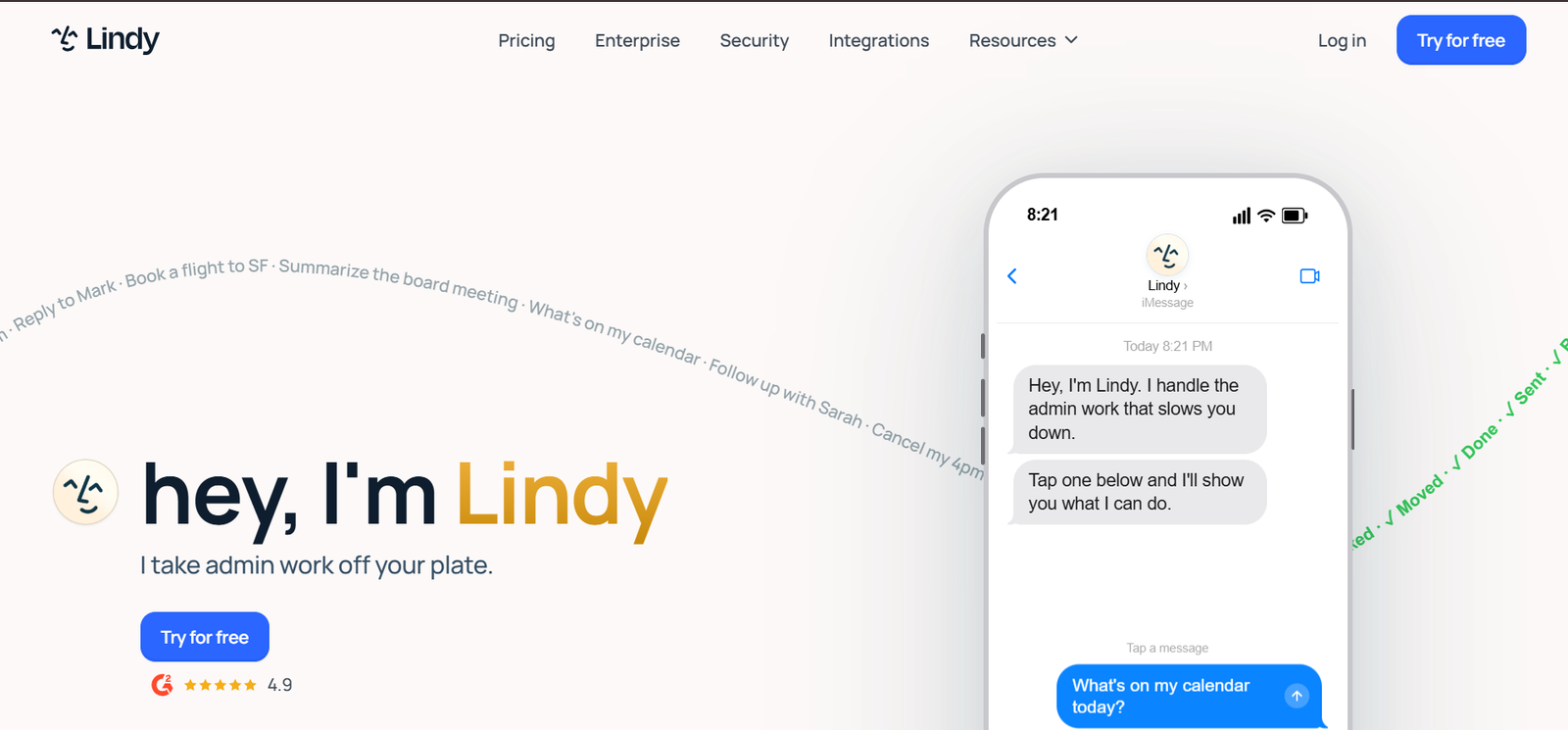
Lindy fits teams that want to delegate work through an assistant rather than spend most of their time maintaining a workflow canvas.
Its published capabilities include scheduled routines, persistent workspace context, custom skills, connected tools, and built-in approvals. See Lindy’s product.
A practical B2B SaaS use case
Prepare the weekly marketing meeting brief.
Give the assistant access to approved campaign reports and the team’s planning documents. Ask it to summarize:
- What changed against the previous period.
- Which figures need investigation.
- What work is blocked.
- Which decisions the meeting needs to resolve.
Define the calculations separately. A fall in demo requests is an observation; “our positioning stopped working” is an interpretation that needs more evidence.
Pricing
The live pricing selector starts Team at $49.99 per active user/month, adding 5,000 monthly credits per user to a shared pool.
Top-ups are listed at $10 per 1,000 credits. The free offer provides $50 in credits that last seven days. Enterprise pricing is custom. Check Lindy’s current plans.
What to watch
Budget for the people using the workspace as well as the workload.
Three active users on the entry tier would mean $149.97/month, before top-ups. Shared credits do not make that a single-seat subscription.
Run your intended routine during the trial. A short summary and a research-heavy report can consume very different amounts of credit.
3. n8n: for teams with a technical owner

n8n is worth considering when marketing needs AI reasoning inside a process with explicit steps, conditions, integrations, and error handling.
Its plans include AI Agent nodes, custom API requests, code steps, and human approval for tool calls. It also offers a self-hosted Community Edition. Explore n8n’s capabilities and plans.
A practical B2B SaaS use case
Build an inbound lead research assistant.
A demo request starts the process. Fixed rules validate the submitted information and check for an existing account. The AI reviews permitted company information against your qualification criteria and prepares a short account brief.
Separate what the prospect supplied from what the agent found. Mark unresolved questions explicitly.
Sales should be able to see why the agent suggested a fit. A confident score without supporting evidence makes the handoff harder.
Pricing
At the displayed execution tiers:
- Starter: €24/month, or €20/month billed annually, with 2,500 monthly workflow executions.
- Pro: €60/month, or €50/month billed annually, with 10,000 monthly workflow executions.
Pricing is based on workflow executions rather than a charge for every individual step. Model and data costs depend on your setup and included allowances. Compare current n8n pricing.
What to watch
Someone needs to own the connections, data structure, testing, and recovery process.
Self-hosting also adds maintenance responsibilities. n8n’s hosting documentation is a useful starting point for assessing that work.
Choose it when you have an owner who can diagnose a failed run, not just someone who can assemble the first version.
4. Dify: for agents grounded in an organized knowledge base
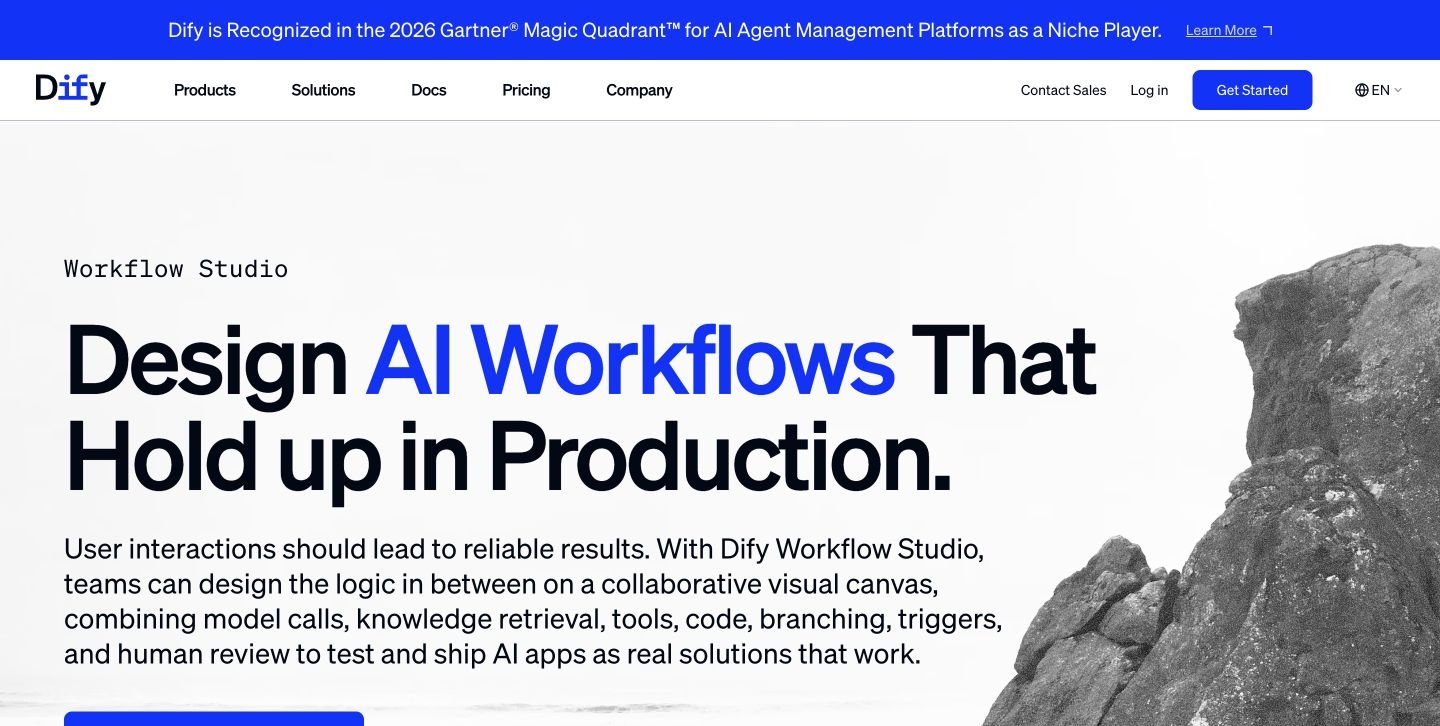
Dify makes sense when the agent’s usefulness depends on retrieving the right information from a maintained collection of documents.
Its Workflow Studio combines visual orchestration with agentic steps. Its Knowledge Pipeline handles preparing information for retrieval. Explore Workflow Studio and Knowledge Pipeline.
A practical B2B SaaS use case
Create an internal product-messaging assistant.
Supply approved product documentation, positioning notes, customer evidence, and writing guidance. A marketer asks for a brief or a draft, and the assistant works from that collection.
Define what happens when the documents disagree. An old feature description should not quietly override a recent product update.
The quality of the underlying brief still matters. Our guide to writing a useful content brief explains the decisions an agent should receive as input.
Pricing
Dify Cloud lists:
- Sandbox: Free, with limited capacity.
- Professional: $59/workspace/month, or $590/year.
- Team: $159/workspace/month, or $1,590/year.
Professional includes three team members and 5,000 monthly message credits. Team includes 50 members and 10,000 monthly message credits. Included credits vary in consumption by model; the pricing page explains using your own model API key after those credits run out. Review Dify’s plans and limits.
What to watch
Document capacity and document quality are separate problems.
You need ownership of the source material, a way to remove outdated information, and tests that check whether the agent retrieves the right passages.
A larger knowledge base can make the answer worse if it contains conflicting versions of the truth.
5. Relevance AI: for coordinated agents across a larger team
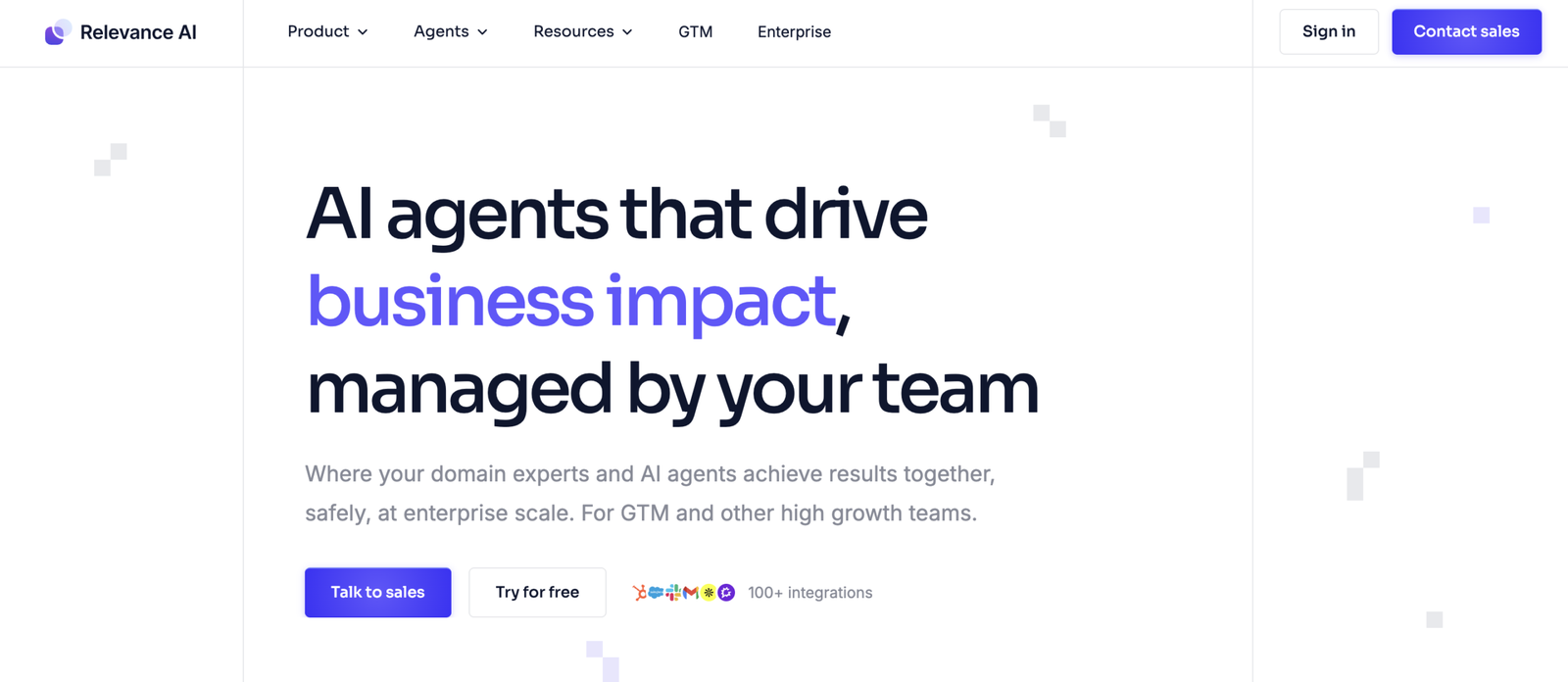
Relevance AI is worth evaluating when several related processes need agents with different responsibilities.
The platform supports agents, tools, knowledge, and coordinated workforces. It also provides approval and escalation capabilities. Explore Relevance AI and its approval controls.
A practical B2B SaaS use case
Coordinate campaign research across marketing and sales.
One agent gathers account context. Another organizes relevant customer evidence. A third prepares a campaign brief using the approved findings.
That arrangement can help when the responsibilities are genuinely distinct. It also introduces more handoffs to test.
Keep the source material and decision history attached to the final brief. A polished document does not tell you whether the earlier research was sound.
Pricing
The current public pricing page presents Enterprise pricing through sales, with custom actions and vendor credits. It lists capabilities including agent evaluations, unlimited agents and tools, and administrative controls. Request current pricing.
Ask for a quote using your expected workload. Include the number of records processed, research depth, run frequency, external data services, and review requirements.
What to watch
Do not start with several agents because the platform supports them.
Get one job working first. Add a separate agent when it improves ownership, context, or testing enough to justify the extra coordination.
For a lean marketing team with one occasional research task, the wider platform may be more than the problem requires.
Test the builders on the same marketing job
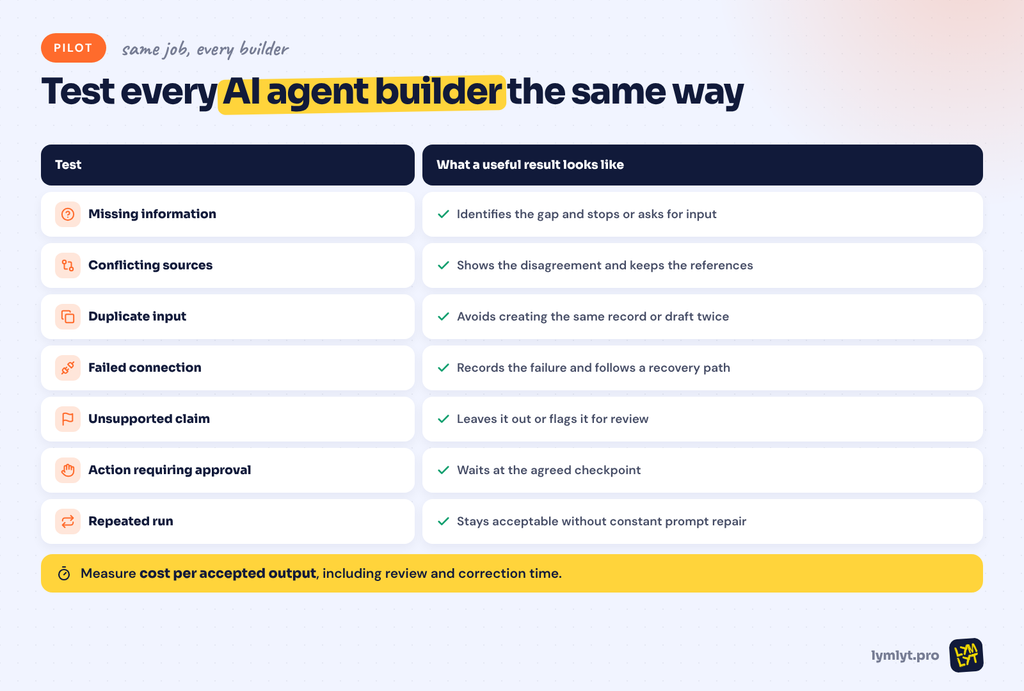
A demo shows whether a builder can produce a convincing example. A pilot should show whether it can handle your ordinary work.
Choose a bounded task and prepare a small reference set that includes incomplete, duplicated, and contradictory inputs.
| Test | What a useful result looks like |
|---|---|
| Missing information | The agent identifies the gap and stops or asks for input |
| Conflicting sources | It shows the disagreement and preserves the references |
| Duplicate input | It avoids creating the same record or draft twice |
| Failed connection | It records the failure and follows a defined recovery path |
| Unsupported claim | It leaves the claim out or flags it for review |
| Action requiring approval | It waits at the agreed checkpoint |
| Repeated run | The result remains acceptable without constant prompt repair |
Measure cost per accepted output, including review and correction time.
A cheap run that creates 30 minutes of cleanup is expensive marketing operations.
Unsupported claims are worth extra attention. The AI citation telephone game shows how one unchecked number spreads once it’s published.
Can you build an alternative in-house with AI?
Yes, particularly for a narrow process with accessible inputs and a clear output.
There are two reasonable routes: maintain a self-hosted builder, or use an AI coding assistant to help create a small custom service.
Either way, your team takes responsibility for the parts a hosted platform would otherwise maintain.
Build one small agent first
A sensible first project is a competitor-update digest.
The system:
- Collects changes from a defined list of public pages or approved feeds.
- Stores the previous version or relevant history.
- Identifies meaningful changes.
- Produces a summary with source links and collection dates.
- Saves a draft for review.
Keep the source list controlled. Give the model a fixed output structure and a clear instruction to distinguish observations from interpretation.
You probably need a scheduler, source storage, model access, logging, and a simple review destination. You do not need to recreate an entire agent platform.
Before building, check what the paid options already cover. Our list of competitive intelligence tools is a good benchmark.
Decide what stays predictable

Use ordinary logic for dates, duplicate checks, record identifiers, calculations, and delivery rules.
Use AI for the parts that require interpretation: determining whether a change matters, grouping themes, or drafting an explanation.
That makes failures easier to locate. If a number is wrong, you should be able to tell whether the problem came from the source, calculation, or generated summary.
Our directory of Claude and Codex skills for marketers offers examples of reusable task instructions. A saved process can help standardize the work, but it still needs reliable inputs and testing.
Allow time for integration and testing

For a narrow internal pilot with two accessible sources and one draft output, use these as planning estimates, not benchmarks:
| Work | Initial allowance | Owner |
|---|---|---|
| Define the task, acceptable output, and exceptions | 2 to 3 hours | Marketing owner |
| Connect sources and organize storage | 4 to 8 hours | Technical builder |
| Implement AI instructions and output validation | 4 to 8 hours | Builder with marketing input |
| Test failures, duplicates, and output quality | 6 to 10 hours | Builder and reviewer |
| Review results and maintain the system | Start with 1 to 3 hours weekly | Named owner |
That is approximately 16 to 29 hours for an initial pilot. More complicated permissions, unreliable sources, or actions that update business systems can expand the work substantially.
AI can help write and debug the implementation. Someone still needs to understand what it does and take responsibility when it fails.
Compare the full cost
Include:
- Model usage and external data services.
- Hosting, storage, and monitoring.
- Initial build time.
- Routine review and maintenance.
- Repairs when a source or integration changes.
For illustration, 20 hours at an internal cost of $75/hour is $1,500 in initial labor, before recurring expenses.
That may be worthwhile for a distinctive, repeated process. It is harder to justify for a task a hosted product already handles adequately.
Watch for these common problems
The source contains instructions. A webpage, email, or document can include text that tries to redirect the agent. Treat retrieved material as evidence, and keep its permitted actions separate from that material.
A retry repeats an action. Research can usually be repeated safely. Creating a CRM record or sending a message needs a duplicate-prevention mechanism.
The agent keeps working without a useful stopping point. Set limits on steps, retries, time, and spend. An incomplete result should be visible.
The knowledge base gets stale. Give someone responsibility for approving and retiring documents. A regular content refresh cycle helps here.
The output looks better than the evidence behind it. Require references and inspect a sample regularly. Fluent writing is not an accuracy check.
Nobody owns the finished system. Name the maintainer before the pilot becomes part of the team’s routine.
A checklist before paying for an agent builder
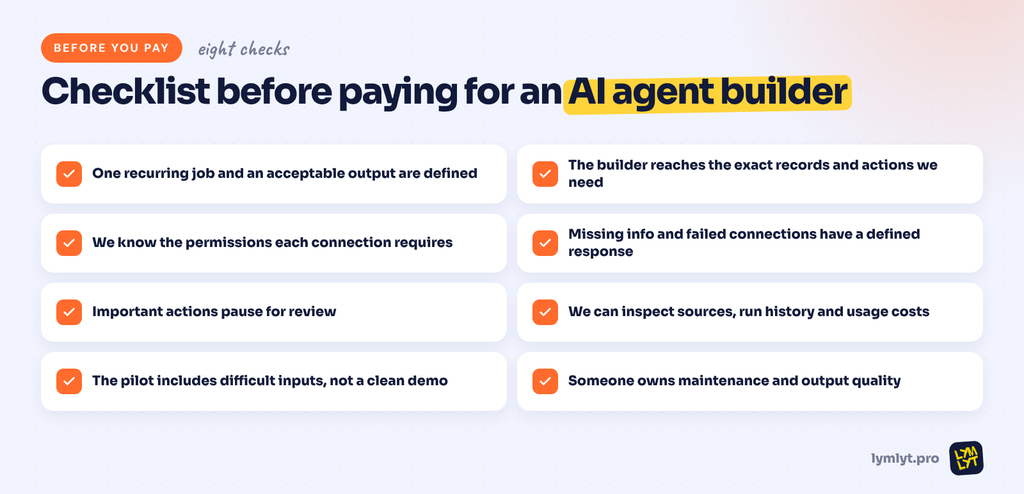
- ☐ We have defined one recurring job and what an acceptable output looks like.
- ☐ The builder can access the specific records and actions we need.
- ☐ We know which permissions each connection requires.
- ☐ Missing information and failed connections have a defined response.
- ☐ Important actions pause for review where needed.
- ☐ We can inspect sources, run history, and usage costs.
- ☐ The pilot includes difficult inputs, not just a clean demonstration.
- ☐ Someone owns maintenance and output quality.
Start with the job your team already understands
Gumloop and Lindy are sensible starting points for teams that want managed agents without building the surrounding infrastructure themselves.
n8n gives a technical owner more control over the process. Dify suits work grounded in maintained documents. Relevance AI deserves a look when the scope extends across coordinated teams and agents.
Pick one recurring job. Run it alongside the current process. Compare accepted output, review time, and total cost.
If an agent helps your team produce research faster, the next decision is still editorial: what deserves to become content, what evidence it needs, and how it will reach buyers. LymLyt’s B2B SaaS content service connects that research to a maintained publishing program.

Rashmita is content marketer with 8 years of experience building and growing SaaS brands. Now she tests various AI tools for marketers and shares her feedback on this blog, LinkedIn, Instagram, and YouTube.