Vs Keywords: Who Actually Ranks When Buyers Compare You
Search “Ahrefs vs Semrush“, one of the most contested vs keywords in SEO software, and the first result belongs to neither company. It belongs to SE Ranking, a third SEO tool, and the comparison closes by suggesting the reader consider SE Ranking instead.
That is not an edge case. It is the normal state of vs keywords in B2B software, and it means the page deciding your most valuable comparison is frequently written by a competitor who was not on the shortlist at all. Every comparison page strategy assumes you can reach the buyer at that moment. Often you cannot, because somebody else got there first.
We checked the same five matchups we used in our AI citation study to see who holds the organic results. Here is what came back, what it costs you, and what to do about it.
How we checked who owns these vs keywords
Five brand pairs, the same ones from the citation study: HubSpot vs Salesforce, Zapier vs Make, Notion vs Confluence, Klaviyo vs Mailchimp, Ahrefs vs Semrush. Bare queries, no modifiers, September 2026.
For each one we logged who appears, and sorted results into three buckets: pages owned by one of the two named vendors, pages owned by a third competitor in the same category, and genuinely neutral third parties like review platforms, affiliate blogs and forums. Note that vs keywords rarely show meaningful volume in a keyword research tool, which is part of why so few teams check them at all.
What this is not. This is a spot check, not a rank-tracking study. Results vary by country, by personalisation, and by the week. Before you plan a quarter around any of it, run the same queries yourself in a logged-out window from your own market and see whether the pattern holds. The method is at the bottom of this post, and it takes about twenty minutes.
We are publishing the pattern rather than a league table for that reason. The pattern is consistent enough to act on. The exact positions are not ours to promise.
Finding 1: the vendors are often absent
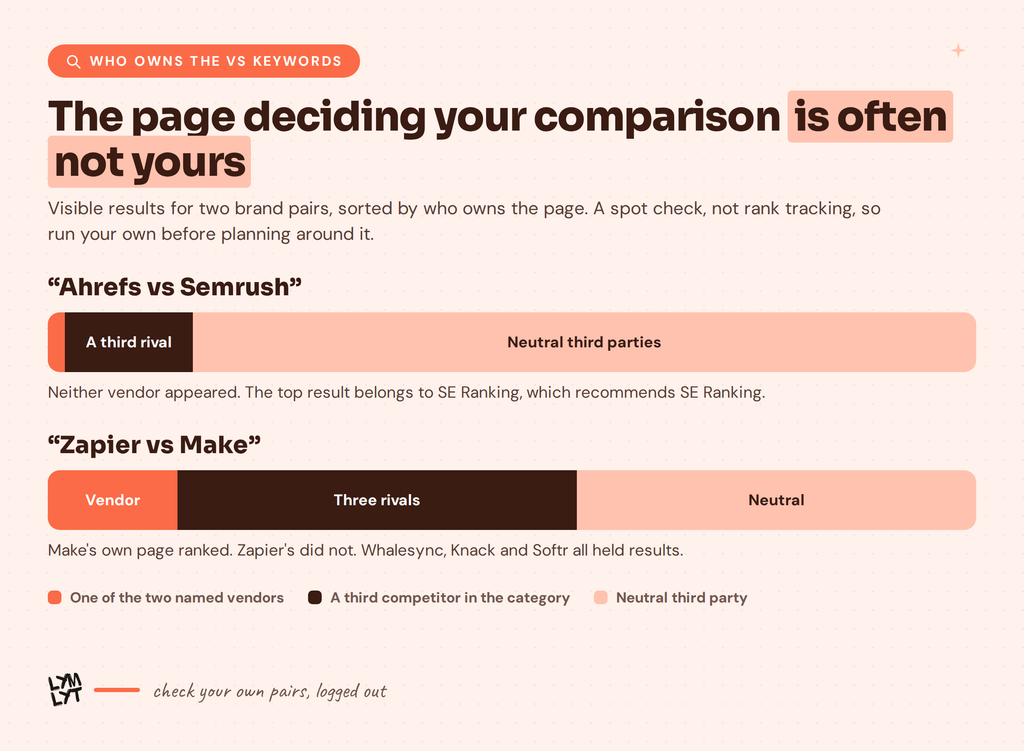
On “Ahrefs vs Semrush”, neither Ahrefs nor Semrush held a visible position. Both companies publish a comparison page. Neither one surfaced.
What did surface: SE Ranking in first, then Exploding Topics, Style Factory, Traffic Think Tank, OneLittleWeb, an ecommerce blog, and at one point a Goodreads author post from 2024. Seven results about two products, written by seven companies that are not those products.
“Zapier vs Make” went differently and only by half. Make’s own comparison page ranked. Zapier’s did not, despite existing. One vendor showed up for the query about itself. The other did not.
So the first thing to check is not whether your vs page is good. It is whether it appears at all. Plenty of B2B SaaS teams have published one, never checked the vs keywords it was built for, and assumed the job was done.
If yours is missing, the pillar’s page structure is the place to start, because a thin page that nobody links to and nobody updates is functionally the same as no page. The same applies to alternatives pages, which chase a different query and a different buyer.
Finding 2: the winner is often a third competitor
This is the part worth sitting with.
The page ranking first for “Ahrefs vs Semrush” is published by SE Ranking, and it recommends SE Ranking as a fairly priced alternative. The results for “Zapier vs Make” include Whalesync, Knack and Softr, which says outright that Softr might be a better fit than either tool the reader asked about.
None of those companies were on the buyer’s shortlist. All of them are now.
That is a smart, cheap acquisition play on vs keywords, and it is available to you too. Your competitors are already running it on each other. The Grow and Convert analysis of 95 posts recommends exactly this: target A vs B comparisons where you are neither product, then add yourself as the third option. Their data puts comparison and alternatives keywords at the highest-converting bucket they track.
The uncomfortable mirror: if a competitor is doing this to your brand pair, a buyer comparing you to your closest rival is reading a page that ends by recommending someone else entirely. You cannot stop them publishing it. You can outrank it, and you can be the one doing it in an adjacent category. It is the same logic behind our own alternatives posts: cover the category honestly, and the recommendation earns its place.
Finding 3: Google and the AI engines disagree
Put this post next to our citation study and something odd appears.
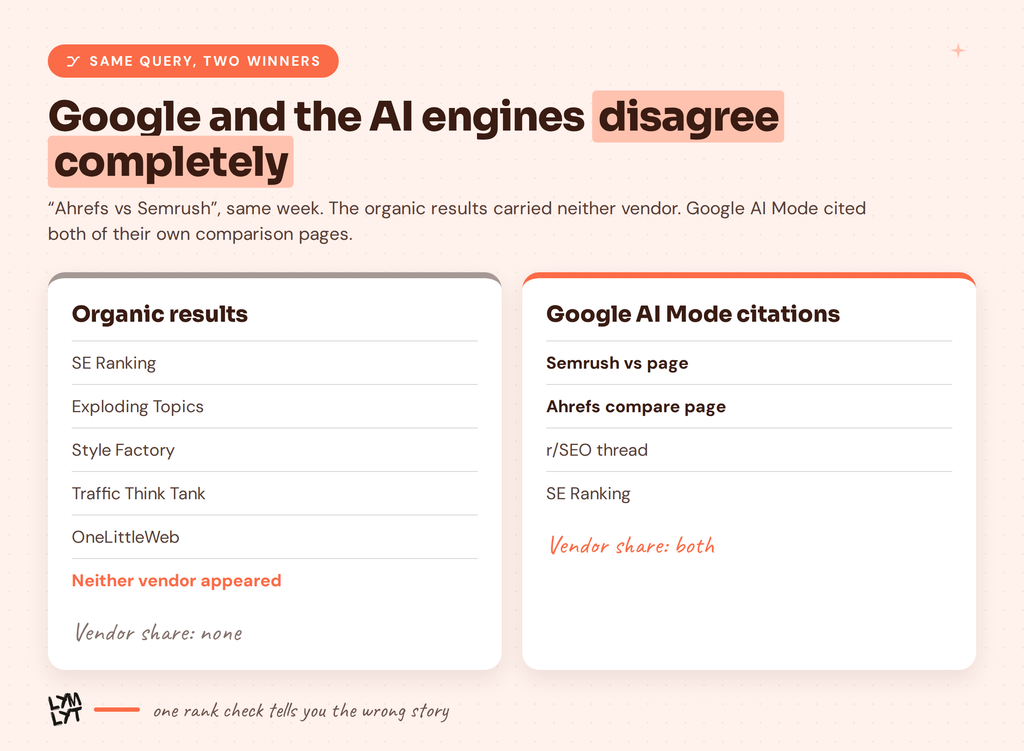
When we ran the same five pairs through Google AI Mode, vendor-owned pages were cited in every answer that cited anything. Semrush’s own comparison page. Ahrefs’ compare page. Make’s and Zapier’s own posts.
On the organic results for the same queries, Semrush and Ahrefs are nowhere, and only one of Zapier and Make shows up.
Same vs keywords, same week, two different winners. The AI layer favours the vendor’s own page. The organic layer favours whoever publishes best. That means a vs page can be failing on one surface while working on the other, and a single rank check will tell you the wrong story either way. Our wider citation study found the same split holds across question types.
It also means the vs page is worth building even if it never cracks page one, which is not something we would have said a year ago. Why sites that rank do not show up in ChatGPT covers the mechanics of that split.
Why the third competitor keeps winning
Three reasons, and all three are fixable.
They answer the question asked. A third-party comparison covers both products and reaches a verdict. A vendor page argues for itself, which is the all-green table problem, and a page that concedes nothing gets treated as promotional by readers and by Google. That is the single biggest reason vendor pages lose vs keywords they should own.
They update. The SE Ranking page carries a date and a stated review month. Most vendor vs pages carry neither, and a comparison with 2024 pricing is a page Google has every reason to demote in favour of one refreshed last month.
They build links to it. A third-party comparison is a linkable editorial asset. A vendor comparison page is a sales page, and almost nobody links to a sales page voluntarily. That gap compounds, which is the same topical authority argument in a narrower frame. Earning those links is its own discipline, covered in our outreach tools roundup.
None of that requires a bigger budget. It requires the page to read like an assessment rather than a pitch, to carry a visible date, and to be worth referencing.
What to do this quarter
Check the vs keywords before touching the page. If you are absent, that is a different problem from being present and losing.
Pitch the pages that rank. The third-party comparisons holding those positions take submissions, corrections and updates. Getting your product represented accurately on the page that already ranks is faster than outranking it, and it is the same play the alternatives format runs.
Write one A vs B where you are neither. Pick the two biggest names in your category, cover them honestly, and appear as the third option. This is the highest-leverage page on this list and the one nobody assigns. It is also the fastest way onto vs keywords where your own brand has no search demand yet.
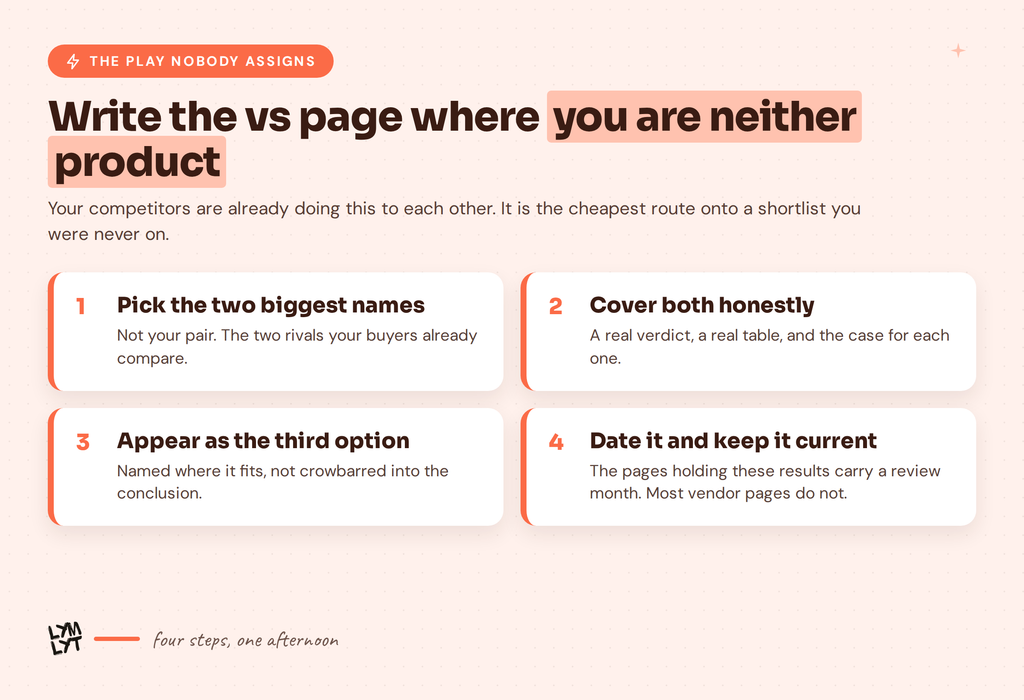
Date the page and keep it current. Pricing and feature rows go stale in weeks, and staleness is both a ranking problem and a substantiation risk.
Track both surfaces. Rank position and AI citation are separate reports, and showing up in ChatGPT is not the same problem as ranking. Our AI visibility checklist covers the second one.
Run it yourself
Five pairs of vs keywords from your category, logged out, your own market.
For each query, log the top ten by owner: one of the two named vendors, a third competitor, or a neutral third party. Note whether each page carries a visible date. Note where your own comparison page sits, if it appears at all.
Then run the same five vs keywords through ChatGPT and Google AI Mode and log the citations. The gap between the two lists is the finding, and it is the part nobody in your category is measuring. If the gaps turn into new sections, our brief generator turns them into something a writer can start on.
Twenty minutes, once a quarter. Track the trend, not the week.
FAQ
Should we target vs keywords for two competitors we are not part of? Yes, if your product is a genuine third option. Cover both honestly and add yourself where it fits. It is the cheapest route onto a shortlist you were not on.
Our comparison page exists but does not rank. What first? Check that it is indexed and dated, then check whether it concedes anything. A page that wins every row reads as promotional, and promotional pages lose to editorial ones on these queries.
Is it worth outranking a third-party page or should we pitch it? Pitch first. It is faster, it costs nothing, and an accurate representation on a ranking page beats an inaccurate one you are trying to displace.
Do vs keywords have enough volume to bother? Usually more than the tools report. Comparison queries are chronically under-counted, and the traffic that does arrive is closer to a decision than any other keyword you own. Traffic is the wrong measure here anyway, as HubSpot’s collapse made clear.
How often do the results change? Enough that a single check is a snapshot rather than a finding. Quarterly is the minimum useful cadence.
Somebody is answering the question when a buyer types your name next to your competitor’s. Right now, in a lot of categories, it is a third company that was never in the running.
That is the job we do. See how we write comparison pages and how we approach AI visibility, look at our work, check pricing.
Think B2B is boring?
That's coz you are not subscribed to ours newsletter. We share a 100 bad days (of B2B marketing) made a 100 good stories. A 100 good stories make YOU interesting at parties.
Almost there. Check your inbox and click the confirmation link.

Jay is the co-founder of LymLyt and an AI partnership consultant helping B2B SaaS companies grow through content strategy, SEO, and AI integration. He writes about content marketing, what makes B2B content convert, and how SaaS teams can build content systems that drive real pipeline.