SAP offered Oracle customers cheaper support. Then Oracle sued.
Imagine trying to persuade a company to replace the software it uses to pay employees and run its finances. Even if the buyer dislikes its current supplier, moving means expense, retraining and the risk of something breaking.
That was SAP’s problem. SAP and Oracle sold business software that companies built their operations around. A better sales pitch could get a meeting. It couldn’t make years of dependence disappear.
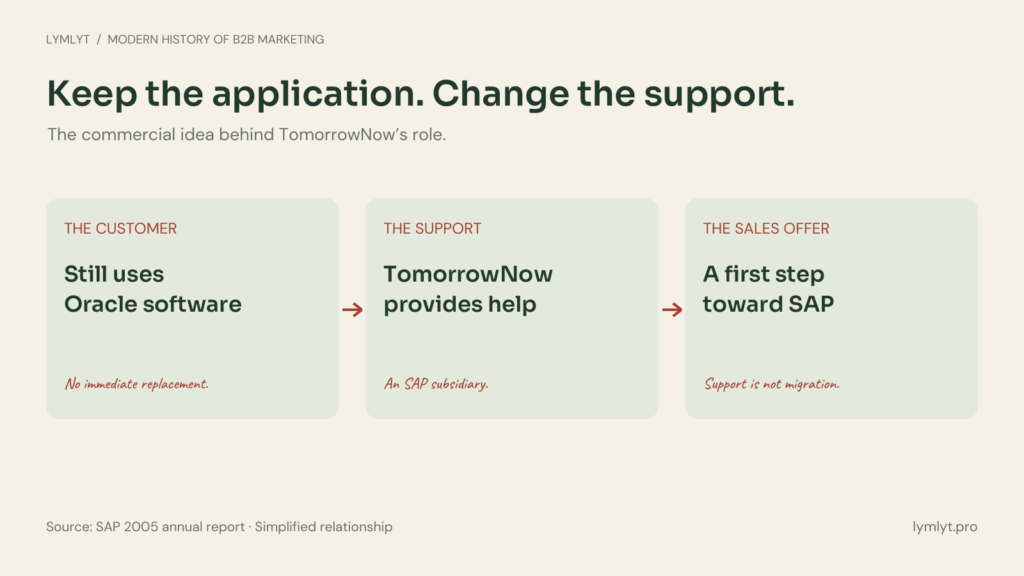
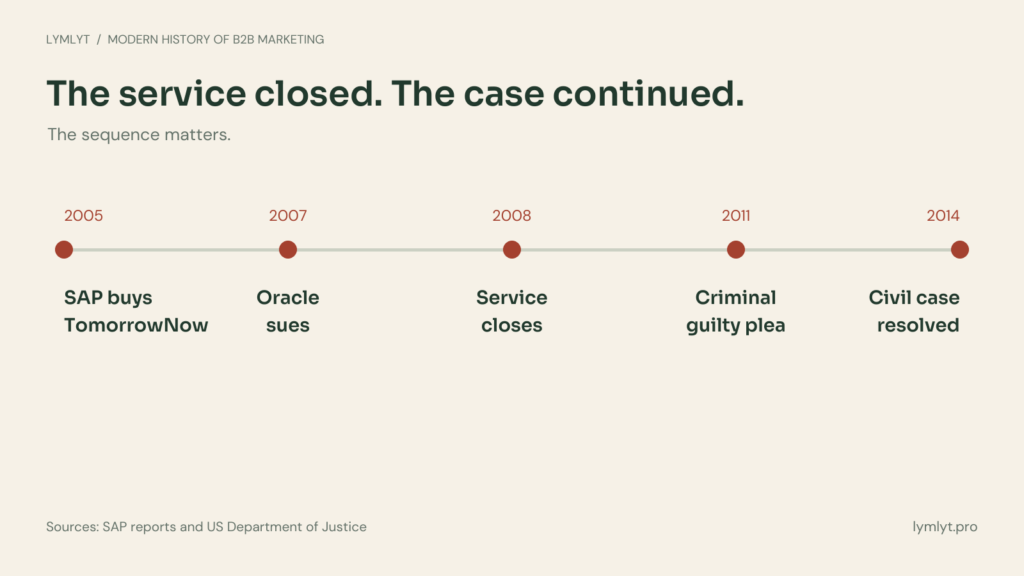
In 2005, SAP bought TomorrowNow, a company providing support for software including PeopleSoft and J.D. Edwards, which Oracle had acquired. SAP could now offer those customers a smaller first step: keep using the applications, but pay someone else to support them.
The offer became part of Safe Passage, SAP’s programme to win customers from Oracle. It had a persuasive promise, a coordinated marketing campaign and customers signing contracts. What it also had was a subsidiary obtaining material it was not entitled to take.
What was SAP actually offering?
Businesses pay for software and often pay recurring fees for help maintaining it. Changing the support provider is different from replacing the software itself.
SAP’s offer combined discounted support through TomorrowNow with incentives and help for customers considering a later move to SAP applications. An internal SAP presentation, subsequently filed in court, advertised support savings of 50% and, where applicable, substantial licence credits toward SAP.
For a buyer, the appeal was immediate savings without an immediate overhaul. For SAP, it was a way to start a relationship with a rival’s customer before that customer was ready to replace its core systems.
That is the marketing idea worth examining: the offer addressed the difficulty of switching, rather than simply insisting SAP was better. It is the question our guide to B2B competitor-comparison pages asks marketers to take seriously. What would a buyer actually have to do to choose you?
SAP called the campaign “Turn up the Heat”
This was more than a promise on a website. SAP’s campaign plan, preserved in a court exhibit, sets out three overlapping waves in 2006: calls and emails with limited-time offers, then advertising and landing pages, followed by targeted outreach and events.
The messages addressed Oracle customers’ uncertainty about future support and offered savings and time to decide. Later activity made the case for moving to SAP.
Simplified from SAP’s campaign-planning slides filed in the Oracle litigation. These are planned activities, not a reconstruction of every ad that ran.
The sequence makes commercial sense. Someone willing to discuss a cheaper support bill may still refuse a meeting about replacing their entire finance system. SAP had an offer for that earlier conversation. For marketers planning content distribution, the useful detail is that the channels supported different stages of the buyer’s decision, rather than repeating the same pitch everywhere.
Did the campaign bring in business?
SAP reported that it did. A TomorrowNow status presentation credited the campaign with more than 150 opportunities and 17 signed contracts.
Those were SAP’s internal figures. Seventeen TomorrowNow support contracts did not mean 17 businesses had replaced their Oracle systems with SAP. Nor do those numbers prove the programme was profitable.
The distinction matters because the smaller commitment was the point of the offer. SAP could win the support relationship first and hope to sell more later. It had evidence that buyers would take that first step.
Why did Oracle sue?
The problem was how TomorrowNow obtained material used in its support business.
Oracle sued in 2007. The dispute concerned unauthorised access and copying of Oracle’s support material and software. In the separate criminal case, TomorrowNow pleaded guilty to computer-intrusion and copyright-infringement charges and received a $20 million fine in 2011, according to the US authorities’ sentencing announcement.
Providing competing support was not, by itself, what that guilty plea established as criminal. The admitted conduct involved obtaining and copying material without authorisation. That is a crucial difference: a company can make an attractive offer and still use unlawful means to deliver it.
SAP shut TomorrowNow down in 2008, as recorded in its 2009 annual filing. The service that helped make the pitch possible was gone. The litigation continued.
Was the final bill $1.3 billion or $359 million?
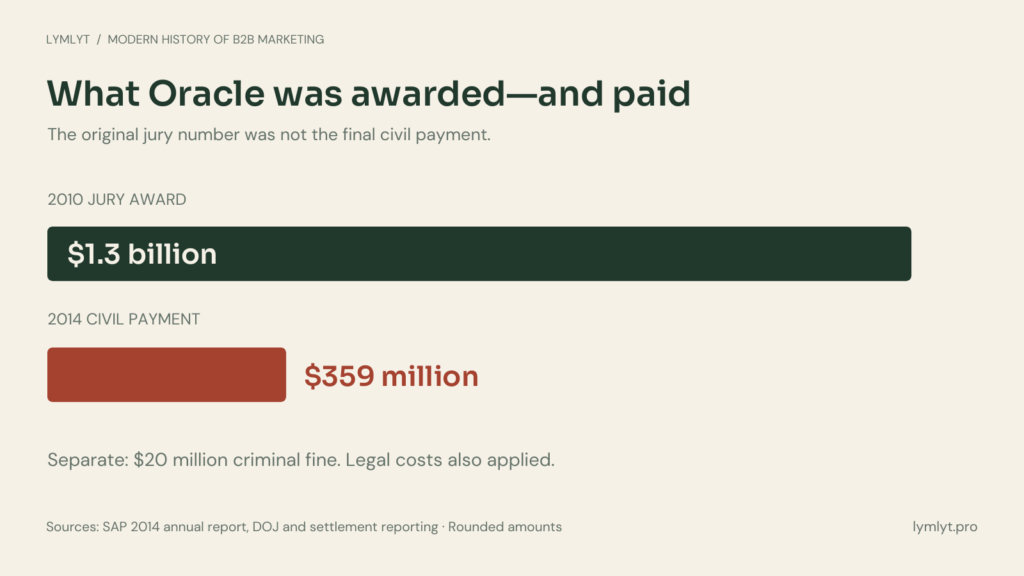
Both numbers appear in this story, but they describe different stages.
A jury awarded Oracle about $1.3 billion in 2010. That award was set aside. After further proceedings, SAP’s 2014 annual report recorded a payment of approximately $359 million on November 25, 2014, following the final civil resolution.
That payment is not a figure to add to the original $1.3 billion award. The criminal fine and legal costs were separate again. The diagram below keeps those amounts apart; it should not be read as one combined bill.
A good offer could not save the business delivering it
SAP had identified a real obstacle to winning Oracle customers: they could want an alternative and still dread the move. Safe Passage gave them something smaller to say yes to. The campaign records let us follow that idea into outreach and signed support contracts.
The ending is equally concrete. TomorrowNow closed. It later pleaded guilty. SAP paid hundreds of millions of dollars to resolve the civil case.
That does not make every competitive-switching offer suspect. It makes this one a useful warning about what a marketer is promising. Before asking a customer to trust your easier way out, you need to know that the business can deliver it lawfully. In this case, SAP found buyers for cheaper support, but closed the subsidiary that provided it while the litigation was still underway.
Think B2B is boring?
That's coz you are not subscribed to ours newsletter. We share a 100 bad days (of B2B marketing) made a 100 good stories. A 100 good stories make YOU interesting at parties.
Almost there. Check your inbox and click the confirmation link.

Rashmita is content marketer with 8 years of experience building and growing SaaS brands. Now she tests various AI tools for marketers and shares her feedback on this blog, LinkedIn, Instagram, and YouTube.