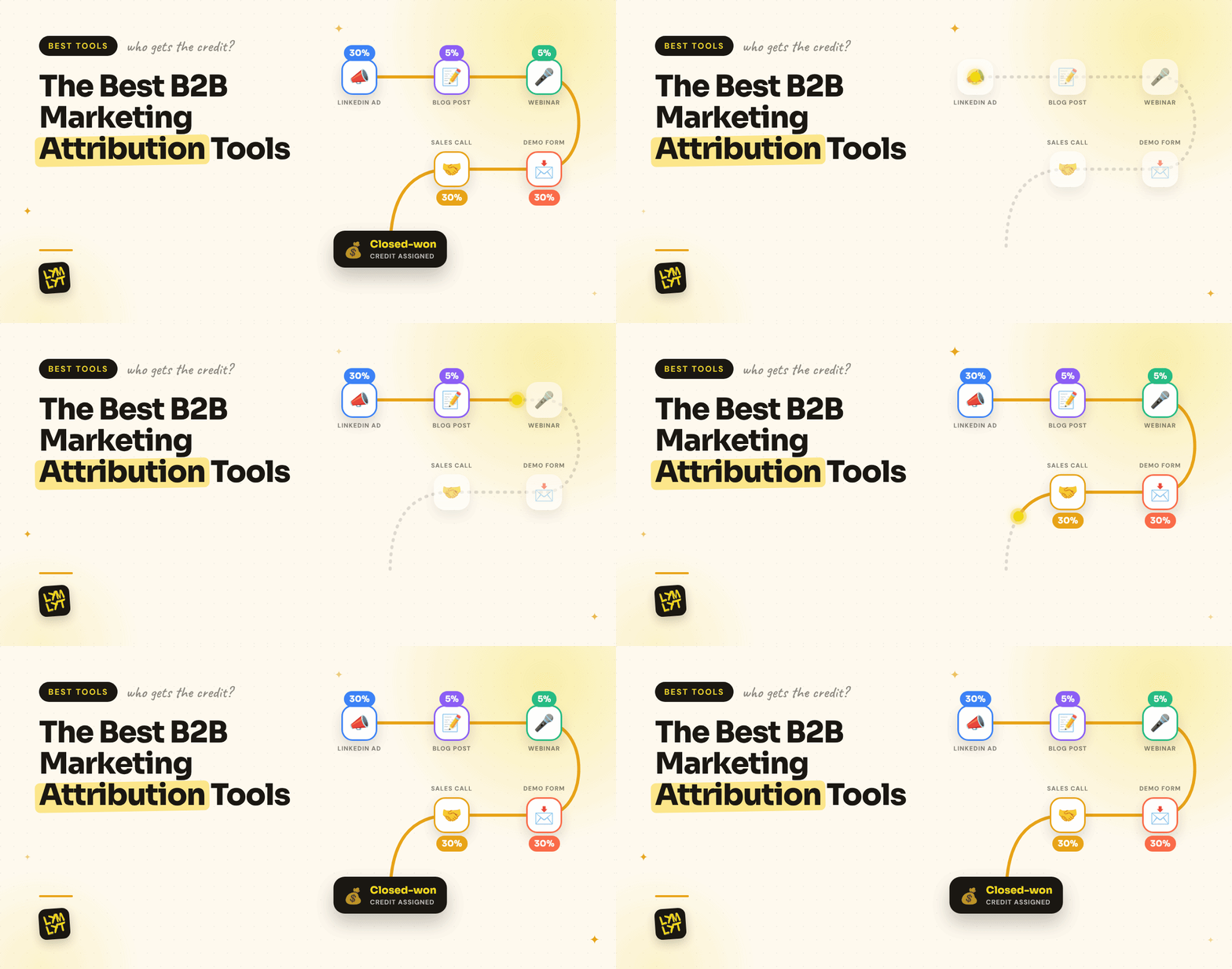
The 9 Best B2B Marketing Attribution Tools in 2026
Your CFO asks which channel drove last quarter’s pipeline. Your CRM says “direct.” Your ads dashboard says LinkedIn. Your sales team says it was a referral. Everyone is guessing, and the budget goes to whoever argues best. B2B marketing attribution tools exist to replace that argument with evidence.
It is a hard problem. Dreamdata’s 2025 LinkedIn Ads Benchmarks Report found the average B2B journey takes 211 days and 76 touches, with 6.8 buyer stakeholders involved (The Wise Marketer). In 6sense’s 2024 research, buyers were nearly 70% through the process before engaging sellers (Demand Gen Report). Last-click reporting cannot describe a journey like that.
No tool sees everything, so this list is sorted by the job each one does, from full-funnel platforms to the free baseline. Start with your budget and your CRM, then pick the tool built for your setup. For the measurement side, our guide to pipeline influenced is a good primer.
Try our FREE AI visibility checklist
What B2B attribution actually needs to do
Attribution assigns credit for revenue to the marketing touches that led to it. B2B makes that harder than B2C in three ways.
Accounts, not people. Several people from one company touch your marketing before one of them fills in a form. Good B2B marketing attribution tools stitch those people into one account journey.
Long cycles. A deal that closes in month seven started with touches your cookie window forgot. Tools need long lookback windows and CRM data to connect the start to the end.
Offline and invisible touches. Events, sales calls, podcasts, communities and AI answers rarely leave a click. As we covered in the recommendation that never appears in your CRM, some of your best sources never show up in any tool, which is why self-reported attribution matters too.
Attribution models, explained
Every tool on this list offers several models. Here is what each one does with the same five-touch journey.
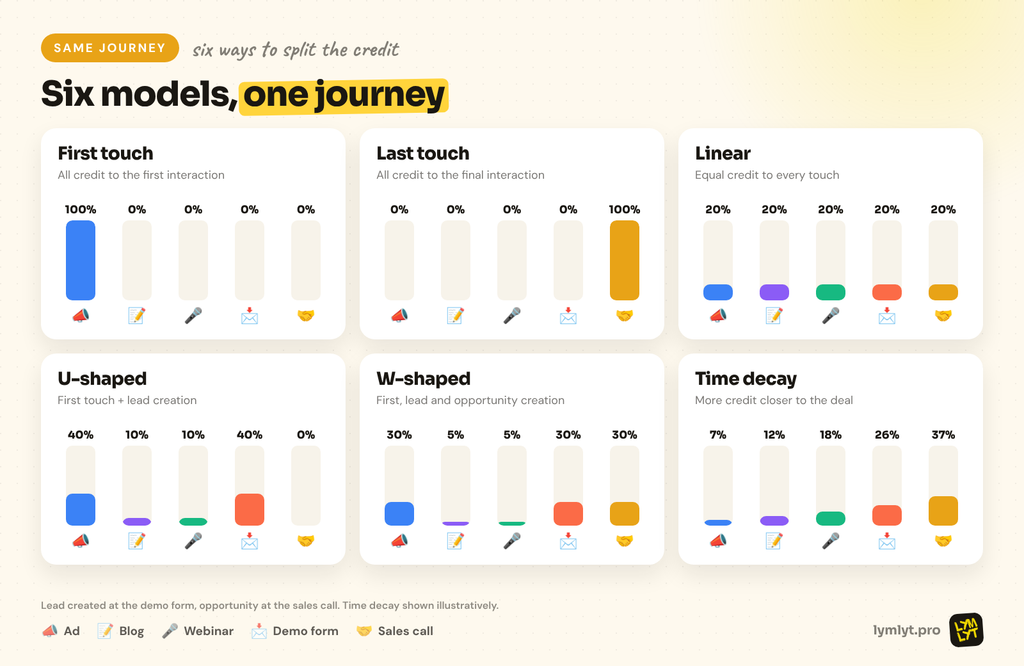
First touch gives all credit to the first interaction. Good for judging what creates awareness.
Last touch gives all credit to the final interaction before conversion. Good for judging what closes, and the default in most ad platforms.
Linear splits credit equally across every touch. Fair, but it treats a random blog visit the same as a demo request.
U-shaped gives most credit to the first touch and the lead-creation touch, and spreads the rest across the middle.
W-shaped adds a third key moment, usually opportunity creation, and is the closest fit for most B2B funnels.
Time decay gives more credit to touches closer to the conversion.
Data-driven models use your own conversion data to assign credit. They need volume to be reliable, which many B2B companies do not have.
No model is “true.” Pick the one that matches the decision you are making, and keep it stable so trends are comparable quarter to quarter.
What to look for in B2B marketing attribution tools
CRM connection. Attribution is only useful if it reaches opportunities and closed-won revenue, which live in your CRM. Check native Salesforce or HubSpot sync.
Account-level stitching. The tool should group anonymous and known visitors into accounts.
Offline and self-reported data. Look for ways to import events, sales activities and “how did you hear about us” answers.
Ad spend import. To compare channels on cost per opportunity, the tool needs spend from LinkedIn, Google and Meta.
Price at your stage. The range on this list runs from free to around $50,000 a year. Match it to how much budget the reports will actually move.
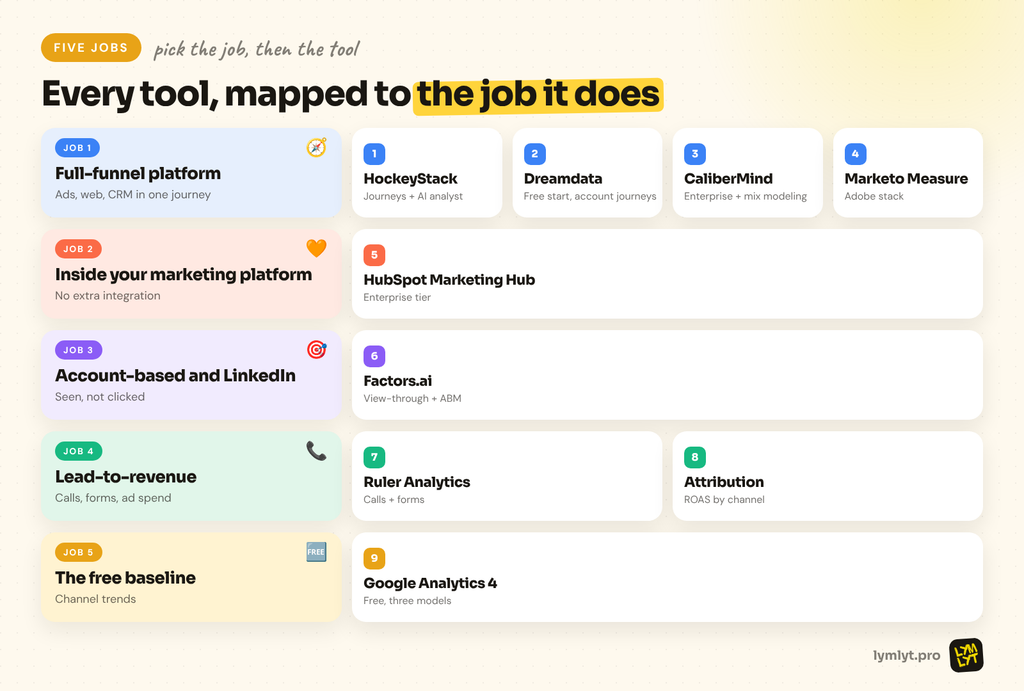
The 9 B2B marketing attribution tools at a glance
| Tool | Job | Best for | Price |
|---|---|---|---|
| HockeyStack | Full-funnel platform | Mid-market SaaS revenue teams | Custom; Vendr median $29,702/yr |
| Dreamdata | Full-funnel platform | Account journeys with a free starting point | Free plan; Advanced custom |
| CaliberMind | Full-funnel platform | Enterprise teams with complex data | Custom; Vendr median $49,750/yr |
| Adobe Marketo Measure | Full-funnel platform | Teams already on Adobe and Marketo | Custom |
| HubSpot Marketing Hub | Inside your marketing platform | Teams running on HubSpot | Enterprise $3,600/mo |
| Factors.ai | Account-based and LinkedIn | ABM teams spending on LinkedIn | Free plan; paid by quote |
| Ruler Analytics | Lead-to-revenue | Lead-gen teams with calls and forms | From $360/mo (annual) |
| Attribution | Lead-to-revenue | Ad-heavy teams on HubSpot, Salesforce or Segment | Pro $399/mo |
| Google Analytics 4 | Free baseline | Every team, as a starting point | Free |
Prices checked on vendor pricing pages and Vendr in October 2026. Vendr figures are median annual contracts reported by Vendr. Confirm before you buy.
Job 1: Full-funnel attribution platforms
These four connect website, ads, CRM and product data into account journeys, with multi-touch models across the whole funnel.
1. HockeyStack
HockeyStack combines attribution, journey analytics and dashboards in one platform for B2B revenue teams. Customers on its pricing page describe examining data across multiple attribution models and attribution “that shows what’s actually working.” Its AI analyst, Odin, answers questions about your funnel in plain language.
It suits marketing ops and revenue teams that want one place to report on pipeline by channel, campaign and content, without building a data warehouse first.
Price: Custom, with startup pricing available (HockeyStack pricing). Vendr reports a median of $29,702 a year across 33 purchases, with a range of $24,040 to $77,500 (Vendr).
Best for: Mid-market B2B SaaS teams that want attribution, journeys and AI reporting in one tool.
Skip it if: You are pre-revenue or running a single channel. The insight needs volume.
2. Dreamdata
Dreamdata builds account-based customer journeys from your website, ads, CRM and other sources, then attributes revenue to the touches inside them. Advanced plans include AI-based and custom attribution models, revenue and content analytics and ROI and ROAS reporting, according to Dreamdata pricing.
Its free plan is the most generous starting point among the platforms here: B2B web analytics, cookie and cookieless tracking, company identification and benchmarks for up to 5 seats, with 2 months of history. Multi-touch attribution models sit on the paid Advanced plan.
Price: Free plan available. Advanced is custom (Dreamdata pricing). Vendr reports a median of $35,440 a year, with a range of $27,000 to $96,000 (Vendr).
Best for: Teams that want to start with free account analytics and grow into full attribution.
Skip it if: You need multi-touch models today and have no budget for Advanced.
3. CaliberMind
CaliberMind is a B2B measurement platform for enterprise go-to-market teams. It combines multi-touch attribution, ABM account scoring, buyer journey signals and marketing mix modeling on a Google BigQuery warehouse with 170+ pre-built connectors. Its assistant, Agent Cal, answers attribution questions in plain language with an audit trail.
It tracks online and offline touchpoints, lets you customize models and writes insights back to Salesforce and other enterprise CRMs, according to CaliberMind.
Price: Not published. Vendr reports a median of $49,750 a year, with a range of $6,000 to $53,340 (Vendr).
Best for: Enterprise teams with messy data across many systems who need attribution and mix modeling together.
Skip it if: You are a small team on HubSpot. Simpler tools will get you most of the way.
4. Adobe Marketo Measure
Adobe Marketo Measure is Adobe’s B2B attribution product. It runs several pre-built models at once, including full-path, U-shaped, W-shaped, first-touch and lead-creation, plus custom and AI-driven models. It collects touchpoints from online channels, offline channels and sales and BDR activity, which Adobe calls “every-touch attribution.”
You can define your own channels, funnel stages and go-to-market motions, and report through in-app dashboards, BI templates, a data warehouse or CRM reports.
Price: Not published. Quoted by Adobe.
Best for: Enterprise teams already invested in Adobe and Marketo Engage.
Skip it if: You are not on the Adobe stack. Setup and cost make more sense inside it.
Job 2: Attribution inside your marketing platform
5. HubSpot Marketing Hub
HubSpot Marketing Hub includes multi-touch revenue attribution reporting on its Enterprise tier, according to HubSpot pricing. Because contacts, deals and campaigns already live in HubSpot, attribution works without a separate integration project.
That makes it the obvious choice if your whole stack already runs on HubSpot. The trade-off is that it only sees what HubSpot tracks, and the Enterprise price is a big jump from Professional. Our list of the best CRM tools for B2B SaaS compares HubSpot with the alternatives.
Price: Enterprise is $3,600/mo with 5 core seats, plus a one-time $7,000 onboarding fee (HubSpot pricing).
Best for: Teams already on HubSpot that want attribution without another tool.
Skip it if: You are on Professional and the Enterprise upgrade is only for attribution. A dedicated tool may cost less.
Job 3: Account-based and LinkedIn attribution
6. Factors.ai
Factors.ai identifies the companies visiting your site, tracks their journeys and attributes pipeline to marketing touchpoints, with a strong focus on LinkedIn. Its Adpilot features include audience sync, conversions API, view-through attribution and bid scheduling for LinkedIn ads, according to Factors.ai pricing.
View-through attribution matters for B2B because most LinkedIn ads are seen, not clicked. Without it, LinkedIn looks worse in your reports than it performs.
Price: Free plan identifies up to 1,500 companies a month with one month of data. Basic, Growth and Enterprise are priced by quote (Factors.ai pricing).
Best for: ABM teams spending heavily on LinkedIn who need to prove its impact.
Skip it if: LinkedIn is a small part of your spend.
Job 4: Lead-to-revenue attribution for smaller teams
7. Ruler Analytics
Ruler Analytics connects leads to revenue in your CRM, including leads that arrive by phone through dynamic call tracking. Every plan includes multi-touch attribution with first click, last click, time decay, linear and position-based models, according to Ruler pricing. Data-driven attribution starts on Medium.
It integrates with Salesforce, HubSpot, Dynamics 365, Pipedrive and other CRMs, which suits lead-gen businesses where calls and forms both matter.
Price: Small is $360/mo billed annually or $400 monthly for up to 10,000 visits. Medium, Large and Advanced scale with traffic (Ruler pricing).
Best for: Lead-gen teams where phone calls and forms both drive revenue.
Skip it if: You need account-level ABM reporting.
8. Attribution
Attribution connects ad spend to revenue for teams on HubSpot, Salesforce or Twilio Segment. The Pro plan includes five models (first touch, last touch, linear, time decay and position-based), all digital ad connectors, ROAS comparison by model and a marketing spend cohort view, according to Attribution pricing.
Account-based attribution, offline channels and custom lookback windows sit on the Custom plan. For ad-heavy B2B teams with simple funnels, Pro covers the core question: which spend turns into revenue?
Price: Pro is $399/mo billed monthly for up to 10,000 tracked visitors, with 16% off yearly and a 14-day trial (Attribution pricing).
Best for: Paid-heavy teams that want ROAS by channel tied to CRM revenue.
Skip it if: You need account-based attribution on the Pro budget.
Job 5: The free baseline
9. Google Analytics 4
Google Analytics 4 is free and almost certainly already on your site. It now offers three attribution models: data-driven, paid and organic last click, and Google paid channels last click. First click, linear, time decay and position-based were removed in November 2023, according to Google.
GA4 cannot see your CRM revenue or stitch people into accounts on its own, so it is a baseline, not a B2B attribution system. Use it to check channel trends and as a sanity check on paid tools.
Price: Free.
Best for: Every team, as the first layer of measurement.
Skip it if: You need revenue, account or offline attribution. Add a dedicated tool.
What attribution actually costs
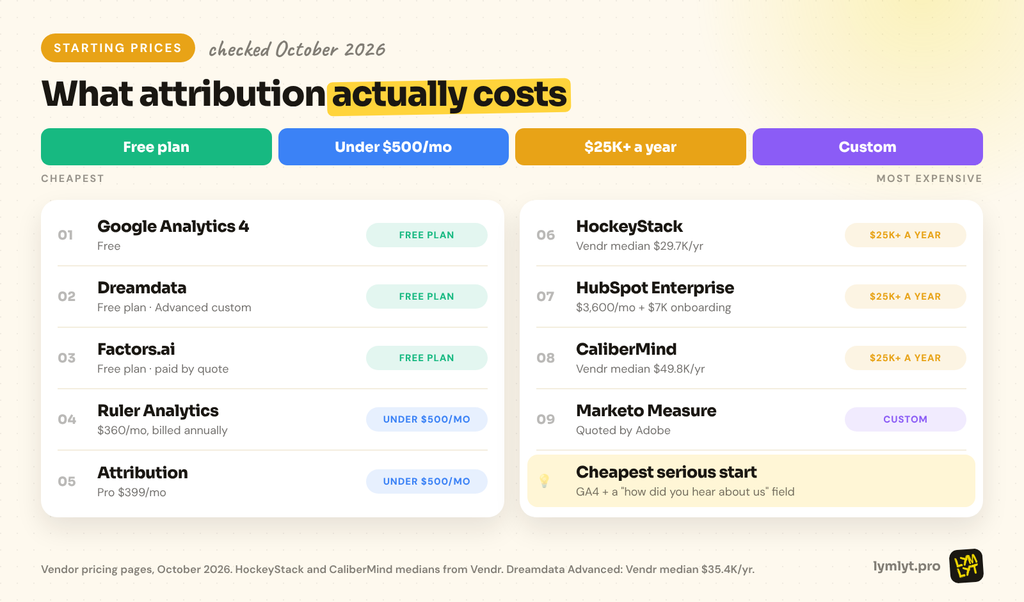
Most B2B teams can start for free. GA4 covers channel trends, and the free plans from Dreamdata and Factors.ai add company identification. Ruler and Attribution sit in the middle at a few hundred dollars a month. Full platforms like HockeyStack, Dreamdata Advanced and CaliberMind typically run $30,000 to $50,000 a year by Vendr’s medians, so buy them when your marketing budget is big enough that better allocation pays for them.
Add self-reported attribution
Software only sees clicks and visits. Add one open-text field to your demo form: “How did you hear about us?” Compare the answers with your attribution reports every month.
The gaps are usually where your best channels hide: podcasts, communities, word of mouth and, increasingly, AI assistants. As we covered in AI has entered the buying committee, buyers now ask ChatGPT for shortlists before they visit a site, and no pixel records that. Our piece on AI visibility ROI covers what to report instead.
How to choose
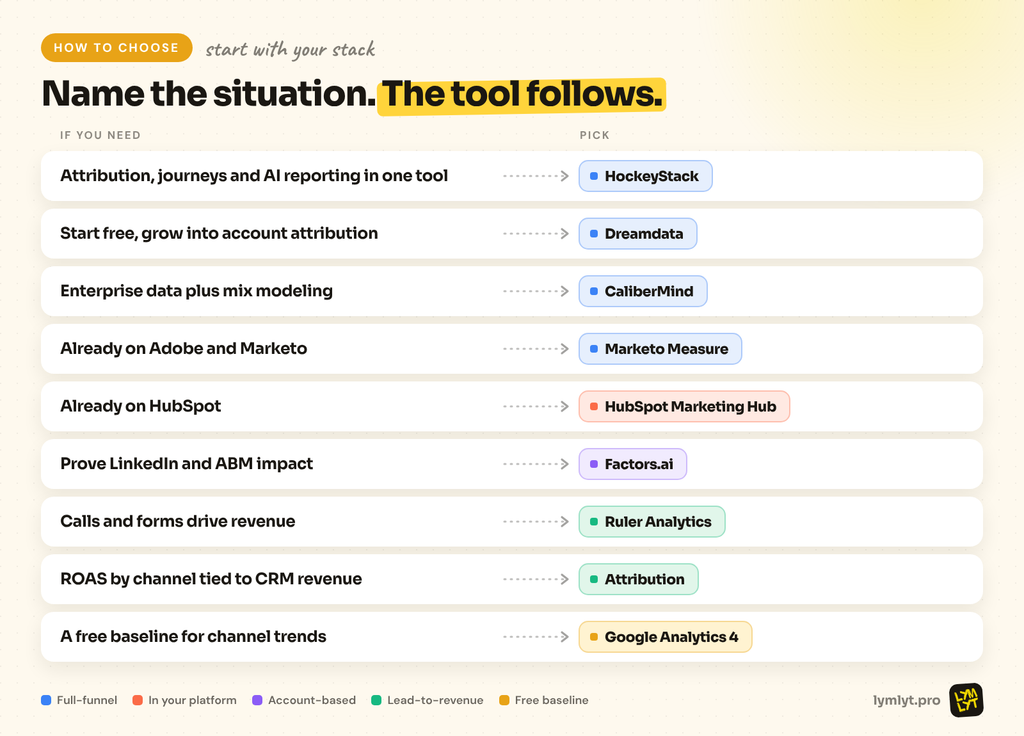
- Attribution, journeys and AI reporting in one tool: HockeyStack
- Start free, grow into account attribution: Dreamdata
- Enterprise data plus mix modeling: CaliberMind
- Already on Adobe and Marketo: Adobe Marketo Measure
- Already on HubSpot: HubSpot Marketing Hub
- Prove LinkedIn and ABM impact: Factors.ai
- Calls and forms drive revenue: Ruler Analytics
- ROAS by channel tied to CRM revenue: Attribution
- A free baseline for channel trends: Google Analytics 4
The bottom line
The best B2B marketing attribution tools will not give you a perfect answer, because B2B journeys are too long and too offline for that. What they give you is a consistent, defensible view of which channels create pipeline, so budget follows evidence instead of opinion.
Start with GA4 and a “how did you hear about us” field. Add a mid-priced tool when ad spend grows, and a full platform when better allocation is worth $30,000 a year or more. Then remember that attribution only measures demand. It does not create it. If your reports show content driving pipeline and you want more of it, our guide to SaaS content marketing metrics shows what to track, and LymLyt can build the content.

Jay is the co-founder of LymLyt and an AI partnership consultant helping B2B SaaS companies grow through content strategy, SEO, and AI integration. He writes about content marketing, what makes B2B content convert, and how SaaS teams can build content systems that drive real pipeline.