Why More MQLs Can Still Mean Less Pipeline
The marketing report looks good. Downloads are up. Webinar registrations are up. The team has passed more leads to sales.
But sales says the conversations are going nowhere.
This is an imagined situation, but a familiar problem: someone can be interested in your content without being interested in buying your product.
AI makes this problem easier to notice. Buyers can get explanations, summaries, and comparisons without requesting a guide from you. A form fill tells you something. It rarely tells you the whole story.
What an MQL actually tells you
An MQL is a marketing-qualified lead. It is a person who meets criteria your company has set for passing a contact to sales.
Those criteria might include a suitable job title, company size, and activity such as attending a webinar or visiting a pricing page.
Pipeline is the potential business your sales team is working on. A qualified opportunity is a possible deal with enough evidence of a suitable buyer and a real need to pursue it.
The label sounds more certain than it is. It means “this person meets our rules.” It does not automatically mean “this company has a buying project.”
A manager might download a guide to learn. A consultant might be researching for a client. A genuine buyer might read everything anonymously and contact you only when they need a specific answer.
The problem is treating all these actions as equally strong buying signals.
Why getting a useful MQL can feel harder
If people can get a basic answer elsewhere, a generic guide gives them less reason to hand over their email address. That is a reasonable explanation for some falling form conversions, rather than proof that AI caused every decline.
G2’s 2025 buyer research, based on 1,169 B2B decision-makers surveyed that April, found that nearly two-thirds preferred speaking with vendor salespeople later in their buying journey. That is a preference, not a rule that every buyer follows.
Buyers can still want help. They may want it after they understand the options, and they may want a useful conversation rather than a standard sales sequence.
There are other explanations to check, too. Your traffic may have changed. Your offer may be weak. Your form may ask too much. Your scoring rules may reward activity that never predicted sales well.
Before blaming the new buying journey, look at who is arriving and what you are asking them to do.
More leads can produce fewer opportunities
Here is a simple, hypothetical example. These are made-up numbers, not industry benchmarks.
| Measure | Campaign A | Campaign B |
|---|---|---|
| MQLs generated | 500 | 150 |
| MQLs that become qualified opportunities | 2% | 12% |
| Qualified opportunities | 10 | 18 |
| Average opportunity value | $20,000 | $20,000 |
| Total opportunity value | $200,000 | $360,000 |
Campaign A wins on lead volume. Campaign B creates more potential revenue.
That does not make B the automatic winner. You would still compare campaign costs, sales effort, actual wins, and how long deals take. Opportunity value is potential revenue, not money earned.
But it shows why celebrating the first number can hide what happens later.
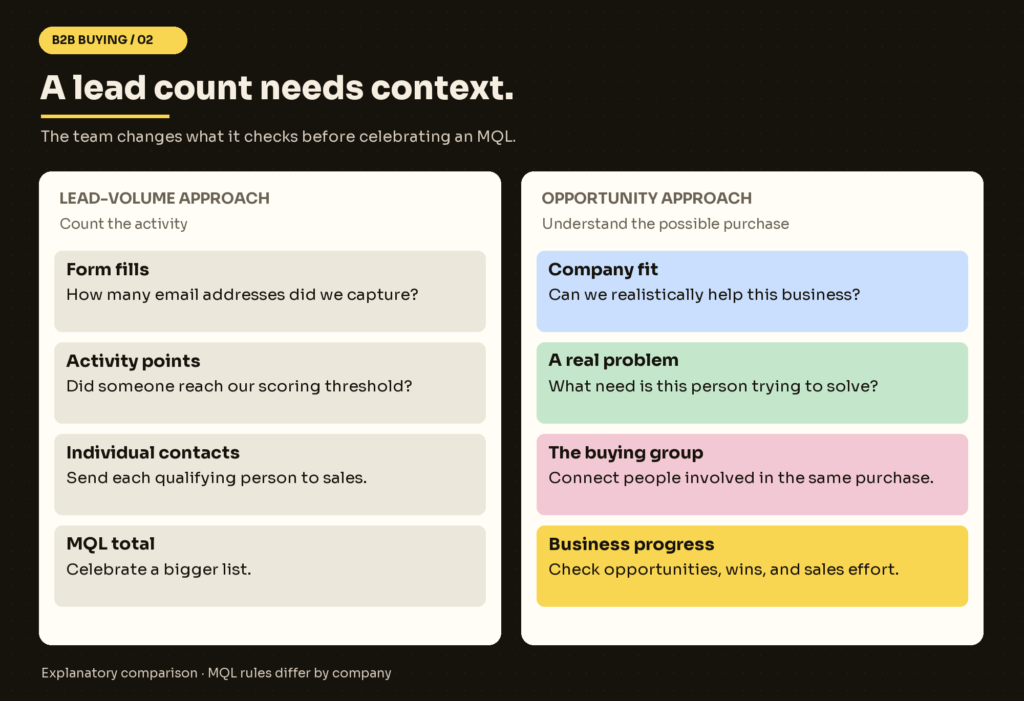
The change is in what the team checks. Activity becomes more useful when it is connected to a real company, problem, and buying process.
One person is only part of the purchase
A software purchase can involve the person who will use it, the manager paying for it, IT, and someone checking contracts.
They need different answers. The user wants an easier day. The manager wants a worthwhile result. IT wants to know what will connect and what could go wrong.
Forrester’s 2025 article on buying groups describes a shift from individual leads to the people involved in a purchase. It includes this account from Palo Alto Networks:
“During the pilot stage, win rates doubled.”
— Jeremy Schwartz, Palo Alto Networks, as reported by Forrester
That is one company’s reported result from a revenue process transformation, not an improvement every company should expect.
The practical lesson is smaller than the headline: when several people from a suitable company are exploring the same problem, connect that information. Do not leave each contact looking like an unrelated lead.
An MQL can still help you organize a handoff. It needs context around it.
The argument on LinkedIn is really about what we reward
In a LinkedIn post about lead generation, Dave Gerhardt argues for the importance of brand and reputation. A commenter pushes back, describing a lead campaign that worked well for their business.
Both are practitioner views, not controlled research. Together, they show why “lead generation is dead” is too broad.
Lead capture can work. A useful request from a suitable buyer is valuable. The question is whether your team rewards capturing an email address or creating a purchase opportunity.
If everyone is judged mainly on MQL volume, teams have a reason to find more people who qualify on paper. Changing the definition without changing the reward may simply create a new version of the same problem.
Give people a reason to take the next step
Useful content should help buyers make progress even when they do not complete a form.
A clear comparison can help someone choose. A case study can help them explain the choice to their manager. An implementation guide can reveal whether the product fits their team.
LymLyt’s guide to why B2B SaaS content does not convert explores gaps between attracting attention and helping someone move forward. Its guide to mapping content to the SaaS funnel is useful for deciding what help belongs at each stage.
Keep a form where there is a clear exchange: a personal assessment, a trial, or a conversation about the buyer’s situation. Make the next step match the help they need.
Reading a blog post should not automatically trigger the same treatment as asking for a product demo.
Start with a better handoff
Marketing and sales can agree on four questions:
- Fit: Can we realistically help this company?
- Problem: Is there evidence of a need our product solves?
- People: Who is involved, and whose questions remain unanswered?
- Next step: What would help this buyer move forward now?
Record what you know and what remains uncertain. A scoring system should help prioritize work, not turn guesses into facts.
A scorecard that connects MQLs to business results
Follow a consistent group of leads over time. A lead captured last week has had less time to become a customer than one captured six months ago. Keep the definitions and observation window the same when comparing sources.
| Measure | How to calculate or record it | What it helps you decide |
|---|---|---|
| Sales acceptance rate | Accepted leads ÷ leads handed to sales | Whether the handoff is useful |
| Opportunity conversion rate | MQLs linked to a qualified opportunity ÷ MQLs in the group | Whether qualification predicts a real purchase project |
| Cost per qualified opportunity | Defined program costs ÷ unique qualified opportunities linked to the program | Whether producing opportunities is affordable |
| Opportunity win rate | Won opportunities ÷ all closed opportunities in the group | Whether suitable demand becomes business |
| Buying-group coverage | Known relevant roles involved in each opportunity | Which questions or stakeholders may still be missing |
Document which costs you include. Count a deal once even when three contacts become MQLs. If an opportunity is linked to several programs, disclose the overlap; do not add each program’s full opportunity value into a company total.
Attribution should explain the handoff, not hide the history
A webinar registration may be the action that made a lead qualify. It does not follow that the webinar created all the interest behind the purchase.
Keep separate records for the action that triggered qualification, the observed campaign history, and what the buyer says introduced them to you. That distinction lets you ask two useful questions: which actions help identify demand, and which programs may help create it?
Use one agreed attribution rule for the reporting question. Google Analytics’ attribution guide explains how a model allocates credit among recorded interactions. Changing the model changes the allocation; it does not make missing interactions visible.
Look at whether source rankings change under another sensible model. If they do, the budget decision is sensitive to the rule. Bring in buyer interviews, actual wins, costs, and sales feedback before reallocating spending.
“Influenced pipeline” means a defined interaction was associated with a deal. It is useful context, not proof the interaction caused that deal. A rising MQL-to-opportunity rate also needs interpretation: a stricter definition can raise the rate without producing more opportunities.
Keep MQL volume beside the measures that explain business progress. Improve the qualification rule because it helps buyers and sales, not because it makes a dashboard look better.
A useful lead is the beginning of understanding a buyer. It is not the finished product of marketing.
Frequently asked questions
Should we stop using MQLs?
Only if the label no longer helps your workflow. Many teams can keep it, strengthen the definition, and add company and buying-project context. Judge it by the quality of the handoff and later outcomes.
Which source should get credit if several campaigns touched a deal?
Use a documented rule for the credit report and keep the wider history available. Count the opportunity once in the company total. Multiple programs can have a relationship with the same deal without each claiming they created all its value.
How long should we wait before judging lead quality?
Use your own sales-cycle history. Compare groups that have had similar time to progress and label newer ones as incomplete. Do not prescribe the same 30-day revenue target for a small subscription and a long enterprise purchase.

Rashmita is content marketer with 8 years of experience building and growing SaaS brands. Now she tests various AI tools for marketers and shares her feedback on this blog, LinkedIn, Instagram, and YouTube.