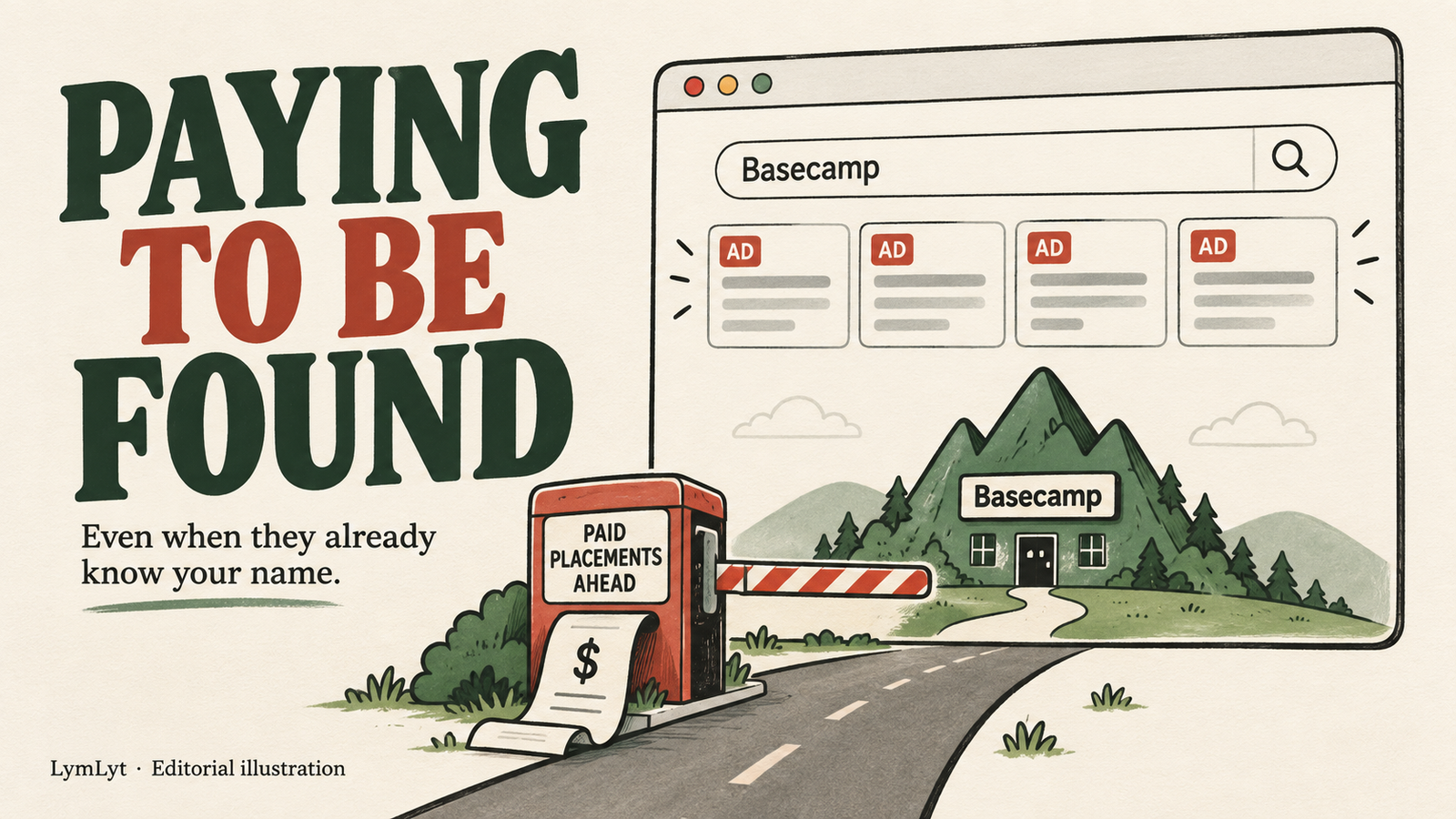
People searched for Basecamp. Google showed them its competitors first.
Imagine spending years building a brand. People finally know your name. They search for your company on Google and see your competitors first.
You can pay to appear above your own organically appearing name. But that means spending money to reach someone who was already looking for you.
That was Jason Fried’s complaint in September 2019. Basecamp, the project-management software company he cofounded, ranked first organically for its own name. Yet four paid ads could appear above its website. On September 3, Fried shared the ad Basecamp had bought in response.
Its headline: “We don’t want to run this ad.”
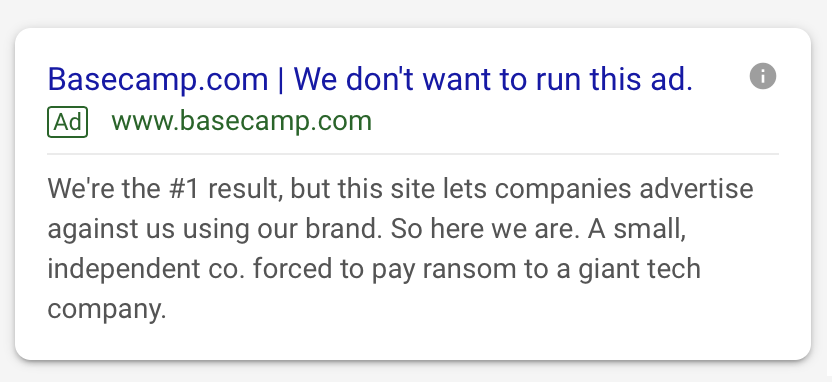
The copy explained that Basecamp was already the number-one result, complained about competitors advertising against its brand, and described the payment as ransom. On Basecamp’s podcast, Fried credited its marketer Adam with writing it.
You can understand the anger. A marketer wants to spend money bringing new people to a business. Basecamp was spending some of its budget trying to reach people who already knew its name.
Google hadn’t removed its organic ranking. It had put advertising space above it. Being the first unpaid result didn’t guarantee being the first business someone saw.
The ad gave people a simple way to share that frustration. By September 5, Genbeta reported that Fried’s post had passed 10,000 retweets and 30,000 likes.
Google answered.
Its response drew a distinction that would decide how much protection Basecamp could expect.
Under Google’s advertising rules, a competitor could use “Basecamp” as a keyword: an instruction to show its ad when someone searched that name. Using the protected name in the visible wording of the ad was different. Google said it restricted that use following a complaint from the trademark owner. It defended allowing trademark keywords as a way to show relevant ads. The contemporary report preserves Google’s response.
For an illustrative example, a fictional rival called Acme Projects could target searches for “Basecamp” while its ad simply said, “Acme Projects — Organise Your Team’s Work.” The word Basecamp wouldn’t have to appear in the advertisement at all.
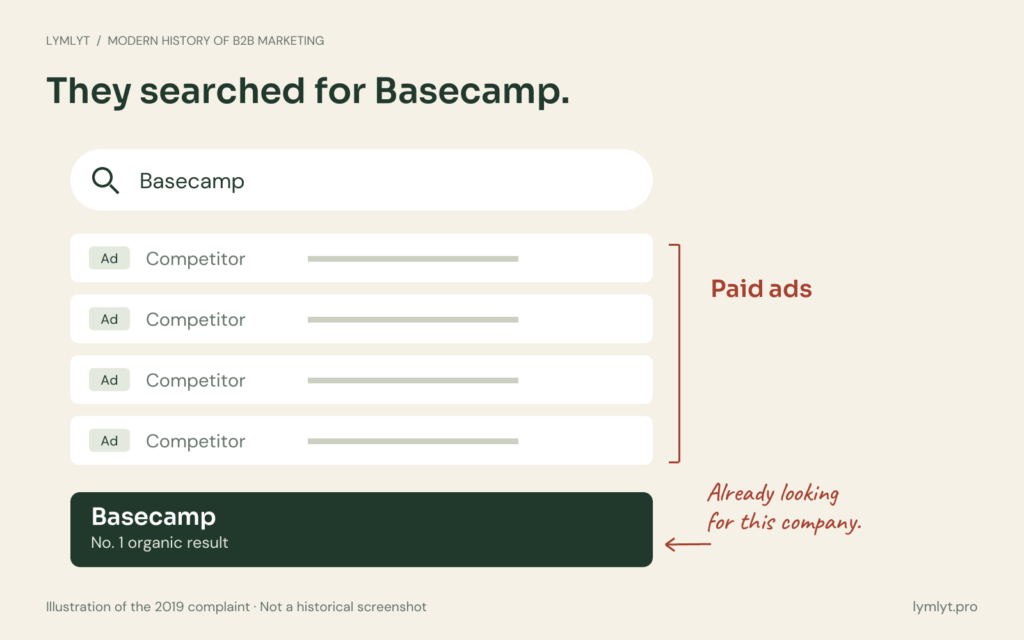
That ad could compete for a paid position above Basecamp’s unpaid result. Bidding money alone doesn’t guarantee first place: Google also considers relevance, ad quality and other factors.
This is familiar territory for marketers who build competitor-comparison pages. Someone interested in another product might be interested in yours. Fried’s objection was to paying Google to defend access to people specifically searching for his company.
Google reported removing ads that broke its policy. But removing offending wording didn’t stop a rival targeting Basecamp searches with a differently worded ad.
The story stayed in the news. On October 14, NPR interviewed Fried about Google’s power over businesses trying to reach customers through search. Basecamp’s complaint was being discussed as an example of a wider problem.
Congress was already looking into that problem.
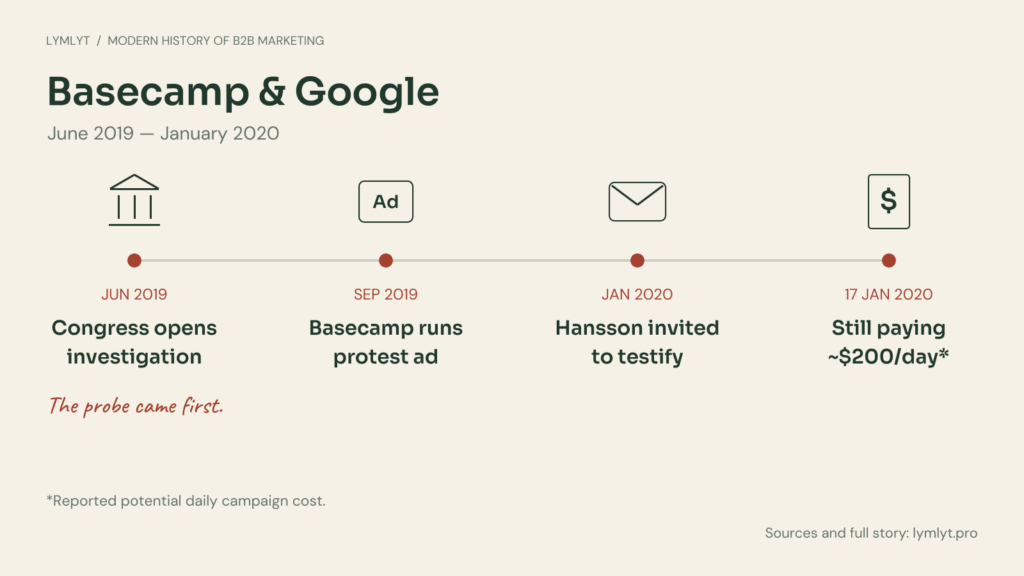
The House Judiciary Committee had opened its digital-markets investigation on June 3, 2019, three months before the protest ad. Lawmakers were examining whether powerful platforms harmed competition and whether existing laws were adequate.
Then, about a week before a January hearing, someone working for the committee emailed Basecamp cofounder David Heinemeier Hansson and invited him to testify.
Hansson later said he wasn’t told exactly why they chose him. He suspected his outspoken criticism on Twitter helped. He had roughly two business days to prepare his written testimony. He described the invitation on REWORK, starting at 2:17.
On January 17, 2020, in Boulder, Colorado, Hansson appeared alongside representatives of Sonos, PopSockets and Tile. This was a hearing gathering businesses’ experiences with powerful platforms. Basecamp’s ad was one example in a broader investigation, rather than the reason Congress opened it.
And by then, the expense Basecamp resented was still there.
Hansson’s written testimony described an ongoing campaign to defend its name that could cost roughly $200 a day. He put the annual figure at upwards of $72,000. Those were reported potential campaign costs, rather than a disclosed final bill for the protest creative.
He also described repeated complaints, slow enforcement and one advertiser returning with another offending ad two months after a takedown. He didn’t date that incident. What his account makes clear is that Basecamp still considered both enforcement and the cost of defending its name unresolved.
The ad later appeared in the House’s digital-markets report, originally released in October 2020. You can see it on page 169 of the official reprint. Its inclusion recorded the complaint; it wasn’t a ruling that Basecamp had won.
So what did the protest achieve?
It attracted public attention and brought a recognisable business complaint into the discussion about Google’s power. But four months after Fried shared the ad, Basecamp was still paying to defend searches for its name.
I found no verified final spending total, refund or evidence establishing how many sales the protest generated. As of September 2026, Google’s published policy still allows trademarks as keywords. That does not tell us what Basecamp spends today.
Like HubSpot’s experience with Google, this story shows how much a marketing effort can depend on a platform’s decisions. Basecamp had got people to remember its name. Its frustration was having to pay again when those people tried to find it.

Rashmita is content marketer with 8 years of experience building and growing SaaS brands. Now she tests various AI tools for marketers and shares her feedback on this blog, LinkedIn, Instagram, and YouTube.