Clay didn’t invent the “GTM engineer” job title, but it paid for their Series C
On Clay’s own blog, in a hiring guide written by Varun Anand (co-founder) and Mishti Sharma (Head of Narratives), there is this sentence:
“Since we coined this role in 2023, it has emerged at companies like Cursor, Lovable, and Webflow.”
Its lead investor said the same thing. From Meritech’s investment memo to a press prints like Sifted.
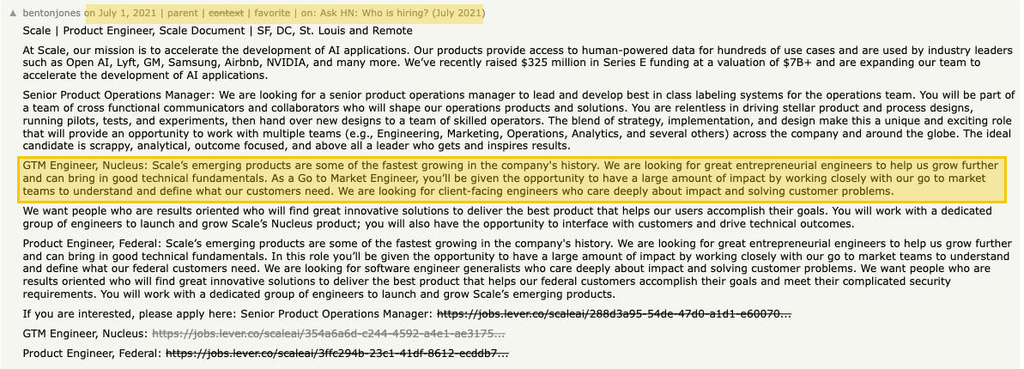
On July 1, 2021, Scale AI posted a job on Hacker News “GTM Engineer, Nucleus.” The body reads: “As a Go to Market Engineer, you’ll be given the opportunity to have a large amount of impact by working closely with our go to market teams to understand and define what our customers need.”
It is still there. news.ycombinator.com/item?id=27702226. Two years before Clay says it invented the role.
So Clay did not coin it. Which they so proudly own and talk about.
What is GTM Engineer?
Honestly, GTM engineering has no fixed definition, it is multiple jobs, clubbed together under one salary, real work, oversold label, and a great chance to create slop campaigns.
But if you want what they believe: a GTM engineer is the person who builds the machine that finds and reaches customers, instead of doing the reaching by hand.
The old way. An SDR opens LinkedIn, finds 50 companies that look right, checks each one’s website, guesses at an email address, writes 50 emails. Takes a week. Half the emails bounce.
The GTM engineer way. They build automations such as:
- Watch for a signal. Say, any company that just posted a job for a “Head of Content.”
- When one appears, pull the company’s details automatically. Size, funding, tech they use.
- Check it against the rules. Over 50 staff, B2B software, raised money in the last two years.
- Find the right person and their verified email.
- Write the email using something real from that company’s site, not a template.
- Drop it into the sales rep’s queue with the reason it was picked.
Does any of this sound right to you? Haven’t people already doing that, the SDRs and other sales folks.
Scale AI said the word and nothing happened
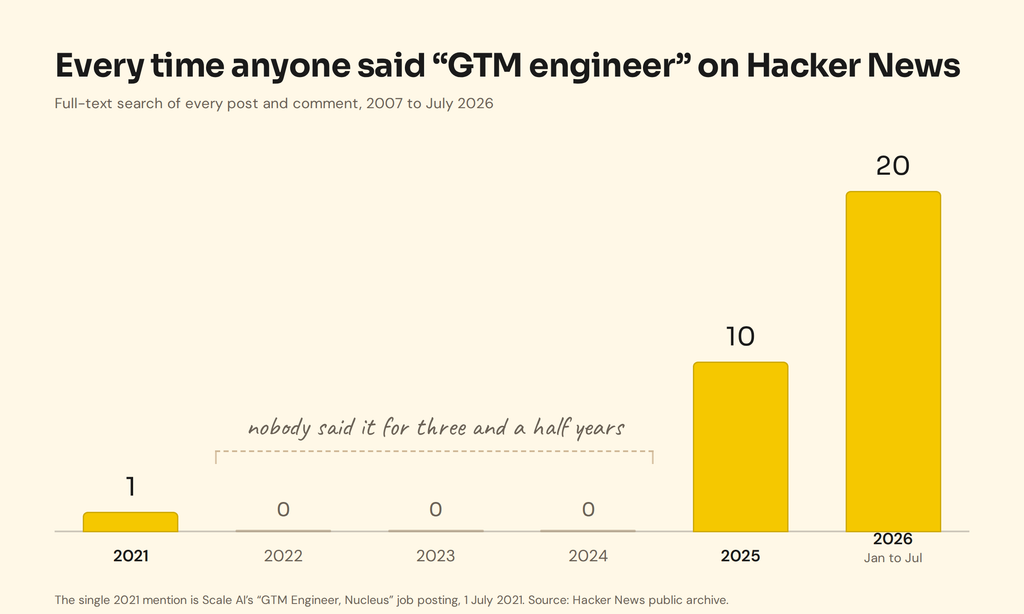
I ran a full-text search across every post and comment ever made on Hacker News. Not a sample. All of it. Here is every time anyone has typed “GTM engineer.”
| Period | Mentions |
|---|---|
| Before July 2021 | 0 |
| July 2021 | 1 |
| August 2021 to December 2024 | 0 |
| 2025 | 10 |
| January to July 2026 | 20 |
Three and a half years of silence. Scale AI had just raised $325M at a $7B valuation when it used the phrase. It had every advantage a company could have in getting a word to stick, and the word did not stick.
The term comes back on March 3, 2025, when a company called Count posts a GTM Engineer role at £95k to “automate as much of our outreach operations as possible.” Then ChipStack in May at $200k+. Then ZeroEntropy in June. By April 2026 somebody launches a job board on Hacker News that lists nothing but GTM Engineer roles.
Clay did not invent the words. Clay invented the reason to say them.
First, a little history of Clay
Clay was founded in 2017 by Kareem Amin and Nicolae Rusan, classmates at McGill. Amin had already sold a company, Frame, to Sailthru in 2012. It started as an attempt to make programming accessible to people who cannot program. It became a spreadsheet that pulls live data from APIs.
For five years it had no idea who it was for.
- Recruiters used it.
- Salespeople used it.
- Front-end engineers used it.
About twenty customers paid between $30 and $200 a month. In the spring of 2022, First Round Review reports, revenue was still “close to $0.”
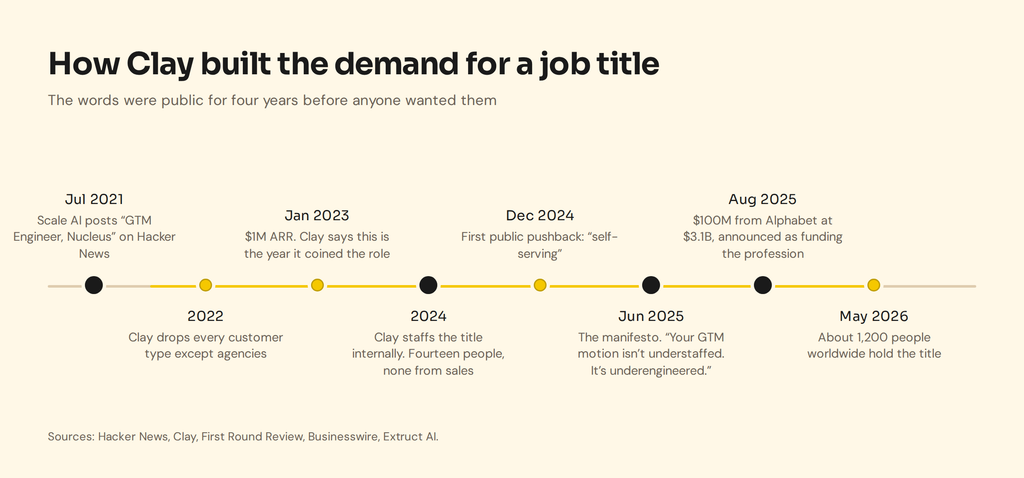
Varun Anand found Clay through a webinar in 2021, cold-emailed Kareem, and joined. In 2022 the two of them decided to pick one customer type and lose everyone else. They chose cold email and lead-gen agencies. Most of the existing customers churned, because they no longer fit.
Then Anand ran what First Round calls reverse demos. The prospect shares their screen. Anand annotates it live and solves their actual problem inside thirty minutes. Eight of those a day, for seven months. He also deleted Intercom, so the only way to get support was to walk into the company Slack.
Clay hit $1M ARR in January 2023. Until that month, self-serve customers were being invoiced by hand through Stripe.
Then they hired the title before they sold it
In 2024, before “GTM engineer” meant anything to anyone outside Clay’s Slack, Clay started using it as an internal job title. The team got to roughly fourteen people. The backgrounds were deliberately not sales: former founders, mechanical engineers, structural engineers.
Anand’s reasoning: “One person can deliver an amazing customer experience, generate content ideas and demand, and relay product feedback, instead of having it segmented in three different roles.”
So when Clay later told the market this role existed, it was not a hypothesis. There were fourteen people doing it, with a manager and a comp band and a hiring process. A title with employees is much harder to argue with than a title with a blog post.
There is an earlier hire that follows the same logic. Eric Nowoslawski ran Growth Engine X, a cold-email agency. So Clay hired him. Not to manage the sales team. They hired him because he already had the trust of the exact people Clay wanted to sell to. When he joined, his friends took Clay seriously.
Then they built the school
Between 2024 and 2025 Clay stopped marketing a product and started marketing a career.
They made the buyer’s résumé the product. Seven independent bootcamps now teach GTM engineering. Clay’s own cohort programme has 2,500 alumni. There are more than sixty Clay Clubs meeting in over thirty countries. Its community has a dedicated “GTM Career Advice” board with 19,600 members where people ask which course to take.
They gave your partners a commercial stake in the title. There are around 120 agencies that proudly claims to be a Clay’s Solutions Partner. Those businesses now need the phrase “GTM engineering” to mean something, because it is on their pricing page. Clay says the partner network was on track to earn $50M in 2025.
They paid the people who were already talking. Clay runs a creator programme of a hundred-plus LinkedIn creators, and per Exit Five it did not recruit outside influencers. It activated users who had already mentioned Clay unprompted. It became one of the first design partners for a creator-management platform in early 2024, which tells you the programme was operationally serious and not a perk. Clay’s own following went from 8,000 to 40,000 in ten months.
Then they put the profession in the funding story instead of the product. On June 18, 2025 Clay published “The Rise of the GTM Engineer.” The line that carried it: “Your GTM motion isn’t understaffed. It’s underengineered.”
Seven weeks later, on August 5, Clay raised $100M from Alphabet’s CapitalG at $3.1B. The press release headline was “Clay Raises $100M Series C to Fuel GTM Engineering Roles Industrywide.” Kareem Amin’s quote: “GTM engineering represents the first true AI-native profession.”
Clark Barron, who wrote the sharpest critique of all this, summed the play up better than I can: “They called the shot, pre-sold it, and got press and capital talking about job creation rather than just tool deployment.”
Saying different numbers at different platforms
| Source | Date | Claim |
|---|---|---|
| Clay press release | Aug 5, 2025 | “280+ GTM Engineer positions posted” |
| Clay website, same day | Aug 5, 2025 | “400+ GTME jobs were posted this spring” |
| Sifted, repeating Clay | Aug 6, 2025 | “over 400 GTM engineer job postings” |
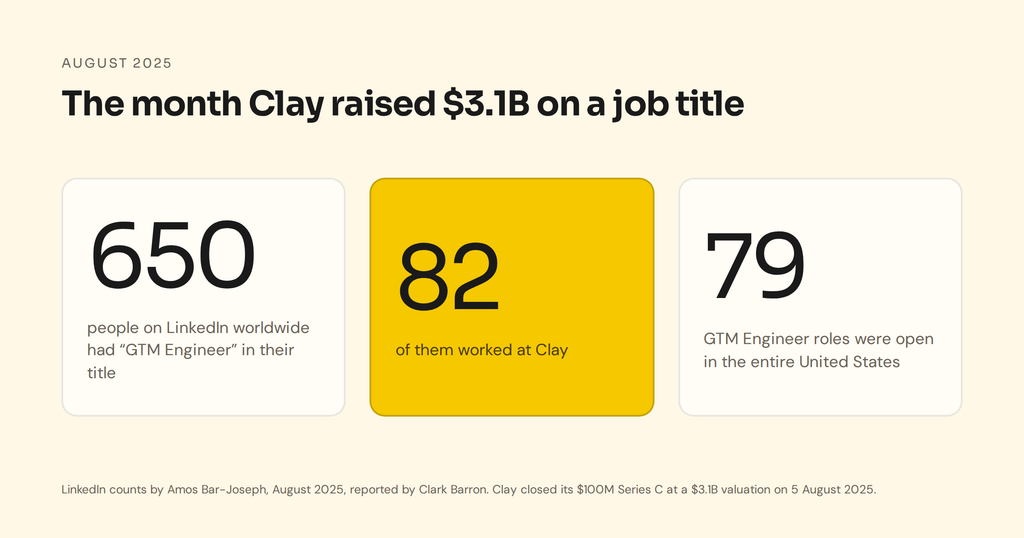
| Amos Bar-Joseph, independent | Aug 2025 | 79 open US roles on LinkedIn |
| Kyle Poyar, independent | Sep 10, 2025 | 128 posts over three months |
Same company, same day, two different numbers. And the independent counts came in at a quarter to a third of the company’s.
The number that stops you is Bar-Joseph’s other one. In August 2025 there were about 650 people on LinkedIn worldwide with GTM Engineer in their title. Eighty-two of them worked at Clay.
Kyle Poyar’s count is the useful one because he gave the ratio. Between June and August 2025 there was one GTM engineering post for every ninety-two SDR posts. He also estimated that about 45% of the people holding the title worked at an agency or a consultancy rather than in-house, which is a familiar pattern to anyone who has watched the freelance versus agency versus in-house argument play out in content marketing.
His verdict: adoption is “uneven,” and the job market lags the LinkedIn discourse.
So is it real, or is it hype
Both.
The tool demand is real and it is not close. Clay hit $100M ARR in December 2025 with over 300 employees and more than 14,000 customers. Enterprise net revenue retention above 200%. Alphabet led a round in August 2025 and by January 2026 employees were selling shares at $5B. Nobody buys that much software out of politeness.
The spread of the title is real but small. Extruct AI pulled about 1,200 LinkedIn profiles with the title in May 2026, up from roughly 650 nine months earlier. Hacker News mentions doubled in seven months. That is genuine growth on a genuinely tiny base.
The job is not a career yet, and that is the honest problem. Extruct’s data says 71% of people with the title are a bare individual contributor “GTM Engineer.” Only 12% are Senior, Lead or Staff. Their conclusion: “The role hasn’t crystallized into a career track yet.”
And nobody agrees what it is. Barron read 28 live postings and found “no shared definition,” with requirements ranging from Salesforce administration to API architecture, and most of them requiring no coding at all. A year after the manifesto, the RevOps community was still publishing articles titled “What a GTM Engineer ISN’T.” Brendan Short, who is bullish on the role, was asked in March 2026 what the career path looks like and answered: “I don’t know.”
The salary is drifting the wrong way. Clay said $160,000 median in August 2025. Independent trackers put it at $132,000 by March 2026. When a title spreads faster than the skill behind it, that is what the number does.
And there is the awkward point Julian Sheinbaum made back in December 2024, before anyone else was pushing back. Clay can collapse SDR, AE and sales engineer into one person because Clay already has enormous inbound demand.
In his words, “it’s much easier to collapse all the roles into one ‘GTM Engineer’ when all you need to do is send a message and prospects want to talk to you.” Most companies cannot do that. The one-person-does-everything model is downstream of demand you already generated, not a substitute for generating it.
My thoughts: the title kept it working: “GTM Engineer.” It sounds fancy to marketers and sales folks, maybe because it had “engineer” in the name. And we know how tech teams are treated in SaaS.
Steal this
Staff the title before you sell it. Fourteen people inside Clay had the job before the market had a definition. If you want to name a category, hire into it first. A title with employees survives scrutiny. A title with a blog post does not.
Name the person, not the product. Every B2B company on earth is trying to name a software category. Clay named a job. The buyer cannot put your category on their LinkedIn profile. They can put a job title there, and they will, because it raises their rate.
Give your partners a commercial stake. A hundred-plus agencies now have “GTM engineering” on their pricing pages. They defend the term for free because their invoices depend on it. This is the same reason certifications work.
Hire your loudest customer. Eric Nowoslawski came with an audience that already trusted him. That is a distribution hire dressed as a headcount decision.
Publish the manifesto seven weeks before the round. June 18 the argument. August 5 the money. The press then covers job creation rather than another AI sales tool, and Sifted repeats your origin story as fact the next morning.
Don’t steal this
Don’t do it if your buyer is salaried. This whole machine runs on agencies and freelancers who sell their own labour. Hand those people a title with a six-figure number attached and they will market it for you forever, because it is worth money to them personally. Hand it to a salaried in-house manager with a fixed band and nothing happens.
Don’t publish two different numbers on the same day. 280 in the wire, 400 on the website. Somebody will notice, and the gap between your count and the independent count becomes the story instead of your round.
Don’t hire one because it is trending. 71% of the people who hold this title have no seniority above them and no path in front of them. If you hire one and cannot answer what their job looks like in three years, you are hiring a churn problem. The RevOps community’s list of what the job is not is a better hiring brief than most of the postings.
Don’t confuse naming a job with having demand. Clay could compress three roles into one because inbound was already flooding in. If yours is not, you are not hiring a GTM engineer. You are hiring someone to do three jobs badly, and you have a demand problem wearing a new title.
The one test before you copy any of this
Ask whether the title you want to invent would look good on your buyer’s LinkedIn profile.
If the answer is yes, you have something, because your buyers will do the marketing and they will not send you an invoice. If the answer is no, and you are naming a software category rather than a person, you are doing normal positioning work. That is fine. It is just not this.
Scale AI had the exact same eight letters in 2021 and got nothing out of them, because Scale AI used them to describe an internal headcount. Clay used them to describe who its customers could become.

Rashmita is content marketer with 8 years of experience building and growing SaaS brands. Now she tests various AI tools for marketers and shares her feedback on this blog, LinkedIn, Instagram, and YouTube.