The End of Software: how Salesforce attacked Siebel in 2000
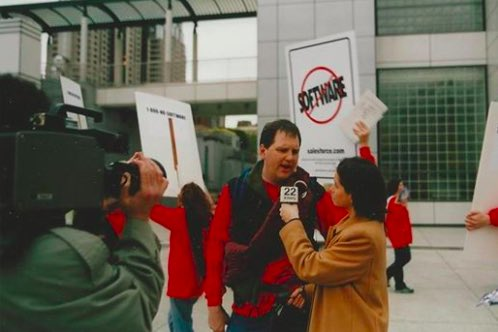
On February 22, 2000, about 25 people in red t-shirts showed up outside Siebel Systems’ user conference at the Moscone Center in San Francisco. The shirts said “death to software.” The placards had the word SOFTWARE crossed out. Somebody started chanting “the internet is really neat, software is obsolete.”
They were actors. Salesforce hired them, along with a fake news crew, and sent them to hand out invitations to a launch party happening that night. The party had three bands, one of which was the B-52s. Admission required you to bring a piece of old software to throw away. There was a game called “Throw the Disk in the Toilet.” The PR agency, OutCast Communications, later counted more than 100 articles from the week.
That is the story everybody tells. It is a fun story and it is mostly useless, because the stunt is the part you cannot copy.
The part you can copy is the number underneath it. In 1999, software license fees made up 63% of Siebel’s revenue. When Salesforce said “the end of software,” it was not being clever about a category. It was pointing at a specific line on Siebel’s income statement and saying that line should not exist. Siebel could not argue back without arguing against itself.
Everything below is about that mechanic, and about what happened in 2024 when ClickUp tried the same stunt without the same number.
What buying software actually cost in 2000
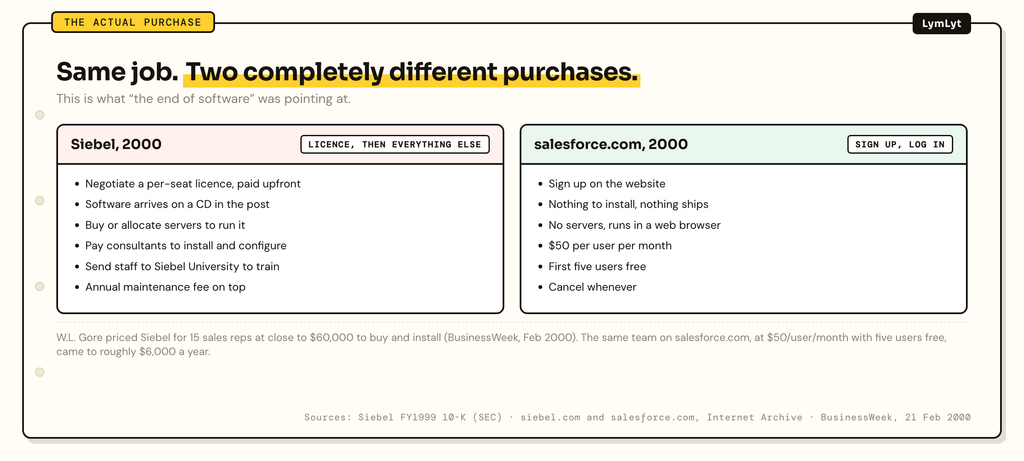
To use Siebel, a company had to do all of this:
- Negotiate per-seat licenses upfront, before anyone touched the product
- Take delivery of the software on physical CDs
- Buy or set aside servers to run it
- Pay consultants for months of installation and customization
- Pay to train the staff
- Pay an annual maintenance fee on top
BusinessWeek reported at the time that getting Siebel running for 15 sales reps cost roughly $60,000 before a single rep logged in. One buyer’s summary: “You’re talking some big bucks here.”
That is not a pricing complaint. That is a project. It needs a budget line, a committee, a vendor review, and someone’s job on the line if it fails. Every one of those steps is a place where the deal can die, and every one of them is a place where the buyer already feels resentment.
The number that turned a slogan into a weapon
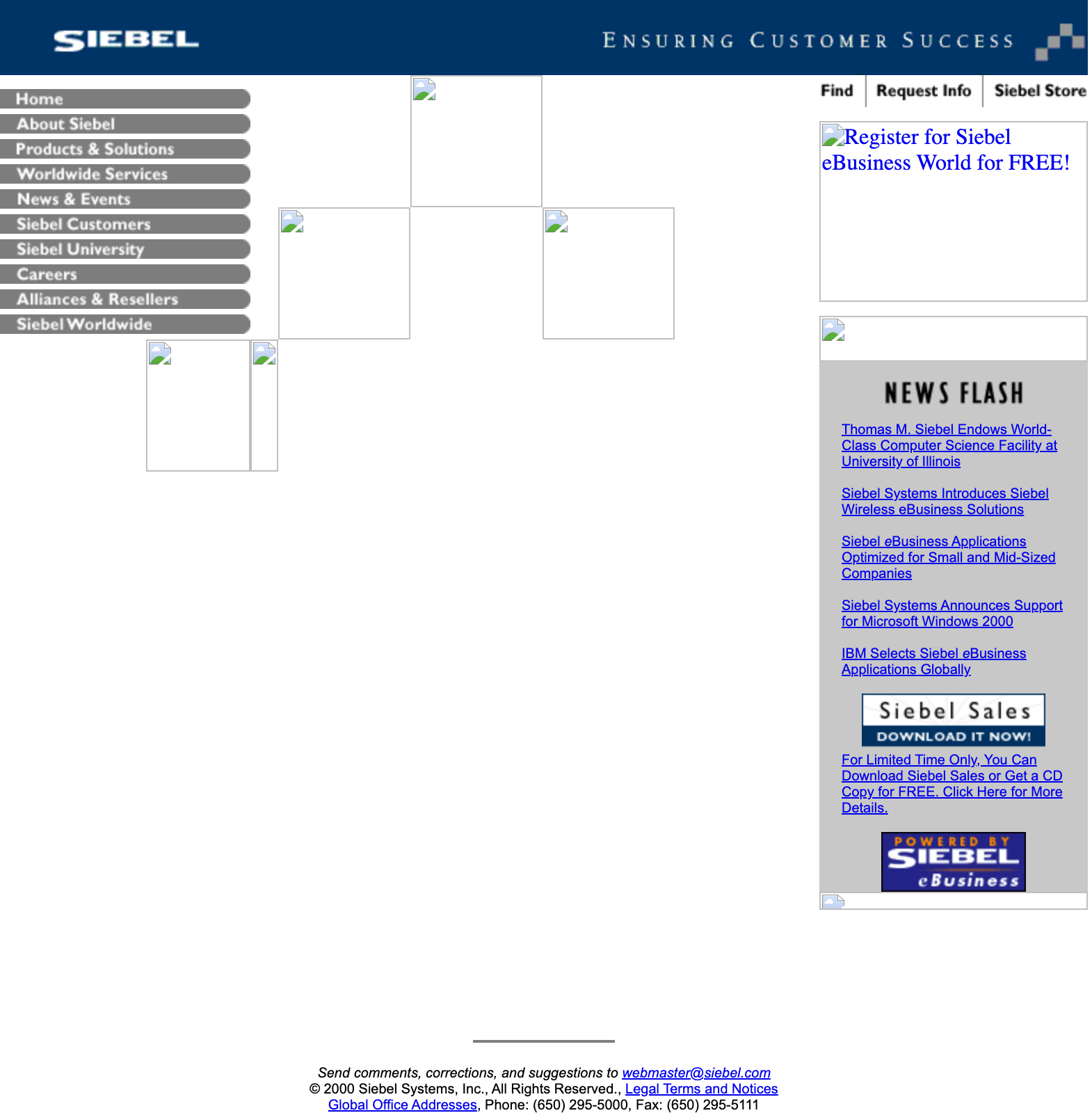
Siebel’s 1999 annual report put total revenue at $790.9 million. Software licenses accounted for $499.4 million of it. That is 63%, and the company recognized that revenue on delivery, which means the money arrived at the moment the license was sold.
Read that as a marketer and it stops being a finance fact. It means Siebel’s entire operation, its sales comp plan, its quarterly forecast, its stock price, all of it, was built on getting customers to sign a large check before they got any value.
Salesforce did not attack Siebel’s interface. It did not attack Siebel’s price. It attacked the existence of the license fee, which was the one thing Siebel could not give up without breaking itself.
This is the difference between a competitive campaign and a comparison page. A comparison page says we are better. A campaign like this says the thing you are paying for should not be a thing you pay for.
What Salesforce put on the table instead
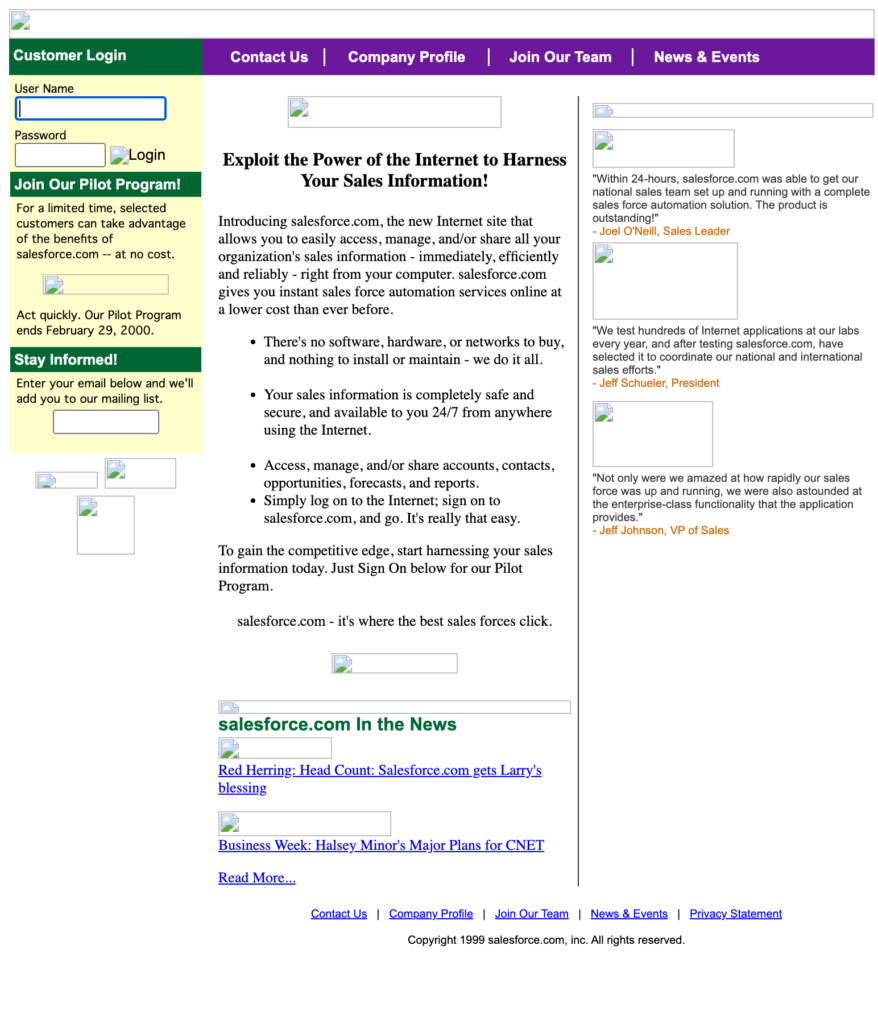
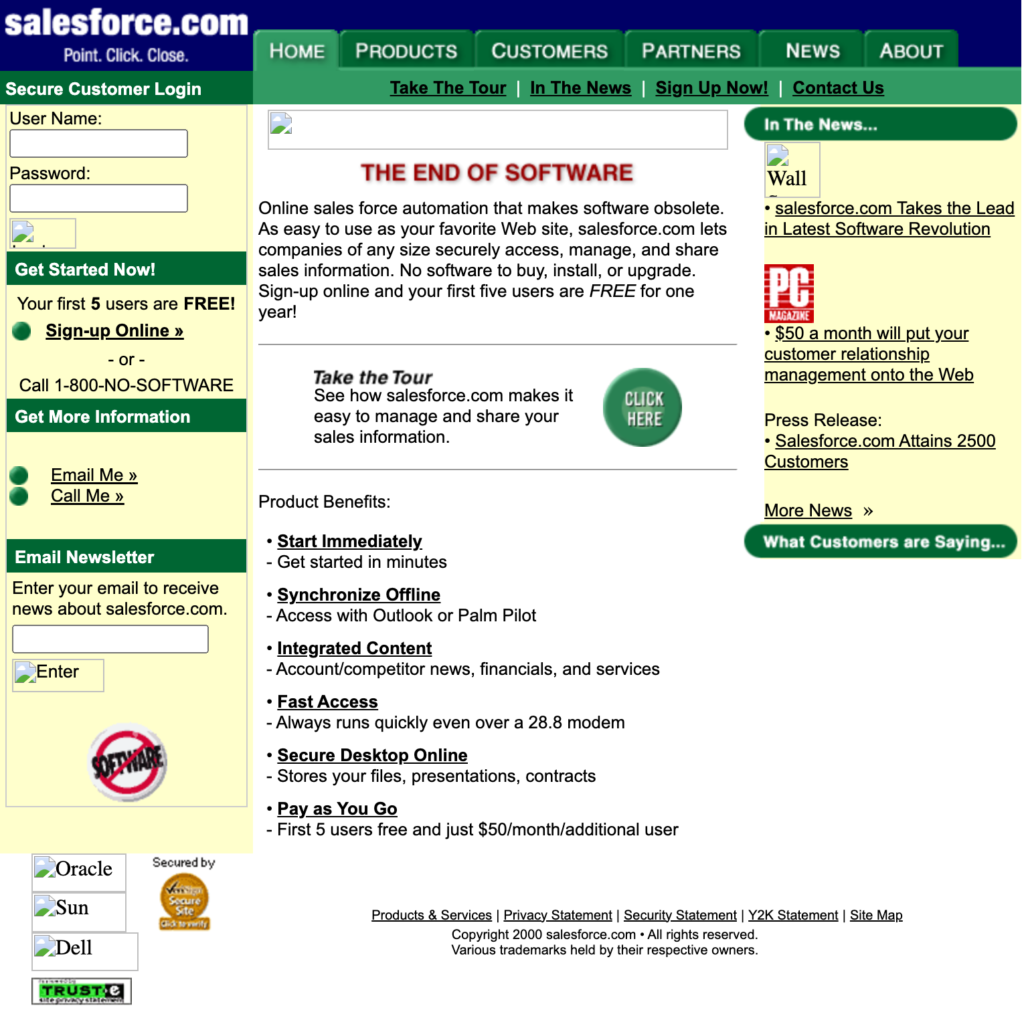
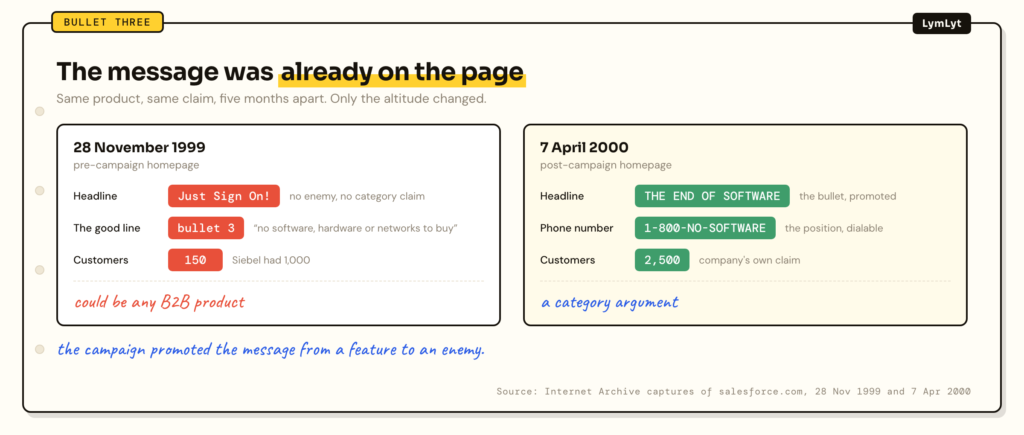
Salesforce had been saying the right thing for months and nobody heard it. On the November 1999 version of the homepage, the line was sitting in the middle of the page: “There’s no software, hardware, or networks to buy, and nothing to install or maintain.”
That was feature bullet three. By April 2000, it was the headline.
The offer itself:
- Siebel: about $60,000 upfront for 15 users. A capital project.
- Salesforce: $50 per user per month, so $9,000 a year for the same 15 users, spread across twelve payments. A credit card decision.
Marc Benioff was not subtle about the goal either. “Our objective is to put Siebel Systems out of business.”
That quote did a lot of work. It was short, specific, and quotable, which is why it got printed. Vague positioning does not get printed.
The six weeks after
On February 21, 2000, the day before the protest, Salesforce had 150 customers. Siebel had around 1,000. By April 4, Salesforce reported 2,500.
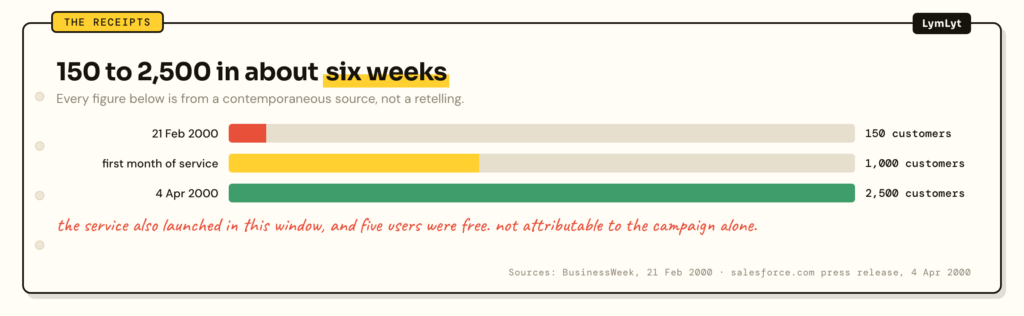
The stunt did not do that on its own. Three things stacked:
The media coverage put the offer in front of a buyer population that already hated the alternative. OutCast’s own account says over 1,000 organizations signed up within two weeks, and most of them came from press coverage rather than sales outreach.
The product could be signed up for in a browser, which meant the coverage converted immediately. A campaign that drives demand to a six month sales cycle produces a spreadsheet. This one produced customers the same week.
And the price sat below the level where anyone needed permission. That is the quiet reason it worked. The campaign changed who the buyer was, from a committee to a sales manager with a corporate card.
If you want the deeper version of how offers like this get documented and reused, our guide to B2B SaaS case studies covers the proof side of the same problem.
What Siebel did about it, which is the part nobody writes about
Siebel was not blind. In late 1999, before the protest, it had already signed a deal with Corio, an application service provider, to host Siebel’s software for customers who wanted it that way.
Look at the shape of that decision. Siebel let a partner deliver the hosted version. That kept the license model intact, kept the revenue recognition intact, and kept the sales force’s commissions intact. It was the answer that did not hurt.
It also did not work, because the customer was still buying a license. The thing they resented was still on the invoice.
Siebel did not launch a real subscription product of its own until October 2003, when it announced Siebel CRM OnDemand with IBM. Three and a half years after the protest. By then Salesforce owned the story.
The lesson here is worth more than the stunt. Salesforce’s positioning worked because the counter-move was expensive for the incumbent. Siebel’s fastest available response was the one that protected its revenue, and that response happened to be the one that did not solve the customer’s problem. Good positioning does not just say something true. It puts your competitor in a position where the cheap answer is the wrong answer.
What happened next
Siebel’s growth stalled. Oracle bought the company in September 2005 for $5.85 billion.
In between, in September 2002, Nucleus Research went through the reference customers listed on Siebel’s own website, the ones Siebel picked, and found 61% of them reported negative ROI after more than two years. Cost per user was north of $18,000 a year. Siebel disputed the study publicly.
Salesforce is now one of the largest software companies in the world, which is its own kind of irony given the slogan.
The 2024 remake that missed
In September 2024, ClickUp ran the same play outside Dreamforce, Salesforce’s own conference. Actors, signs, the whole format. The signs said “Cut the Slack.” They filmed it properly and built comparison landing pages to catch the traffic.
The execution was arguably better than the original. Higher production value, better distribution, a real capture plan.
It did not land the same way, and the reason is the number.
Slack and ClickUp sell the same way. Both are subscriptions. Both are per user. Both can be cancelled at the end of a term. There is no license fee, no CD, no six month implementation, no consultant invoice. Ask the core question of Slack: what line on the invoice does the buyer resent, and could Slack delete it tomorrow?
Slack could match anything ClickUp claimed by the end of the quarter, because nothing in Slack’s revenue model prevents it. Siebel could not have done that in 2000 without giving up 63% of its revenue.
So ClickUp’s version came out as a feature argument wearing a revolution’s clothes. The format was borrowed. The grievance underneath it was missing, and the grievance is the whole thing.
Steal this
Look for your most opinionated sentence and find out where you buried it. Salesforce’s best line spent months as feature bullet three. Go read your own homepage and find the sentence a competitor would hate to see in a headline. It is almost never at the top. Most companies lead with what is safe to say and hide what is worth saying.
Name a line item, not a feeling. “Faster” and “easier” cost nothing to claim and nothing to counter. “You should not be paying an implementation fee” is a claim with a target. Buyers do not remember adjectives. They remember the invoice.
Learn how your competitor makes money before you write a word. Public filings, earnings calls, analyst notes, job listings for their sales roles. You are looking for the revenue line they cannot cut. That line is your campaign. Everything else is a comparison page.
Say something a journalist can quote. “Our objective is to put Siebel Systems out of business” is eleven words that got reprinted for twenty-five years. If your positioning cannot survive being pulled out and quoted alone, it is a paragraph, not a position.
Don’t steal this
A stunt with nothing behind it is just a stunt. The protest worked because there was a genuinely different product at the end of it. Take away the $50 per month and the browser signup, and February 22 was 25 people in red shirts embarrassing themselves outside a convention center.
Do not attack a category you are standing in. If your business model matches the incumbent’s, every shot you take hits you too. This is the ClickUp trap and it is easier to fall into than it looks, because the format is so appealing.
Absolute positioning gets expensive later. Salesforce eventually built an app marketplace, a services arm, and a six figure contract motion. All the things “no software” was meant to reject. If your position is a permanent one, be honest with yourself about whether you will still want it in ten years, or whether you are borrowing energy today that you repay later.
The one test before you copy any of this
Name the specific line on your competitor’s invoice that your buyer resents. Then ask whether your competitor could delete that line tomorrow without damaging their business.
If they could delete it, you have a feature comparison. Run a good comparison page and stop there.
If they could not delete it, you might have a campaign.
Most companies never run this test, which is why most competitive marketing is loud and forgettable. The stunt is the cheapest part to copy and the least useful. The homework is the part that makes it work.
A note on sources
The protest itself is best documented through Marc Benioff’s 2009 book Behind the Cloud and OutCast Communications’ own account of the campaign, which lists coverage in the Wall Street Journal, Forbes, BusinessWeek, the New York Times and CNET during that week. Details vary between retellings, including the number of protesters and the exact chants, so treat the theatrical specifics as approximate.
The financial claims are firmer. Siebel’s 1999 revenue split, the Oracle acquisition price, the Nucleus Research findings, and the launch of Siebel CRM OnDemand are all in public filings, press releases and contemporaneous trade coverage.

Rashmita is content marketer with 8 years of experience building and growing SaaS brands. Now she tests various AI tools for marketers and shares her feedback on this blog, LinkedIn, Instagram, and YouTube.