Claude now watermarks everything it writes. Here’s what that means.
Anthropic now watermarks every piece of text that passes through it. The support page went live on August 11, 2026.
You can’t see the mark. Your editor can’t see it. It stays in the text when you copy and paste it. There’s no switch to turn it off.
People are dicussing everywhere about how to by pass this, what’s going to happen, and more. Here are some answers that will help you understand better.
What did Anthropic actually do?
Two separate things.
- Text watermarks. Claude models launched on or after August 2, 2026 put a hidden mark inside the words. Not in a file header. In the text itself. Anthropic says it travels with the text when you copy and paste, and may survive some editing.
- File metadata. For files like .png, .jpg and .svg, Claude attaches a signed record using the C2PA standard. Adobe, the BBC and Microsoft use the same thing for Content Credentials. It says the file went through Claude. It also shows if anyone changed the file after.
The marking happens at the model level. So it doesn’t matter where the text came from. Chat, API, Claude Code, Cowork, Tag. It also applies through AWS, Google Cloud and Microsoft Foundry.
This is worldwide. Not EU only.
Hold on. There’s no such thing as an invisible watermark in text.
One Redditor said exactly this. They didn’t get what it meant, because you can’t point at a watermark in a paragraph the way you can in a photo.
Fair question. Here’s how it works.
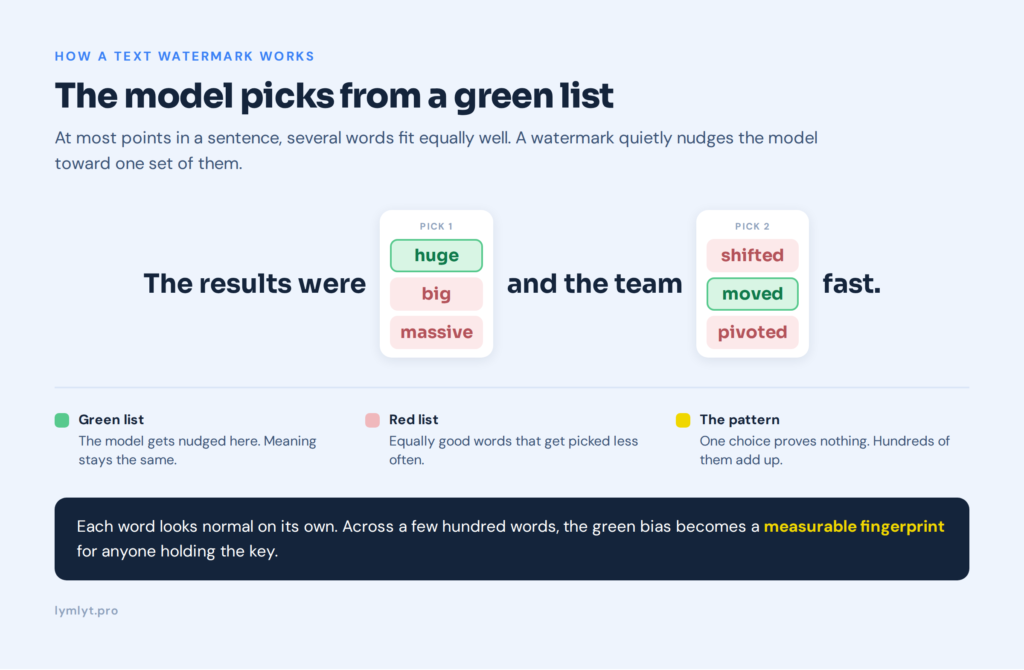
A model writes one word at a time. At most points, several words would fit equally well (Big. Large. Huge). The model picks one.
A watermark rigs that pick. The best-documented method splits the vocabulary into a green list and a red list. The model gets nudged toward green words.
Each choice looks normal on its own. Nobody reading it would notice. But across a few hundred words, the green bias adds up into a pattern. Anyone with the key can measure it.
That’s the whole trick. It’s a statistical fingerprint, not a hidden character.
Google does the same thing with SynthID Text and has open-sourced its version.
This also explains why the mark behaves the way it does. Long text carries a strong signal. Short text doesn’t have enough words to be sure. And quality doesn’t drop, because the model was choosing between equal options anyway.
Can I turn it off?
No.
There’s no opt-out. It applies to every Claude product, in every region, on every supported model.
Does this mean I don’t own my work anymore?
You still own it. Ownership terms didn’t change.
This was the loudest argument in the thread and most of it was based on a misread. The mark records that Claude processed the text. It doesn’t claim authorship and it doesn’t touch your commercial rights.
One reddit commenter framed it as Claude taking credit for work you directed. Another shot back that the mark isn’t claiming credit, it’s just noting the content is AI-made. The second read matches what Anthropic wrote.
Does it mess with commercial work or apps built on the API?
Mostly no.
If you build on the API, the mark passes through to your end users. You still handle your own transparency duties under Article 50. That’s it.
For content teams, the practical answer is also no. Nothing about your rights or your publishing changed.
But there’s a catch worth knowing. A mark means Claude processed the text. It doesn’t mean Claude wrote it.
Use Claude to proofread your own draft, and the output comes back marked. Anthropic says this directly on its own page.
That’s what set people off. A radio host told Forbes he’d dropped Grammarly for Claude to check his writing, and now his own work carries a mark.
How much editing removes it?
Nobody knows (not even Anthropic).
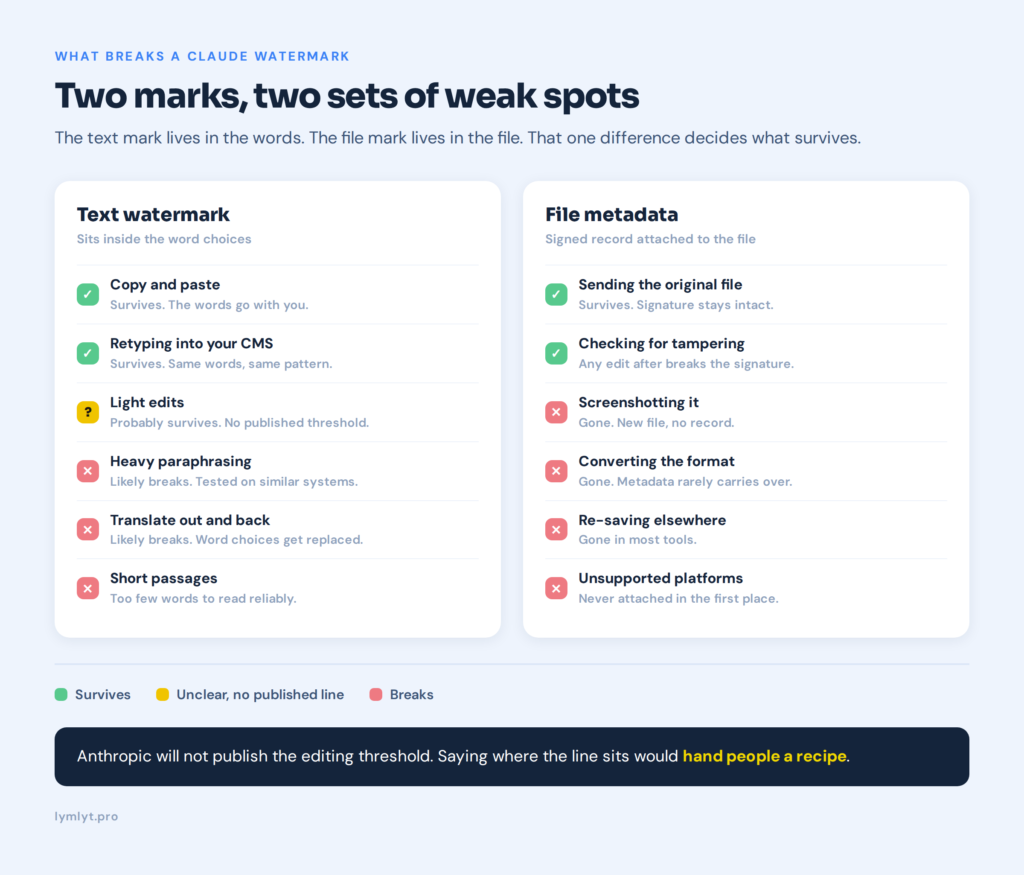
Copy and paste won’t remove it. Neither will retyping into WordPress or screenshotting the words. The mark lives in the word choices, so it goes wherever the words go.
Light edits probably survive. Anthropic says the mark “may persist through some editing” and leaves it there.
Heavy paraphrasing probably breaks it. A 2025 study on SynthID tested this. Paraphrasing, chopping and reassembling text, and translating out and back all cut detection significantly.
Short passages don’t hold a reliable signal.
Anthropic won’t publish the threshold. Publishing it would hand people a recipe. TechCrunch asked and got nothing.
Will ChatGPT and Gemini do this too?
Google already does. SynthID has covered images since 2023 and now covers text, audio and video.
OpenAI is the odd one. It has had working text watermarking for years and chose not to ship it. The Wall Street Journal reported the internal debate. Three worries won:
- false positives,
- easy workarounds,
- and users leaving for a competitor that doesn’t mark.
Meta, Microsoft and Mistral signed the same rules. None has shipped text marking yet.
It’s spreading outside the big labs too. Suno is watermarking songs. Substack teamed up with Pangram to flag AI newsletters.
Why did this happen now?
The EU. Specifically the AI Act’s Article 50(2) Code of Practice on Transparency, which kicked in on August 2, 2026. It says providers have to mark AI content so machines can read it. The Commission also published guidelines on the obligations.
About 190 organizations signed it by the end of July. Section 1 covers model and system providers and has 82 signatories. Anthropic, OpenAI, Google, Meta, Microsoft, Mistral, Cohere, Black Forest Labs and Getty Images are all on it.
So this isn’t an Anthropic policy. Every major lab agreed to the same thing. Anthropic just shipped first, and applied it everywhere instead of only in Europe.
Is this actually a problem?
For most people, no.
The whole thing is a big shrug. Watermarking only hurts people trying to pass AI work off as their own. Don’t lie about using AI and you’ll be fine.
There’s no reason to hide AI use unless you have a reason to hide it, and in that case you probably shouldn’t be using it. The people panicking and the people shrugging are describing different situations.
So what IS the real problem?
Your build pipeline might reject the code. Picture a client’s security auditor or a CI scanner flagging a clean pull request because it detected a watermark. The code is fine. The policy might not care. That’s a brand new kind of paperwork problem and nobody has written the rules for it yet.
False positives are coming. Most code is boilerplate. There’s often one correct way to write a function. Writing has the same problem. Two people explaining the same technical concept will land on similar phrasing. Detection is a probability score, not a yes or no. Run enough documents through it and you get wrong answers. People already got accused of AI writing over an em dash. This makes that worse.
No mark starts to count as proof. This one cuts the other way and almost nobody mentioned it. Another commenter did. Say a client contract bans AI use. A clean detection result now backs you up.
The watermark takes a risk that already existed and makes it checkable.
What does a watermark actually prove?
Less than people think. Anthropic is unusually blunt about this.
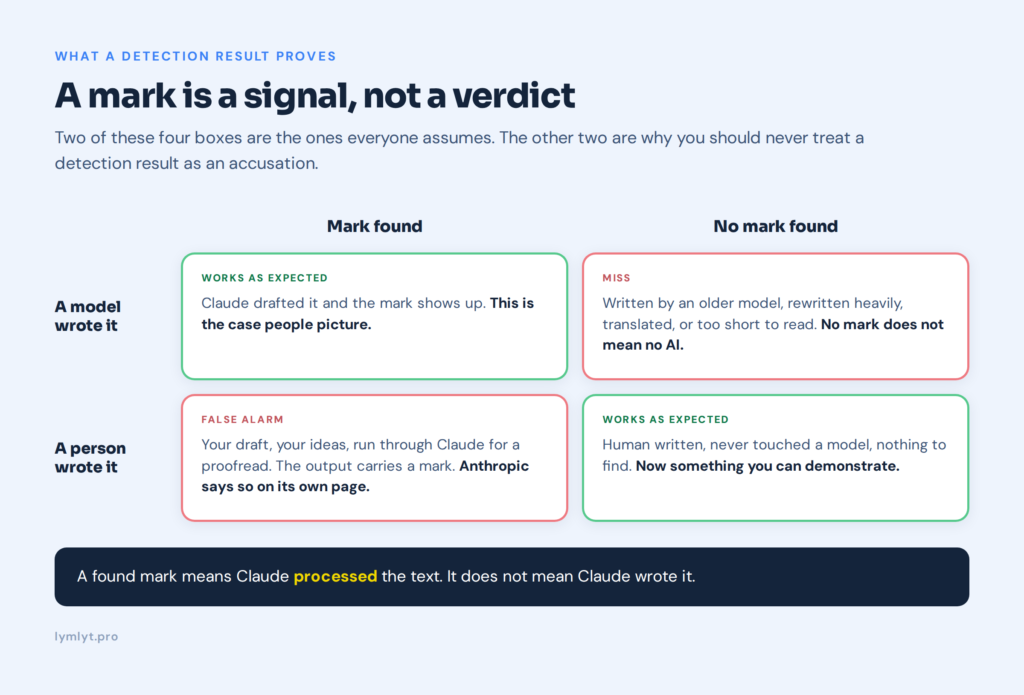
A mark found means Claude touched the text. Not that Claude wrote it. Proofreading counts. So does translating, summarizing, and converting a file.
No mark found doesn’t mean no AI. It could be an older model. It could be text that got heavily rewritten. It could be a passage too short to read. For files, the metadata dies through format changes, re-saving or a screenshot.
So it’s a signal, not a verdict. Treat a detection result as an accusation and you’ll be wrong often enough to hurt someone.
What does this change for B2B content teams?
Depends on how you work.
Prompt, copy, light edit, publish? That’s now measurable by anyone who wants to measure it.
It isn’t illegal. Maybe questions credibility.
B2B buyers read eight to twelve pieces before they talk to sales. They’re already skeptical. Once a prospect or a competitor can run your thought leadership through a detection tool and get a hit, the question changes. It stops being “is this good” and becomes “did anyone here actually think about this.”
Procurement is moving too. Enterprise buyers have started asking vendors about AI use in deliverables. Agencies will get asked to certify their process. Anyone selling model output as senior strategy is in for a rough quarter. Worth factoring into what you budget for content.
There’s a discovery angle as well. Everyone publishing near-identical model output already made it hard to stand out. We wrote about that in AI didn’t cause content blindness, marketers did, and the AI SEO statistics show it in the traffic numbers.
What should you actually do?
Write down your process. Where models get used. Where humans decide. Who reviews. Who signs off. When your boss/client asks next time, you want that answer ready.
Stop treating disclosure like a confession. Teams that are open about using AI for research and drafts report no trouble. Teams hiding it are the exposed ones. Buyers care whether the thinking is real. They don’t care whether a model helped with a first draft.
Lead with what a model can’t make. Original research. Customer interviews. Your own numbers. An opinion someone will argue with. That’s what gets cited, by readers and by LLMs. It’s also the part no watermark touches. Our AI visibility checklist scores where you stand, and AI citations vs AI mentions explains what to aim for.
Skip the humanizer tools. They’ll advertise hard off this news. No tool can fix AI writing problem, only a human can fix it by adding more value to it.
Use provenance as a selling point. A human-led process used to be a claim. Now it’s something you can demonstrate.
The bottom line
The watermark isn’t the threat.
It measures something a lot of content teams have avoided measuring for two years.
The teams in trouble swapped thinking for generating and hoped nobody would check. The teams that are fine used AI where it helps, on research, drafts and edits, and kept the strategy and the point of view human.
That’s how we work at LymLyt. We plan, write and publish B2B SaaS content built on real positioning and opinions we’ll defend. A senior editor has to justify every claim before it ships. There’s no AI fingerprint on it because a person did the thinking.
See our work. Look at blog writing, SEO content writing and AI visibility. Check the pricing. Or book a 30-minute call and leave with a content plan either way.

Rashmita is content marketer with 8 years of experience building and growing SaaS brands. Now she tests various AI tools for marketers and shares her feedback on this blog, LinkedIn, Instagram, and YouTube.