The best Skale alternatives for B2B SaaS in 2026
Skale is a good agency. That is the honest starting point, and it is worth saying before we talk about anyone else.
They have spent years turning organic search into a revenue channel for VC-backed SaaS companies. They report on MRR and pipeline instead of traffic screenshots. They have shipped real results for brands like Maze, Perkbox, Rezi, and Slite. If you are a Series B company with the budget and you want a full-service SEO engine run by senior people, Skale will likely do the job.
So why are you searching for an alternative?
In our experience working with 16+ B2B SaaS marketing teams, the search for a “Skale alternative” almost never comes from a Skale quality problem. It comes from one of three places. The price floor is too high for your stage. The custom-quote, discovery-call, annual-commitment model is more agency than you need right now. Or the thing you actually need is not a strategy deck. It is someone to write and publish the content your team keeps missing.
This guide is built around those three reasons. We put the twelve strongest alternatives into three groups so you can skip the eight that were never right for your stage and spend your time on the three that are. LymLyt sits at the top because it solves the most common version of the problem: you have a plan, you do not have the hands.
Let us get into it.
The 12 Skale alternatives at a glance
| Agency | Type | Best for | Starting price | Publishes for you | Lock-in |
|---|---|---|---|---|---|
| LymLyt | Content-led | Lean SaaS teams who need content written and shipped | $4,499 starting | Yes | None |
| Embarque | Content-led | Early-stage SaaS wanting scaled content ops | $5,000–$10,000/mo | Sometimes | Short |
| SimpleTiger | Content-led | Early to mid-stage SaaS, programmatic SEO | $5,000–$10,000/mo | Sometimes | Flexible |
| Omniscient Digital | Full-service engine | Growth and enterprise SaaS with budget | $10,000+/mo | Yes | 6–12 mo |
| Directive Consulting | Full-service engine | Enterprise, multi-channel revenue ops | $15,000–$50,000/mo | Yes | Annual |
| Siege Media | Full-service engine | Brands needing links plus design assets | $10,000+/mo | Yes | 6–12 mo |
| Foundation Inc | Full-service engine | Distribution beyond Google (LLMs, Reddit, social) | $10,000+/mo | Yes | 6–12 mo |
| Animalz | Full-service engine | Enterprise editorial thought leadership | $8,000–$30,000/mo | Yes | 6–12 mo |
| First Page Sage | Full-service engine | Enterprise GEO and thought leadership | $8,000–$20,000/mo | Yes | Annual |
| Grow and Convert | Conversion specialist | Funded teams wanting bottom-funnel content | $10,000/mo | Yes | 6 mo+ |
| Breaking B2B | Conversion specialist | Early-stage SaaS chasing demos and trials | ~$3,000/mo | Yes | Flexible |
| GTM 80/20 | Fractional operator | Teams wanting a senior operator, no agency overhead | $2,500–$6,000/mo | Depends | Month-to-month |
What “Skale alternative” actually means
Full-service SEO engines. These agencies own the whole organic program: strategy, keyword mapping, content production, technical SEO, link building, and now GEO. Skale lives here. So do Omniscient Digital, Directive, Siege Media, and Foundation. They are excellent, they are expensive (usually $8,000 to $25,000 a month, sometimes more), and they expect a runway of six to twelve months before the compounding kicks in. Right for funded companies that want to hand off the entire channel.
Content-led execution partners. These agencies focus on the part most SaaS teams are actually stuck on: getting good content researched, written, and published on schedule. Less “here is your 40-page strategy,” more “here are two ranked drafts this week and yes, we published them for you.” LymLyt sits here, along with Embarque and SimpleTiger. Right for lean teams, solo marketers, and founders wearing the marketing hat who have the plan and need the output.
Conversion and bottom-funnel specialists. These agencies obsess over content that drives trials, demos, and signups instead of top-of-funnel traffic. Grow and Convert built a whole methodology around it. Breaking B2B works this angle for early-stage companies. Right when your CEO measures the content team by demos booked.
Once you know which of the three you need, the shortlist writes itself. The mistake is comparing a $3,000 content partner against a $20,000 enterprise engine as if they do the same job. They do not, and the price gap is telling you that.
One more thing changed in 2026: AI search. Buyers now start research inside ChatGPT, Claude, Perplexity, and Google’s AI Overviews before they ever type a branded query. Generative AI referral traffic grew more than tenfold in a single year. Every agency on this list now claims a GEO or “AI visibility” service. Bolting the line item onto a pitch deck is easy. Actually structuring content so it gets cited by an LLM is a different skill, and it is worth pressure-testing on the discovery call.
What B2B SaaS marketers should actually look for
Not every criterion matters equally. Here is what we would weigh, roughly in order, if we were the ones buying.
Do they know B2B SaaS cold? Generic SEO agencies apply the same playbook to a plumber and a data platform. SaaS content lives or dies on understanding the product, the ICP, and the buying committee. Ask for case studies at your ARR stage, not their flashiest logo.
Who actually writes it, a human or a model? In 2026 this is the question. Plenty of agencies quietly run everything through an LLM and charge you retainer rates for lightly edited output. That content reads fine and ranks for a week, then gets buried when everyone else publishes the same thing. Ask directly.
Do they publish, or just deliver drafts? “Approved” should mean “live.” A surprising number of agencies hand you a Google Doc and leave the CMS formatting, internal linking, and publishing to your already-stretched team. If you are the whole marketing department, this is not a small detail.
What is the contract? Most full-service agencies lock you into six to twelve months. That is defensible for SEO, which compounds slowly. It is also a real risk if the fit is wrong. Month-to-month and no-lock-in options exist and are worth the trade-off for many teams.
Is pricing published or a mystery? No published pricing means a discovery call before you know if you can even afford them. That is friction when you are comparing five agencies at once. Ask for a budget range in the first ten minutes.
Do they measure pipeline or vanity metrics? Traffic and rankings are inputs. Signups, demos, and MRR are outputs. The better agencies report the outputs. Get specific about what “results” means in their case studies.
How real is their GEO story? If they cannot explain, concretely, how they get content cited inside AI answers, the “AI visibility” line on their site is marketing. LymLyt built a dedicated AI visibility service around exactly this, and it is a fair bar to hold everyone to.
Can they scale up and down? Your content needs are not flat. An agency that only works at one fixed volume forces you to overbuy in slow months.
Group 1: Content-led execution partners
This is where most people searching for a Skale alternative actually belong, even if they do not know it yet. You do not have a strategy gap. You have a bandwidth gap. The plan exists in a Notion doc. What is missing is someone to research, write, edit, and publish the content week after week without you managing them like a full-time report.
These agencies plug in as your content arm. They cost less than the full-service engines because they are not trying to own your technical SEO, your link velocity, and your quarterly board narrative. They are trying to fill your calendar with content that ranks and converts.
1. LymLyt
- Best for: B2B SaaS marketers and founders who have the plan and need the words to show up, on schedule, in their voice.
- Price: Starting $4,499/month. Compare here with full-time hire.
- What they own: Content strategy, blog writing, SEO content, AI visibility, landing page copy, case studies, lead-gen resources, and comparison pages.
- What you give them: One goal-setting call, product access or a walkthrough, and your style guide if you have one.
- Who writes it: A human with 12+ years in B2B SaaS content. Tools are used for research and analysis, drafts are written and edited by a person.
- Publishes for you: Yes, directly to your CMS after final edits.
- Contract: Yes. No lock-ins, no exit fees.
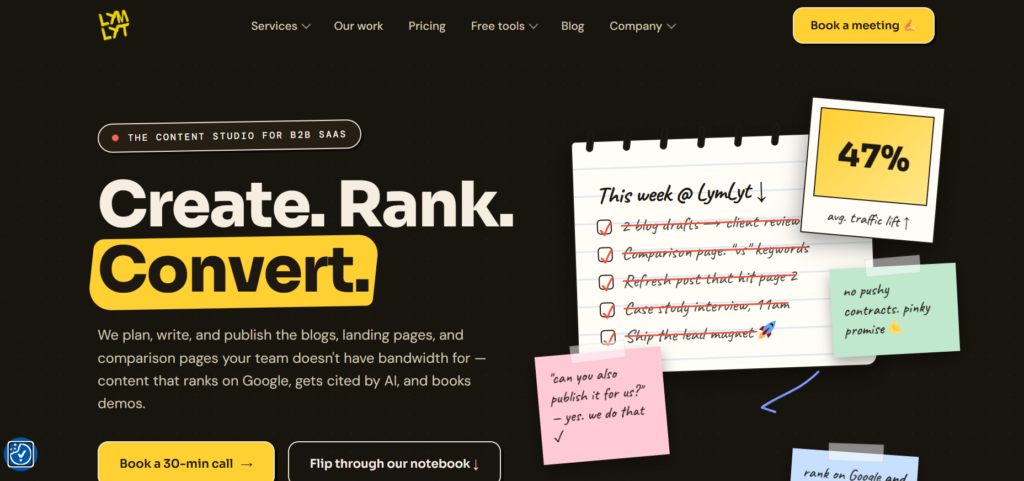
LymLyt is a B2B SaaS content studio run by founders Rashmita and Anubhav, built on a simple observation from twelve years in the industry: the plan is rarely the problem, bandwidth is. Most SaaS marketers know exactly what content they should be publishing. They just never get to it because they are running ten channels at once. LymLyt takes drafting, editing, and publishing off the plate so the marketer can stay on strategy.
The output covers the full “create, rank, convert” loop: blog posts and SEO content to get found, case studies and comparison pages to build trust, and landing pages and lead magnets to turn visits into booked demos. The AI visibility service is a genuine one, focused on getting brands cited inside ChatGPT, Claude, Gemini, and Perplexity answers, which is where a growing share of B2B research now starts. Clients include Admiral, Recurly, and Skrapp, with published case studies like Recurly’s 5.8x lift in conversion and Skrapp’s 4x organic traffic in six months. The reported average is a 47% traffic lift across engagements.
Where LymLyt separates from Skale is the shape of the relationship. Skale is a full-service engine with a custom quote and a runway. LymLyt is a content arm you can start with this week, scale up and down, and walk away from if it is not working.
Reviews from clients like Admiral’s marketing director point to a strong grasp of how SEO, content, lead-gen CTAs, and page design fit together, which is exactly the range a stretched marketing team needs from one partner. The honest limitation: LymLyt is content-led, so if your bottleneck is aggressive technical SEO or high-volume link building at enterprise scale, you would pair them with a specialist or look at the full-service group below.
Skip it if: you want a single vendor to own technical SEO audits, site migrations, and a heavy monthly link-building quota alongside content, in which case a full-service engine fits better.
2. Embarque
- Best for: Early-stage SaaS that wants scaled content operations at a mid-market price.
- Price: Roughly $5,000 to $10,000 a month.
- What they own: SEO content production at volume, keyword strategy, and AEO.
- Publishes for you: Often, depending on scope.
- Contract: Shorter commitments than the enterprise agencies.
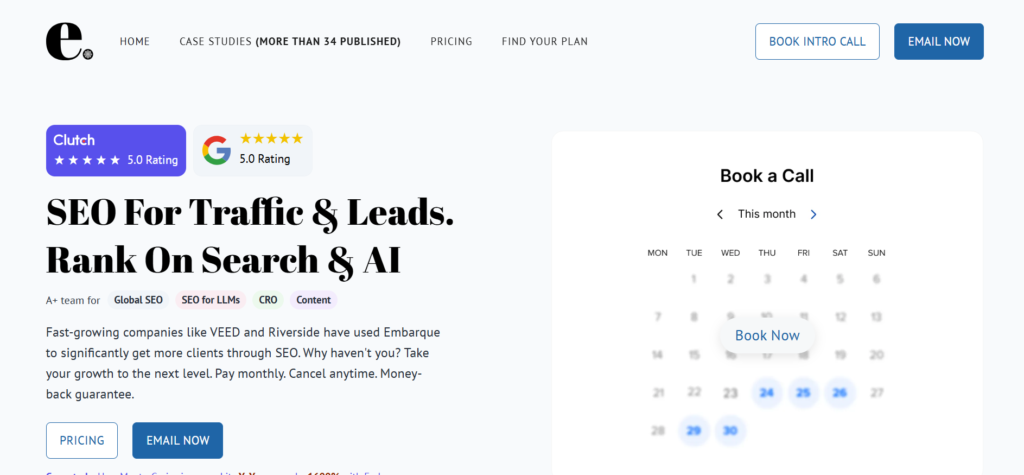
Embarque built its reputation on affordable, scaled content for startups that need to publish consistently without an enterprise budget. It sits in the same mid-market band as SimpleTiger and is commonly recommended for early-stage teams. Reviews praise the value and the turnaround. Honest complaints note that at the volume end, some content can feel more templated than differentiated, so it rewards clients who bring a clear brief and point of view. Good when you need a lot of solid content fast and are less focused on premium editorial polish.
Skip it if: you are in a content-saturated category where the winning move is fewer, sharper, genuinely original pieces rather than volume.
3. SimpleTiger
- Best for: Early to mid-stage SaaS wanting a focused SEO partner, strong on programmatic.
- Price: Roughly $5,000 to $10,000 a month.
- What they own: SaaS SEO strategy, content, technical SEO, and programmatic SEO.
- Publishes for you: Usually.
- Contract: Flexible relative to enterprise shops.
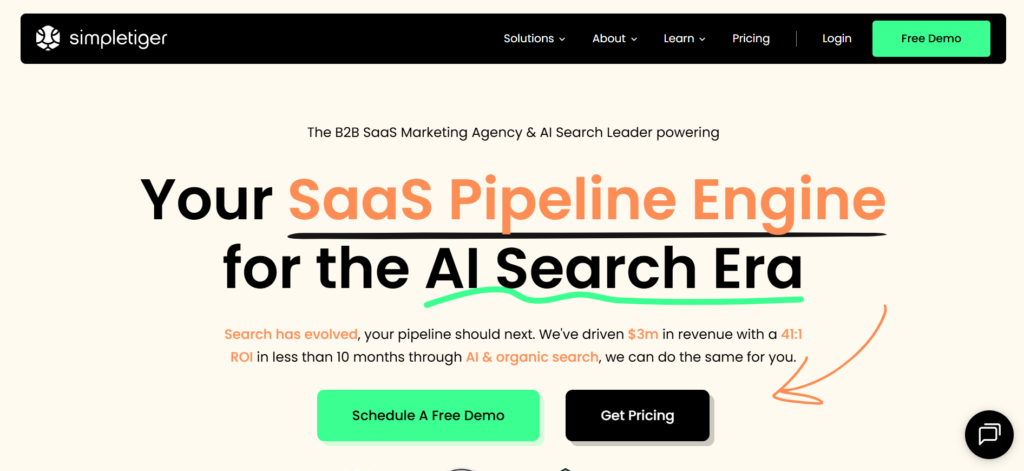
SimpleTiger is a long-running SaaS SEO specialist that punches at a more accessible price than the enterprise engines. Reviews praise the SaaS focus and the programmatic SEO chops, which suit products with large, structured content opportunities (think directories, integrations pages, and location or use-case templates).
Honest complaints note that the boutique team size means the very largest engagements are better served elsewhere. A strong middle option for companies that have outgrown a freelancer but are not ready to spend $20,000 a month.
Skip it if: you need the depth and headcount of a large agency for an enterprise-scale, multi-country program.
Group 2: Full-service organic growth engines
This is Skale’s actual peer group. If your reason for leaving Skale is fit or results rather than price, these are the agencies to compare against directly. They run the entire organic channel, they employ senior strategists, and they price accordingly. Expect $8,000 to $25,000 a month as the normal band, six to twelve months of runway, and reporting tied to pipeline.
Pick from this group when you have the budget and you want to hand off the whole thing.
4. Omniscient Digital
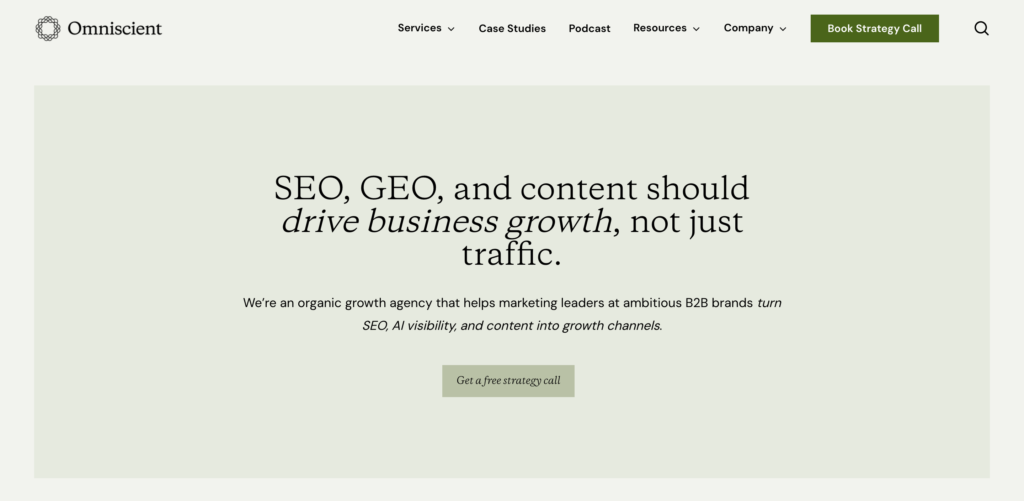
- Best for: Growth-stage and enterprise SaaS that want content-led SEO with real revenue attribution.
- Price: Starts around $10,000 a month, typically $10,000 to $25,000.
- What they own: Strategy, content, programmatic SEO, digital PR, link building, and GEO.
- Publishes for you: Yes.
- Contract: Six to twelve months.
Omniscient Digital is one of the strongest direct Skale competitors, founded in 2019 with leadership out of HubSpot, Shopify, and Workato. Its “barbell content strategy” splits investment between high-intent conversion content and long-form authority pieces. The results speak loudly: reported outcomes include an 810% increase in organic sessions and a 400x jump in product signups for Jasper, and $3.7 million in pipeline for Smartling. Reviews consistently praise the strategic depth and the revenue focus. The honest catch is the price and the stage: this is built for well-funded teams, and early-stage companies will find the floor out of reach.
Skip it if: you are pre-Series A or your monthly content budget is under five figures.
Check out: Omniscient Alternatives.
5. Directive Consulting
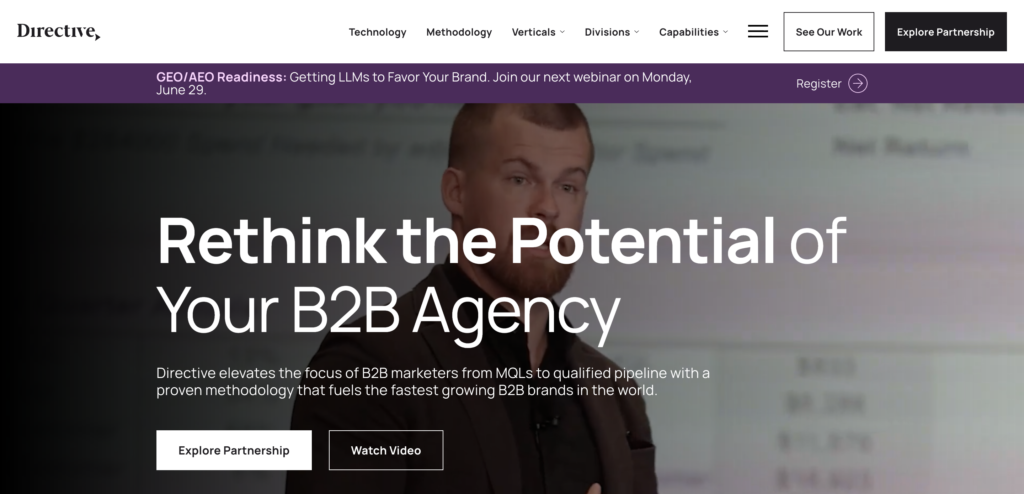
- Best for: Enterprise SaaS that wants SEO, content, paid, and revenue ops integrated under one roof.
- Price: Roughly $15,000 to $50,000 a month.
- What they own: Full-funnel: SEO, content, paid media, CRO, and revenue operations.
- Publishes for you: Yes.
- Contract: Annual.
Directive Consulting is the heaviest hitter on this list, with more than $1 billion in attributed client revenue and a model built for complex, multi-stakeholder enterprise buying cycles. If organic is one lever among several and you want a single agency coordinating SEO with paid and rev ops, Directive has the depth. Reviews praise the integration and the seniority. The honest reality is that this is enterprise pricing for enterprise problems, and it is overkill for most companies searching for a Skale alternative.
Skip it if: you are anything short of a funded, multi-channel enterprise team.
6. Siege Media
- Best for: Brands whose bottleneck is domain authority and referral traffic, not just content volume.
- Price: $10,000+ a month.
- What they own: SEO strategy, content, link building, and in-house graphic design.
- Publishes for you: Yes.
- Contract: Six to twelve months.
Siege Media stands out for pairing content with in-house design, which lets them produce link-worthy visual assets without outsourcing. Clients like Instacart, Zendesk, and Zapier point to strength across both SaaS and marketplace verticals. If your growth is blocked by authority and backlinks rather than raw output, Siege is a natural fit. Reviews praise the design-forward approach and link results. The honest note is that the premium reflects that design capability, so if you do not need visual assets and link building, you are paying for range you will not use.
Skip it if: your gap is straightforward content production and you do not need heavy link building or custom design.
Check out: Siege Media Alternatives.
7. Foundation Inc
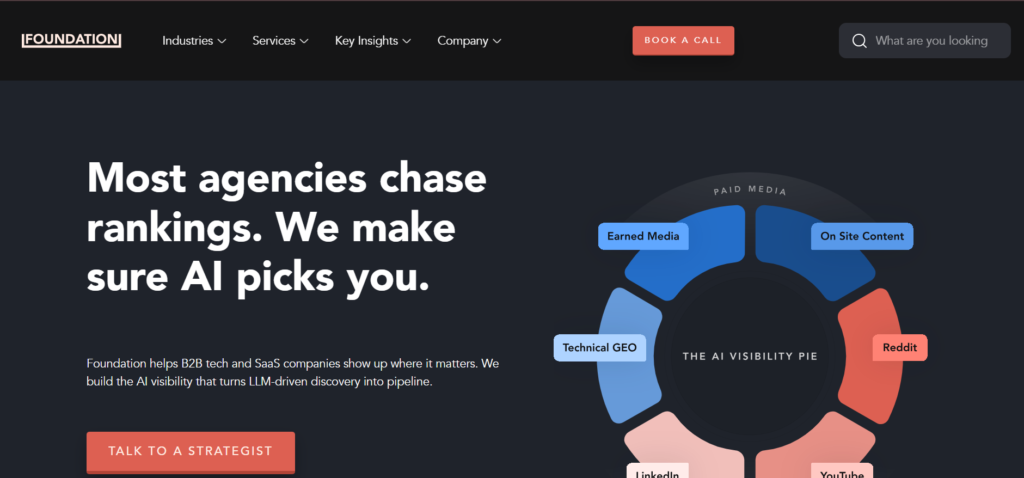
- Best for: Companies that need visibility beyond Google, across LLMs, Reddit, and social.
- Price: Starts around $10,000 a month.
- What they own: Distribution-first content built to spread across search, AI answers, communities, and social.
- Publishes for you: Yes.
- Contract: Six to twelve months.
Foundation Inc takes a distribution-first stance: content is built to travel across every channel buyers actually use, not just to rank in classic search. In content-saturated categories where ranking alone no longer builds authority, that multi-channel amplification compounds into a brand effect single-channel SEO cannot match.
Reviews praise the distribution thinking and the amplification results. The honest trade-off is that this model works best when you already have a product and audience to amplify to, so it is less suited to a company still building its first content foundation.
Skip it if: you are early and need core ranking content built before you worry about cross-channel distribution.
8. Animalz
- Best for: Enterprise SaaS that wants premium editorial thought leadership.
- Price: $8,000 to $30,000 a month.
- What they own: High-end editorial content and thought leadership, with senior in-house writers.
- Publishes for you: Yes.
- Contract: Six to twelve months.
Animalz is the name for editorial quality, with a long track record positioning SaaS companies as category leaders through substantive, expert-level writing. Clients include Notion and Intercom.
Reviews praise the writing caliber and the thought-leadership positioning. The honest complaints are current and specific: third-party reviews note that the editorial approach can struggle with pipeline attribution, and their AI citation optimization is still developing as buyers increasingly research vendors inside ChatGPT and Claude. Choose Animalz when brand authority matters more than direct conversion tracking.
Skip it if: your CEO measures content on demos and signups and wants tight pipeline attribution.
Check out: Animalz Alternatives
9. First Page Sage
- Best for: Enterprise teams that want a dedicated GEO and thought-leadership program.
- Price: $8,000 to $20,000 a month.
- What they own: SEO, thought leadership, and generative engine optimization.
- Publishes for you: Yes.
- Contract: Annual.
First Page Sage has rebranded heavily around AI search, having pioneered a GEO methodology back in 2023. If AI visibility is your explicit priority and you have enterprise budget, they have a longer track record with it than most.
Reviews praise the GEO focus and the thought-leadership output. The honest note is the annual contract and the enterprise price, which make this a poor fit for teams that want to test a partner before committing.
Skip it if: you are not ready to sign an annual contract or your budget sits below the enterprise tier.
Group 3: Conversion and fractional specialists
The last group is for a specific mandate: content that moves the bottom of the funnel, or a senior operator without the full agency wrapper. If your CEO judges the content team by trials and demos, start here.
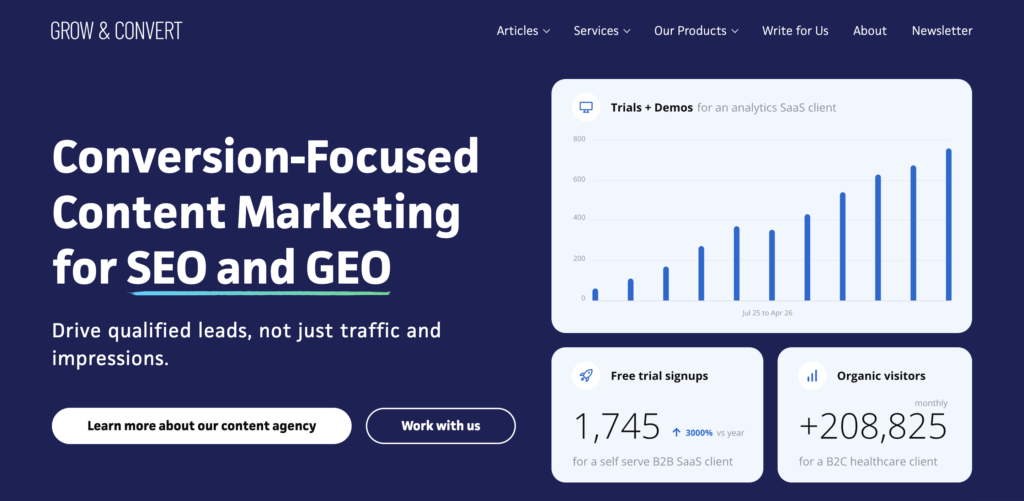
10. Grow and Convert
- Best for: Funded teams that want content engineered for signups and demos, not traffic.
- Price: Around $10,000 a month.
- What they own: Bottom-funnel content built on their Pain Point SEO methodology.
- Publishes for you: Yes.
- Contract: Six months and up.
Grow and Convert pioneered Pain Point SEO, which targets keywords that signal a buyer is actively looking for a solution instead of casually researching. Their case studies lead with trial signups and qualified leads rather than traffic charts, and they have worked with Patreon, ServiceTitan, Leadfeeder, and Yelp.
Reviews praise the conversion focus and the methodology. The honest catch is that the deliberately narrow bottom-funnel focus means you get less top-of-funnel authority building, so pair them with something else if you also need to grow the audience.
Skip it if: you need broad topical authority and awareness content, not just high-intent conversion pieces.
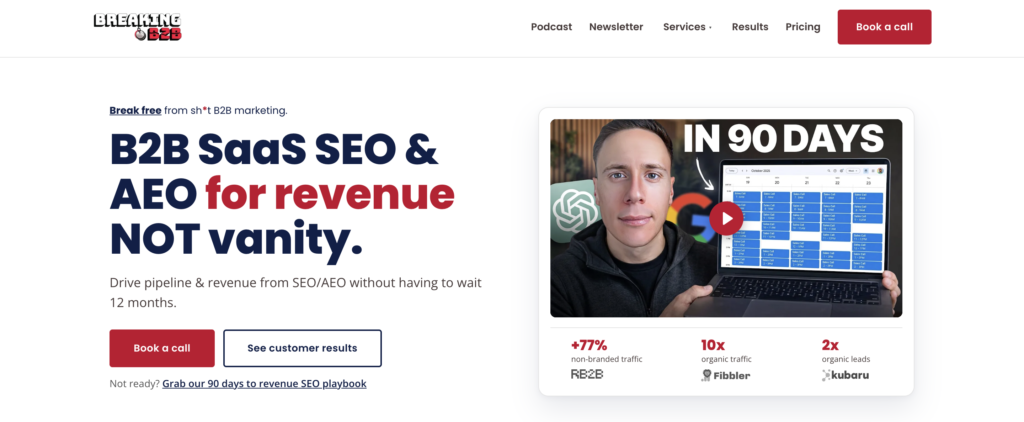
11. Breaking B2B
- Best for: Early-stage SaaS chasing demos and trials on a boutique budget.
- Price: Around $3,000 a month.
- What they own: Conversion-focused SaaS SEO and content for smaller teams.
- Publishes for you: Yes.
- Contract: Flexible.
Breaking B2B is frequently recommended for early-stage SaaS that wants the demos-and-trials mindset of Grow and Convert at a fraction of the price. Reviews praise the accessibility and the bottom-funnel focus. The honest note is that a boutique operation has capacity limits, so it suits companies with a focused scope rather than a sprawling content mandate. A solid entry point if you want conversion-oriented content without a five-figure commitment.
Skip it if: you need high volume across many content types at once.
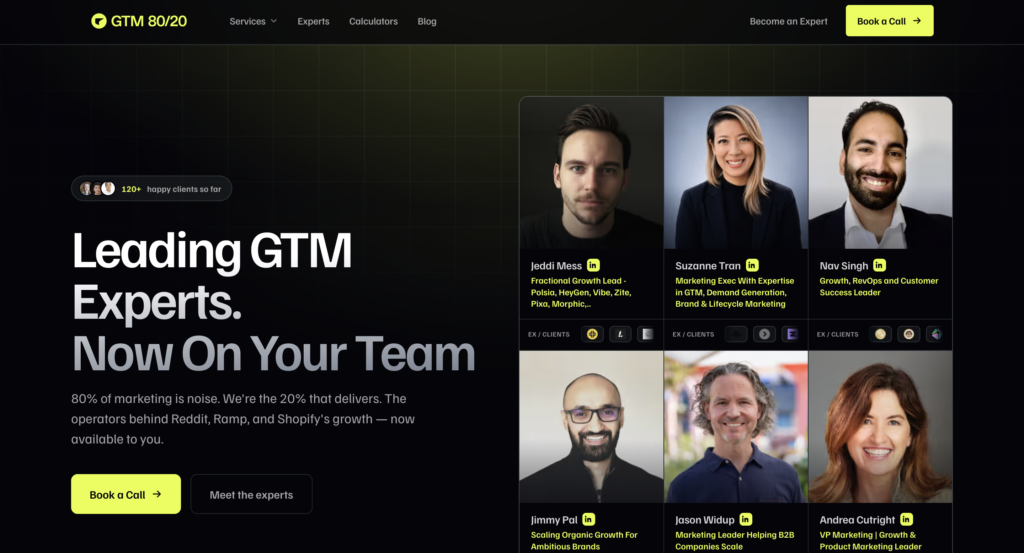
12. GTM 80/20
- Best for: Teams that want a senior SEO operator matched to them directly, without agency overhead.
- Price: $2,500 to $6,000 a month.
- What they own: Fractional senior SEO and GEO talent, matched to your account.
- Publishes for you: Depends on the operator.
- Contract: Month-to-month.
GTM 80/20 is a fractional model: instead of an agency layer, you get matched (reportedly in 24 to 48 hours, from a network with a 3% acceptance rate) with a senior operator who owns your program month to month.
For teams that trust their own strategy and want expert execution without long lock-in, it is an efficient structure. Reviews praise the seniority and the flexibility. The honest trade-off is that a single operator is not an agency, so bandwidth is capped by one person’s hours, and you do not get the bench depth of a full team.
Skip it if: you need a full team producing high volume across strategy, content, links, and technical at once.
The B2B SaaS marketer’s playbook
Enough about the agencies. Here is how to actually pick, organized by what you are trying to do.
You are the whole marketing team and content keeps slipping. This is the most common case, and it is the one LymLyt was built for. You need a content arm that researches, writes, and publishes without you managing it, that scales up and down as your quarter shifts, and that does not lock you in while you figure out fit. Start with LymLyt. Embarque and SimpleTiger are the backups if you need higher raw volume.
Your CEO measures content by demos and trials. You need bottom-funnel content, not awareness traffic. Grow and Convert if you are funded, Breaking B2B if you are early. LymLyt’s comparison pages and lead-gen content also live in this lane at a lower entry point.
You have real budget and want to hand off the whole channel. Compare Skale directly against Omniscient Digital and Siege Media. Add Directive if organic is one lever inside a bigger paid and rev-ops program.
Your bottleneck is authority and backlinks. Siege Media for the design-plus-links model, or Foundation for cross-channel distribution that builds authority beyond Google.
AI visibility is your priority. Every agency claims it; pressure-test who can actually explain it. LymLyt’s AI visibility service is built around getting cited in AI answers, and First Page Sage has the longest enterprise GEO track record if budget is not a constraint. It is also worth understanding the broader tooling shift, which we cover in our top 100 AI tools rundown.
You trust your own strategy and just want senior execution. GTM 80/20’s fractional model, month to month.
You are pre-Series A with a tight budget. Breaking B2B, scoped LymLyt, or a fractional operator. Skip the $10,000-plus engines entirely for now; they are not built for your stage.
Three rules that hold regardless of who you pick. First, pick by the job you need done, not by the biggest logo on the agency’s client wall. Second, start with one real workflow, your highest-value content type, before you hand over the whole channel. Third, watch the fit early: the no-lock-in options exist precisely because the wrong six-month agency commitment is an expensive mistake to sit inside.
How to run the discovery call
Whichever three you shortlist, the discovery call is where you separate the real fit from the good pitch. Bring these questions, in this order, and you will get to a decision faster.
Ask for a budget range in the first ten minutes. If they dodge, that is information. Ask who writes the content and how much of it runs through an LLM. Ask to see a currently-ranking article from a past client at your ARR stage and have them walk you through how it converts. Ask whether “delivered” means a Google Doc or a published, formatted, internally-linked page in your CMS. Ask, concretely, how they get content cited in AI answers, and listen for a real method versus a buzzword. Ask what the contract term and exit terms are before you fall in love with the strategy.
If you want a shortcut to a scoped plan and a straight number, LymLyt runs a 30-minute goal-setting call and you leave with a content plan and a cost, whether or not you work with them. Book it here.
How to choose, in one screen
- Bandwidth problem, lean team, no lock-in: LymLyt.
- High volume, mid-market budget: Embarque or SimpleTiger.
- Full channel handoff, enterprise budget: Omniscient, Siege, or Skale itself.
- Multi-channel enterprise program: Directive.
- Demos and trials focus: Grow and Convert (funded) or Breaking B2B (early).
- Links and design assets: Siege Media.
- Distribution beyond Google: Foundation.
- Editorial thought leadership: Animalz.
- Dedicated GEO, enterprise: First Page Sage.
- Senior operator, month to month: GTM 80/20.
The bottom line
Every agency on this list can save you the doing. Not one of them can save you the thinking.
That is the part worth remembering when you compare retainers. The research still has to be right. The message still has to be sharp. The strategy still has to fit your actual buyer. An agency can take the writing and publishing off your plate, and the best ones do it brilliantly, but if the underlying point of view is generic, you get generic content that ranks for a week and gets buried. We wrote more about why so much B2B content stopped landing in AI didn’t cause content blindness, marketers did.
Skale is a strong agency for the company it is built for: funded, ready to hand off the whole channel, comfortable with a custom quote and a runway. If that is you, talk to them. If instead you have the plan and you are missing the hands to execute it, that is a different problem, and it has a different answer.
LymLyt exists for that second version. We plan, write, and publish the blog posts, landing pages, and comparison pages your team does not have bandwidth for, with no pushy contracts and a straight answer on cost. See what we do, or book a 30-minute call and leave with a content plan either way.

Rashmita is content marketer with 8 years of experience building and growing SaaS brands. Now she tests various AI tools for marketers and shares her feedback on this blog, LinkedIn, Instagram, and YouTube.