Google Knowledge Graph: What It Is and How to Use It for SEO in 2026
The Google Knowledge Graph is the reason Google can answer questions without sending you anywhere.
“SEO is slowly moving from optimizing pages to optimizing entities.”
There was a time when SEO felt almost mechanical. Pick a keyword. Repeat it often enough. Get a few backlinks. Wait for Google to crawl your page, and you had a decent shot at ranking.
That version of Google does not exist anymore.
Today’s search engine wants to understand the world the way people do. When someone searches “Apple,” Google should not have to guess whether they mean a fruit, a trillion-dollar company, or the Beatles’ record label. It needs context. Not keywords.
Google’s answer is the Google Knowledge Graph. Launched in 2012, it moved Google beyond matching text to understanding real-world things: people, companies, products, places, and the relationships between them.
More than a decade later, it powers Knowledge Panels, influences AI Overviews, and increasingly determines whether your business is seen as a trusted entity or just another domain. Most SEO discussions still revolve around keywords, backlinks, and content optimization. But underneath all of it sits a system that decides whether Google actually knows who you are.
Understanding that system has become one of the most valuable skills in modern SEO.
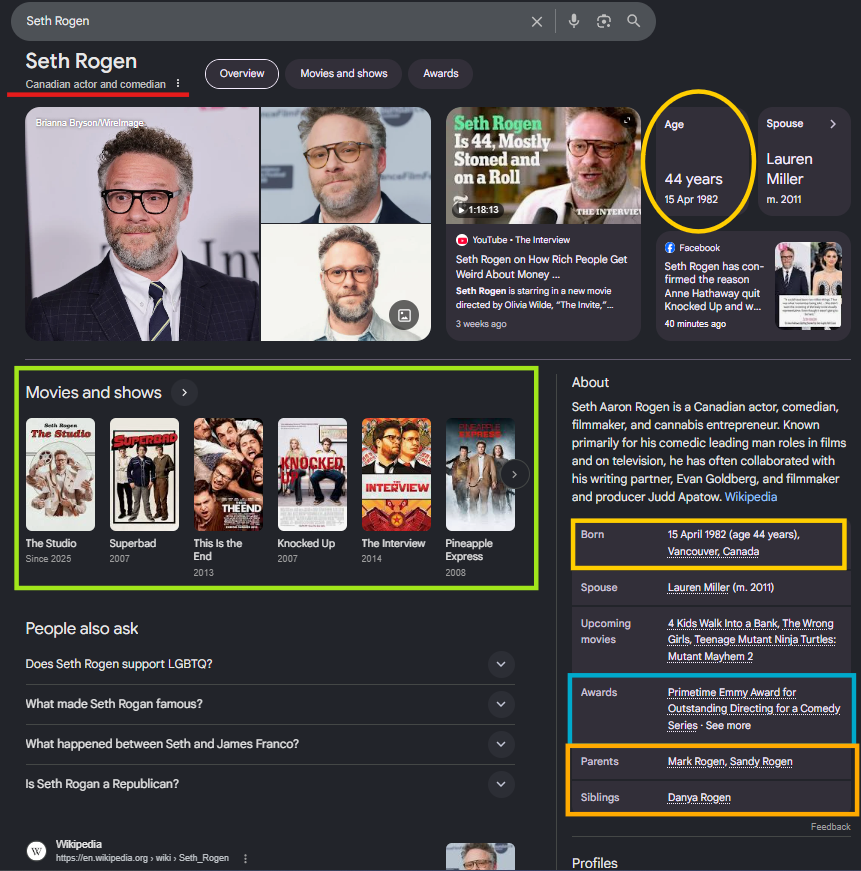
Google’s Knowledge Panel is a public view of its Knowledge Graph. Rather than storing just a name, Google understands an entity through its attributes (age, occupation), relationships (parents, spouse, birthplace), connected entities (movies and TV shows), and verified associations (awards). Together, these relationships allow Google to answer questions without relying solely on keyword matching.
Google Does Not Think in Keywords Anymore
Imagine you meet someone at a networking event.
They introduce themselves with a single word.
Apple.
You would probably ask: “Apple… the company?” or “Apple… the fruit?”
That single word is not enough. You need context.
Google has the exact same problem.
Every day, billions of searches contain words that could mean multiple completely different things.
Take these examples.
Mercury: a planet, a chemical element, a Roman god, an automobile brand.
Jaguar: a luxury car manufacturer, a wild cat, an NFL football team.
Amazon: an e-commerce company, a rainforest, a river, a streaming platform.
If Google relied only on keywords, it would constantly misunderstand what people were searching for.
Instead, Google identifies entities.
An entity is simply something that exists independently and can be uniquely identified.
People are entities. Companies are entities. Books are entities. Movies are entities. Countries are entities. Products are entities. Even abstract concepts like artificial intelligence or climate change become entities once Google can define them clearly.
Instead of storing the word Apple, Google stores Apple Inc. And attached to that entity are hundreds of relationships: CEO, headquarters, stock ticker, products, founders, industry, competitors, subsidiaries, official website, and social profiles.
The word itself becomes almost irrelevant. Google is not matching text anymore. It is matching meaning.
This is why building topical authority matters so much. Google does not only understand what keywords you use. It understands what entities you are associated with.
From Strings to Things
When Google announced the Google Knowledge Graph back in 2012, it described the project with a simple phrase: “Things, not strings.”
It sounds catchy, but it represents one of the biggest shifts in search history.
A string is just text. Apple. That is all Google used to see. A collection of letters.
An entity is much richer.
Apple Inc. Founded: 1976. Founders: Steve Jobs, Steve Wozniak, Ronald Wayne. Headquarters: Cupertino, California. CEO: Tim Cook. Industry: Consumer Electronics. Products: iPhone, MacBook, iPad, Apple Watch, Vision Pro.
Notice what is different. Google is not storing a webpage. It is not storing a paragraph. It is storing structured knowledge.
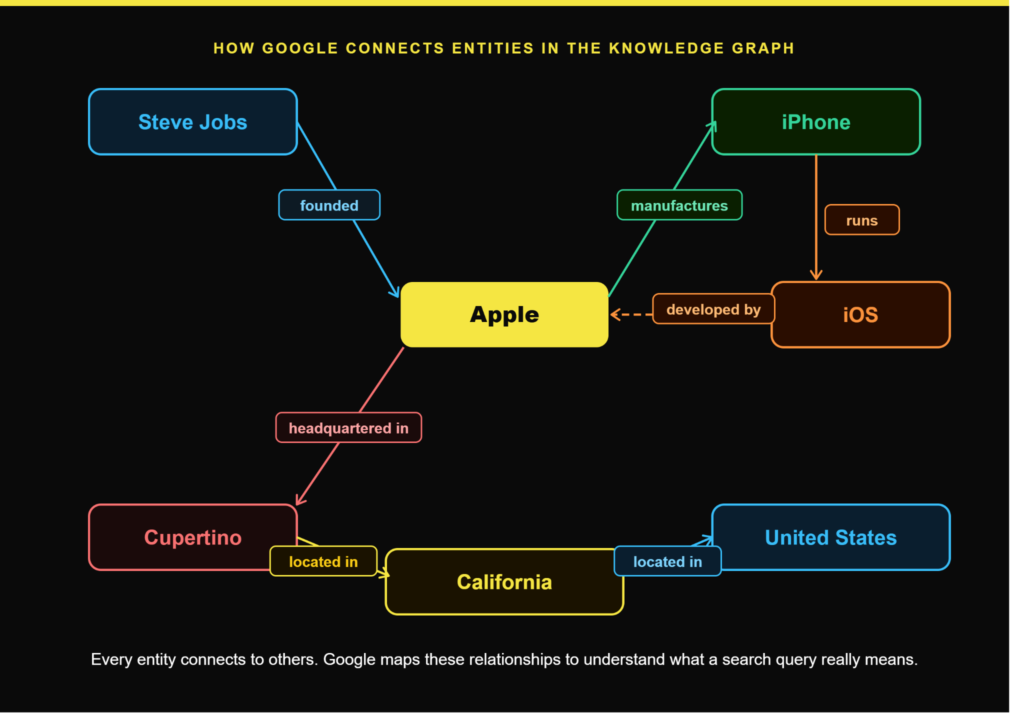
Every attribute becomes a relationship connecting one entity to another. Tim Cook is connected to Apple. Apple is connected to Cupertino. The iPhone is connected to Apple. Apple belongs to the Consumer Electronics industry. The graph keeps growing as more entities connect to each other.
Instead of isolated webpages, Google builds something that resembles a gigantic map of knowledge.
The Google Knowledge Panel is a public view of its Knowledge Graph. Rather than storing just a name, Google understands an entity through its attributes (age, occupation), relationships (parents, spouse, birthplace), connected entities (movies and TV shows), and verified associations (awards). Together, these relationships allow Google to answer questions without relying solely on keyword matching.
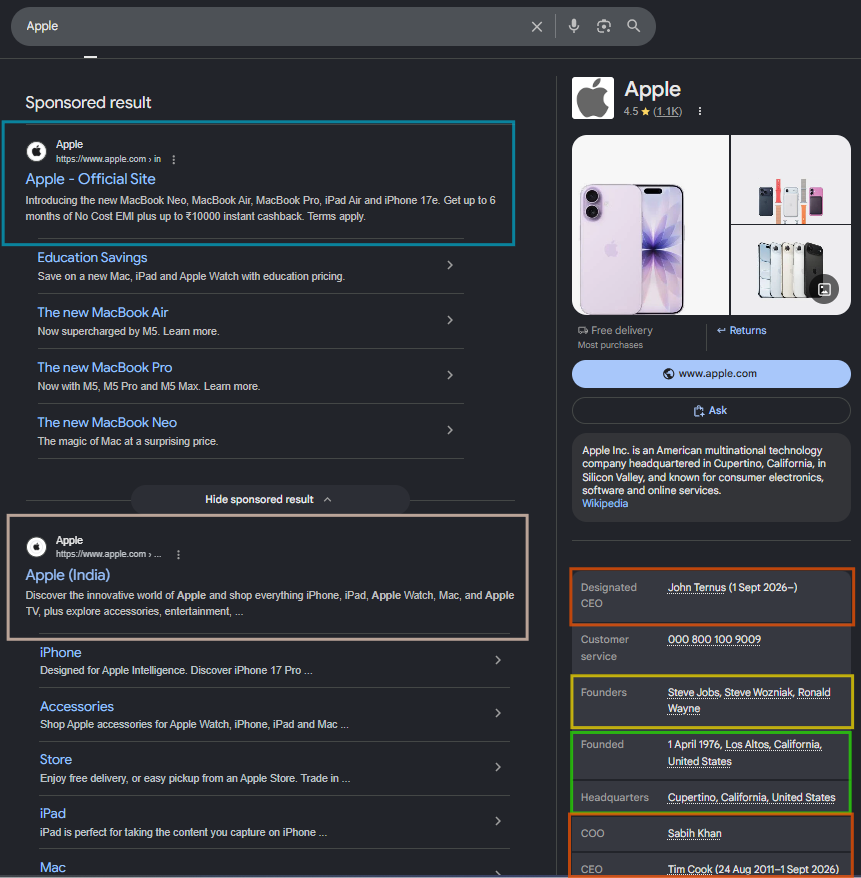
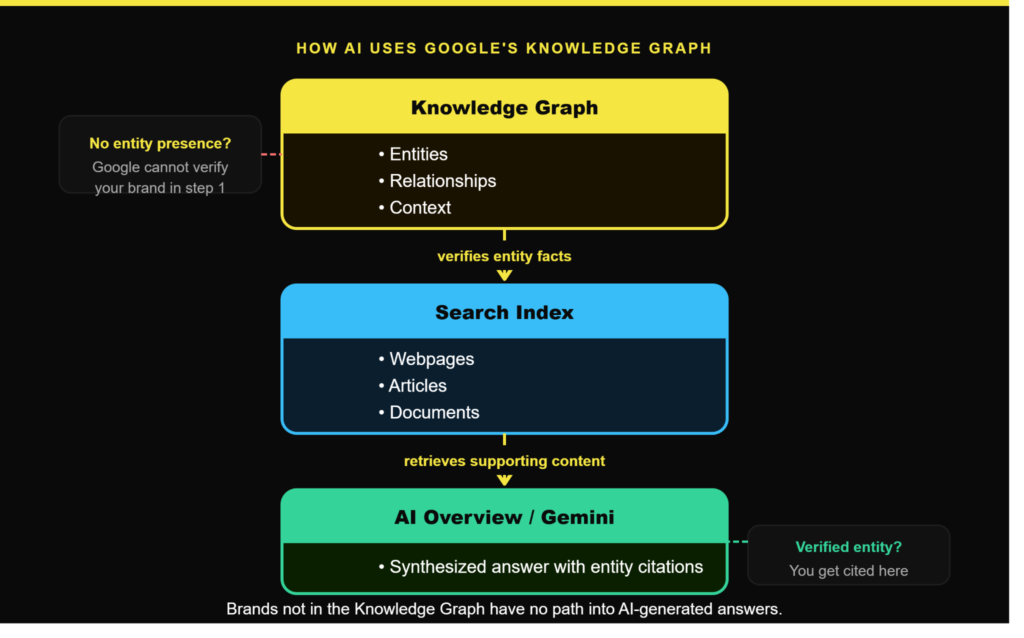
Google Search runs on two systems working together. The search index retrieves and ranks pages. The Knowledge Graph understands entities like Apple, its founders, headquarters, and products. When you search “Apple,” Google identifies the entity first, then pulls supporting pages. That combination is what makes modern search feel like it actually understands your question.
Think of the Google Knowledge Graph Like a Giant Social Network
Facebook connects people. LinkedIn connects professionals. Google connects knowledge.
Imagine every company, person, movie, place, product, and concept in the world as a node in a massive network. Now imagine lines connecting all of them.
Steve Jobs founded Apple. Apple manufactures the iPhone. The iPhone runs iOS. iOS was developed by Apple. Apple is headquartered in Cupertino. Cupertino is located in California. California is located in the United States.
Every new relationship makes Google’s understanding stronger.
This is why Google often seems to “know” answers without reading webpages in real time. If someone asks who founded Apple, Google does not need to search every article about Apple. It already has that relationship stored. If someone asks what products Apple makes, the answer already exists inside the graph.
The web is still important. Google constantly crawls webpages to discover new information. But once that information becomes trustworthy enough, it may become part of Google’s structured understanding of the world.
The search index stores documents. The Google Knowledge Graph stores knowledge.
This is also directly relevant to GEO for SaaS. AI engines like ChatGPT and Perplexity pull from structured entity data when generating answers, not just from raw web pages. Being in the Knowledge Graph is increasingly a prerequisite for appearing in AI-generated responses.
Why This Matters More Than Ever in 2026
For years, the Google Knowledge Graph was mostly associated with those information boxes that appeared on the right side of desktop search results. Many marketers assumed that was its only purpose. It is not.
Today, almost every major AI-powered search experience depends on entities.
When Google generates an AI Overview, it is not reading one webpage and summarizing it. It is combining information from multiple trusted sources while relying on its understanding of entities and relationships to avoid confusion.
The same applies to Google Gemini. Ask Gemini about a company, and it already understands who founded it, what products it sells, which industry it belongs to, and how it relates to other organizations. That understanding does not come from a single webpage. It comes from years of building an interconnected graph of entities.
This is also why two websites with equally good content can perform very differently. One belongs to a recognized entity with a long history, consistent information, authoritative mentions, structured data, and trusted references. The other is simply another website. Google trusts entities. It evaluates pages. That distinction is becoming increasingly important as AI reshapes search.
For B2B SaaS companies specifically, understanding the Google Knowledge Graph is now inseparable from your broader B2B SaaS SEO strategy. Entity presence determines which brands get cited in AI answers, not just which pages rank on page one.
What Exactly Is Stored Inside the Google Knowledge Graph?
When people hear that the Google Knowledge Graph contains 54 billion entities and over 1.6 trillion data points, the numbers sound almost impossible to imagine.
What does a “data point” even mean?
It is much simpler than it sounds.
Imagine your company. Let’s say your business is called Lymlyt.
Google might store information like this:
| Attribute | Stored fact |
| Company name | Lymlyt |
| Founded | 2025 |
| Founder | Rashmita Behera |
| Headquarters | India |
| Industry | Content Marketing Agency |
| Website | https://lymlyt.pro |
| https://www.linkedin.com/company/lymlyt-agency | |
| Focus | B2B SaaS content marketing |
Each row is considered one structured data point about the entity. Now multiply that by billions of companies, people, books, products, universities, cities, songs, and organizations. That is how you end up with trillions of data points: not random trivia, but individual pieces of structured information connected together into one enormous graph.
How Google Builds Its Knowledge Graph
Google is not in the business of maintaining an encyclopedia by hand. The web changes too quickly for that. New startups launch every day, executives change jobs, products are discontinued, companies rebrand, and new technologies emerge almost overnight.
Instead, the Google Knowledge Graph is constantly learning. Every time Google crawls the web, it is not just discovering new pages. It is looking for signals that help it answer three fundamental questions: Does this entity exist? What do we know about it? Can we trust this information?
Those three questions drive almost everything the Knowledge Graph does.
Your Website Is Not Google’s Only Source of Truth
One of the biggest misconceptions in SEO is believing that Google learns everything about your business from your website.
Your website is important. It is often the most authoritative place to describe your own company. But Google does not stop there.
Imagine you launch a new software company. Your homepage says you were founded in 2025. Your LinkedIn page says 2024. Crunchbase says 2023. Your Google Business Profile has no founding year. A press release mentions 2022.
Which one should Google believe?
It cannot simply trust whichever page it crawls first. Instead, Google compares information from multiple trusted sources until it develops enough confidence to store a particular relationship inside the Knowledge Graph.
Think of it less like copying information and more like investigative journalism. The more independent sources that agree with each other, the more confidence Google has that the information is accurate. That is why consistency matters so much. It is not just about branding. It is about reducing ambiguity.
Google Builds Confidence, Not Just Data
Suppose five reputable websites mention your company. Four of them say you are based in London. One says you are based in Manchester. Google now has conflicting information.
It does not immediately declare one source wrong. Instead, it evaluates the credibility of each source. Has this website been accurate before? Does your own website confirm the same location? Does your Google Business Profile match? Does your LinkedIn company page agree?
As more evidence accumulates, Google gradually becomes more confident about one version of the truth. The Google Knowledge Graph is not just collecting information. It is constantly evaluating it. That is one reason why becoming a recognized entity takes time. Trust is not built overnight.
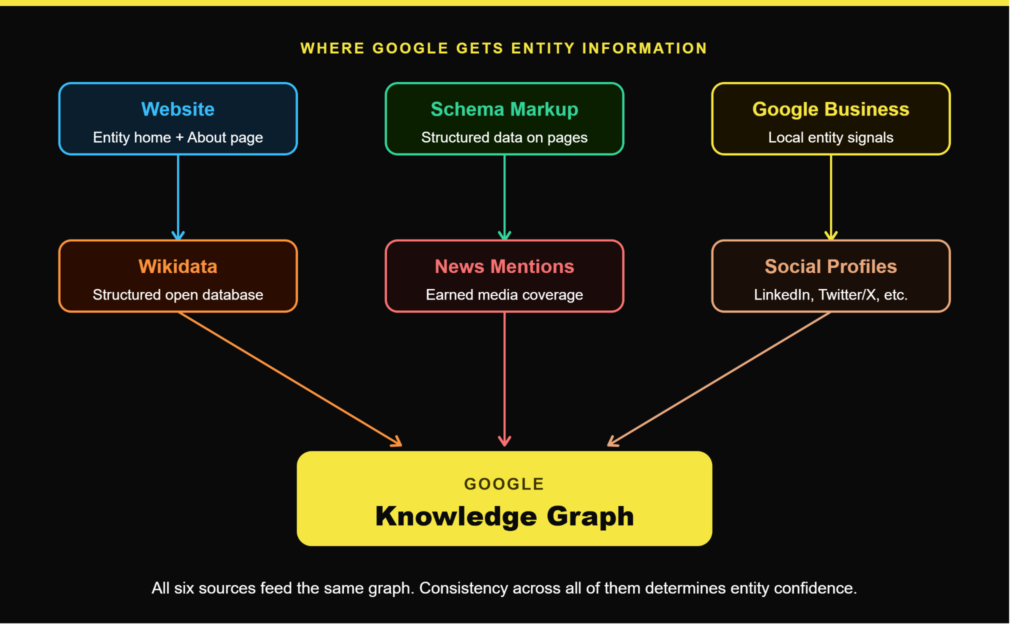
Where Does Google Get Entity Information?
Although Google does not publicly reveal every source it uses, years of patents, documentation, and observations from the SEO community paint a fairly clear picture.
Your Website
Your own website is often Google’s first stop. Pages like About, Team, Contact, product pages, company history, and press pages help Google understand who you are and what you do. This is also where structured data, such as Schema.org markup, becomes valuable. It gives Google explicit labels instead of forcing it to infer everything from plain text.
Writing strong homepage content that clearly states who you are, what you do, who you serve, and when you were founded is one of the most underrated entity signals available to any B2B company.
Structured Data
Schema markup acts like labels attached to your content. Instead of writing “Jane Doe founded Acme Software,” schema can explicitly say: this is a Person, this person is the founder, this organization is Acme Software. Google already understands natural language remarkably well. Schema simply reduces ambiguity. It helps Google connect information faster and with greater confidence.
Public Knowledge Bases
Google also relies on structured databases that already organize information into entities and relationships. Some of the most influential include Wikidata, Wikipedia, Google Business Profile, government databases, business registries, and academic databases. Not every company needs a Wikipedia page. But structured public references make Google’s job significantly easier.
Trusted News Publications
Imagine your company announces a funding round. That announcement appears on TechCrunch, Forbes, Reuters, and your company blog. Google now sees multiple trusted sources describing the same event. Each mention reinforces the relationship between your company and that funding announcement.
This is one reason digital PR has become increasingly valuable. It is not only about backlinks anymore. Authoritative mentions help strengthen entity recognition.
Social Profiles
Your LinkedIn page, YouTube channel, GitHub organization, X profile, and Facebook page individually do not create an entity. Together, they reinforce that all these accounts belong to the same organization. Consistency across platforms matters far more than simply being present everywhere.
From Millions to Billions: How the Knowledge Graph Has Grown
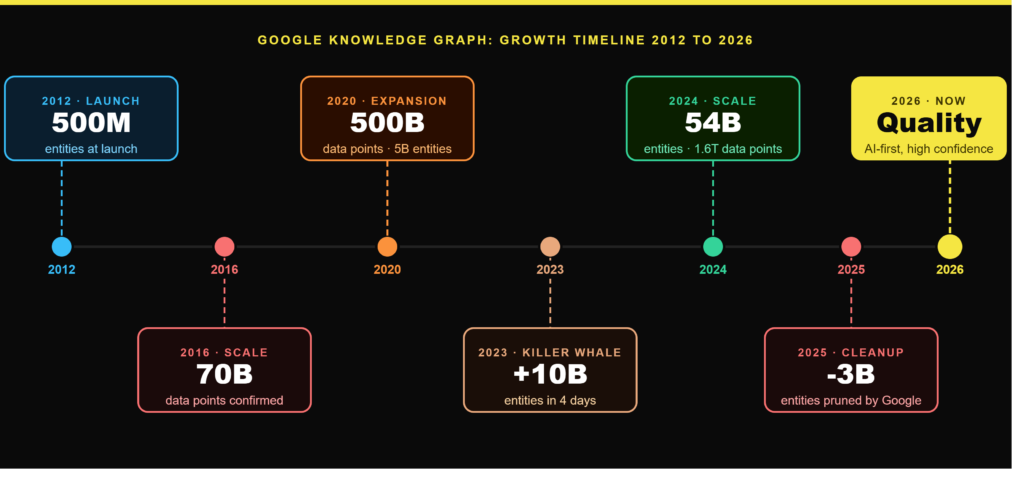
When Google introduced the Google Knowledge Graph in 2012, it announced that the system contained roughly 500 million entities connected by 3.5 billion data points. At the time, that sounded enormous. Today, those numbers feel almost tiny.
By 2016, it contained around 70 billion data points. In 2020, Google surpassed 500 billion data points and 5 billion entities. In 2023, Google added more than 10 billion new entities in just four days using improved machine learning techniques.
Today, the Google Knowledge Graph is estimated to contain approximately 54 billion entities connected by 1.6 trillion data points. Those numbers are difficult to visualize. But the important takeaway is not the scale. It is the direction. Every year, Google’s understanding of the world becomes richer, more connected, and more precise.
Why Your Website Alone Is Not Enough
You can write the best About page in the world. You can publish flawless schema markup. You can optimize every heading, image, and paragraph. None of that automatically makes your business an entity.
Google does not create entities because you say you exist. It creates entities when enough trustworthy evidence across the web supports your existence and clearly defines who you are.
That is why entity SEO extends far beyond on-page optimization. It is about creating a consistent digital identity across your website, social profiles, structured data, press mentions, business listings, authors, and citations. Together, they tell the same story from different places. When those signals consistently reinforce one another, Google becomes increasingly confident that your business is not just another website. It is a real entity.
This is closely related to how topic clusters work. Just as clusters build topical authority through interconnected content, entity signals build brand authority through interconnected references across the web.
Why Your “About Us” Page Matters More Than You Think
Ask ten marketers which page on a website is the most important for SEO, and you will hear the usual answers: the homepage, the pricing page, the blog, product landing pages. Rarely does anyone mention the About page. Ironically, it is one of the first places Google looks when it is trying to understand who you are.
Your About page should become the canonical description of your business. This page is what many SEOs refer to as an Entity Home.
What Is an Entity Home?
An Entity Home is the canonical page that represents an entity on the web. For most companies, that is usually the About page. For an individual, it might be an author page. For a product, it could be the main product page.
The exact URL does not matter. The purpose does. It should be the page Google can rely on whenever it wants to answer the question: “Who exactly is this?”
What Makes a Strong Entity Home?
Many About pages read like marketing copy. “Our mission is to revolutionize the future through innovation.” It sounds impressive. It does not help Google very much.
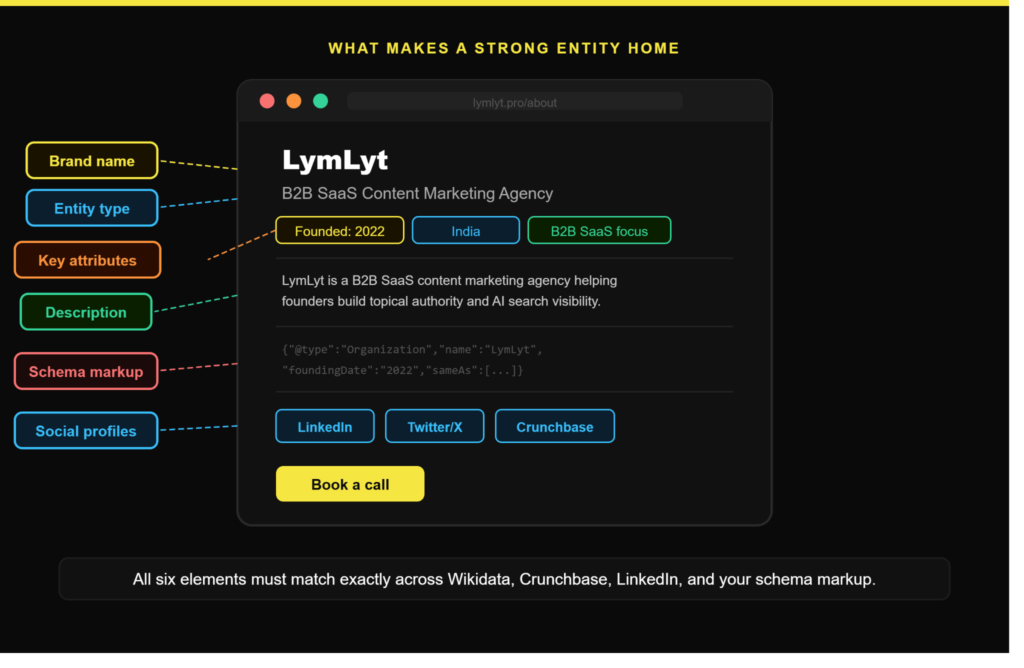
A good Entity Home balances storytelling with clarity. By the time someone leaves the page, both humans and search engines should understand exactly who you are. It should include:
A clear company name. Lead with the name, not a slogan. Google should not have to guess the entity.
A concise description. Within the first few paragraphs, explain what the company does, who it serves, and what makes it different. Specific descriptions create stronger entity signals.
Key attributes. Include founding date, headquarters, founders, industry, and products. These become relationships Google can verify.
Leadership. Founders and leadership deserve dedicated mentions. If your CEO already has an author page, link to it. Google is not only understanding companies. It is connecting people to organizations.
Products and services. Do not assume Google will figure this out from navigation menus. State them explicitly.
Social profiles. Link official profiles: LinkedIn, X, GitHub, YouTube. These help reinforce that multiple profiles belong to the same organization.
A strong About page acts as an Entity Home, a single authoritative source that clearly explains who the organization is. Below is a mock-up created for our own website Lymlyt.pro.
Schema Markup Is Not Magic
Few SEO topics are surrounded by more myths than schema markup.
Some believe adding Organization schema automatically creates a Knowledge Panel. Others think schema directly improves rankings. Neither is true.
Schema does not create entities. Schema does not convince Google that your business exists. What it does is much simpler. It helps Google understand your content with less ambiguity.
Imagine walking into a library where every book has no title, no author, and no category. You could still figure things out by reading every page. It would just take a lot longer. Schema is the label on the spine.
Google is perfectly capable of understanding content without schema. Structured data simply makes that understanding easier and more reliable. This is also relevant to GEO optimization. AI engines that power AI Overviews and Gemini prefer content with clear entity signals, and schema is one of the clearest signals you can provide.
The Schema Types That Matter Most
Organization: The foundation of entity SEO. It tells Google your company name, logo, website, founding date, contact information, and social profiles.
Person: Useful for founders, executives, and authors. This helps Google connect individuals with organizations and content.
Article: Every blog post should clearly identify headline, author, publication date, and publisher. Google increasingly evaluates who wrote content, not just the content itself.
Product: For SaaS companies and software businesses. Defines product name, brand, pricing, reviews, and availability.
Breadcrumb: Small but useful. Helps Google understand site hierarchy.
SameAs: One of the most overlooked properties. It explicitly connects your entity to profiles across the web: website, LinkedIn, GitHub, Crunchbase, YouTube, Wikipedia, and Wikidata. Instead of forcing Google to infer these relationships, SameAs tells it directly.
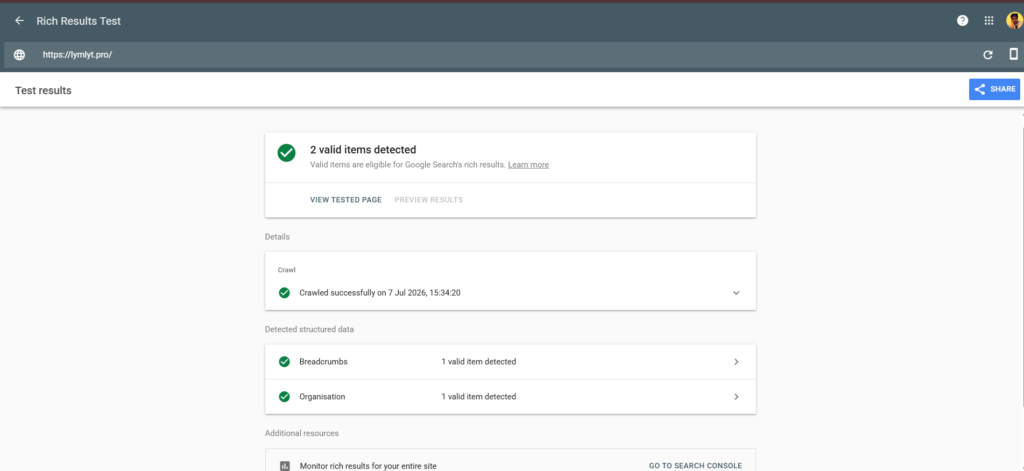
Schema doesn’t create entities, but it helps Google understand them faster and with greater confidence. LymLyt’s homepage returns two valid schema types: Organisation and Breadcrumbs.
What Is Wikidata?
Wikipedia gets all the attention. Wikidata quietly does much of the heavy lifting.
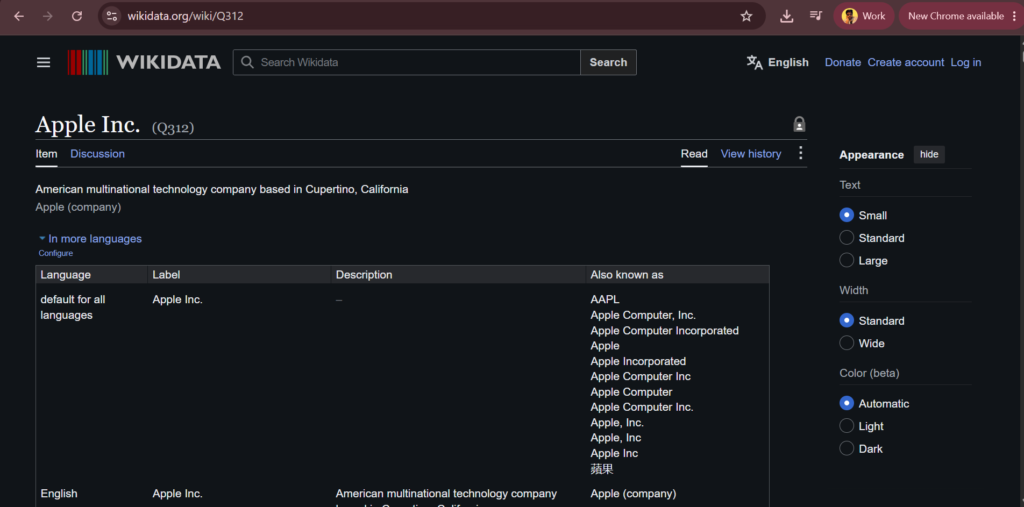
The two projects are related, but they are completely different. Wikipedia stores articles. Humans write paragraphs explaining a topic. Wikidata stores structured relationships. Instead of paragraphs, it stores properties.
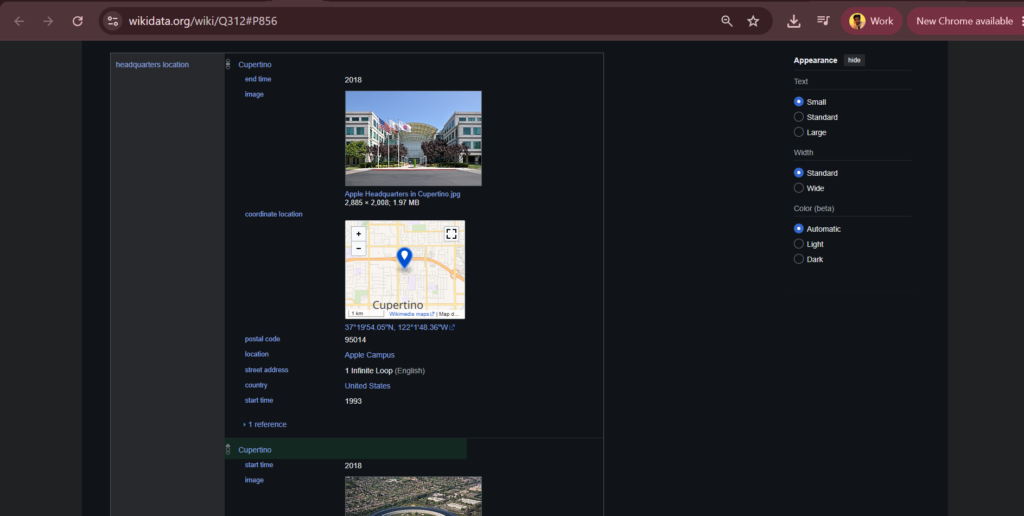
For Apple Inc: Founded 1976, Founder Steve Jobs, CEO Tim Cook, Headquarters Cupertino, Website apple.com. Every relationship is stored individually. Machines love this format. Google does too.
Why Wikidata Matters
There has been endless debate in the SEO community about whether Google directly uses Wikidata. The better question is: does having accurate information in Wikidata make it easier for search engines to understand an entity? Absolutely. Wikidata provides structured, referenced, machine-readable information that reinforces entity consistency across the web.
For organizations that already meet Wikidata’s notability guidelines, maintaining an accurate entry is worthwhile. For newer startups, do not rush to create one just for SEO. Wikidata is not a shortcut. It is another signal in a much larger ecosystem.
Why the Knowledge Graph Matters Even More in the Age of AI
For years, the biggest reward for becoming a recognized entity was getting a Knowledge Panel. Today, that is no longer the biggest benefit.
Google is increasingly using AI to answer questions instead of simply listing webpages. AI Overviews summarize information from multiple sources, Gemini understands follow-up questions, and conversational search experiences are becoming more common.
All of these systems face the same challenge: how do you make sure the AI is talking about the right thing?
Imagine someone asks: “Which CRM software is best for startups?” The AI does not first search for the keyword CRM software. It first identifies entities: HubSpot, Salesforce, Pipedrive, Zoho CRM, Freshsales. Each of these is already a recognized organization with known products, pricing pages, documentation, customer reviews, founders, competitors, and thousands of relationships stored across Google’s understanding of the web.
Only after identifying those entities does the AI begin deciding which ones deserve to appear in the answer.
Traditional search ranked pages. AI first understands entities, then chooses which pages to cite.
This shift is exactly why understanding why your content is not converting often starts with entity clarity. If Google does not recognize your brand as an entity, your content starts every race from behind, regardless of how well it is written.
The Knowledge Graph Is Memory. The Search Index Is Evidence.
The search index is like a giant library. It stores documents: articles, landing pages, research papers, videos. The Knowledge Graph is different. It stores understanding: Apple was founded by Steve Jobs, Nike operates in the Sportswear industry, Stripe was founded by Patrick Collison.
Google uses both together. When someone asks a question, the Knowledge Graph helps identify what the question is about. The search index helps determine what is new. The AI combines both before generating an answer.
Can You Rank in AI Search Without Becoming an Entity?
Technically, yes. Practically, it becomes much harder over time.
Imagine two cybersecurity blogs. Both publish an excellent article about ransomware. One belongs to Microsoft. The other belongs to a brand-new domain created last month. The content quality is identical.
Who does Google already understand? Microsoft. It knows the company. It knows the authors. It knows the products. It knows the industry. It has years of relationships connecting Microsoft to cybersecurity.
The new website has none of that context. This does not mean new brands cannot compete. It means they need to build their entity alongside their content. That is the same logic behind building a SaaS content engine: you do not just publish posts, you build a system that compounds authority over time.
Building an Entity Google Can Trust
Entity SEO is largely about consistency. Every place Google looks should tell the same story.
Step 1: Build a Strong Entity Home
Your About page should become the canonical description of your business. Include company name, clear description, founders, products, headquarters, contact information, social links, and company history.
Step 2: Implement Structured Data Correctly
Do not install every schema type you can find. Implement the ones that genuinely describe your content. At minimum, most businesses should have Organization, WebSite, Person, Article, and Breadcrumb schema. Schema is not about quantity. It is about accuracy.
Step 3: Create Real Author Entities
Hundreds of blogs still publish articles under names like “Admin” or “Marketing Team.” Those are not entities. Instead, create detailed author pages. Include biography, expertise, social profiles, company role, articles written, and credentials.
When one author consistently publishes content around a specific topic, Google begins associating that person with the subject. That is valuable for both traditional search and AI-generated answers. This is directly connected to building a strong B2B SaaS content calendar: consistent publishing under real author entities builds recognition faster than sporadic anonymous posts.
Step 4: Stay Consistent Everywhere
Make sure these details remain consistent across every platform: company name, logo, headquarters, website, descriptions, social profiles, and contact details. Consistency is not glamorous. It is incredibly effective.
Step 5: Earn Mentions, Not Just Backlinks
SEO has obsessed over backlinks for decades. They are still important. But not every valuable mention includes a hyperlink. Entity SEO rewards recognition, not just hyperlinks. Appearing in best-of roundups like the best SaaS content marketing agencies generates entity corroboration signals from authoritative pages, not just traffic.
Step 6: Connect Related Entities
Your website should not feel like isolated pages. Your founder page should link to your company. Your company should link to your products. Products should link to documentation. Articles should link to authors. Authors should link back to the company. You are helping Google understand relationships.
Step 7: Build Topical Authority
Google does not simply recognize companies. It also recognizes expertise. Publish fifty detailed articles about B2B SaaS content marketing and Google starts associating your brand with that topic. This is why keyword research done correctly builds entity-topic associations, not just ranking opportunities. Every cluster post you publish reinforces a relationship between your entity and a subject.
Entities become stronger when their areas of expertise are clear. This is why choosing between topic clusters and standalone keyword targeting matters so much for entity SEO. Clusters signal depth and ownership of a subject. Isolated posts signal nothing about expertise.
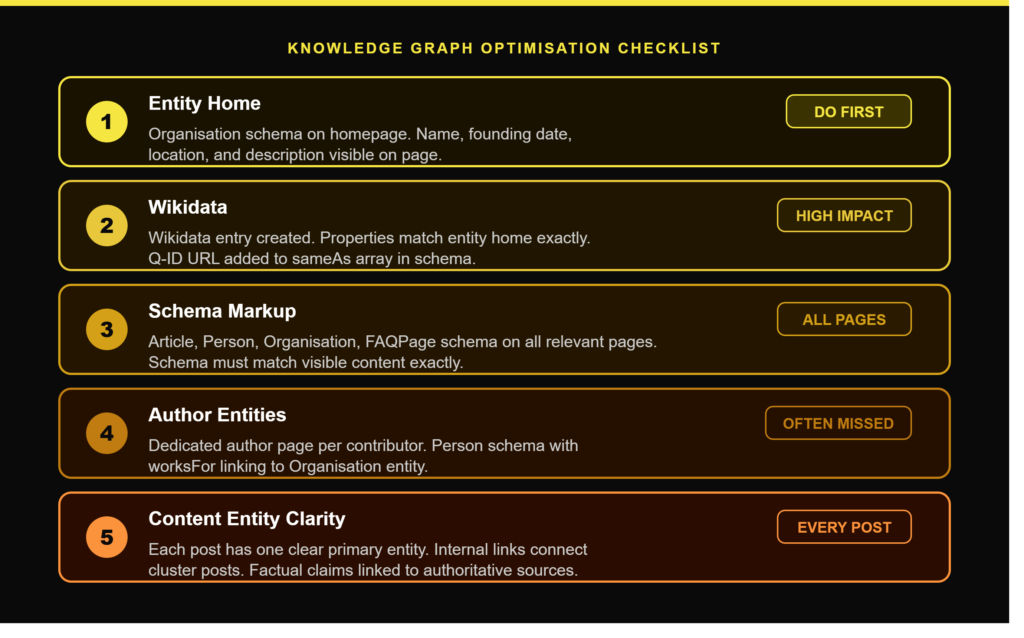
Inconsistent entity information across sources is the single biggest suppressor of Knowledge Panel visibility. Get one source wrong and Google’s confidence in your entire entity drops.
Common Entity SEO Mistakes
Treating the About Page Like Marketing Copy. Google needs facts before it needs slogans. Clear descriptions beat clever taglines.
Ignoring Author Pages. Authors are entities too. Invest in them.
Publishing Inconsistent Information. Different founding dates, different addresses, different company names: all of these reduce confidence.
Thinking Schema Solves Everything. Schema supports entity understanding. It does not create trust.
Chasing Wikipedia Too Early. Wikipedia follows strict notability guidelines. Focus on building a genuinely notable business first. Recognition should be earned naturally, not manufactured for SEO.
Forgetting That Brands Are Entities Too. Your blog is not the only thing Google evaluates. Your organization itself becomes part of the ranking equation. Investing in brand recognition is not separate from SEO anymore. Increasingly, it is SEO.
Entity SEO Is a Long-Term Investment
There is no button that tells Google to recognize your business. No form to submit. No shortcut that instantly creates a Knowledge Panel.
Entity SEO works more like building a reputation in the real world. You publish consistently. You become known for something. Other trusted organizations mention you. Your information stays accurate. Your digital identity becomes stronger year after year.
This is why AI newsletter resources tracking entity and GEO developments are worth following closely. The rules around entity recognition and AI citation are still evolving, and the teams that stay current will compound their advantage.
Eventually, Google stops seeing your website as just another collection of pages. It starts recognizing your business as something real. And once that happens, every future piece of content benefits from that trust.
The Biggest Misconceptions About the Google Knowledge Graph
“Adding Schema Will Create a Knowledge Panel.”
Schema markup helps Google understand your content. It does not guarantee recognition as an entity, nor does it automatically generate a Knowledge Panel. Schema is an important piece of the puzzle. It is not the puzzle itself.
“You Need a Wikipedia Page.”
Not anymore. Google learns from thousands of sources today. Wikipedia can reinforce Google’s understanding of a well-known entity, but it is neither a requirement nor a realistic goal for most businesses.
“The Knowledge Graph Is Just the Knowledge Panel.”
The panel is simply the visual interface. The Knowledge Graph is the system behind it. A company can exist in the Knowledge Graph without displaying a Knowledge Panel for every search.
“This Only Matters for Big Brands.”
Smaller companies have more to gain. Large companies like Microsoft, Apple, or Adobe already have decades of digital history. Smaller companies have the opportunity to shape their entity from the beginning.
“Entity SEO Has Replaced Traditional SEO.”
Not at all. Keywords still matter. Content still matters. Backlinks still matter. Technical SEO still matters. Entity SEO does not replace traditional SEO. It strengthens it.
The Future of Search Is Built on Entities
Search has always evolved alongside the way people use the internet. The first generation of search engines matched words. The next generation learned to rank pages. Today’s search engines are learning to understand knowledge itself.
That is why concepts like entities, relationships, authorship, topical authority, and structured information are becoming increasingly important. They are not replacing SEO. They are expanding it.
Large language models, conversational search, AI assistants, and Google’s AI Overviews all depend on understanding the world as interconnected entities rather than isolated webpages. The websites that succeed over the next decade will not simply publish more content. They will build stronger digital identities.
Final Thoughts
For years, SEO was largely about convincing Google that a page deserved to rank. That challenge has not disappeared. But another one has quietly emerged alongside it: convincing Google that your business deserves to be understood.
That is what entity SEO is really about. It is not chasing a Knowledge Panel. It is not obsessing over Wikipedia. It is not stuffing every schema type into your HTML. It is about creating a clear, consistent identity that Google can confidently recognize wherever it encounters your brand.
When your website, authors, products, social profiles, structured data, press mentions, and public references all tell the same story, you are no longer giving Google fragments to interpret. You are giving it a complete picture.
And that is increasingly important because AI-powered search is not built around keywords alone. It is built around understanding. The businesses that thrive over the next few years will not necessarily be the ones publishing the most content. They will be the ones that are easiest for search engines and AI systems to recognize, connect, and trust.
In that sense, the future of SEO is not just about ranking pages. It is about becoming an entity worth remembering.
Want your brand established as a recognised entity in Google’s Knowledge Graph so you appear in AI-generated answers, not just organic results? Book a call with LymLyt.

Jay is the co-founder of LymLyt and an AI partnership consultant helping B2B SaaS companies grow through content strategy, SEO, and AI integration. He writes about content marketing, what makes B2B content convert, and how SaaS teams can build content systems that drive real pipeline.