Top AI SEO Agencies for B2B SaaS in 2026
A growing share of B2B vendor research no longer starts with Google. Buyers open ChatGPT, Perplexity, or Google AI Overviews and ask direct questions: which tools are best for this use case, what do companies like mine typically use, and which vendors keep coming up in this category.
If your brand is not being cited in those answers, you are invisible to a segment of your market before the evaluation even begins. According to HG Insights, nearly half of B2B buyers now use AI platforms for vendor research before visiting a vendor website. Gartner projects traditional search volume will fall 25% by the end of 2026 as AI agents replace Google for product research.
This has created a new discipline with several overlapping names. Generative Engine Optimization (GEO) focuses on earning citations across large language models like ChatGPT, Claude, Gemini, and Perplexity. Answer Engine Optimization (AEO) covers visibility in direct-answer formats including AI Overviews and voice search. Most serious agencies now treat both as one system, since the underlying signals that drive AI citation and traditional ranking are increasingly the same: authoritative, well-structured, genuinely useful content with strong entity presence and credible external references.
The problem is that most agencies added “GEO” to their service pages without changing how they work. Telling genuine AI SEO capability apart from rebranded traditional SEO is now one of the harder purchasing decisions a B2B SaaS marketing team has to make. This list exists to make that easier.
What separates real AI SEO capability from a rebrand
Before getting into the agencies, it is worth being clear on what to look for, because the terminology is still unsettled and easy to abuse.
An agency with genuine AI SEO capability does at minimum: track citation share and share of voice across AI platforms (not just Google rankings), produce content that is structured for how LLMs retrieve and cite information rather than just for keyword density, build entity authority through third-party mentions and digital PR, and report on AI-driven referral traffic separately from organic search traffic.
An agency that has simply rebranded will talk about GEO and AEO prominently, then describe a content and technical SEO process that is identical to what they were doing two years ago.
The other thing worth knowing: using AI tools to do SEO (AI-assisted keyword research, AI-generated content briefs, AI-assisted writing) and optimizing for AI search are completely different disciplines. This list is about the second one.
How we evaluated these agencies
Each agency on this list was assessed against four criteria:
Genuine GEO methodology: Does the agency track AI citation rates, conduct prompt-based visibility research, and structure content specifically for LLM retrieval, or have they just relabeled their existing SEO process?
B2B SaaS fit: Do they understand multi-stakeholder buying cycles, technical audiences, and long evaluation windows? Generalist agencies that serve everyone from local businesses to SaaS companies rarely develop the depth needed here.
Transparency: Do they publish pricing, methodology, and results, or does everything require a discovery call to reveal?
Stage fit: Are they honest about who they are right for and who they are not?
Quick comparison
| Agency | Best for | Pricing | Core AI SEO strength |
|---|---|---|---|
| LymLyt | B2B SaaS content built for both Google and AI citation | From $3,000/month | AI-SEO content, entity authority, stage-mapped content |
| First Page Sage | Enterprise B2B SaaS building long-term category authority | $8,000–$12,000/month | GEO methodology pioneer, authority content, LLM citation research |
| Graphite | High-growth SaaS and product-led companies | Custom | AI-powered SEO platform, AEO infrastructure, velocity-focused |
| iPullRank | Enterprise with complex technical architecture | Custom (enterprise) | Entity engineering, JavaScript rendering, large-scale AI retrieval |
| Spicy Margarita | B2B SaaS prioritizing bottom-funnel AI visibility | Custom | BOFU-first GEO, active GEO research and experimentation |
| NoGood | Growth-stage SaaS needing GEO integrated with demand gen | Custom | Full-funnel growth, AI SEO paired with paid and lifecycle |
| DerivateX | B2B SaaS ($5M+ ARR) needing rapid AI citation improvement | From $5,500/month | AEO-first methodology, 90-day sprints, transparent attribution |
The agencies
1. LymLyt
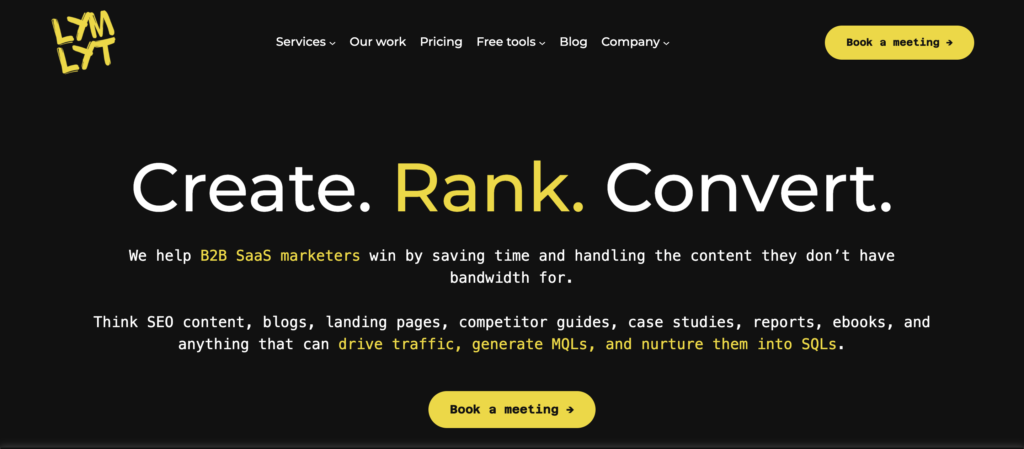
Best for: B2B SaaS companies in adtech, martech, salestech, and fintech that want content built to rank on Google and get cited by AI platforms without running two separate programs.
LymLyt is an organic growth focused content marketing agency that builds content programs designed to perform across both traditional search and AI-generated answers. For B2B SaaS companies, that distinction matters because your buyers are now researching on multiple surfaces simultaneously, and content that ignores either one is leaving visibility on the table.
Most AI SEO agencies treat GEO as a technical layer bolted onto existing content. LymLyt approaches it differently: the content itself is the foundation. Content that is genuinely authoritative, clearly structured, grounded in real expertise, and written for a specific audience is the same content that earns Google rankings and AI citations. Those two goals do not require separate programs.
How LymLyt approaches AI SEO for B2B SaaS
The work starts with understanding where your buyers are doing their research, what questions they are asking in AI tools, and what answers are currently being surfaced in your category. That informs a content strategy built around both keyword-driven search intent and the kinds of questions buyers ask AI assistants during vendor evaluation.
SEO content is structured for LLM retrieval: clear headings, direct answers to specific questions, well-attributed data points, and content that reflects genuine category expertise rather than generic coverage. That structure is what gets cited. AI models do not cite content that could have been written by anyone about anything. They cite content that is specific, confident, and demonstrably informed.
Blog content is mapped to the actual search and research behavior of buyers at each stage: awareness content that surfaces LymLyt clients in category conversations, consideration content that positions them as a credible option when buyers are comparing vendors, and late-stage content that reinforces the decision for buyers who are close to committing. That same mapping is what determines which content is most likely to earn AI citations for high-intent queries.
Distribution and reporting close the loop. LymLyt tracks which content is driving organic traffic, which is being linked to from third-party sources (an important AI citation signal), and how the full content program is contributing to leads and pipeline. That reporting connects content activity to business outcomes rather than treating AI visibility as a vanity metric.
What LymLyt produces for AI SEO specifically:
- Content audits identifying which existing pages have AI citation potential and which are working against it
- Topic cluster mapping built around both Google keyword intent and AI answer patterns in your category
- Long-form SEO content structured for LLM retrieval and featured snippet capture
- Entity-building content that establishes your brand as a recognized, citable authority in your category
- Distribution across owned channels to generate the engagement signals that AI models use as quality proxies
- Reporting that tracks organic traffic, referral links, and lead contribution alongside AI visibility signals
Results: A bootstrapped email enrichment SaaS saw 4x organic traffic and a 79% increase in organic leads within six months after LymLyt rebuilt the content architecture around BOFU-first keywords and authority-building. Domain authority climbed from 39 to 55 across 152 optimized pages. A B2B fintech company saw a 5.8x increase in competitor page conversion rate and 25% more leads after copy was rewritten around buyer intent rather than product descriptions.
Pricing: From $3,000/month retainer. Project-based work also available. No locked contracts or annual commitments.
Where LymLyt is not the right fit: If you need a dedicated technical SEO specialist to fix complex JavaScript rendering issues or restructure enterprise-scale site architecture, that is a different engagement type from content-led AI SEO. LymLyt’s strength is content authority and organic growth, not large-scale technical SEO infrastructure.
Book a 30-minute call to talk through what AI SEO looks like for your category.
2. First Page Sage
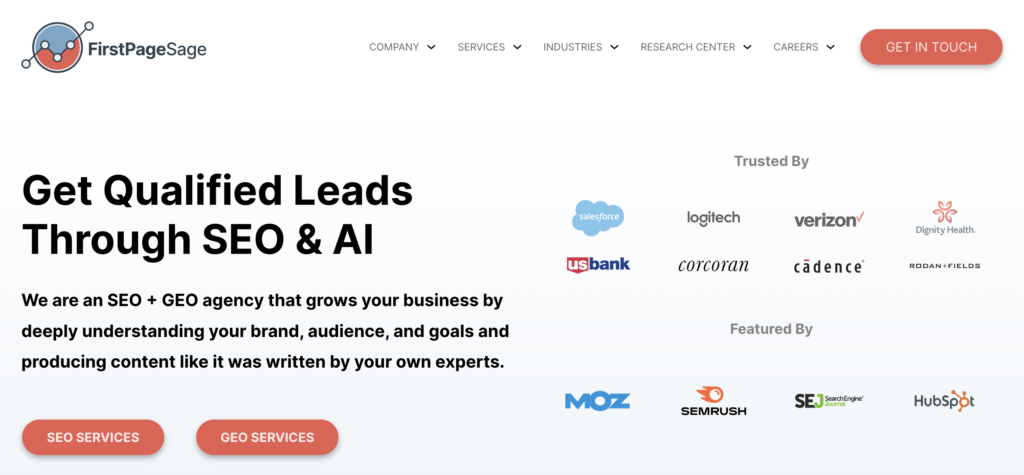
Best for: Enterprise B2B SaaS companies building long-term category authority and wanting the deepest GEO research methodology available.
First Page Sage claims to have coined the term “Generative Engine Optimization” and has been building GEO methodology since early 2023, making them one of the longest-running practices in the space. Founded in 2009 by Evan Bailyn, the agency has published the most comprehensive benchmark dataset in the GEO category, including an 18-month study across 127 companies that produced average GEO customer acquisition costs by industry. For B2B SaaS, they found an average CAC of $249 through GEO, the lowest of any sector they tracked.
Their methodology centers on authority content engineered for AI citation: long-form, research-backed pieces on category questions and commercial-intent topics, combined with structured data and database placement strategies that make clients visible where AI models build their reference lists. Notable clients include Salesforce, Okta, and Cadence Design Systems.
Pricing: $8,000–$12,000/month for comprehensive AI search optimization programs (third-party sourced).
Honest limitation: First Page Sage is a long-term program, not a fast-growth play. Engagements typically run 12 months and are designed for category dominance on a 12 to 24-month horizon. If you need pipeline movement in 90 days, this is not the right fit.
3. Graphite
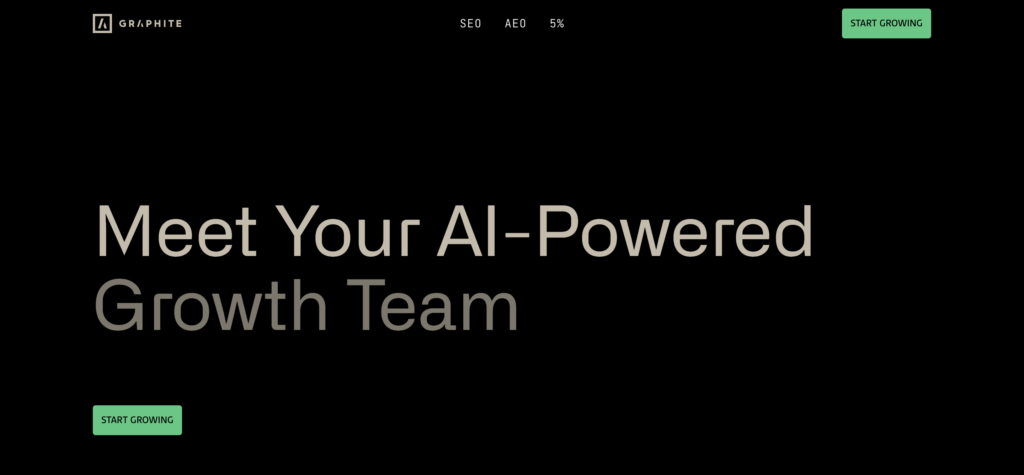
Best for: High-growth SaaS and product-led companies that want AI-powered SEO infrastructure with measurable velocity.
Graphite operates on a pointed philosophy: 95% of traditional SEO work is waste, and the other 5% drives all meaningful results. The agency uses AI to identify and execute that 5%, building what they describe as a full-stack AI-powered growth team covering editorial, programmatic SEO, AEO, technical optimization, and performance tracking. Their proprietary internal platform tracks performance across search engines and generative models in a single framework, which gives clients visibility into AI citation share alongside traditional rankings.
Their work focuses on high-growth SaaS and technology companies, and they have published methodology around AEO that goes beyond keyword content into entity recognition, structured data, and citation engineering. They appear consistently in third-party GEO agency evaluations as one of the firms that has built real AEO infrastructure rather than relying on category language.
Pricing: Custom. Available through consultation.
Honest limitation: Graphite is best suited to companies with existing content operations and meaningful traffic. If you are starting from a very early baseline, the velocity-focused model requires a foundation to accelerate.
4. iPullRank
Best for: Enterprise B2B companies with complex site architecture that need technical SEO and entity engineering as the foundation for AI visibility.
iPullRank is the most technically rigorous agency on this list. Their GEO work is grounded in deep technical disciplines: JavaScript rendering, log file analysis, large-scale site architecture, and what they call relevance engineering, which is the practice of structuring content and entity signals so that AI retrieval systems can accurately interpret and cite a brand. They have published a comprehensive AI Search Manual that has become a reference document in the GEO field.
Their track record spans over $4 billion in organic search results delivered. For enterprise B2B companies where the site is technically complex and the content library is large, iPullRank’s ability to coordinate across multiple technical teams is a genuine differentiator.
Pricing: Custom. Enterprise-only, with six-figure annual engagements at the high end.
Honest limitation: iPullRank is explicitly enterprise-focused. Smaller companies without technical resources to implement their recommendations will not get full value from the engagement. They are engineers who happen to do marketing, which is exactly what some clients need and a poor fit for others.
5. Spicy Margarita
Best for: B2B SaaS companies that want bottom-funnel AI visibility for buyers in active vendor evaluation.
Spicy Margarita is led by Ben Goodey, one of the more credible voices in the GEO space with an active research and education practice. The agency originally built its reputation on bottom-of-funnel SEO strategies designed to capture revenue-intent traffic, and has adapted that methodology for generative engine optimization, specifically targeting the queries buyers make inside LLMs when they are actively researching vendors.
For B2B SaaS companies with long sales cycles, that BOFU-first GEO focus is particularly valuable. A buyer asking ChatGPT “what are the best [category] tools for [use case]” nine months into an evaluation is not browsing. Getting cited in that answer has direct pipeline impact. Spicy Margarita is one of the few agencies that focuses on earning those citations rather than on broader AI visibility metrics.
The team is also notable for publishing ongoing research and experiments in the GEO space, which means their methodology is actively updated rather than static.
Pricing: Custom.
Honest limitation: Spicy Margarita is a smaller specialist agency. If you need a large agency with broad services including paid media, lifecycle marketing, and MarTech implementation, they are not built for that scope.
6. NoGood
Best for: Growth-stage SaaS companies that want AI SEO integrated with demand generation rather than run as a standalone channel.
NoGood is a full-funnel growth agency that has integrated GEO into a broader demand generation model. For B2B SaaS companies where content, paid media, and AI visibility need to work together rather than in parallel, NoGood’s integrated approach avoids the coordination cost of managing separate agencies for each function.
They appear regularly in GEO agency comparisons as a credible option for Series A and B SaaS companies, particularly those that have moved beyond pure content and need their AI SEO strategy connected to paid amplification and lifecycle programs. Their client portfolio spans consumer and B2B SaaS companies.
Pricing: Custom.
Honest limitation: NoGood’s strength is integration. If you only need focused AI SEO execution without the broader demand gen layer, a specialist agency will likely give you deeper methodology for the same investment.
7. DerivateX
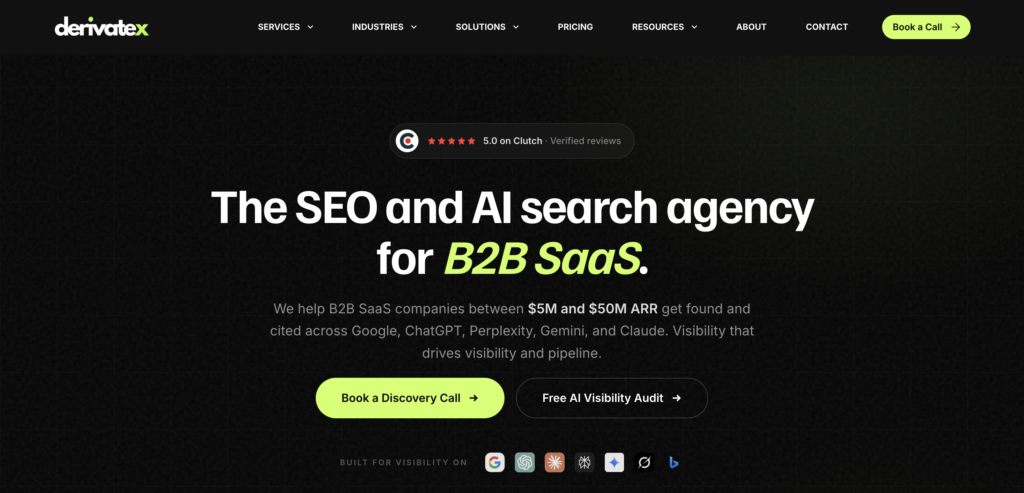
Best for: B2B SaaS companies at $5M+ ARR that need rapid, measurable improvement in AI citation share with transparent attribution from day one.
DerivateX is a focused AEO specialist built specifically for B2B SaaS. Their positioning is unusually honest: they publish pricing, they describe their methodology in detail, and they include their own limitations explicitly in their agency comparisons. Their 90-day sprint model produces early AI visibility results before moving to month-to-month engagements, which makes them one of the more accessible options on this list for companies that want to test GEO before committing to a long-term program.
Their methodology centers on tracking citation rates and share of voice across AI platforms from the outset, meaning clients can see AI-driven visibility movement before they see traditional ranking changes. That matters because AI citation and Google rankings do not always move together, and many agencies have no way to report on the former.
Pricing: From $5,500/month, starting with a 90-day sprint.
Honest limitation: DerivateX is a focused specialist. Companies that need paid media, lifecycle marketing, or broad content production alongside AEO will need to run those functions separately or with a second partner.
How to think about which agency fits your situation
The most useful filter is not budget or agency size. It is where you are in the AI visibility journey.
If you have no existing GEO program and want to start with content that builds authority across both Google and AI platforms, LymLyt, First Page Sage, and Spicy Margarita are the right starting points. The work is content-led and compounds over time.
If you have existing content and need to understand where you stand in AI answers and how to close specific visibility gaps fast, DerivateX and Graphite both offer structured audit and sprint approaches with visible early results.
If your site has significant technical debt, complex architecture, or a large legacy content library that AI crawlers cannot process correctly, iPullRank is the right fit before any content-led GEO work begins.
If you need GEO, paid media, and lifecycle marketing working together as one program rather than managed separately, NoGood is worth evaluating.
One honest note: content blindness is as real in AI search as it is in traditional search. AI models are trained on the web, and they cite content that is specific, authoritative, and demonstrably useful. Generic content written to cover a topic rather than to say something real about it is as invisible to AI as it is to readers. The agencies that perform best in this space are the ones that understand that AI citation is a byproduct of genuine content quality, not a technical workaround that bypasses it.
What AI SEO actually costs in 2026
Serious B2B SaaS GEO and AEO engagements range from $3,000 to $25,000+ per month. Anything below $1,500/month is almost certainly rebranded traditional SEO with no genuine AI citation methodology behind it.
A practical way to think about the tiers:
$3,000–$5,000/month covers a content-led AI SEO program: topic cluster mapping, structured content production targeting both Google and AI intent, entity-building, and distribution. This is the right entry point for growth-stage companies that want to compound authority over time.
$5,500–$10,000/month is where specialist AEO and GEO programs live, with dedicated prompt research, citation tracking, structured data implementation, and regular reporting on AI visibility alongside organic metrics.
$10,000–$25,000+/month is enterprise territory: large content libraries, complex technical architecture, proprietary tracking platforms, and GEO programs running in parallel with digital PR and authority-building at scale.
One thing to verify before signing anything: ask the agency to show you how they currently track AI citation share for existing clients and what metrics they use to measure GEO success. If the answer is page rankings and organic traffic with no AI-specific visibility data, the GEO service is the traditional SEO service with a new name on it.
Frequently asked questions
What is the difference between GEO and AEO?
AEO (Answer Engine Optimization) originally referred to optimizing for direct-answer formats: featured snippets, voice search results, and position-zero content. GEO (Generative Engine Optimization) is the broader discipline of building citation presence across large language models like ChatGPT, Claude, Perplexity, and Gemini. In practice, the strongest agencies treat both as one system, because the signals that earn AI citations and those that win featured snippets are increasingly the same: authoritative, structured, specific content from a credible source.
Does AI SEO replace traditional SEO?
No, and any agency claiming otherwise is oversimplifying. Google remains the dominant search surface for most B2B queries, and the technical foundations of traditional SEO (site speed, crawlability, internal linking, structured data) are the same foundations that support AI visibility. What has changed is that those foundations now need to support two surfaces simultaneously, and content strategy needs to account for how AI systems retrieve and synthesize information alongside how human readers search and navigate. The best programs in 2026 treat them as one connected system.
How long before AI SEO produces visible results?
AI citation visibility can move faster than traditional SEO rankings. Some agencies report meaningful citation improvements within 60 to 90 days for clients with existing content authority. Starting from zero authority takes longer: 6 to 12 months is a realistic horizon for building enough entity presence and content depth to earn regular AI citations in competitive categories.
How do we know if our content is being cited by AI tools?
The simplest starting point is manual testing: ask ChatGPT, Perplexity, and Claude the questions your buyers are most likely to ask about your category and see whether your brand appears. More rigorous tracking requires tools that monitor citation share and share of voice across platforms at scale. Most of the agencies on this list provide this as part of their reporting infrastructure. If an agency cannot show you how they would track your AI visibility, that is a sign they do not have a real GEO program behind the service name.
The bottom line
AI SEO is not a separate discipline from content marketing. It is what content marketing looks like when you account for where buyers are actually doing their research in 2026. The agencies that do it well are the ones that understand content authority as the foundation and AI citation as the outcome, not the other way around.
If you are a B2B SaaS company in adtech, martech, or fintech and want to understand where your content stands in AI search and what to build next, book a 30-minute call with LymLyt.
Disclaimer: Pricing and services are subject to change. All figures are sourced from publicly available information as of mid-2026. Always verify directly with agencies before making a decision.

Rashmita is content marketer with 8 years of experience building and growing SaaS brands. Now she tests various AI tools for marketers and shares her feedback on this blog, LinkedIn, Instagram, and YouTube.