
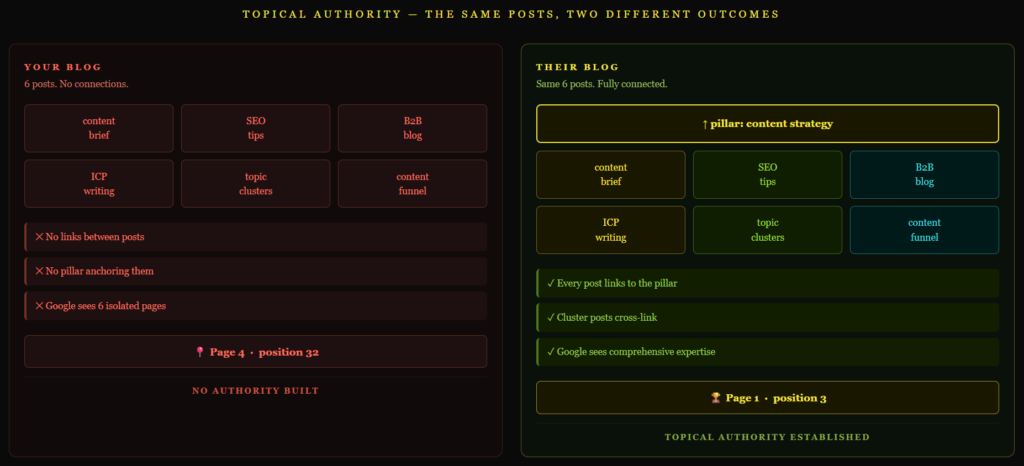
Lets help you understand topical authority by a common scenario. A competitor publishes a blog post. It is not better than yours. The writing is average, the examples are generic, and you covered the same topic three months ago.
Theirs ranks on page one. Yours is on page four.
You check their backlinks. Similar to yours. Domain authority. Similar. Publishing frequency. Actually lower.
The difference is not the post. It is the context around the post. They have 15 articles on related topics, all linking to each other, all signalling to Google that this site owns this subject. You have one post sitting alone.
That is topical authority. And building it is the difference between a blog that compounds and one that publishes indefinitely without gaining traction.
Here is what topical authority actually is, why it matters more than ever in 2026, and how a B2B SaaS company with a small content team can start building it without needing 200 posts to see results.
What Topical Authority Actually Is
Topical authority is Google’s measure of how comprehensively a website covers a subject.
It is not about having the most backlinks. It is not about publishing the longest posts. It is about whether your site, taken as a whole, demonstrates that it knows a topic inside and out, covering it from every relevant angle, at every stage of the buyer journey, with enough depth and consistency that Google trusts you as the go-to source.
Think of it this way. If someone searches “how to write a content brief,” Google has to decide which site to show first. It will favour the site that has not just one post on content briefs, but a whole cluster of related content: on content strategy, on writing for your ICP, on SaaS content mistakes, on how briefs connect to the content engine. That site has demonstrated comprehensive expertise. The site with one standalone post has not.
This is the core shift in how Google evaluates content. A single well-written page targeting one keyword used to be enough. Now Google wants to see that the page exists within a body of work that proves genuine mastery of the subject.
Why It Matters More in 2026
Two things have made topical authority more important than it was even two years ago.
First, AI-generated content has flooded the internet with keyword-targeted posts that are technically correct and completely forgettable. Google’s response has been to weight domain-level expertise more heavily. A site that has published 20 deeply connected posts on B2B SaaS content marketing will consistently outrank a site that published one post targeting the same keyword, even if that one post is objectively better written.
Second, AI search engines like ChatGPT and Perplexity are pulling from sites they trust as authoritative sources. Sites that demonstrate topical authority get cited more frequently in AI-generated answers because these engines preferentially reference sources that cover a subject comprehensively, not just accurately. Topical authority is now an input to both Google rankings and AI visibility simultaneously.
This is also why most B2B blogs fail to build any lasting search presence. They publish without a topical strategy, accumulate disconnected posts, and never signal comprehensive expertise to Google on anything.
How Topical Authority Works in Practice
The structure that builds topical authority is called a content cluster. It has two components:
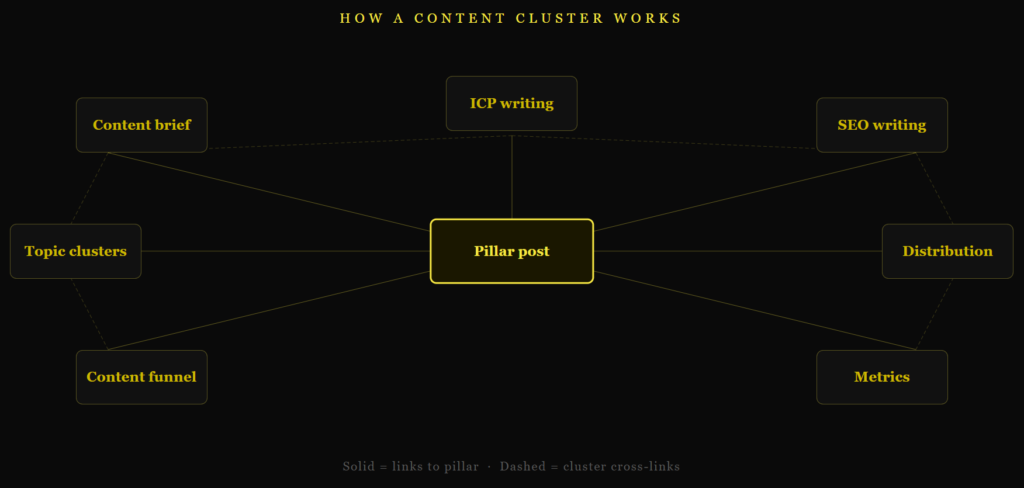
The pillar post is a comprehensive piece that covers a broad topic at a high level. It links out to every supporting post in the cluster. For a B2B SaaS content agency, the pillar for the content strategy cluster might be a complete guide to content marketing for SaaS startups. It covers the full landscape and signals to Google that this is the authoritative hub for this topic.
The cluster posts go deep on specific subtopics that the pillar introduces but does not fully cover. Each cluster post links back to the pillar and to other relevant cluster posts. Supporting posts like why your ICP is not reading your blog, how to build a SaaS content engine, and SaaS content marketing metrics that actually matter are examples of cluster posts that sit underneath a content strategy pillar.
The links between pillar and cluster posts are what make the system work. Google follows those links and builds a picture of how comprehensively the site covers the topic. Without the links, the posts are just a collection of individual pages. With them, they become a content cluster that signals topical authority.
This is also why topic clusters outperform random keyword lists every single time for sites trying to build organic presence from a low domain authority base.
How to Start Building Topical Authority for B2B SaaS
Step 1: Pick one topic area and commit to it
The most common mistake is trying to build authority on too many topics at once. A B2B SaaS content agency should not be trying to rank for content marketing, SEO strategy, email marketing, social media, and AI tools simultaneously. Pick the one or two topic areas most directly connected to what you sell and go deep there first.
For a B2B SaaS content agency, that core topic area is B2B SaaS content marketing. For a project management SaaS, it might be remote team collaboration. Pick the one or two areas most directly connected to what you sell and go deep there before expanding into anything adjacent.
Step 2: Audit what you already have
Before publishing anything new, map your existing posts to topic clusters. Which posts belong together? Which ones have no natural neighbours? Where are the gaps, the subtopics your buyers would logically search for that you have not covered yet?
This is the fastest way to find your highest-priority new posts. You do not need to start from zero. You need to fill the gaps in clusters that already exist.
Step 3: Build internal links between related posts
Internal links are the mechanism that turns a collection of posts into a cluster. Every post should link to the pillar of its cluster and to at least two or three other posts in the same cluster. This is what signals to Google that these posts are connected and that your site covers this topic comprehensively.
This is one of the highest-ROI activities for any B2B SaaS blog. The SaaS content distribution playbook and the content funnel that maps to demos should be linking to each other, linking to the content engine post, and linking back to the pillar. Without those links, each post sits in isolation.
Step 4: Publish new posts to fill cluster gaps, not to chase new keywords
Once you have your clusters mapped, every new post decision should answer one question: which gap in an existing cluster does this fill? Not “what keyword has decent volume” but “what subtopic is missing from a cluster we are already building authority on?”
This is the shift from a keyword operation to a topical authority strategy. It means saying no to posts that would be interesting but do not strengthen any existing cluster, and yes to posts that complete a cluster and activate the authority you have already built. Using the best keyword research tools becomes more valuable once you have a topical framework to plug those keywords into.
Step 5: Make sure every post has a clear pillar to link back to
If you publish a post and there is no clear pillar for it to link to, either that post is the pillar (and needs cluster posts around it) or it does not fit your current topical strategy and should be deprioritised.
Every post needs a home in a cluster. Orphaned posts (ones with no internal links to or from them) are one of the most common reasons B2B SaaS blogs fail to build authority despite publishing consistently. Google cannot connect isolated pages into a picture of comprehensive expertise.
How Long Does It Take
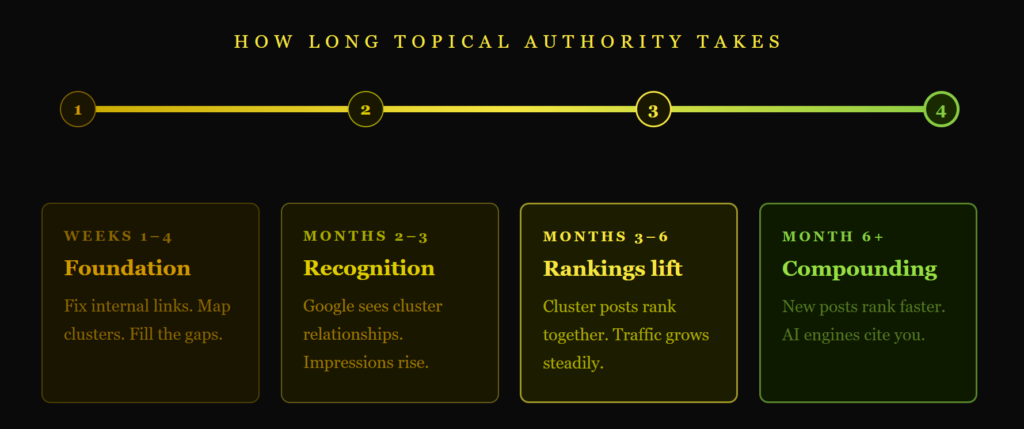
Topical authority builds over months, not days. For a site with low domain authority and an existing content base, the realistic timeline is:
- Weeks 1 to 4: Internal linking cleaned up, cluster gaps identified, new posts filling gaps
- Months 2 to 3: Google starts recognising cluster relationships, impressions increase for cluster posts
- Months 3 to 6: Rankings begin lifting across the cluster, not just for individual posts
- Month 6 onwards: Compounding begins. New posts in established clusters rank faster because the cluster authority is already built
This timeline shortens significantly if the internal linking is done properly from the start. A site that publishes 4 posts per week with no internal linking strategy will build topical authority slower than a site that publishes 2 posts per week with every post connected to an existing cluster.
Where Most SaaS Blogs Go Wrong With Topical Authority
The gap is almost never the content itself. It is the structure around it.
A blog with 30 posts on related topics but zero internal linking is not a content cluster. It is a pile of individual pages. Google crawls each one in isolation and never builds a picture of comprehensive expertise. The posts compete with each other instead of reinforcing each other.
The fix does not always require new content. Fixing the internal linking across existing posts is often the single highest-ROI action available to a SaaS blog. It costs no new content and activates authority that has already been built but is sitting disconnected.
The most common content mistake teams make is treating topical authority as a future project. It is not. Every post published without connecting it to a cluster is a missed opportunity that compounds over time into a blog with lots of content and no authority on anything.
The Bottom Line
Topical authority is not a technical SEO concept. It is a publishing philosophy. It says: pick a territory, cover it comprehensively, connect everything you publish, and give Google a reason to trust your site as the authoritative source on the subject.
For B2B SaaS companies, it is also the most realistic path to organic growth. You do not need a massive domain authority or thousands of backlinks to build topical authority on a specific, focused subject. You need consistent publishing, strong internal linking, and the discipline to go deep on a topic before expanding to the next one.
If you want help building the topical structure for your content, let’s talk.
Leave a Reply