The Recommendation That Never Appears in Your CRM
Imagine a founder asking another founder: “Who helped you fix your reporting?”
The answer comes with a company name and a warning: “They were good, but give yourself enough time for setup.”
The founder searches for that company, reads a case study, and books a call.
The company’s customer relationship management system, or CRM, may record a search visit and a demo request. The recommendation that made the visit happen may be missing.
This is an imagined example. It explains a real measurement problem: the place where someone arrives is not always the place where their interest began.
Recommendations help people judge risk
Buying for a business carries consequences. A poor choice can waste money, interrupt work, or leave someone explaining a failed project to their manager.
A trusted person can help answer questions a product page struggles to settle:
- Was the setup as straightforward as promised?
- Did support help when something went wrong?
- Would you choose them again?
- What should we check before signing?
The value is often the detail around the recommendation. Hearing “it worked for us” is useful. Hearing why it worked, where it struggled, and how similar the situation was is more useful.
AI has made research faster. People still help check it.
Word of mouth has always mattered in B2B. AI did not invent the need for a trusted second opinion.
What changes is the amount of material buyers can gather before they speak to a vendor. An AI tool can produce a comparison quickly. A peer can help judge whether that comparison reflects everyday use.
Forrester’s 2026 business buying summary describes buyers using internal and external networks to justify decisions and reduce risk, alongside AI-assisted research. Its research spans business buying; an individual small-company purchase may be much simpler.
The practical lesson is to help both kinds of investigation. Publish clear information and give people a good experience they can describe honestly.
“Human interactions remain essential, even as genAI reshapes the buying process.”
The buying group has a wider network around it
The people approving a purchase may be influenced by others who never speak to your sales team.
A consultant may help define the requirements. A former colleague may recommend a vendor. A customer may describe a problem in a private community. An industry specialist may explain a trade-off in public.
Forrester’s article on buying networks describes this wider set of influences, including peers, consultants, analysts, and journalists.
That widens the marketing question. Instead of only asking how to reach the person filling in a form, ask who that person trusts and what those people need to understand.
You cannot control their recommendations. You can earn their attention, answer their questions, and give them evidence worth sharing.
A real community conversation shows how this happens
In a LinkedIn post about software renewal decisions, Dave Gerhardt shares an Exit Five member’s question about whether to renew ZoomInfo or consider Cognism or Apollo.
The member asks peers for advice before deciding where to spend the budget.
It is a reported community example, not evidence that one vendor won. It is also older than the current AI wave, which helps make the point: buyers were already using trusted networks. New research tools sit alongside that behavior.
A vendor watching only its own website would see a small part of this decision.
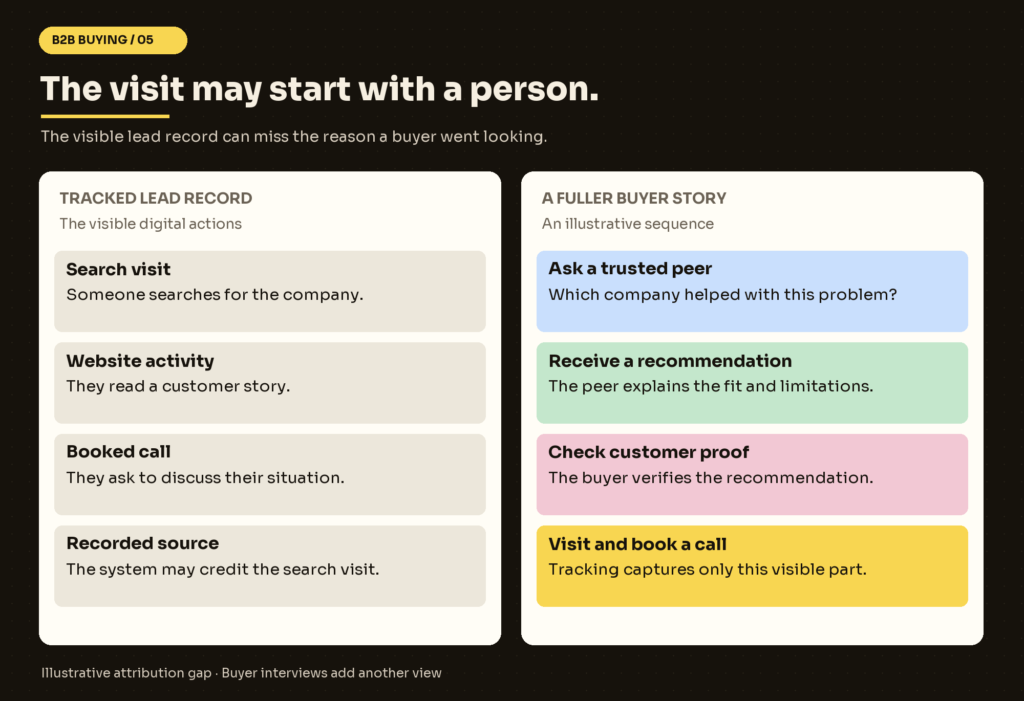
An illustrative attribution gap. A recommendation may be missing from tracking, even when later website actions are visible.
Start with an experience worth recommending
The first word-of-mouth project is often a product or service project.
Deliver what you promised. Help customers reach a useful result. Make support dependable. Explain limitations early enough for the customer to plan around them.
Then learn what people actually praise.
You may think your main strength is a feature. Customers may recommend you because your team made a difficult change easier. That difference should shape your marketing.
Ask customers when they would suggest your business to someone else—and when they would not. Their answers can make your positioning more precise.
A referral campaign will struggle if customers do not have a clear, positive experience to pass on.
Make the recommendation easier to explain
“You should talk to them” is a useful introduction. Give the person making it something that explains why.
A strong customer story describes the starting problem, what changed, the result, and the conditions behind it. A short summary should link to the fuller evidence.
LymLyt’s case study writing approach focuses on turning customer experience into a clear story. That story can help a peer recommend you and help a buyer make the case internally.
Useful material might include a short product walkthrough, an implementation outline, or a fair comparison. LymLyt’s guide to honest comparison pages is relevant here: people need to know who you suit and where another option may fit better.
Permission matters for customer stories. Ask before publishing names, results, or quotes, and let customers check the details attributed to them.
Build relationships around useful work
Communities, partner networks, and events can create opportunities for people to exchange experience.
An introduction between two people with the same problem can be valuable. So can a small discussion with practical answers and room for disagreement.
The event itself does not guarantee trust. The quality of the interaction matters. A room full of people listening to a sales pitch is different from a room where people can ask honest questions.
The 2025 Edelman–LinkedIn thought leadership report examines how useful ideas can influence people involved in purchases, including those less visible to sales. That is another reason to make your expertise accessible beyond the main contact.
A good explanation can travel through a network even when its author is absent.
Keep discovery, validation, and tracking in separate fields
The answer to “where did you hear about us?” is useful, but it may mix several stages of the decision. Ask a few short, open questions at a suitable point in the sales conversation.
| Record | Question or evidence | Why keep it separate? |
|---|---|---|
| Tracked arrival | Recorded source of the website visit or enquiry | It shows the visible arrival |
| Reported discovery | Where did you first hear about us? | It may reveal an earlier introduction |
| Reported consideration | What made you include us in your options? | It shows what made the company worth evaluating |
| Reported validation | What helped you feel confident enough to move forward? | It identifies proof and people that reduced uncertainty |
| Business outcome | Opportunity, result, value, and dates | It connects the account to actual progress |
Keep the buyer’s own wording alongside categories. Make answers optional and include “not sure.” A sales representative suggesting “was it LinkedIn?” can shape the answer you later treat as evidence.
Record known partner or customer introductions consistently. Preserve what happened before and after the introduction; a referral can introduce a company, help an existing opportunity, or validate a choice.
One deal can have several influences and one revenue total
Here is an invented example showing how to report a journey without losing information or inflating revenue.
| Field | Example record |
|---|---|
| Tracked enquiry source | Organic search |
| Buyer-reported discovery | Introduction from another founder |
| Buyer-reported validation | Customer case study, YouTube walkthrough, and AI comparison |
| Deal outcome | One won opportunity worth $50,000 |
| Revenue counted in the business total | $50,000 once |
The founder, search visit, and content can all appear in the history. They do not create three separate $50,000 sales. If a report assigns channel credit, state its rule. If a report lists channel involvement, label it as overlapping influence.
Similarly, do not call every opportunity that touched a customer story “case-study-generated pipeline.” That label describes a stronger claim than the evidence supports.
Build a review that helps you decide what to fund
A small team can do this in a spreadsheet or the CRM it already uses. Review the following together:
- Coverage: How many suitable opportunities have buyer answers? Report the response count and the total eligible opportunities. Five mentions from five interviews tell a different story from five mentions among fifty.
- Patterns: Which customers, communities, partners, events, and pieces of proof recur? Separate discovery from validation.
- Outcomes: Do these opportunities progress and win? Compare groups with similar time to mature and consider differences in company fit, deal size, and sales attention.
- Costs: What did the program require in spending and staff time? Include the definition in the report.
- Decision: What will you continue, change, or test next, and what evidence would change your mind?
A higher win rate among referred buyers is encouraging. It does not prove the referral program caused the difference: those buyers may already be a better fit or more ready to purchase.
If volume allows, test a defined advocacy or invitation activity across randomly assigned eligible groups, with a planned outcome and observation window. Comparing people who chose to attend an event with people who did not is weaker evidence; the groups may differ before the event starts.
With low deal volume, use interviews and longer-term patterns, and label conclusions as tentative. Assess the program over enough time for opportunities to develop, while reviewing audience response and relationship quality sooner.
Word of mouth may resist complete tracking. It can still be assessed through consistent buyer accounts, real introductions, costs, and commercial outcomes.
LymLyt’s guide to the SaaS content funnel can help connect that evidence to the information buyers need next.
Word of mouth becomes easier when people know what you do, have a reason to trust you, and can explain your value to someone else. Marketing can support all three.
Frequently asked questions
Can a CRM capture word of mouth?
It can capture known introductions and what buyers report. It cannot automatically reconstruct every private conversation. Separate those records from the tracked website source rather than forcing them into one field.
Does “direct” traffic mean someone recommended us?
No. Treat it as a traffic classification, not a story about why the buyer came. Ask about discovery and keep unknown answers unknown.
How do we report referral ROI?
Report program costs and the outcomes associated with documented introductions, with clear definitions. Describe this as an observed return under your reporting rule. A claim about additional revenue caused by the program needs stronger evidence, such as a suitable controlled test.

Rashmita is content marketer with 8 years of experience building and growing SaaS brands. Now she tests various AI tools for marketers and shares her feedback on this blog, LinkedIn, Instagram, and YouTube.