How Much Does Content Marketing Cost for B2B SaaS in 2026?
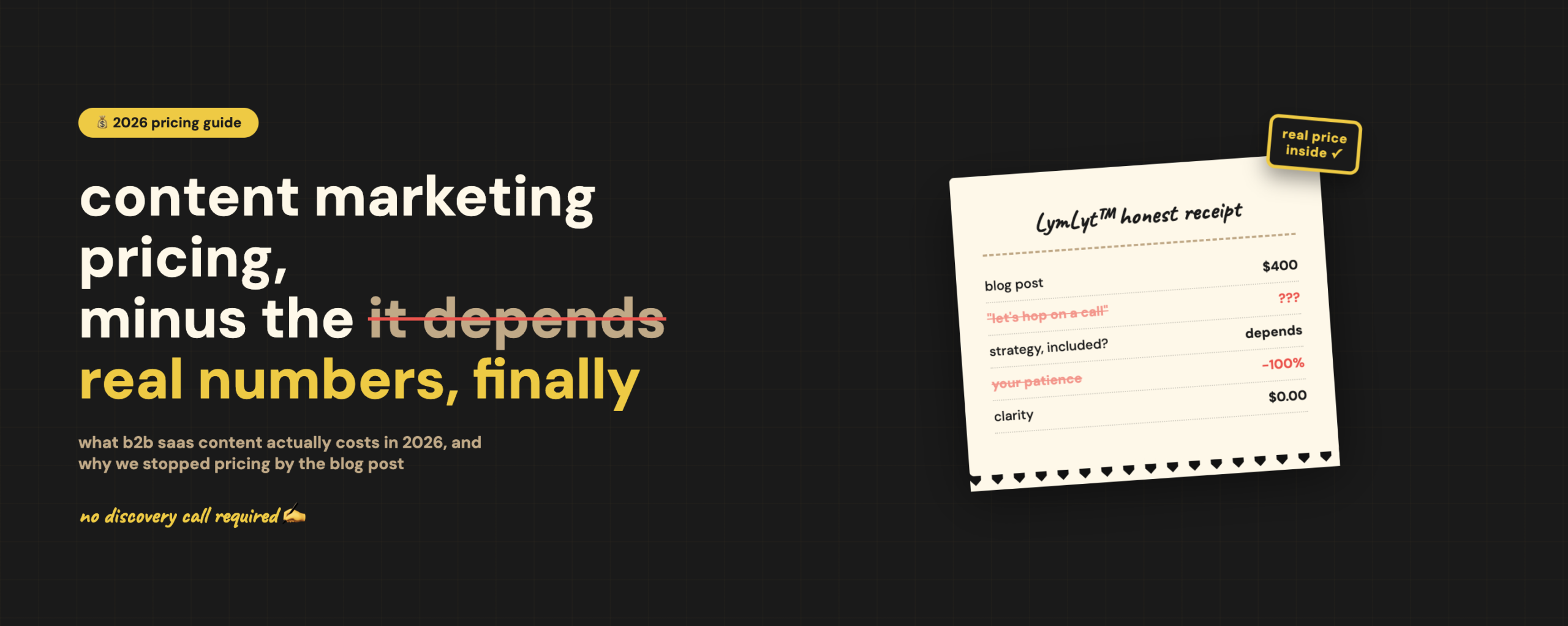
Ask five content marketing agencies what they charge and you’ll get five different answers, none of them a real number. “It depends on scope.” “Let’s hop on a call.” “Send us your goals and we’ll put a proposal together.” You leave the call with a vibe, not a budget.
So here’s the actual 2026 math, pulled from the agencies and analysts who’ve published real numbers this year, then the part most agencies won’t tell you: why “per blog post” pricing is the wrong way to buy content in the first place.
What B2B SaaS companies actually pay in 2026
Full-service monthly retainers: Most B2B SaaS companies land between $5,000 and $15,000 a month for a serious content program, according to Column Five’s 2026 pricing guide. If you need strategy, SEO, technical recommendations, AI visibility, conversion support, and pipeline reporting bundled in, The Rank Masters puts that figure at $12,000 to $30,000+ a month.
By funding stage: daydream’s 2026 budget guide for Series A through pre-IPO SaaS breaks it down further: retainers run $15K-$75K/month depending on stage, project-based campaigns range $10K-$60K, and performance models start around $5K/month plus 10-30% of attributed revenue. The Rank Masters’ stage benchmarks land lower for earlier companies: seed and bootstrapped teams should expect $1,500-$5,000/month, Series A $5,000-$12,000/month, growth-stage $10,000-$25,000/month, and enterprise $20,000-$50,000+/month.
Per-piece pricing: Tactical blog posts run $200-$800. Whitepapers run $3,000-$12,000. Writing-only setups (no strategy, no SEO, no publishing) land at $500-$2,000 per article, or $1,500-$5,000/month for something lightweight.
Around all this pricing, the marketer or founder who hired the agency never understands what was the “value” behind it. “Were we just getting articles and drafts for such hefty price?” Especially now, when everybody believes AI can draft and design like human (which they can’t BTW), it has gotten difficult to just say we create content and not talk about the “value” of that content.
Why “per blog post” pricing doesn’t actually tell you what you’re buying
Per-piece and flat-retainer pricing both answer the wrong question. They tell you how much content you’re getting. They don’t tell you what that content is supposed to do.
The Rank Masters calls this out directly: “The biggest pricing mistake SaaS teams make is comparing vendors by deliverable volume.”
One proposal says “8 blog posts a month.” Another says “3 articles, 2 refreshes, 1 comparison page, technical recommendations, SME interviews, reporting, and conversion updates.” The first looks cheaper per article. The second is the one that actually moves pipeline.
Column Five frames the same problem from the buyer’s side: “A $5,000 retainer and a $50,000 retainer are not the same product at different scales. They represent fundamentally different services, and the gap between them is where most buyers make expensive mistakes.”
Their advice on red flags is blunt too: per-word pricing is a warning sign, because “content is not a commodity measured by the pound.”
We ran into this from the other side, writing the content, watching client after client hit “we’re publishing consistently but nothing’s moving.” Ten blog posts a month sounds like a lot until you notice they’re spread across ten unrelated keywords, none of them building on each other, none of them adding up to authority on anything. The content wasn’t the problem. The way it was scoped was.
Why we price around topics, not blog posts
We rebuilt our own pricing page around a simple idea: you don’t want ten blog posts, you want to own a topic. So instead of selling deliverable counts, we sell topic bundles.
Pick a topic you want traffic, authority, and leads on. Each plan builds a content engine around it: a pillar blog post plus 7-13 SEO-mapped supporting blogs on the long-tail keywords around it, a lead-gen asset, social posts, and a newsletter snippet, all pointed at that one topic instead of scattered across unrelated ones.
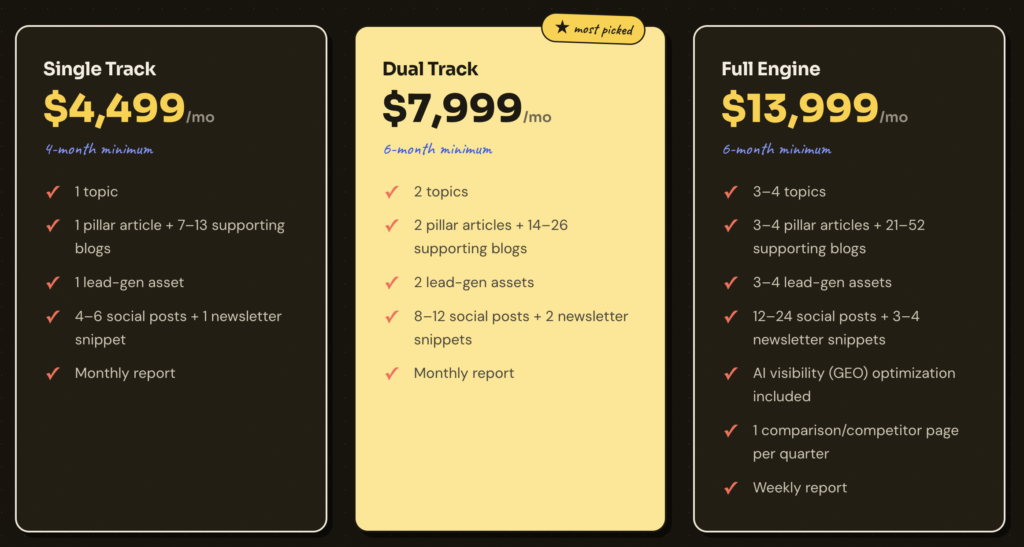
- Single Track ($4,499/mo, 4-month minimum): one topic at a time, for a focused push before you branch out.
- Dual Track ($7,999/mo, 6-month minimum): two topics running in parallel, building authority on two fronts.
- Full Engine ($13,999/mo, 6-month minimum): three to four topics, AI visibility (GEO) optimization included, for teams trying to own a whole category.
Here’s what one plan actually looks like:
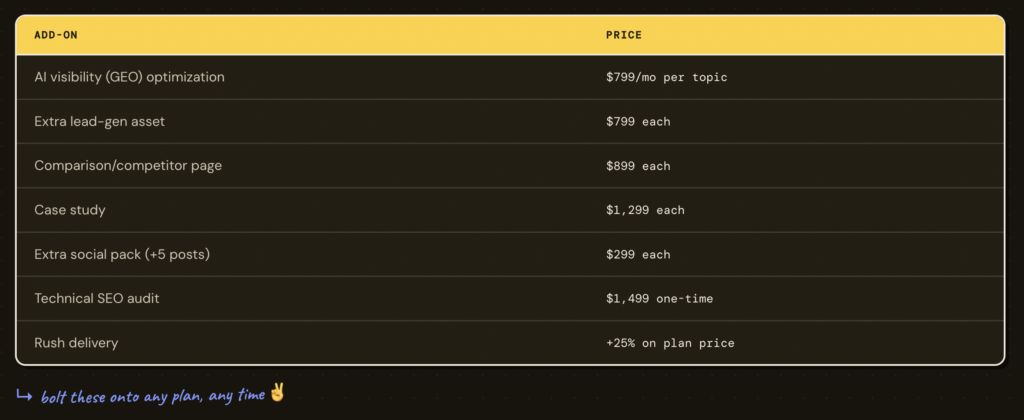
On top of the base bundle, everything a client actually needs beyond it, an extra lead-gen asset, a comparison page, a case study, rush delivery, is a priced add-on. Nothing hidden behind a “let’s discuss on a call”:
Why this makes the buying decision easier, not harder
Three things this structure fixes that per-piece and flat-retainer pricing don’t:
You know what you’re actually paying for. Not “10 posts,” but “authority on this specific topic, tracked against traffic, AI citations, and leads.” The scope maps to a business outcome, not a word count, which is exactly what daydream means when it says price alone isn’t the signal, staff seniority, strategic time, and ownership of performance are.
It scales the way your strategy does. Running one big pillar topic this quarter? Single Track. Launching a category play across three fronts? Full Engine. You’re not stuck negotiating a new proposal every time your priorities shift.
The minimum commitment is honest about how SEO and AI visibility actually work. Nobody ranks or gets cited off one month of content. A 4-6 month minimum isn’t a lock-in tactic, it’s the runway the work actually needs to show up in rankings and AI answers. This also lines up with what most 2026 benchmarks report: daydream puts typical time-to-value at 3-9 months for organic pipeline.
Price it out: LymLyt vs. building this in-house
The napkin math, live.
To be clear: hiring in-house isn’t a bad path. If you’ve got the volume to keep a full content team busy and the budget to carry it while it ramps, an in-house team gives you control an agency can’t match. The trade-off is time and cash up front, not the outcome itself.
Indeed lists the average U.S. senior content marketing manager salary at $133,876/year (range $87,897-$203,905), and that’s one hire, before writers, a designer, a social lead, benefits, tools, or the 3-6 months it typically takes to source and ramp that team. Replicating a Full Engine-level scope in-house (a strategist, a few writers, a designer, a social manager, an SEO/GEO specialist) runs roughly $40,000-$45,000/month in loaded salary alone. A comparable agency retainer for that scope of work typically lands 60-70% lower, and starts producing in weeks instead of a quarter.
That’s the honest answer to “how much does content marketing cost”: less than doing it yourself while you’re standing the team up, more than a freelancer writing disconnected posts, and worth exactly what it produces, if the pricing is scoped to an outcome instead of a page count.
Curious what a topic-bundle plan would look like for your product? See the full pricing breakdown →

Rashmita is content marketer with 8 years of experience building and growing SaaS brands. Now she tests various AI tools for marketers and shares her feedback on this blog, LinkedIn, Instagram, and YouTube.