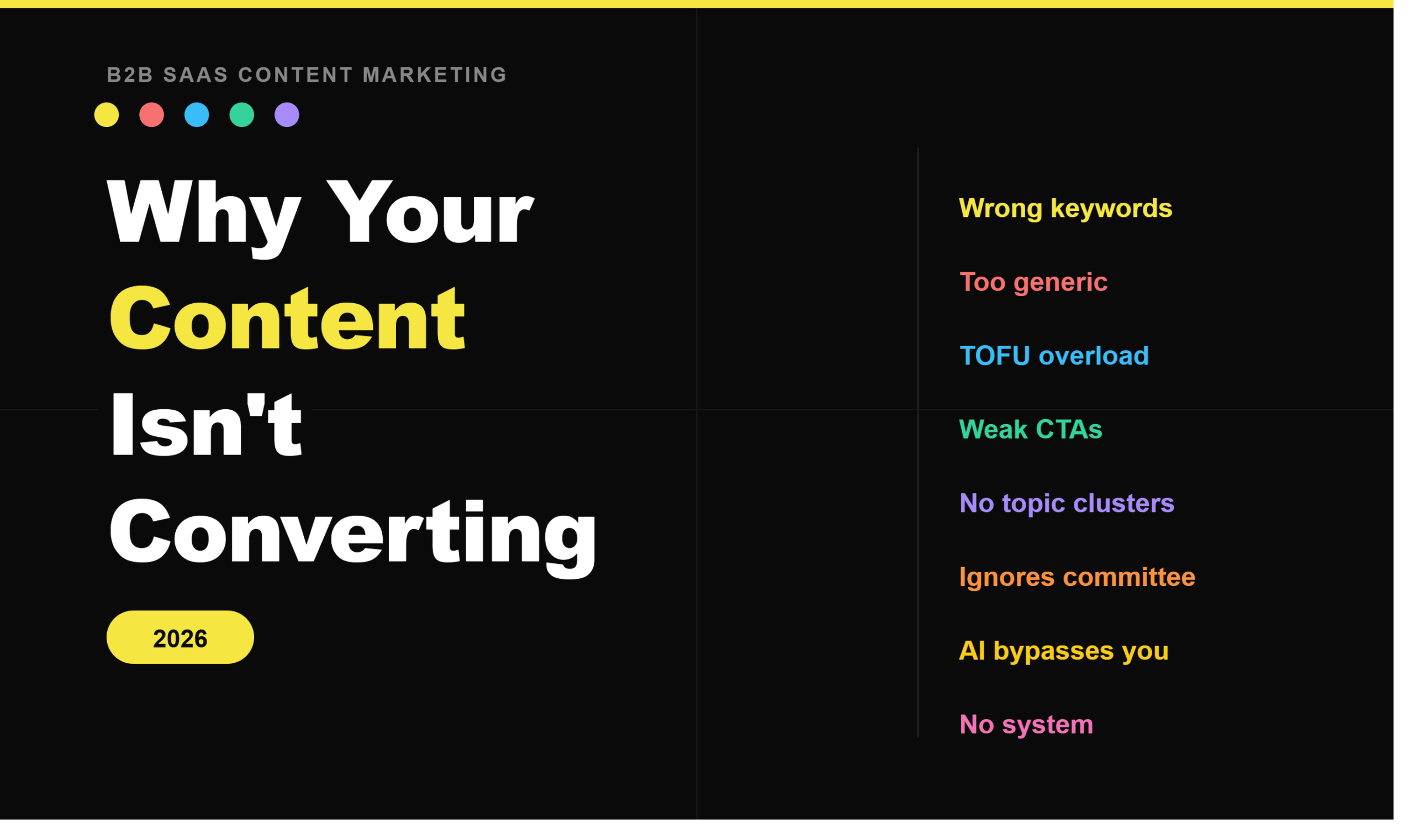
Why Your B2B SaaS Content Isn’t Converting (And How to Fix It)
Your content gets traffic. But the demos aren’t coming in.
The blog hits page one. Sessions go up. And then, nothing happens.
This is one of the most common problems in B2B SaaS marketing. On the surface, it looks like an SEO win. Underneath, it’s a conversion problem.
The good news: most of the reasons are fixable. Better still, none of them require more content.
Why B2B SaaS content doesn’t convert: the honest answer
Only 13% of MQLs become SQLs in B2B SaaS. That number hasn’t moved in years.
So the gap is not a traffic problem. It’s a content-to-pipeline alignment problem.
Most B2B SaaS teams publish content for awareness. They target broad keywords, cover general topics, and then wonder why readers don’t book demos. In reality, the content was never built to convert. It was built to rank.
Those are two very different goals. Confusing them is where most teams go wrong.
Reason 1: You’re targeting the wrong keywords
Not all keywords bring the same visitor. Some attract researchers. Others attract buyers.
A post ranking for “what is content marketing” brings people who are learning. Meanwhile, a post ranking for “best content agency for B2B SaaS” brings people who are ready to hire.
In fact, 57% of B2B decision-makers start their research using search engines. However, they are not all at the same stage. Most of your traffic is arriving too early in the buying journey.
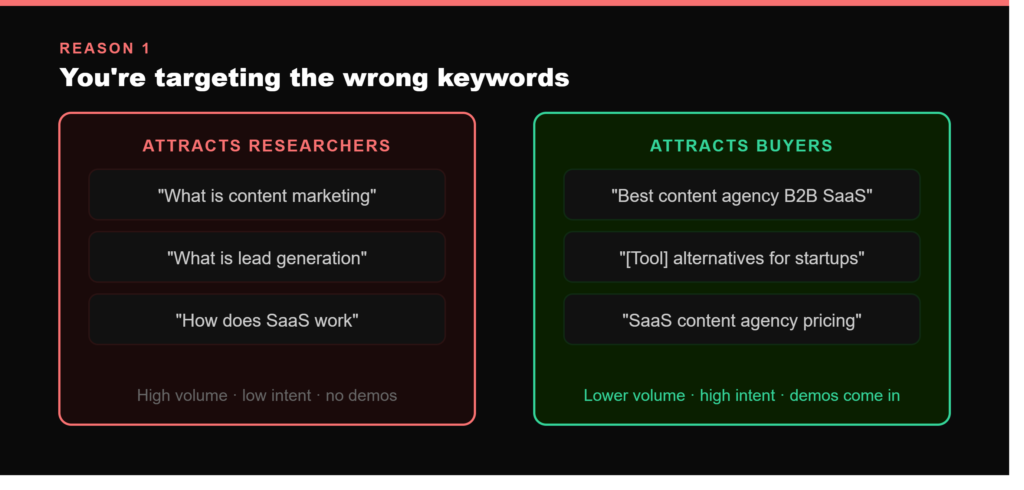
The fix is keyword research built around buying intent. Specifically, look for:
- “Best [your category] for [your ICP]”
- “[Your category] alternatives”
- “[Your category] pricing”
- “How to [solve the problem your product solves]”
These keywords have lower volume. That said, they have much higher conversion rates.
This is the core idea behind Pain Point SEO: target the specific problem your buyer has right now, not the general category they will eventually care about.
Reason 2: Your content targets everyone, which means it helps no one
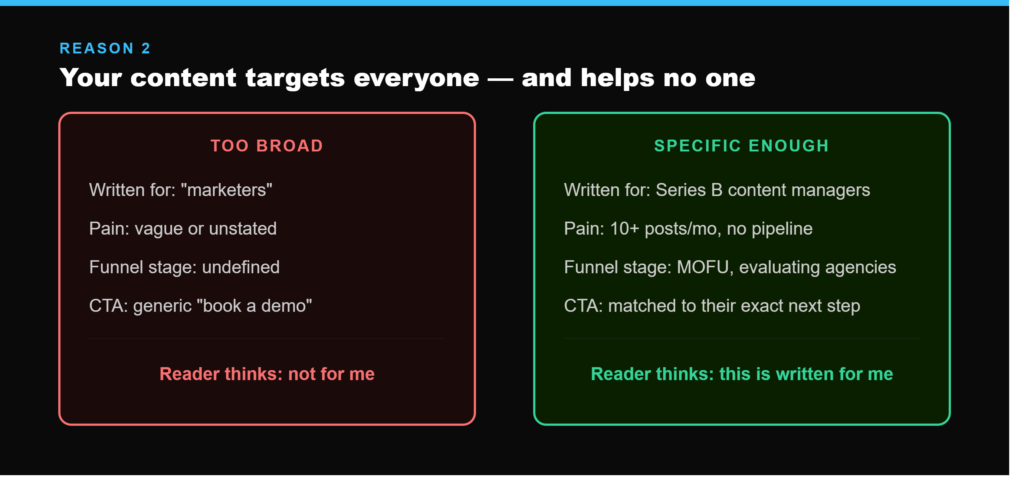
Generic content is the biggest conversion killer in B2B SaaS. Specifically, it destroys relevance.
A post written for “marketers” is too broad. By contrast, a post written for “content managers at Series B SaaS companies who publish more than 10 posts per month” is specific enough to actually resonate.
Specificity builds trust. As a result, trust drives conversions.
Before you publish anything, ask yourself:
- Does this post name a specific pain the reader recognises?
- Does it speak to a specific role or company stage?
- Would my best customer read this and think “this is written for me”?
If the answer is no, the post is too general.
Fixing this starts before you write a word. It begins with a proper content brief that defines the reader, their problem, their stage in the funnel, and the one action you want them to take.
Also check: Free brief generator.
Reason 3: Your content lives only at the top of the funnel
According to research, case studies, proprietary research, and thought-leadership content are the most effective content types for generating sales in B2B SaaS.
Yet most B2B SaaS blogs ignore this entirely. They publish 80% awareness content and almost nothing at the middle or bottom of the funnel.
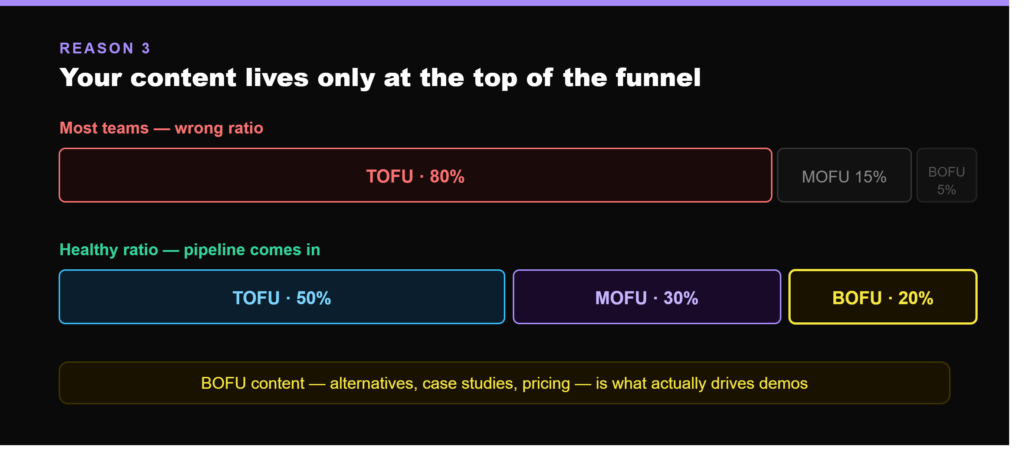
A healthy B2B SaaS content calendar looks like this:
- Top of funnel (50%): educational posts, explainers, industry trends
- Middle of funnel (30%): comparisons, use cases, how-to guides for your ICP
- Bottom of funnel (20%): alternatives posts, case studies, pricing breakdowns, demo-focused content
Most teams run 80% TOFU and then wonder why content doesn’t generate pipeline.
The solution is straightforward: fix the ratio. Map every piece to a funnel stage before you publish. If you can’t assign it a stage, don’t publish it yet.
Reason 4: Your CTAs are weak or missing entirely
Traffic without a clear next step goes nowhere. In other words, even a well-ranking post fails if it doesn’t tell readers what to do next.
Check your last three posts. Does each one have:
- A specific, relevant CTA matched to the content topic?
- A CTA placed mid-article, not just at the very end?
- A CTA that offers something the reader actually wants at that moment?
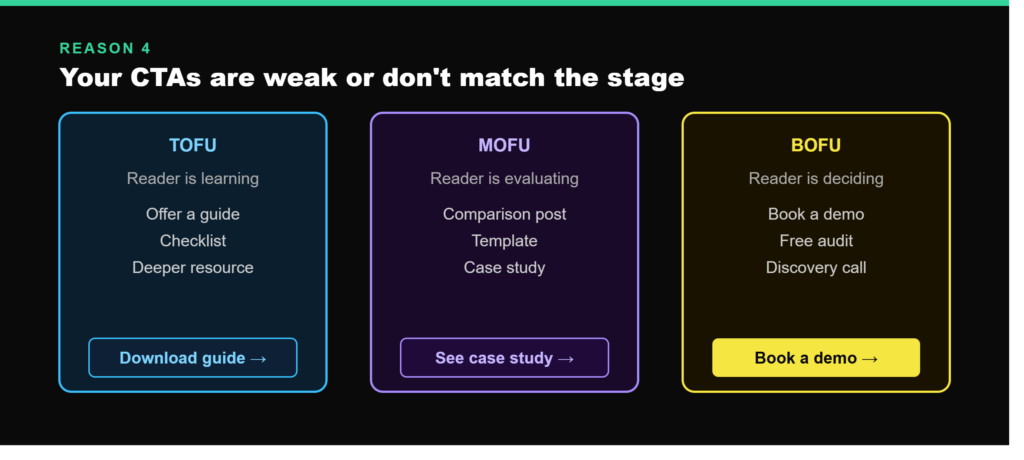
Most posts end with “Book a demo” and nothing else. That works for bottom-of-funnel readers. However, it does nothing for someone reading an educational post.
Instead, match the CTA to the funnel stage:
- TOFU post: offer a related guide, checklist, or deeper resource
- MOFU post: offer a comparison, template, or case study
- BOFU post: offer a demo, a call, or a free audit
Above all, the CTA is not an afterthought. It is the conversion mechanism. Treat it as part of the content strategy, not a line you add after publishing.
Reason 5: You’re not building topical authority
One post doesn’t convert a buyer. A cluster of connected posts does.
Buyers read multiple pieces before they decide. First, they read your introductory post. Then they check your comparison post. Finally, they look at your case study. Each piece builds trust incrementally.
A single isolated blog post, however well written, rarely converts cold traffic directly into a demo. A connected cluster that covers a topic deeply, and links each piece to the others, keeps the buyer on your site and builds the authority that pushes them toward a decision.
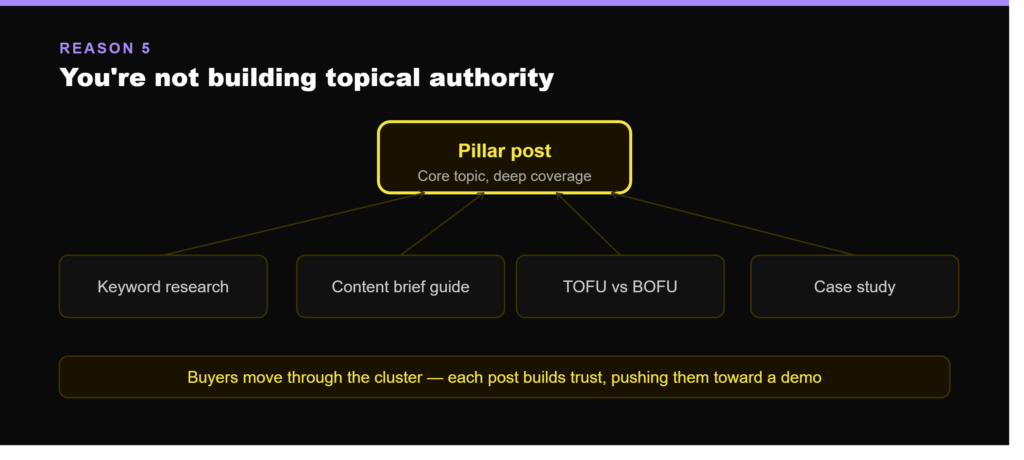
This is exactly what topical authority means in practice. It’s not just an SEO strategy. It is, fundamentally, a conversion strategy too.
So build clusters, not standalone posts. Link them together. Let buyers move through them naturally.
Reason 6: Your content ignores the buying committee
Demo-to-opportunity conversion rates range from 60% to 80% for average B2B SaaS performers.
However, getting to the demo requires convincing more than one person.
B2B SaaS purchases involve multiple stakeholders. The founder reads one thing. Meanwhile, the marketing lead reads another. The CFO wants to see ROI. Additionally, the technical buyer wants to know about integrations.
Most content speaks to only one of them.
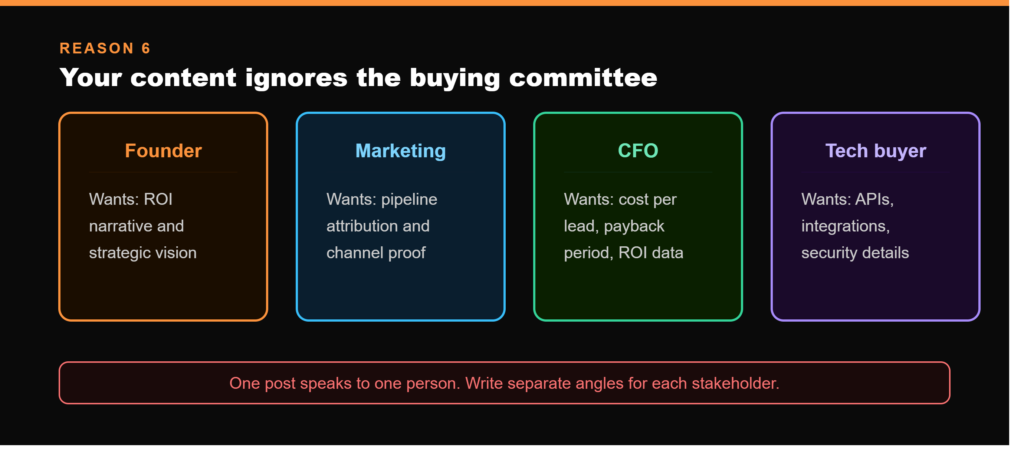
Instead, audit who reads each piece and whether it speaks to their specific concern. You may need separate posts for the same topic, each aimed at a different role:
- “Content marketing ROI for CFOs”
- “How to evaluate a content agency as a marketing lead”
- “What good content strategy looks like for a B2B SaaS founder”
Same topic. Different angle. Different buyer. Consequently, a different conversion lever.
Reason 7: AI search is bypassing your content entirely
71% of B2B SaaS buyers now say they rely on AI chatbots for software research at some stage of their journey.
As a result, if your brand doesn’t appear in ChatGPT or Perplexity answers, buyers may never reach your content at all.
This is the GEO problem. Your content could rank well on Google and still miss the buyers who ask AI tools for vendor shortlists before they ever open a search engine.
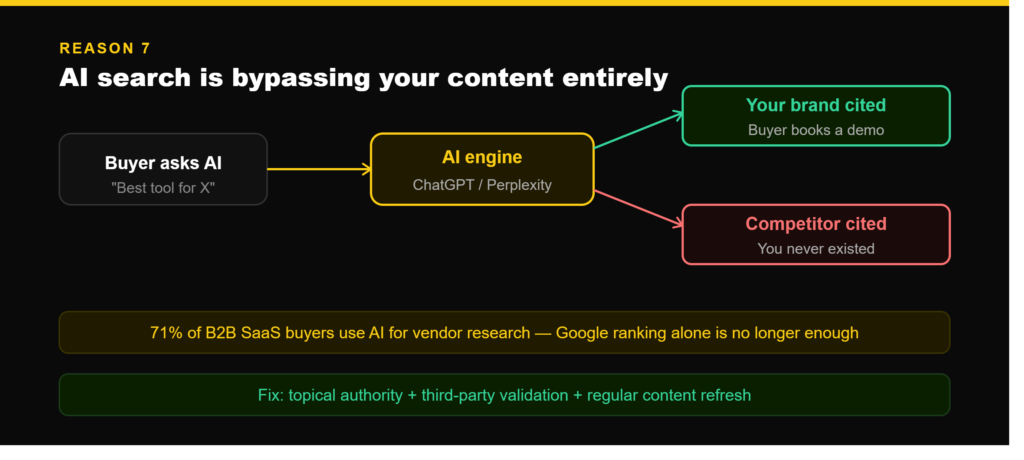
Fortunately, the fix connects directly to reasons 5 and 3 above:
- Build topical authority through deep, connected content
- Add third-party validation through G2, review sites, and community platforms
- Refresh content regularly so AI engines treat it as current
Moreover, AI-referred buyers convert better. They arrive already in evaluation mode, not discovery mode.
Reason 8: You have no content system
Most teams know what to do but lack the capacity to execute consistently.
This is the most honest diagnosis in B2B SaaS content. Strategy without a system produces bursts of content followed by long gaps. Those gaps break topical authority. They also break trust with buyers who check whether a brand is still active before they reach out.
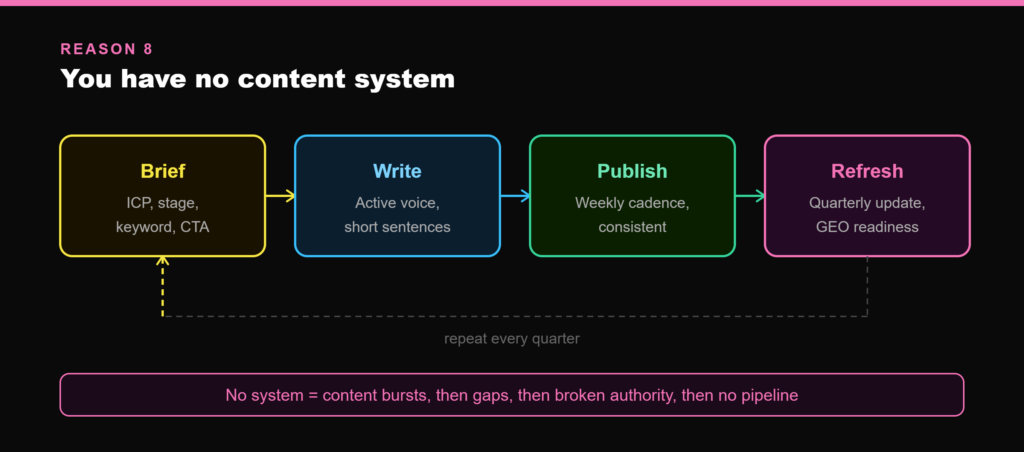
A real SaaS content engine solves this. Specifically, it includes:
- A documented editorial process from brief to publish
- A defined refresh cycle for existing posts
- Clear ownership at each stage
- A publishing cadence the team can actually sustain
Consistency compounds. For example, a team publishing one strong piece per week for twelve months builds more pipeline than a team that publishes ten posts in January and disappears until April.
How to audit your content for conversion problems
Run this check on your top five traffic posts this week:
- Check the keyword. Is it informational or buying-intent? If it’s purely informational, you may need a separate piece targeting the buying-intent version of that topic.
- Check the funnel stage. Is it TOFU, MOFU, or BOFU? Does the CTA match that stage?
- Check the specificity. Does it name a specific ICP, role, or pain? Or is it written for everyone?
- Check the internal links. Does it link to related posts in the same cluster? Does it guide the reader toward a conversion?
- Check the CTA. Is there more than one? Is it relevant to the content topic?
Most teams find two or three of these problems in every post. Fortunately, fixing them doesn’t require new content. Instead, it means rewriting CTAs, strengthening internal links, and targeting the right keywords for new pieces going forward.
The real fix
More content is not the answer. Better-targeted content is.
The teams converting at the highest rates all share the same three habits. First, they map every piece to a specific buyer, stage, and action. Second, they build clusters instead of isolated standalone posts. Third, and most importantly, they treat their content strategy like a B2B SaaS content calendar designed for pipeline, not publishing frequency.
Traffic is easy to get. Pipeline, however, is what actually matters. So build content for the second one.
LymLyt builds B2B SaaS content programs that convert, not just rank. Book a call with us.
Think B2B is boring?
That's coz you are not subscribed to ours newsletter. We share a 100 bad days (of B2B marketing) made a 100 good stories. A 100 good stories make YOU interesting at parties.
Almost there. Check your inbox and click the confirmation link.

Jay is the co-founder of LymLyt and an AI partnership consultant helping B2B SaaS companies grow through content strategy, SEO, and AI integration. He writes about content marketing, what makes B2B content convert, and how SaaS teams can build content systems that drive real pipeline.