

The Problem With “Publishing” Content in SaaS
Most B2B SaaS companies are creating content. Very few are actually operating it.
A blog goes live this week. A case study gets written when sales asks for proof. A LinkedIn post fills a gap in the calendar. Each action feels productive in isolation. The backlog moves. The website grows. Marketing appears busy.
But revenue barely notices.
This is the core failure of SaaS content today. Activity is mistaken for progress. Motion is confused with momentum. Teams are doing work, but the work is not engineered to produce consistent outcomes.
Revenue does not respond to effort or frequency. It responds to structured, repeatable execution. Without structure, even strong content performs inconsistently. One article ranks. The next disappears. Traffic spikes briefly, then flattens. Leads arrive sporadically, without pattern or predictability.
When there is no Content Operations Engine, content depends on human memory and available bandwidth. Topics are chosen reactively. Deadlines slip when priorities shift. Review cycles stretch because ownership is unclear. Publishing becomes irregular. Updates rarely happen. Distribution is optional rather than expected.
Over time, the symptoms compound.
SEO slows because content is not planned as a system. Sales teams reuse outdated assets or rebuild them from scratch. High-performing pieces are never expanded. Low-performing ones are never fixed. Content exists, but it does not build on itself.
This is why many SaaS teams feel stuck. They are publishing more than ever, yet growth feels fragile. Results fluctuate month to month. No one can clearly explain what is working, what is not, or what should be created next.
The failure is rarely creativity. Most SaaS teams have ideas, insights, and domain expertise.
The failure is operational.
Content without systems becomes effort.
Content with operations becomes leverage.
Until content is managed like infrastructure rather than output, it will continue to look busy while delivering unpredictable results.
Content Creation vs Content Operations
Publishing content and running content are not the same function.
Publishing produces output.
Content Operations produces outcomes.
Most B2B SaaS teams operate in publishing mode. Content exists as a series of tasks rather than a managed system. Topics are brainstormed in meetings, pulled from Slack threads, or decided based on what feels urgent that week. Writers start from a blank page every time. Content gets published, shared once or twice, and then quietly disappears into the archive.
Performance is often reviewed, but rarely operationalized. A post ranks or fails, traffic moves up or down, and the team moves on. There is no closed loop between results and planning. Wins are not scaled. Losses are not corrected. Each new piece starts fresh, disconnected from what came before it. Learn more about building effective Saas Content Engine.
This model can generate occasional spikes. A blog ranks unexpectedly. A post performs well on LinkedIn. A case study helps close a deal.
But these are temporary wins, not durable growth. Nothing compounds because nothing is designed to.
Content Operations changes the function of content entirely.
Instead of treating content as isolated deliverables, a Content Operations Engine treats it as infrastructure. Every piece is planned, documented, distributed, measured, and improved within a defined system. Decisions are made before writing begins, not after performance disappoints.
The discipline mirrors how engineering teams ship product:
- planning replaces guesswork
- ownership replaces ambiguity
- workflow replaces memory
- iteration replaces one-and-done publishing
- feedback loops replace vanity metrics
Content no longer depends on who is available or who remembers what. It runs on process.
In a Content Ops model, publishing is not the finish line. It is a midpoint. Content lives beyond launch through updates, repurposing, sales enablement, and performance-driven iteration. High-performing assets are expanded. Underperforming assets are fixed. Every new piece strengthens the overall system.
Content creation is about producing more.
Content Operations is about producing better, consistently, and at scale.
One fills a calendar.
The other builds momentum.
And in SaaS, momentum is what turns content into a revenue engine rather than a recurring task.
A Simple Contrast
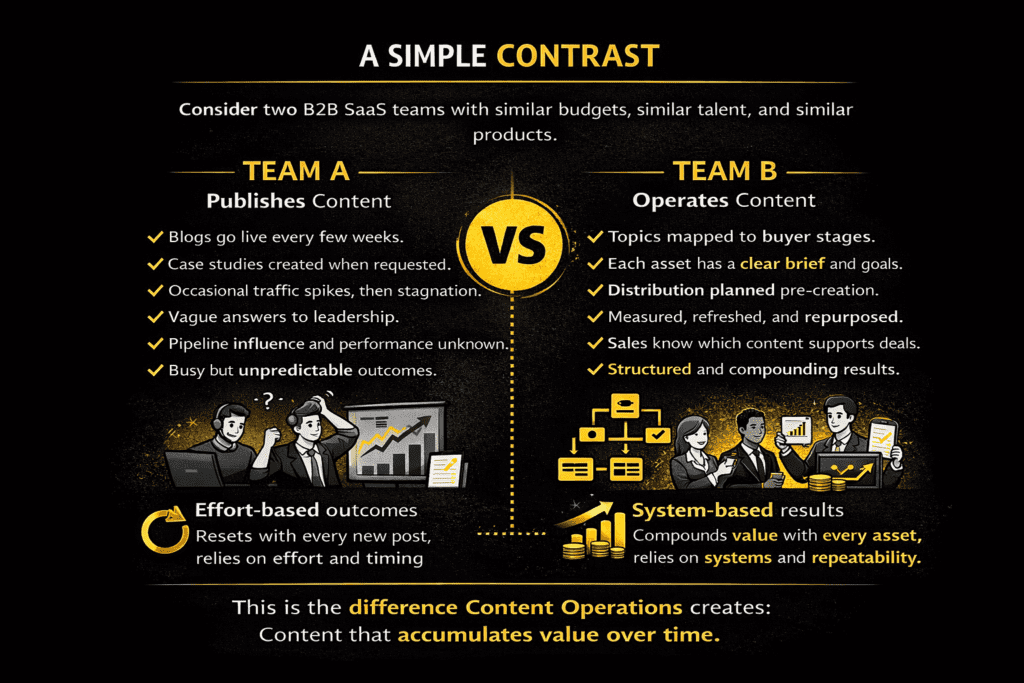
Consider two B2B SaaS teams with similar budgets, similar talent, and similar products.
Team A publishes content.
Blogs go live every few weeks. A case study is created when sales asks for proof. Occasionally, a post performs well and traffic jumps. Then growth slows. Rankings stall. Engagement flattens. When leadership asks what is working, the answers are vague. No one can explain which content drives pipeline, which assets influence deals, or why performance rises and falls.
The team is busy, but outcomes are unpredictable.
Team B operates content.
Topics are mapped to buyer stages, not brainstorms. Every asset starts with a clear brief, a defined intent, and a measurable goal. Distribution is planned before the draft is written. Content is refreshed, expanded, or repurposed based on performance data. Sales knows exactly which assets support pricing objections, feature comparisons, and late-stage decisions.
Nothing is accidental. Nothing is wasted.
Both teams publish content.
Only one builds momentum.
Team A resets with every new post.
Team B compounds value with every asset.
One relies on effort and timing.
The other relies on systems and repeatability.
This is the difference Content Operations creates. Not more content, but content that accumulates value over time.
In SaaS, this distinction determines whether content remains a cost center or becomes growth infrastructure.
Why Content Ops Is Now Non-Optional for SaaS
SaaS buyers no longer wait for sales to educate them.
They research independently across blogs, comparison pages, documentation, newsletters, communities, and social content long before booking a demo. By the time they speak to sales, they already have opinions about pricing, alternatives, strengths, and gaps. In many cases, they have already shortlisted vendors and eliminated others without ever filling out a form.
Content now does the work sales used to do.
A pricing page explains value before a call. A comparison article answers competitive objections. A use-case guide signals whether the product fits a specific workflow. A case study builds confidence before a demo is even requested. If this content is missing, outdated, or inconsistent, deals slow down or never start.
The real question is no longer “are we publishing content?”
It is:
Can we produce high-quality content predictably, at scale, without burning out the team or stalling growth?
Most SaaS teams cannot, and the reasons are operational, not creative.
Planning is reactive. Content ideas come from Slack messages, last-minute sales requests, or whatever feels urgent that week. There is no roadmap tied to buyer stages or revenue goals.
Every piece starts from zero. Writers research the same concepts repeatedly. Messaging drifts because nothing is standardized. Velocity slows as effort increases.
Content is rarely reused or refreshed. A strong blog post ranks for a while but is never expanded. A case study becomes outdated as the product evolves. High-value assets decay quietly.
Publishing cadence fluctuates. Output spikes during campaigns and drops during busy quarters. SEO and audience trust suffer because consistency is accidental.
Performance insights never shape future output. A post performs well or poorly, numbers are noted, and the team moves on. Wins are not scaled. Losses are not corrected.
This is how content plateaus.
For example, a SaaS company might publish dozens of top-of-funnel blogs and see steady traffic growth, yet demos remain flat. The content attracts readers, but nothing guides them toward evaluation or decision. Another team may create excellent sales collateral, but because it is built ad hoc, sales keeps asking for new versions, and nothing compounds.
Content Ops solves this by replacing inspiration-driven publishing with repeatable execution tied to business goals.
Instead of reacting to requests, teams plan content around buyer intent. Instead of reinventing assets, they reuse and expand what works. Instead of publishing and moving on, they measure impact and iterate. The system ensures content scales without chaos, stays accurate without constant rework, and improves over time instead of decaying.
In a SaaS environment where buyers self-educate and efficiency matters, operating content is no longer optional.
It is foundational.
Without Content Ops, content remains fragile and effort-heavy. With it, content becomes a durable growth asset that supports pipeline, accelerates deals, and compounds value over time.
What a Content Operations Engine Actually Is
A Content Operations Engine is not more tools, more meetings, or another approval layer.
It is a structured operating system for content. One that turns ideas into measurable outcomes through repeatable execution. It defines how content moves from insight to impact without relying on individual heroics, tribal knowledge, or constant reinvention.
At its core, Content Ops treats content like infrastructure. It is planned upfront, built to last, maintained deliberately, and continuously improved based on performance. Just like product or revenue systems, it is designed to scale without breaking.
Instead of asking teams to “create more,” a Content Operations Engine answers deeper questions:
What should we create?
Why does it matter?
Where will it be used?
How will it be measured?
What happens after it is published?
This shift is what separates content that merely exists from content that compounds value.
The Six Core Pillars of a Content Operations Engine
1. Strategy Before Volume
Content begins with buyer needs, not keywords or editorial instinct.
Topics are mapped to real moments in the buyer journey: problem awareness, solution evaluation, competitive comparison, objection handling, proof validation, adoption, and expansion. Every asset is designed to move the buyer forward, not just attract attention.
For example, instead of publishing ten loosely related blogs for traffic, a SaaS team may design a focused cluster that addresses a single high-intent use case, supported by comparison pages, FAQs, and proof assets. The result is not just visibility, but progression toward a buying decision.
Strategy before volume reduces waste. It prevents content that ranks but never converts, and ensures coverage across the full funnel, not just the top.
2. Standardized Briefs
Every asset starts with clarity, not a blank page.
A standardized brief defines the audience, buyer stage, problem being addressed, primary message, supporting points, success metric, and distribution plan before writing begins. This turns content creation from guesswork into execution.
Writers and creators do not invent structure each time. They operate within a system that improves consistency, speeds production, and aligns messaging across channels. Reviews become faster because intent is explicit, not implied.
Over time, these briefs also become institutional memory. Anyone can understand why a piece exists, how it should perform, and how it can be updated or repurposed later.
3. Defined Workflow Ownership
Content moves through a documented pipeline from ideation to measurement.
Each stage has a clear owner: planning, creation, review, publishing, distribution, and performance analysis. Handoffs are explicit. Deadlines are visible. Nothing depends on someone remembering to follow up.
This mirrors how mature SaaS teams ship product. Bottlenecks surface early. Output becomes predictable. The system carries work forward even when priorities shift or team members change.
When ownership is defined, content stops stalling in drafts, approvals stop dragging indefinitely, and publishing becomes reliable rather than reactive.
4. Mandatory Distribution
Publishing is a midpoint, not the finish line.
In a Content Ops Engine, every asset is deployed intentionally across owned channels and sales touchpoints by default. Distribution is planned before writing begins, not as an afterthought.
A single piece may support SEO, email, social, in-product education, onboarding, and sales conversations. Sales knows which assets to use for pricing objections, feature comparisons, or late-stage validation because content is designed with those moments in mind.
This ensures valuable content does not sit idle in a CMS. It actively supports growth across marketing, sales, and customer success.
5. Performance Measured Beyond Traffic
Success is defined by impact, not output.
Traffic is only one signal. Content Ops tracks engagement depth, assisted conversions, pipeline influence, sales usage, and downstream behavior. These signals feed directly back into planning.
For example, a page with moderate traffic but high demo influence may be expanded, while a high-traffic article with no downstream impact may be repositioned or deprioritized.
When performance is tied to business outcomes, decisions move from opinion to evidence. Content planning becomes smarter over time instead of repeating the same mistakes.
6. Refresh Cycles Built In
Content is not published once and forgotten.
High-performing assets are expanded, updated, and reinforced. Underperforming assets are improved, consolidated, or retired. Refresh cycles are scheduled, not reactive.
This is where compounding happens. Instead of constantly producing net-new content, teams increase the value of what already exists. Rankings strengthen, messaging stays accurate, and content improves with age rather than decaying.
Over time, the content library becomes an asset base, not a growing backlog.
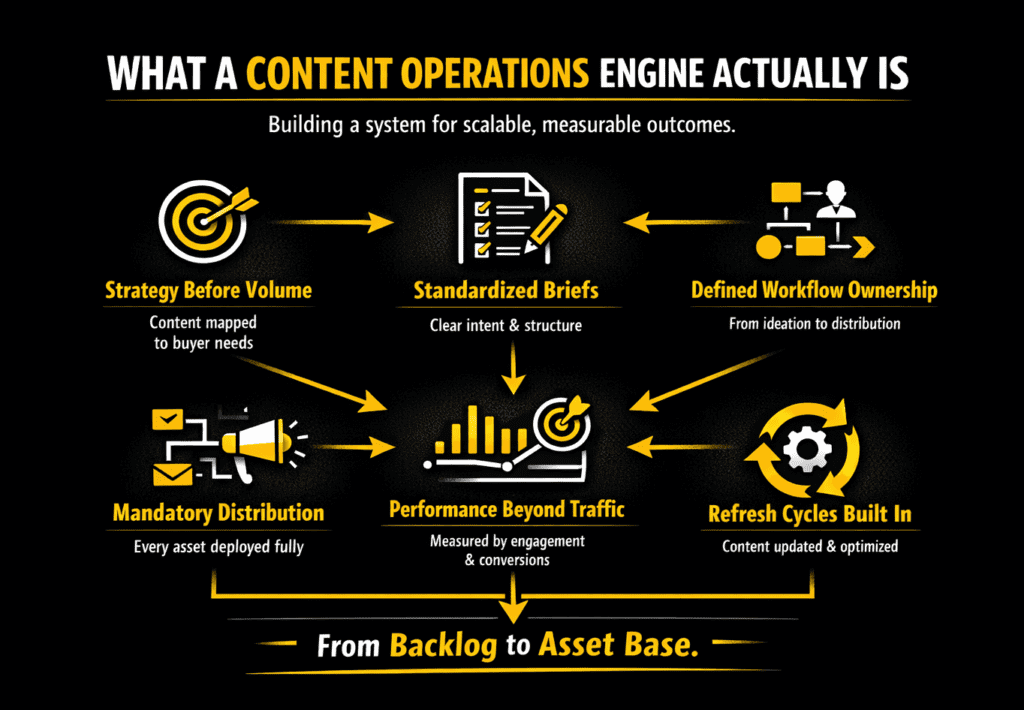
This is what a Content Operations Engine actually is.
Not a publishing function, but a system.
Not a calendar, but an operating model.
Not more content, but content that accumulates value.
When content is operated this way, it stops behaving like a recurring task and starts functioning like infrastructure built to support sustainable SaaS growth.
What Changes When Content Ops Is in Place
When a Content Operations Engine is implemented, the shift is structural, not cosmetic. Teams do not just “feel” more organized. Outcomes change in visible, measurable ways across marketing, sales, and revenue.
Output becomes predictable
Content no longer depends on last-minute pushes or individual availability. With defined workflows, briefs, and ownership, teams know what is being created, when it will ship, and why it exists. Planning replaces guesswork, and delivery becomes reliable. Leadership can forecast content output with confidence instead of hoping deadlines hold.
Quality stabilizes, then improves
Standardized briefs, clear intent, and documented strategy remove randomness from creation. Writers are not solving the same problems repeatedly. Messaging stays consistent across assets, reviews become faster, and quality stops swinging between strong and weak. Over time, performance data feeds back into planning, raising the baseline with each iteration.
SEO shifts from linear to compounding
Without Content Ops, SEO growth relies on publishing more pages. With Content Ops, growth comes from strengthening what already exists. High-performing assets are expanded, refreshed, and supported by related content. Internal linking improves. Rankings stabilize instead of resetting. SEO stops being a monthly chase and starts behaving like an asset that compounds value.
Sales gets current, usable assets
Content is no longer outdated, scattered, or rebuilt from scratch. Sales teams know which assets exist, what stage they support, and when they were last updated. Case studies, comparison pages, and objection-handling content stay relevant and easy to use. Content becomes a tool in conversations, not a forgotten resource.
Marketing stress drops as efficiency rises
When content runs on systems, pressure decreases. Fewer emergencies. Less rework. Fewer “what should we publish next?” debates. Teams spend less time managing chaos and more time improving performance. Effort scales without burnout because the system carries the load.
Content becomes revenue-adjacent, not ornamental
Most importantly, content stops being something that looks good on a website and starts influencing pipeline. It supports discovery, evaluation, and decision-making. Its impact can be measured, explained, and improved. Content earns its place alongside product, sales, and growth, not as a supporting decoration, but as infrastructure.
This is the real outcome of Content Operations.
Not more content.
Not better planning.
But content that consistently contributes to growth instead of merely existing.
The ROI Shift Most SaaS Teams Miss
Most SaaS teams try to improve content ROI by publishing more. More blogs. More landing pages. More case studies. More output is treated as the lever for growth.
It rarely works.
Publishing more content does not increase ROI.
Multiplying the impact of each asset does.
One strategically designed article can do the work of ten disconnected pieces when it is built inside a Content Operations Engine. A single asset can:
- Anchor SEO depth across multiple related keywords
- Feed consistent social distribution over weeks or months
- Equip sales with proof points, explanations, and objection-handling material
- Support multiple buyer stages through repurposed formats
- Improve over time through scheduled refreshes instead of decaying after launch
Without Content Ops, this multiplication never happens.
Content is created, published, promoted briefly, and forgotten. Each new piece starts from zero. Past effort does not reduce future work. Value resets every cycle.
With Content Ops, value accumulates.
Assets are designed for reuse from the start. Distribution is planned, not improvised. Performance data informs expansion and updates. High performers compound, low performers are fixed, and nothing exists in isolation.
This is the real ROI shift.
Content as a task consumes resources repeatedly.
Content as infrastructure compounds returns over time.
SaaS teams that understand this stop chasing volume and start building leverage.
Signs You Need Content Operations
You likely need Content Ops if content decisions depend on momentary judgment instead of a defined system.
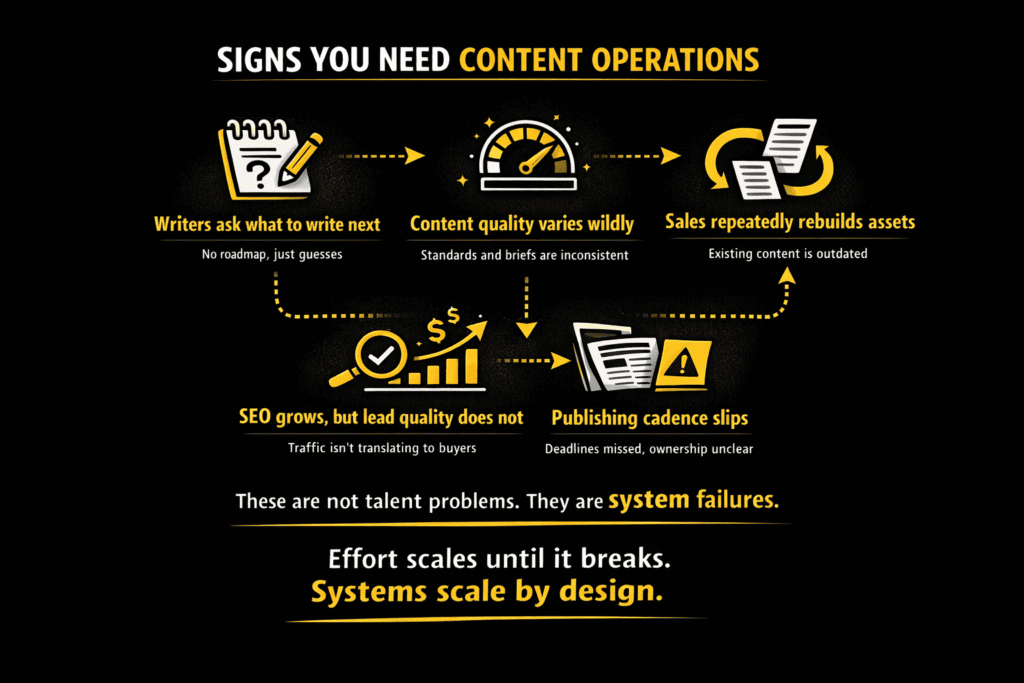
Common signals include:
- Writers ask what to write next instead of executing against a documented roadmap tied to buyer stages and business goals. Content planning lives in conversations, not in process.
- Content quality varies widely because every asset is created differently, with inconsistent briefs, expectations, and review standards.
- SEO metrics improve but lead quality does not, signaling that content attracts attention without moving buyers toward decisions.
- Sales repeatedly rebuilds or rewrites assets because existing content is outdated, hard to find, or not designed for real sales conversations.
- Publishing cadence slips when priorities shift, reviews stall, or ownership is unclear across stages of the workflow.
These symptoms often get misdiagnosed as hiring problems, creativity gaps, or bandwidth constraints. They are not. They are system failures.
Content Operations replaces fragile, people-dependent execution with repeatable structure, so output, quality, and impact remain consistent as the business grows. Also see how strategic blog writing turns readers into customers by choosing the best keyword research tools.
How to Build a Content Operations Engine in 45 Days
You do not need a massive overhaul to operationalize content. You need a clear sequence and disciplined execution. In 45 days, most SaaS teams can move from reactive publishing to a functioning Content Ops Engine. Also refer: How to Build a SaaS Content Engine in 2026.
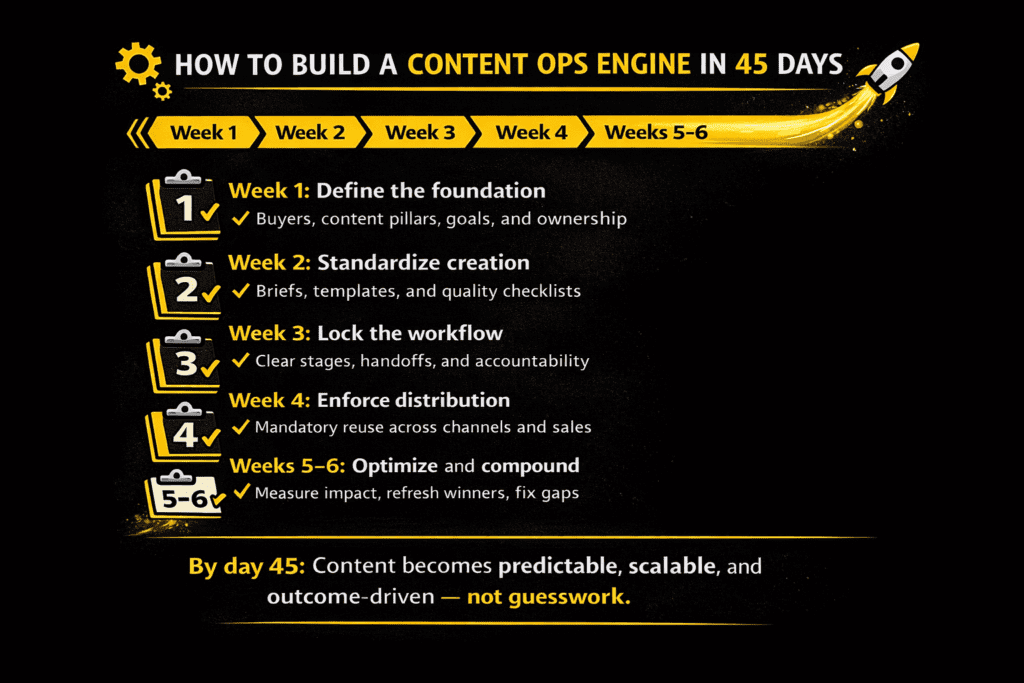
Week 1: Define buyers, pillars, and ownership
- Identify core buyer personas and decision stages
- Map content pillars to positioning, product value, and revenue goals
- Define ownership across strategy, creation, review, distribution, and measurement
- Document what content exists to support each stage and where gaps remain
Week 2: Create briefs, templates, and checklists
- Build standardized content briefs with intent, audience, funnel stage, and success metrics
- Create repeatable templates for blogs, comparisons, case studies, and sales assets
- Establish checklists to stabilize quality and reduce review friction
- Eliminate blank-page creation as a default behavior
Week 3: Implement workflow stages and accountability
- Define the end-to-end workflow from ideation to optimization
- Assign a clear owner to each stage and handoff
- Set criteria for moving content forward to prevent bottlenecks
- Make work visible so delays and capacity issues surface early
Week 4: Enforce distribution and repurposing
- Require a distribution plan for every asset before creation begins
- Map content to owned channels and sales touchpoints by default
- Repurpose core assets into multiple formats to extend reach and usefulness
- Align marketing and sales around how content supports real conversations
Weeks 5–6: Measure, refresh, and iterate
- Track performance beyond traffic: engagement, assisted conversions, sales usage
- Expand and reinforce high-performing assets
- Improve, reposition, or retire underperforming content
- Feed insights directly back into planning to strengthen the system
By day 45:
- Output becomes predictable
- Quality stabilizes
- Content compounds instead of resetting
- Teams stop guessing and start executing with confidence
That is when content shifts from a recurring task to an operating engine. To enhance your content and to give it more meaning we need infographics and images, check out this helpful article about- Best AI Image Generators.
Final Word
Blogs fill websites.
Content Operations fills pipelines.
The fastest-growing SaaS teams are not simply publishing more content. They are operating it strategically. They treat content like infrastructure. It is planned, repeatable, measurable, and directly tied to revenue outcomes.
Busy teams create content.
Structured teams create results.
The future of SaaS content is not about volume.
It is about operational excellence, compounding value, and predictable growth.





Leave a Reply