Why B2B Marketing Now Lives Across LinkedIn, YouTube, and Instagram
Imagine a marketing manager seeing a useful LinkedIn post on the train home.
A week later, they watch a YouTube tutorial from the same company. They send a short Instagram video to a colleague because it explains a problem their team keeps having.
Months later, when the team needs a solution, that company feels familiar.
This is an imagined journey, not a claim that every buyer uses all three platforms. It shows why social content can matter before there is a lead to count.
Social helps people learn before they are shopping
A buyer does not need a live project to care about a useful idea.
They might want to run better meetings, understand a new regulation, or fix a messy reporting process. Helping with those problems gives them a reason to pay attention before they need your product.
Later, the same content can help them compare options, see a workflow, or explain a choice to their team.
Social can support discovery, learning, and evaluation. Your website can do those jobs too. The useful change is to make valuable information available where buyers already spend time.
A post that makes sense only after someone clicks away asks for attention before earning it.
LinkedIn is useful, but it is not the entire audience
The Content Marketing Institute’s 2025 B2B report found that 85% of respondents named LinkedIn among the platforms delivering the best value. YouTube was cited by 22% and Instagram by 21%.
The report covered 980 B2B marketers, mostly in North America, surveyed in 2024. These are marketers’ assessments, not the percentage of buyers who purchase through each platform.
The findings support considering several channels. They do not support giving every platform an equal budget.
A tool for agency owners may have a different audience from equipment sold to hospital procurement teams. Start with the people you want to reach and the information they need.
Give each channel a useful job
Think of these as starting points to test, rather than permanent rules.
LinkedIn: share useful judgment
Explain something your team has learned. Show a trade-off. Answer a question customers regularly ask.
“Three reasons customer handoffs break” is more useful than “We are revolutionizing customer success.”
LinkedIn also makes conversation visible. A thoughtful answer from a practitioner can add context the original post missed.
In a LinkedIn post on cumulative marketing effects, Dave Gerhardt opens with a provocative line:
“Measurement kills marketing.”
His argument is that content can build familiarity over time, and demanding a sale from each interaction misses that effect. This is a practitioner view, not a measured return for every post. A useful response is to improve measurement: evaluate the program and its audience without expecting each post to close a deal.
YouTube: show how something works
Some questions need more than a paragraph. A buyer may want to see a workflow from beginning to end.
For example, creator Thalita Milan’s HubSpot CRM tutorial is organized around tasks such as adding contacts, creating properties, and sending emails. It is an independent tutorial, not a HubSpot-produced video or evidence of sales results.
The format illustrates a useful job for video: help someone understand what using a tool involves.
You can apply that idea to your own product. Show the setup, a realistic task, and the result. Explain where someone might need help.
Instagram: make an idea easy to see and share
Instagram can suit visual workflows, short explanations, customer stories, and people explaining their work.
A documented Instagram example from Notion shows its customer Loom at work. The example is reproduced in StoryChief’s article; it illustrates the format, rather than proving its effect on revenue.
A customer doing something recognizable can make a product easier to understand than another feature list.
That does not mean your buyers want corporate lifestyle content. Ask whether the clip teaches something, shows a result, or answers a real question.
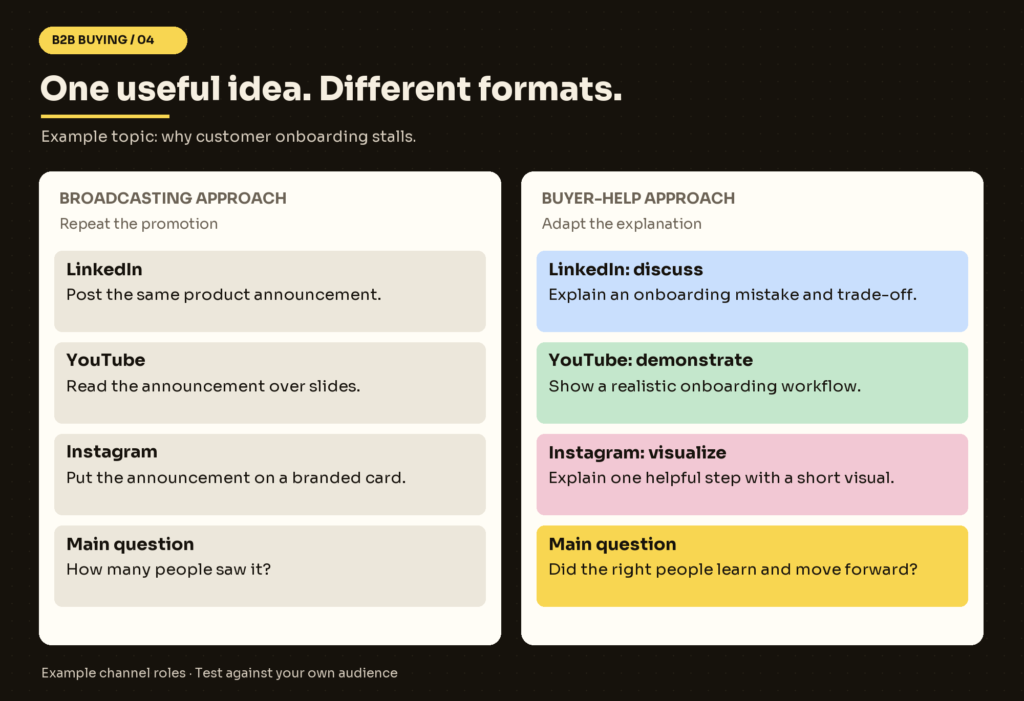
Possible channel roles, not fixed buyer behavior. Choose and test them against your own audience.
More followers can still mean very few buyers
In a Reddit post about B2B Instagram, a tech startup co-founder reports gaining more than 11,000 followers but no inbound leads. They describe engagement coming mostly from other tech accounts and people who do not appear to be buyers.
The account is self-reported and unverified. It does not prove Instagram cannot work for B2B. It does illustrate the question a follower count cannot answer: who is paying attention?
Before increasing posting frequency, check audience fit, the clarity of the offer, and whether there is a useful path from the content to a business conversation.
A small audience of relevant people can be more valuable than a large audience attracted by unrelated entertainment.
Use one strong idea in several ways
You do not need three separate content machines.
Suppose customers keep asking why their onboarding process stalls. Start by answering that question properly.
- On LinkedIn, explain a common mistake and invite useful discussion.
- On YouTube, demonstrate a better onboarding workflow.
- On Instagram, show one step with a clear visual and a short explanation.
- On your website, provide the complete guide and relevant product details.
This is an example plan. The value comes from adapting the idea to the format, rather than posting identical copy everywhere.
LymLyt’s guide to content across the SaaS funnel can help connect those pieces to buyer needs. Its approach to B2B SaaS blog writing is useful for developing the deeper explanation behind shorter social posts.
A practical social scorecard
Give each channel a job before deciding what success means. The following are starting points, not a universal set of targets.
| Channel and job | Early signals | Commercial evidence to look for |
|---|---|---|
| LinkedIn: useful judgment and discussion | Relevant people responding, useful questions, repeat engagement | Qualified conversations and buyers who recall the content |
| YouTube: explain and demonstrate | Watch time, relevant questions, use of practical walkthroughs | Suitable enquiries and buyers who used a video to evaluate |
| Instagram: visual explanation and familiarity | Relevant replies, saves, and shares where reported | Suitable conversations and buyer accounts of the content |
| The whole program | Reaching the intended audience consistently | Unique qualified opportunities, wins, and costs over time |
These signals can disagree. A popular video may reach students rather than buyers. A modestly viewed explanation may help a real buying group. Inspect who responds and what they need; do not assume every save represents buying intent.
LinkedIn and Ipsos’s 2025 benchmark, surveying 1,500 senior B2B marketers, found that 78% used video. Adoption is a reason to examine the format, not proof that any video will pay for itself.
How to attribute social when people watch but do not click
Use tagged links where a link serves the reader. UTM tags are labels on a URL that help identify a campaign visit. Connect identifiable enquiries to the CRM, while keeping the channel’s own engagement reports separate.
Then ask buyers what introduced the company and which content helped them evaluate it. A person might watch a YouTube video and later type your name into search. The click report and their account explain different parts of the journey.
Do not label all branded searches or direct visits as social-driven. Do not add the same deal once for LinkedIn, again for YouTube, and again for Instagram. Count unique opportunities in the business total and show overlapping channel involvement separately.
Platform-reported conversions also follow each platform’s settings and credit rules. If two platforms claim involvement in one sale, that is still one sale. Reconcile those reports with the CRM rather than adding their revenue claims together.
For a larger paid program, consider a controlled lift test where eligibility and volume allow it. Google’s explanation of Conversion Lift uses an ad-exposed group and a control group to assess additional results. This is a different question from allocating credit to clicks.
For organic content, isolating exposure can be difficult. Compare program-level trends, buyer feedback, and commercial results, accounting for changes in sales activity, pricing, seasonality, and other campaigns. A before-and-after change is useful evidence to investigate, not proof of cause.
Before starting, agree on the audience, spending, early signals, business outcomes, and a review period informed by your sales cycle. Continue, adjust, or reduce a program based on that combined evidence. “We cannot attribute it perfectly” should not become “we never need to assess it.”
When someone wants more detail, make it easy to find: an explanation, a comparison, a case study, or a conversation that fits their question. LymLyt’s guide to content that fails to convert can help identify gaps in that next step.
The point of social is to become useful and recognizable to the right people. A platform only deserves more effort when it helps you do that.
Frequently asked questions
Should every post generate a lead?
No. A post may explain a problem or help a buyer evaluate. Assess it against that job, and assess the overall program against audience quality and business progress.
Is “how did you hear about us?” enough to measure social?
It is helpful, but people may forget or name only the most recent interaction. Keep their wording alongside tracking, costs, and opportunity outcomes. Ask what helped them evaluate as well as what introduced you.
When should we stop investing in a channel?
When a fair review finds weak audience fit and little useful response or commercial progress despite reasonable adjustments. Choose the review window around your buying cycle and write the criteria before the results arrive.

Rashmita is content marketer with 8 years of experience building and growing SaaS brands. Now she tests various AI tools for marketers and shares her feedback on this blog, LinkedIn, Instagram, and YouTube.