The 13 best Kalungi alternatives for B2B SaaS in 2026
Kalungi does exactly what it promises. You hand over marketing, and a fractional CMO plus a ten-person team runs the whole function like an in-house department, built on the T2D3 growth model. For a funded SaaS company that has product-market fit and no real marketing team, that is a clean answer to a hard problem.
So why are you reading a list of alternatives?
Almost never because Kalungi is bad at the job. It is the number on the invoice. Full-service engagements start around $45,000 a month, and their own pages put the full package at $50,000+. That price replaces eight to twelve hires, which is the point. It also prices out most companies that type “Kalungi alternative” into Google at 11pm.
Here is what usually happens next. You go looking for “someone cheaper who does what Kalungi does,” and you end up comparing agencies that are actually solving three different problems. One agency runs your entire marketing department. Another writes and ranks your content. A third gives you a senior marketing brain a few days a week and expects you to handle execution. All three call themselves the answer. Only one of them matches the gap you actually have.
This guide sorts the field by that gap. Twelve alternatives, grouped by what they really do, with real 2026 pricing and the honest complaints that most roundups leave out. LymLyt sits at the top, and we will be straight about why: LymLyt is not a Kalungi clone. It is the content and SEO pick for teams who realized they never needed a full outsourced department in the first place.
The 13 Kalungi alternatives at a glance
| Agency | Type | Best for | Starting price (2026) |
|---|---|---|---|
| LymLyt | Content + SEO + AI visibility | B2B SaaS teams that need content and SEO as one system, with flexible terms | Single Track from $4,499/mo, Dual Track $7,999/mo |
| Holini | B2B paid acquisition + analytics | B2B SaaS companies that need senior PPC execution and full-funnel attribution | Custom |
| Omniscient Digital | Content + SEO + GEO | Mid-market SaaS that wants organic growth tied to pipeline | ~$10,000/mo |
| Grow and Convert | Bottom-funnel content | Teams that want content built to convert, not just rank | Flat ~$10,000/mo |
| Siege Media | SEO content + digital PR | Content plus links and visual assets at scale | ~$8,000–$20,000/mo |
| Animalz | Editorial content | High-craft thought leadership for senior audiences | ~$12,000–$25,000/mo |
| SimpleTiger | SaaS SEO + PPC | Organic-led SaaS that wants SEO with some paid and Webflow | From ~$5,000/mo (or 5% of revenue) |
| Directive | Full-service | Full-funnel demand gen across paid, SEO, content, RevOps | $6,500/mo startup, $8k–$30k/mo |
| Powered by Search | Full-service demand gen | Series A to C SaaS moving from lead gen to demand gen | Custom |
| Refine Labs | Demand creation | $50M+ ARR teams rebuilding demand and pipeline conversion | ~$15,000–$40,000+/mo |
| Chief Outsiders | Fractional CMO | Companies that need senior leadership, execution handled elsewhere | ~$8,000–$15,000/mo |
| CMOx | Fractional CMO | Startups restructuring a marketing function around clear KPIs | Custom fractional retainer |
| First Page Sage | SEO-led fractional CMO | Technical B2B that wants SEO leadership and thought leadership | ~$10,000–$18,000/mo |
What a Kalungi alternative actually means
The category splits into three shapes. Pick the wrong shape and you either overpay for capacity you cannot use or underbuy and wonder why nothing ships.
Shape one: the full outsourced department. This is the direct Kalungi replacement. A fractional leader plus an execution team covering strategy, positioning, demand gen, paid, content, and RevOps. You are buying a marketing function, not a project. It costs the most because it is the most people. Directive, Powered by Search, and Refine Labs live here.
Shape two: content and SEO execution. You already have a marketing lead, or a founder who can make the calls. What you lack is throughput. Someone to research, write, and rank content that actually pulls pipeline, plus the SEO and now the AI-search work that goes with it. This is the widest lane and the one most Kalungi shoppers land in once they do the math. LymLyt, Omniscient Digital, Grow and Convert, Siege Media, Animalz, and SimpleTiger sit here.
Shape three: leadership without the full team. You can execute, or you have juniors and freelancers who can. What you are missing is a senior operator to set direction, build the plan, and stop you wasting quarters. A fractional CMO gives you that brain for a few days a week. Chief Outsiders, CMOx, and First Page Sage cover this.
The Kalungi model bundles all three shapes into one contract. That bundling is exactly why it is expensive, and exactly why unbundling it saves most companies real money. If you need only content and SEO, paying department rates for a department you will not use is the most common mistake in this whole search.
What marketing leads should actually look for
You are comparing agencies, not tools, so the evaluation is different. A bad software pick costs you a monthly fee. A bad agency pick costs you two quarters and a board conversation. Weigh these before you sign anything.
- Who actually does the work. The senior person on the sales call is rarely the person on your account. Ask directly. Reddit threads on fractional and full-service agencies are full of bait-and-switch staffing complaints where the pitch team hands off to juniors. Get the names.
- B2B SaaS specialization, verified. “We work with SaaS” and “we only work with B2B SaaS” are different businesses. The second one already understands trials, PLG, ARR math, and your sales cycle. The first one is learning on your budget.
- Pipeline attribution, not traffic. The agencies worth hiring in 2026 tie their work to pipeline stage and revenue, not sessions and rankings. If the reporting is a traffic chart, you are buying a vanity metric.
- AI search readiness. Most B2B buyers now start vendor research in ChatGPT, Perplexity, and Google’s AI answers. An agency still pitching you on ranking number one is selling a metric that decides less than it used to. Ask how they earn citations in AI answers, not just links on page one.
- Contract flexibility. Annual lock-ins are standard at the top of this list. Month-to-month is rarer and worth a lot when you are not sure the fit will hold. Know which you are signing.
- Where they stop. Every honest agency has a hard edge. Organic-only shops do not run your paid. Fractional CMOs do not execute. Demand-gen specialists do not write your blog. The clean ones tell you. The rest let you find out in month three.
- Time to first real result. Content and SEO take six to twelve months to show pipeline, full stop. Anyone promising rankings in weeks is either lying or selling something that will not last. Set the timeline honestly on both sides.
Content and SEO partners
This is where most Kalungi shoppers actually belong. You have someone steering the ship. You need throughput on content and organic search, done by people who understand SaaS and can tie the work to pipeline instead of pageviews. Six options, strongest fit first.
1. LymLyt
- Best for: B2B SaaS companies from Seed to Series C that want content and SEO run as one pipeline-driving system, without hiring a full department.
- Price: Topic-bundle plans. Single Track from $4,499/mo (4-month minimum, one topic cluster at a time). Dual Track $7,999/mo (6-month minimum, two clusters in parallel). A full-engine tier is available for broader scope.
- What you give it: Your positioning, your ICP, real input on what to say. LymLyt is strategy-first, so the work needs collaboration on the message, not just a keyword list.
- Turnaround: Standard content in 5 to 7 business days, with rush options available.
- Free option: Free intro call, no pitch deck.
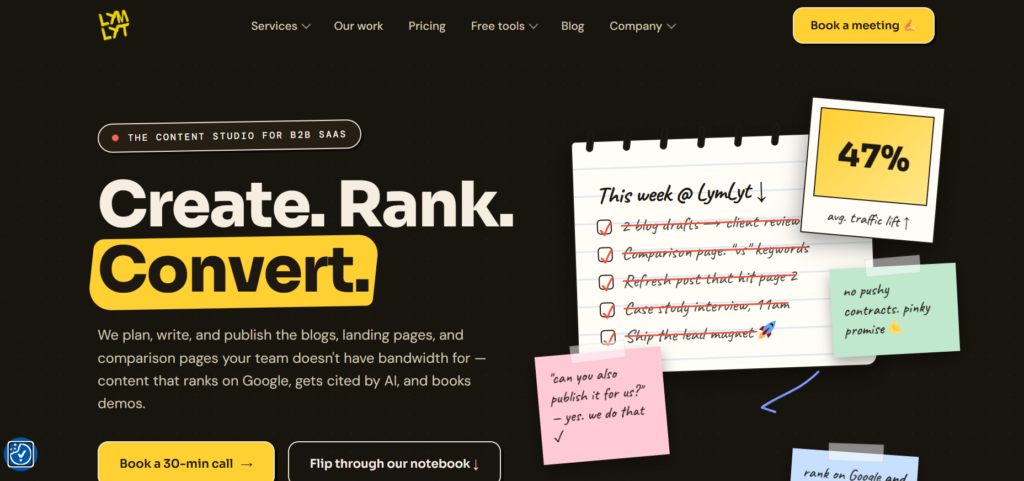
LymLyt is a content and SEO service built only for B2B SaaS, across adtech, martech, sales-tech, and fintech. The model is deliberately narrow. It handles blog writing, landing pages, competitor guides, case studies, reports, and SEO content, and it structures that content to rank on Google and to get cited in AI answers like ChatGPT and Perplexity. The engagement runs on a fractional model, which means you work with senior strategists rather than a rotating junior account team.
The reason it tops this list is honesty about scope. LymLyt does not pretend to be Kalungi. It will not run your paid media, staff your whole marketing function, or manage RevOps. What it does is the thing most SaaS teams are actually short on: content that says something specific enough that a reader keeps reading and an AI engine has a reason to quote it. Reviews from B2B SaaS clients consistently note that the content gets picked up because it has a point of view, not because it hit a word count. The flexible terms matter too. You are not locked into a twelve-month contract to find out whether the fit holds.
Skip it if: You need paid media management, a technical SEO audit, programmatic content at scale, or a full outsourced marketing department. That is a Kalungi or Directive conversation, not a LymLyt one.
2. Holini
- Best for: Growing B2B SaaS and technology companies that already have marketing leadership but need senior specialists to improve paid acquisition and connect advertising with pipeline and revenue.
- Price: Custom. Holini states that its typical clients invest at least $10,000 per month in PPC ads or expect to reach that level soon.
- What you give it: An in-house marketing lead, a defined ideal customer profile, and access to advertising, analytics, and CRM platforms.
- What it includes: Google Ads, Microsoft Ads, LinkedIn Ads, YouTube Ads, conversion tracking, advertising and CRM data integration, full-funnel measurement, and custom reporting.
- Free option: An initial fit call is available. Holini does not advertise a standalone free service.
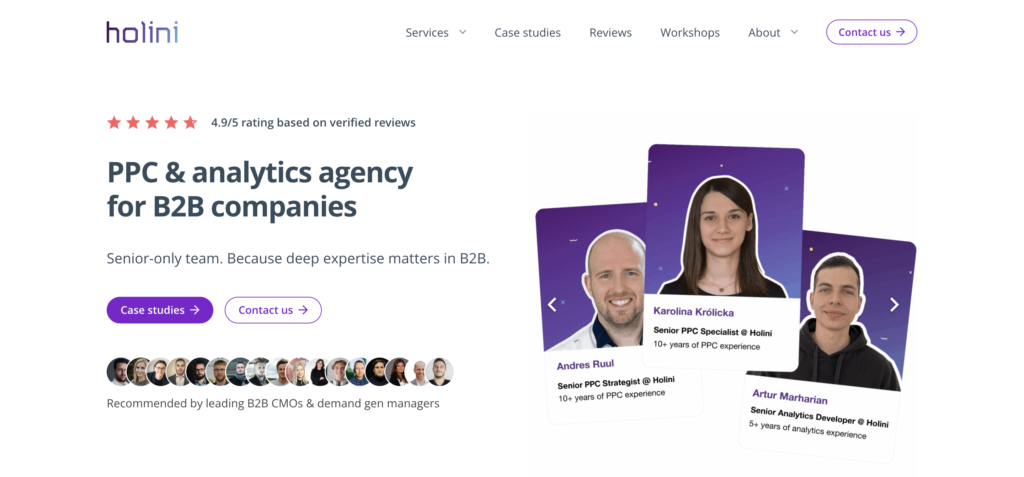
Holini is a senior-only PPC and analytics agency for B2B companies. It is a narrower Kalungi alternative for companies that do not need an entire outsourced marketing department but do need experienced specialists to manage paid acquisition and improve measurement.
Holini focuses on determining which campaigns generate qualified pipeline and paying customers—not simply clicks or form submissions. Its work combines paid search and paid social with analytics, offline conversion tracking, CRM data, and full-funnel reporting.
This makes Holini complementary to a content and SEO partner such as LymLyt. LymLyt helps B2B SaaS companies build organic visibility, content, and AI-search presence, while Holini manages paid acquisition and its connection to downstream sales results. A company needing both could use the two services alongside each other without substantial overlap.
Holini’s published case studies include:
- Veriff: Opportunity pipeline value tripled in three months, while opportunity pipeline ROAS increased by 377%. The work included sending CRM opportunity, deal-value, and customer data to Google Ads.
- DeskTime: Qualified leads increased by 86%, paying customers by 106%, and estimated lifetime value by 195%, while CAC decreased by 43% between October 2022 and October 2024.
- Livespace: Paid-search MQL volume increased by 37%, sales-accepted leads by 25%, and the MQL-to-SAL conversion rate by 47% over six months.
The honest limitation is scope. Holini is not positioned as an SEO, long-form content, AI-visibility, PR, or fractional CMO agency. It is relevant when paid acquisition and attribution are the missing capabilities—not when the company needs its entire marketing function replaced.
Skip it if: You are still validating product-market fit, do not have an in-house marketing lead, have no previous PPC experience, or primarily need content, SEO, and organic visibility.
3. Omniscient Digital
- Best for: Mid-market SaaS with a $10k+ monthly budget that wants organic growth measured in pipeline.
- Price: Full-service organic programs start around $10,000/mo. Thought-leadership projects start lower, around $3,000.
- What you give it: Access to your subject-matter experts and your revenue data, so attribution works.
- Free option: Free strategy call to assess fit.
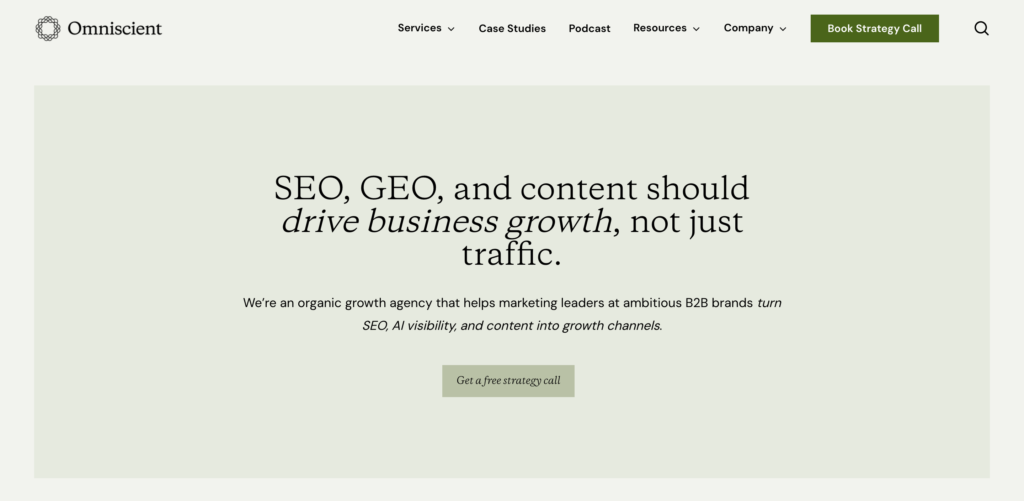
Omniscient Digital is an organic growth agency founded in 2019, working almost exclusively with B2B software. The founding team came out of in-house roles at HubSpot, Shopify, and Workato, which shows in how they think about go-to-market rather than just keywords.
Their methodology, sometimes branded Surround Sound SEO, aims to get your brand associated with a category across enough content touchpoints that both readers and LLMs start linking the two. They have driven organic growth for Jasper, SAP, Adobe, Asana, and Loom, and their case studies increasingly isolate AI-referred traffic, which is harder than most agencies attempt.
The honest limit is scope and floor. Omniscient is organic-only, so paid media lives elsewhere, and the $10,000 entry point rules out early-stage budgets. Their AEO work is added onto an existing SEO foundation rather than built AI-native from scratch, so if AI-search citation is your single biggest priority, press them on how they measure it.
Skip it if: You are pre-Series A on budget, or you need paid and organic under one roof.
Check out: Omniscient Alternatives.
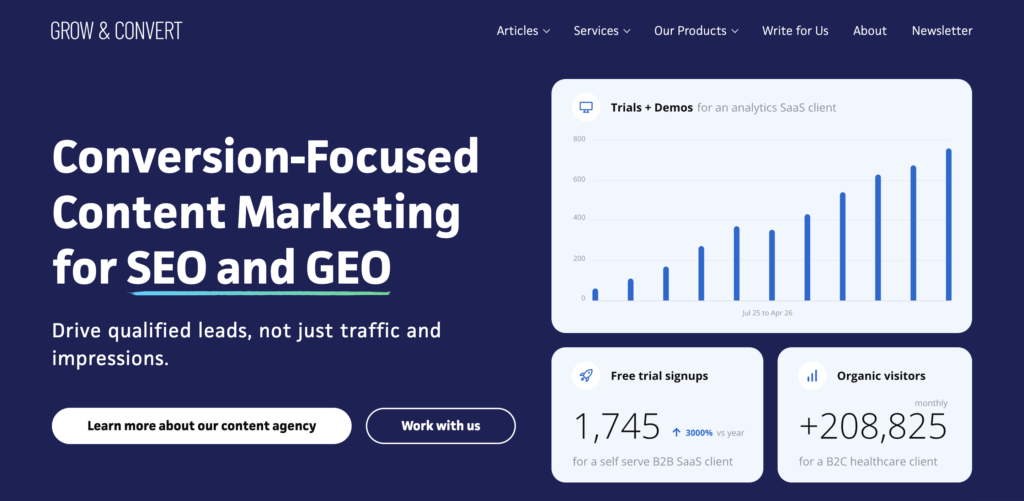
4. Grow and Convert
- Best for: Teams that would rather have ten pieces that convert than a hundred that rank.
- Price: Flat monthly retainer, mid-market positioning, commonly around $10,000/mo.
- What you give it: Time from your sales, product, and customer success teams for interviews.
- Free option: Free call.
Grow and Convert coined Pain Point SEO back in 2018, and the methodology still holds up. Instead of chasing search volume, they target the high buying-intent phrases real buyers use, informed by direct interviews with your customer-facing teams.
The result reads like how your buyers actually talk, and every engagement runs with conversion tracking tied to individual pages, so you can see which content produced signups rather than sessions. For a SaaS team drowning in top-of-funnel traffic that never converts, this is the correction.
The trade-off is deliberate narrowness. High-intent keywords tend to have low volume, so this is not the play if you want a big traffic number for a fundraise deck or broad category awareness. It is bottom-funnel by design.
Skip it if: Your goal this quarter is top-of-funnel reach or thought-leadership authority rather than direct conversions.
5. Siege Media
- Best for: SaaS brands that want SEO content plus links and visual assets from one team.
- Price: Roughly $8,000 to $20,000/mo, with digital PR often scoped separately.
- What you give it: Topic priorities and design direction. They handle production at volume.
- Free option: Free call.
Siege Media, founded by Ross Hudgens, is one of the most data-driven content shops in the space and reports over $148 million in annual traffic value across its client base. The differentiator is the combination most content agencies cannot match: SEO content, custom graphic design, and digital PR link building under one roof.
Their KOB analysis, weighing keyword opposition against benefit, is a well-known framework for prioritizing what to write by ROI. They have repositioned toward GEO and built internal tooling for strategy and content refreshes, which signals an operation built for scale.
The honest notes are contract terms and voice. Siege typically signs annual agreements, so this is a commitment, and the house style leans toward SEO-and-visuals rather than founder-voice thought leadership. If your brand hinges on a distinct personal point of view, that is a different kind of shop.
Skip it if: You want month-to-month flexibility or a strong individual voice on every piece.
Check out: Siege Media Alternatives.
6. Animalz
- Best for: Companies that need editorial quality good enough for senior technical buyers.
- Price: Roughly $12,000 to $25,000+/mo.
- What you give it: Deep access to your experts and patience for a slower, higher-craft process.
- Free option: Free call.
Animalz has long been the editorial quality benchmark in B2B SaaS content. Founded in 2015 and now led by CEO Ty Magnin with co-founder Walter Chen as chairman, the agency built its name on writing that reads like it came from someone who understands your product, not just your keyword.
Through 2025 and 2026 it repositioned around AEO for AI search. If your priority is authority and long-form thought leadership that a CMO would be proud to publish, few teams write better.
Two honest flags. Animalz went through a significant layoff in 2023 that cut headcount from its peak, so ask about current team structure and who is on your account. And it carries no Clutch reviews as of mid-2026, which means less independent verification of client satisfaction than Siege or others offer. The pricing floor also sits above most content-first alternatives.
Skip it if: Budget is tight, or you need direct pipeline attribution and multi-channel execution rather than premium editorial.
Check out: Animalz Alternatives
7. SimpleTiger
- Best for: Organic-led SaaS that wants SEO with some PPC and Webflow capacity attached.
- Price: Custom, described as starting at 5% of revenue or funding for your stage. Clutch minimum sits around $5,000/mo.
- What you give it: Site access and a discovery call to scope the percentage model.
- Free option: Free discovery call.
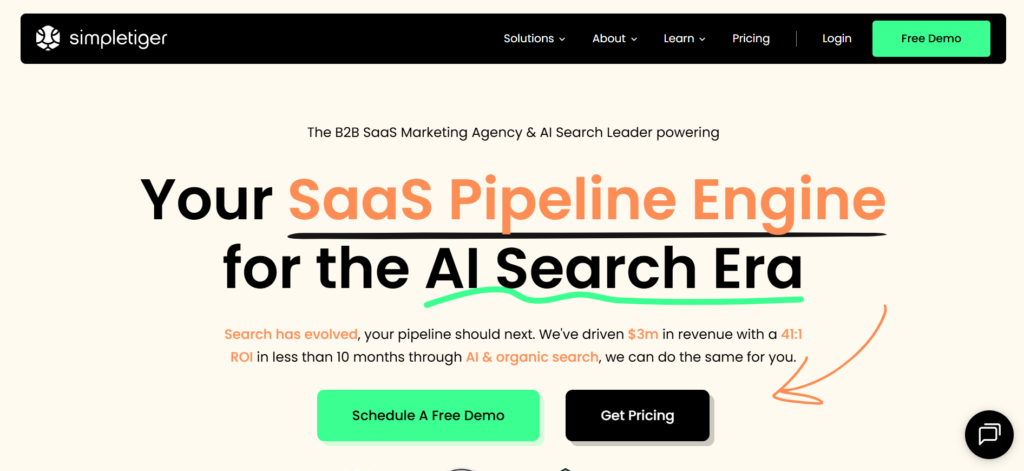
SimpleTiger has been doing SaaS SEO since 2006, which is a long track record in a field full of two-year-old agencies. The core is SEO, with keyword research, technical work, content, and link building, and the founders consult on accounts directly. Around that core they offer PPC and Webflow design, plus a standalone GEO Jumpstart package for AI-search optimization that runs on top of an existing SEO foundation. Their Clutch profile is strong and deep, with 30-plus reviews at a 4.9 rating.
The honest note is the pricing model. Charging a percentage of revenue or funding is unusual and can be hard to budget against, so confirm the exact dollar figure and scope before signing. Their GEO work is designed as an add-on to a site that already has topical authority, so pre-PMF teams with no SEO foundation should factor that in. And if your board wants exact CRM-attributed pipeline from ChatGPT and Perplexity, press them on whether their current methodology proves that at scale.
Skip it if: You are pre-product-market-fit, or you need a fixed, predictable monthly fee from day one.
Full-service growth agencies
These are the closest direct replacements for Kalungi. A leader plus a team running multiple channels, priced accordingly. If your real gap is “we have no marketing function and need one built,” this is your section.
8. Directive Consulting
- Best for: Funded B2B SaaS that wants full-funnel demand gen across paid, SEO, content, and RevOps.
- Price: A published startup package at $6,500/mo, with typical retainers running $8,000 to $30,000/mo depending on scope and ad spend.
- What it includes: Paid media, SEO, content, CRO, and RevOps under one Customer Generation framework.
- Free option: Free call.
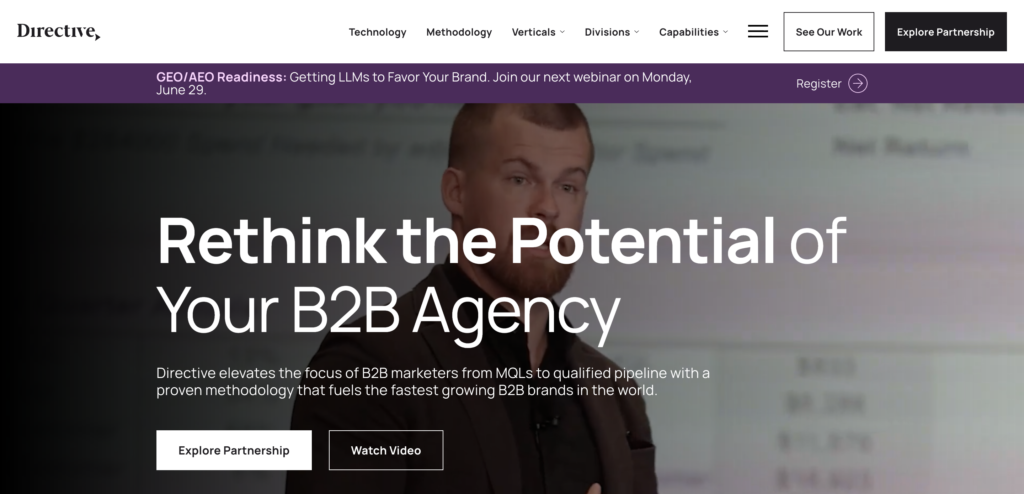
Directive is a roughly 150-person agency in Irvine that works with mid-market and enterprise SaaS like ZoomInfo, Chili Piper, and Sumo Logic. Their Customer Generation framework ties paid media, SEO, and analytics into pipeline rather than lead volume, and clients praise their willingness to be held to pipeline metrics.
The $6,500 startup package is genuinely notable: it is pitched as a full marketing team for the cost of a single hire, which makes Directive one of the few real Kalungi alternatives at a lower entry point.
The honest note is account consistency. At scale, some clients report that team continuity varies over longer engagements, so ask who owns your account and how handoffs are managed.
Skip it if: You only need one channel fixed while the rest of your marketing is healthy, or your budget cannot clear the startup tier.
9. Powered by Search
- Best for: Series A to C SaaS shifting from lead generation to demand generation. Price: Custom.
- What it includes: Paid media plus content and SEO, structured so marketing keeps working when you pause ad spend.
- Free option: Free call.
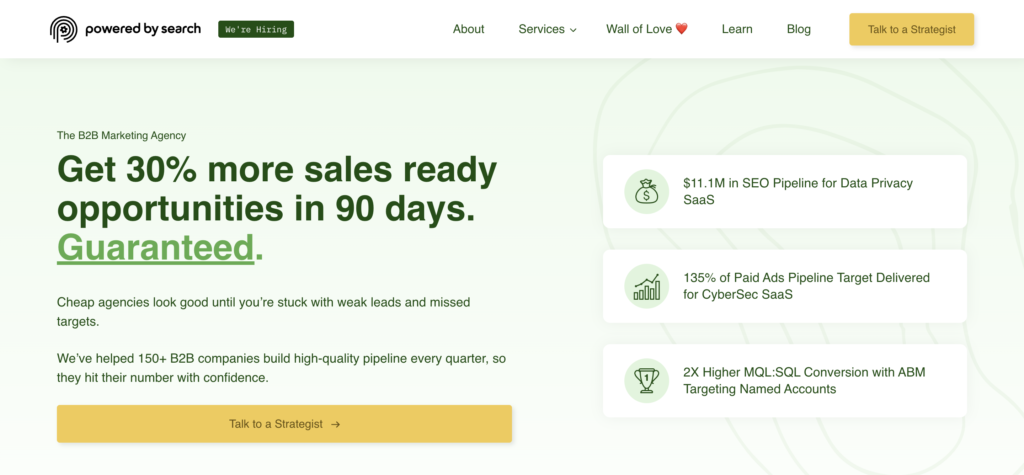
Powered by Search focuses on the transition most growth-stage SaaS teams are trying to make: moving away from gated content and MQL volume toward genuine in-market demand. They combine paid with content and SEO so the program does not collapse the moment you turn off ads, which is the classic failure mode of paid-only agencies. For a company that has outgrown lead gen but has not built brand and demand, this is a coherent partner.
The honest note is transparency. Pricing is custom and not published, so you will not get a number until you talk to them, and their sweet spot is the funded Series A-to-C band rather than seed-stage or enterprise.
Skip it if: You want pure organic content, a published price floor, or you are pre-Series A.
10. Refine Labs
- Best for: $50M+ ARR teams that generate plenty of MQLs but convert weak pipeline.
- Price: Historically $15,000 to $40,000+/mo.
- What it includes: Demand creation and dark-funnel strategy, focused on pipeline over lead volume.
- Free option: Free call.
Refine Labs built a large reputation on demand creation, the idea that you build awareness and preference before you ever try to capture a lead. For a mid-market or enterprise SaaS team whose problem is pipeline quality rather than lead quantity, the thinking is genuinely influential, and much of the modern B2B demand-gen playbook traces back through them.
Two honest flags that matter in 2026. Founder Chris Walker exited in July 2025, which creates real questions about methodology continuity, and the agency carries zero verified Clutch reviews, the weakest third-party verification on this list. It is also demand-gen only, so no SEO, no RevOps, no content execution engine. The price floor and $50M+ ARR target rule out most sub-Series B companies. If you are considering Refine Labs, raise the leadership transition directly on the first call.
Skip it if: You are below Series B, or you need SEO, content, and RevOps execution rather than demand strategy.
Fractional CMO and marketing leadership
Different problem entirely. You or your team can execute. What you lack is a senior operator to set direction and stop you wasting quarters. A fractional CMO gives you that brain for a few days a week, usually 10 to 25 hours. The catch runs through this whole category: leadership and execution are separate, and the gap between them is where growth stalls.
11. Chief Outsiders
- Best for: Companies that need board-level marketing leadership with execution handled elsewhere.
- Price: Roughly $8,000 to $15,000/mo.
- What it includes: A senior fractional CMO from a large bench, with a structured Growth Gears methodology.
- Free option: Free consult.
Chief Outsiders runs one of the largest fractional executive networks, with 120-plus CMOs and CSOs and a 4.9 Clutch rating across a deep review history. They carry serious PE and VC experience, which makes them a strong fit for backed and fast-growing firms that need a real operator in the leadership seat. The Growth Gears framework gives structure to strategy and prioritization.
The honest limit is the one built into the model. Chief Outsiders is strong on strategy and board-level positioning and light on hands-on execution, relying on your internal team or separate agencies to actually ship. Buyers should also read past the average Clutch score and ask directly about staffing, since the broader fractional space has documented complaints about handoffs to more junior people.
Skip it if: Your gap is execution capacity rather than strategic direction.
12. CMOx
- Best for: Startups that need a marketing function built or restructured around clear KPIs.
- Price: Custom fractional retainer.
- What it includes: A fractional CMO plus the Functional Marketing framework for structure and prioritization.
- Free option: Free consult.
CMOx specializes in bringing order to chaotic early-stage marketing. Their Functional Marketing framework is KPI-driven and built to establish clear metrics and align a scattered marketing effort, which is exactly what a lot of founder-run SaaS marketing needs before any agency spend makes sense. If your problem is that nobody owns marketing strategy and everything is reactive, a CMOx engagement can install the operating system.
The honest note is the same category caveat. A fractional CMO sets direction and expects execution to happen around them, so budget for the writers, designers, and channel specialists who will do the actual work. The total cost of a fractional CMO plus the execution resources they require can climb quickly once you add content, paid, and CRO.
Skip it if: You already have marketing leadership and simply need content and campaigns produced.
13. First Page Sage
- Best for: Technical B2B companies that want SEO-led marketing leadership and thought leadership.
- Price: Roughly $10,000 to $18,000/mo.
- What it includes: Fractional CMO guidance weighted toward SEO strategy and technical content.
- Free option: Free consult.
First Page Sage sits at the intersection of this section and the last one. They hold a 4.9 Clutch rating, bring more than fifteen years of experience, and specialize in technical B2B SEO and thought leadership delivered with a leadership layer on top. For a technical or developer-focused SaaS where the growth lever is clearly organic and the founder wants senior direction rather than another vendor to manage, they are a credible pick.
The honest limit is channel breadth. First Page Sage is SEO-first with minimal paid media capability, so a company that needs a genuinely multi-channel plan will have to pair them with a paid specialist.
Skip it if: You need paid media, or a broad multi-channel program rather than SEO-led leadership.
The free audit reality
Agencies do not offer free tiers. They offer free audits and discovery calls, and it is worth being clear-eyed about what those are. Almost every name on this list will run you a “free SEO audit” or “free marketing teardown.” That audit is a sales asset. It is designed to surface enough problems that hiring the agency feels urgent, and it is usually accurate, because your marketing does have problems. The audit itself is real value. Just read it knowing what it is built to do.
The one free thing that consistently earns its keep is the intro call, when you use it to interrogate rather than get pitched. Ask who works on your account. Ask for two references from companies at your stage. Ask how they attribute results to pipeline. Ask what they will not do. The agencies that answer those cleanly are the ones worth a paid trial. The ones that redirect to case studies and frameworks are managing you.
Free trials in the software sense do not exist here, so the closest equivalent is a short, scoped paid pilot: a one-month content sprint or a single SEO project before a longer retainer. LymLyt’s pause-or-cancel flexibility functions the same way. You can start small and stop cleanly, which is the real test any agency should be willing to pass.
The marketing lead’s playbook
This is the part that matters. Forget the ranking. Match the agency to the job in front of you.
You have no marketing function and need one built. This is the true Kalungi replacement, and Directive is the most accessible entry with its $6,500 startup package for a full-funnel team. Powered by Search fits if your specific problem is the shift from lead gen to demand gen. Refine Labs only makes sense at $50M+ ARR when pipeline conversion, not lead volume, is the failure.
You have a lead and need content throughput. This is where most Kalungi shoppers actually land. LymLyt for content and SEO run as one system with flexible terms. Omniscient Digital if you have a $10k+ budget and want organic tied to revenue attribution. Grow and Convert when the brief is conversions over reach.
You need traffic that converts, not just traffic. Grow and Convert is purpose-built for this with Pain Point SEO. LymLyt fits when you want that conversion focus plus AI-search visibility and flexible terms in the same engagement.
You need authority for a senior technical audience. Animalz for premium editorial, budget permitting. First Page Sage if the authority play is SEO-led and you want a leadership layer with it.
You need links and visual content at scale. Siege Media, which combines SEO content, design, and digital PR in a way most content shops cannot.
You need direction, not hands. Chief Outsiders for a senior operator with PE and VC pattern recognition. CMOx to install structure and KPIs in a startup that has none. Both expect you to handle execution, so plan for that cost.
You want to own organic and AI search specifically. SimpleTiger for a long SaaS SEO track record with a GEO add-on. Omniscient Digital and LymLyt for content-led organic that is built to earn citations in AI answers, not just rank on Google.
Three rules that hold regardless of which name you pick. First, buy for the gap you have, not the department you imagine you need, because the whole reason Kalungi felt expensive is that it sells all three shapes at once. Second, start with one real workflow, a single content sprint or one SEO project, before you sign a year. Third, agree on how pipeline gets attributed before money changes hands, because “we increased traffic” is not a result you can take to a board.
How to run the agency search
A few moves save you a bad quarter.
Write a one-page brief before you talk to anyone. Your stage and ARR, your ICP, the single most important outcome for the next two quarters, your budget range, and the one channel you most need help with. Send it ahead of every intro call. Agencies that respond to the brief with a scoped point of view are worth your time. Agencies that respond with a generic deck are not.
For content and SEO engagements specifically, ask for a sample built for your product, not their portfolio. A short outline or a single draft written for your ICP tells you more than fifty case studies. The best content teams say something specific because they took the time to understand what you do. You will feel the difference in one paragraph.
Match the contract to your certainty. If you know the channel and the fit, an annual retainer at a shop like Siege or Animalz is fine. If you are testing, favor month-to-month or scoped projects, and treat lock-in as a cost. LymLyt’s pause-and-cancel terms and SimpleTiger’s project options both let you start without a year-long bet.
If AI search matters to you, and for most B2B SaaS it now does, ask every agency the same question: how do you earn citations in ChatGPT, Perplexity, and Google’s AI answers, and how do you measure it? The answers separate the teams that rebuilt their methodology for AI search from the ones that bolted “AEO” onto an old menu. For the wider tooling that supports this work, our top 100 AI tools rundown is a useful reference, and if you are still comparing the content-agency field specifically, our guide to the best SaaS content marketing agencies and the best B2B SEO agencies go deeper on that lane.
How to choose
- No marketing function, need the whole thing built: Directive first, Powered by Search for demand-gen focus, Refine Labs only at $50M+ ARR.
- Have a lead, need content and SEO throughput: LymLyt for flexible content and SEO as one system, Omniscient Digital for organic tied to revenue at $10k+, Grow and Convert for conversion-first content.
- Authority and thought leadership: Animalz for premium editorial, First Page Sage for SEO-led leadership.
- Links and visual content at scale: Siege Media.
- SEO track record with a GEO add-on: SimpleTiger.
- Direction without execution: Chief Outsiders for a senior operator, CMOx for structure and KPIs.
The bottom line
Kalungi is not overpriced for what it is. It is a whole marketing department, and departments cost department money. The mistake is buying one when your actual gap is a fraction of that: content that ranks and converts, an SEO program that shows up in AI answers, or a senior brain a few days a week. Unbundle the need and the search gets simple.
For most of the teams that go looking for a Kalungi alternative, the honest answer is content and SEO done well, on flexible terms, by people who only work with B2B SaaS. That is the LymLyt lane, and it is why LymLyt tops this list without pretending to replace an entire agency.
One caveat worth keeping in front of you. Every agency here saves you the doing. None of them saves you the thinking. The message, the positioning, and the point of view still have to be yours and still have to be good. The reason so much B2B content ranks for nothing and converts no one is not the AI writing it. It is that nobody had anything specific to say, a problem we wrote about in why marketers, not AI, caused content blindness. Pick a partner who pushes you toward specificity, not away from it.
If content and SEO is the gap, see what we do at LymLyt or book an intro call. No pitch deck.

Rashmita is content marketer with 8 years of experience building and growing SaaS brands. Now she tests various AI tools for marketers and shares her feedback on this blog, LinkedIn, Instagram, and YouTube.