The best Animalz alternatives for B2B SaaS in 2026
| Agency | Best for | Starting price |
|---|---|---|
| LymLyt | Strategy-led SEO and blog content for lean B2B SaaS teams | ~$4,499/month |
| Campfire Labs | Narrative, interview-driven storytelling | ~$4,900/month |
| Beam Content | Expert-driven lead magnets and playbooks | ~$7,500/month |
| Grizzle | Content plus digital PR plus YouTube | ~$10,000/month |
| Growth Plays | Technical and developer-audience content | Custom, undisclosed |
| Codeless | High-volume long-form production | ~$8,000/month |
| Flying Cat Marketing | SEO-first content for growth-stage SaaS | ~$5,000/month |
| RevenueZen | SEO paired with LinkedIn organic distribution | ~$4,000/month |
| Foundation | Distribution-first content strategy | ~$8,000/month |
| Grow and Convert | Bottom-funnel, conversion-focused content | Custom, undisclosed |
Strategy-led content and SEO
These agencies treat content as a business function tied to pipeline, not a blog to fill. This is the lane LymLyt, RevenueZen, and Grow and Convert all compete in, though each answers the “how do we prove it worked” question a little differently.
LymLyt
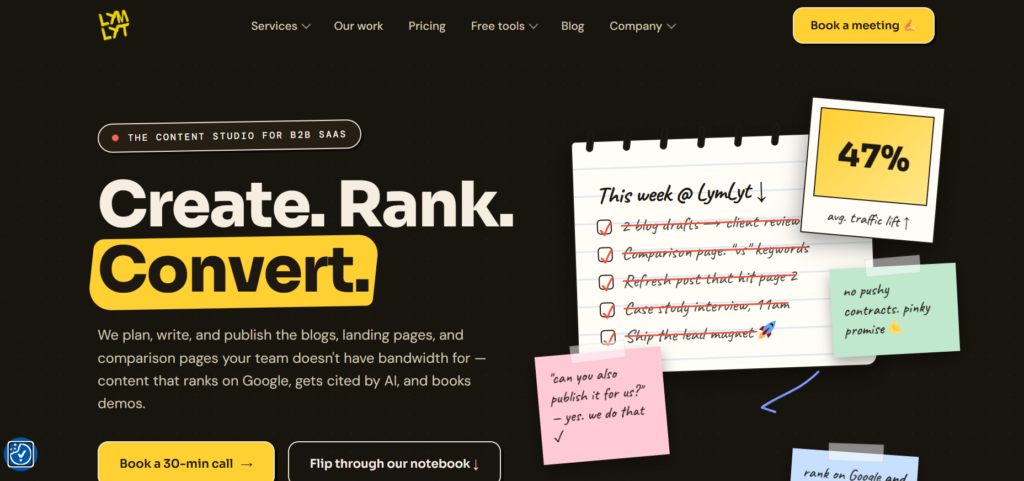
- Best for: B2B SaaS teams who want SEO and content strategy handled by a small, senior team instead of handed to a rotating cast of junior writers.
- Price: Starting $4,499 for one pillar topic and all content around it.
- What you give it: Your product, your ICP, and access to whoever on your team can answer the hard questions a generic writer would skip.
- Time to first result: Fast onboarding since the team is small and senior by design.
LymLyt runs blog writing and SEO/AI content specifically for B2B SaaS companies, built around the idea that most content underperforms not because AI cannot write sentences, but because nobody is doing the strategic thinking behind the sentences.
The content blindness framing is the clearest articulation of this: teams that skip strategy and go straight to production end up with a lot of words and no results, regardless of who or what wrote them. That is the exact trap that a $15,000-a-month volume shop can fall into just as easily as a founder typing prompts into ChatGPT.
Skip it if: you need a full-service agency handling paid media, design, and video alongside content, since LymLyt’s focus stays specifically on content strategy and writing.
RevenueZen
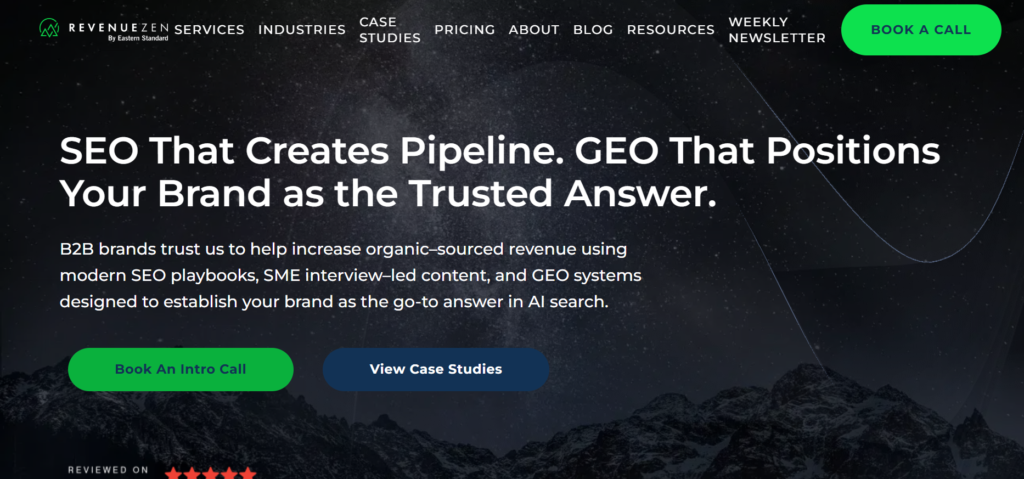
- Best for: Teams that want SEO content paired with an active LinkedIn distribution motion.
- Price: Retainers begin around $4,000/month for integrated content and LinkedIn programs.
- What you give it: Access to founders or execs willing to be the voice behind LinkedIn thought leadership.
- Time to first result: LinkedIn distribution can show engagement faster than organic search, often within weeks.
Most content agencies stop at the blog. RevenueZen’s differentiator is running the website content and LinkedIn organic program at the same time, on the theory that B2B buyers research across both before they ever hit your site.
Their methodology is anchored in intent-based keyword research, competitor content gap analysis, and expert-led interview content that reflects genuine practitioner knowledge, then pushed out through LinkedIn as well as search.
Skip it if: nobody on your team is willing to post personally on LinkedIn, since the model depends on a human face for the distribution half of the work.
Grow and Convert
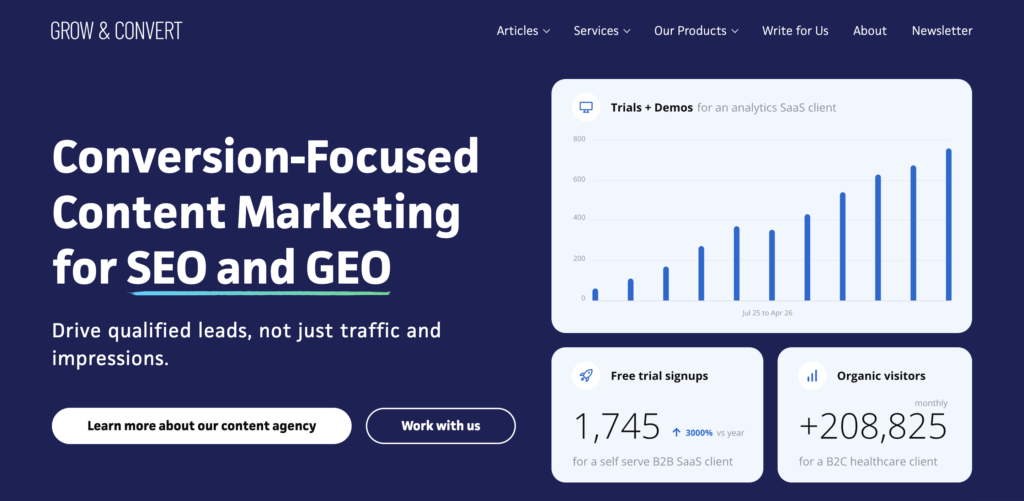
- Best for: Teams whose blog gets traffic that never converts.
- Price: Custom, not published.
- What you give it: Existing analytics access and a clear view of your funnel so the agency can see where traffic drops off.
- Time to first result: Conversion-focused rewrites of existing pages can show movement faster than new content from scratch.
Grow and Convert built its name on a specific complaint: agencies chase search volume and hand you traffic that bounces. Their approach starts from the buyer’s actual questions at the bottom of the funnel rather than the keyword with the biggest number next to it, which is why other agencies on this list point to them by name as the fix for “traffic that doesn’t convert.”
Skip it if: you need broad top-of-funnel awareness content, since their strength sits specifically at the conversion end of the funnel.
Storytelling and narrative-driven content
For brands that need a point of view, not just a topic cluster.
Campfire Labs
- Best for: High-growth B2B SaaS companies that want editorial-quality, interview-based storytelling.
- Price: Retainers start around $4,900/month.
- What you give it: Access to subject-matter experts, customers, and founders for interviews.
- Time to first result: Editorial process takes longer than templated content, expect weeks per piece rather than days.
Campfire Labs is staffed by former journalists, and it shows in the output: content designed to build trust and credibility by showing expertise through stories rather than keyword-stuffed posts.
They have worked with names like Lattice, Gremlin, and Calendly, and other agencies in this space cite them directly as the answer when a brand needs authority and a point of view rather than volume.
Skip it if: you need high-volume programmatic SEO content, since Campfire isn’t built for programmatic SEO, technical SEO, or high-volume publishing, and the team runs a four-day work week that can affect Friday turnaround expectations.
Beam Content
- Best for: Companies that need expert-driven lead magnets, not just blog posts.
- Price: Starts around $7,500/month.
- What you give it: Interview time with founders, sales reps, and customer-facing teams.
- Time to first result: Similar to Campfire, this is a slower, interview-heavy process built for depth over speed.
Beam Content specializes in ebooks, case studies, and guides built to work as lead magnets rather than pure SEO plays, built from source interviews rather than desk research. It is a good fit for teams that already have SEO covered and need the deeper, gated content that sits further down the funnel.
Skip it if: your priority is ranking pages and organic traffic volume, since gated lead magnets are not built to drive search rankings the way blog content is.
Full-stack and technical content
For brands with multi-channel needs or genuinely technical buyers.
Grizzle
- Best for: Teams that want content, digital PR, and YouTube handled as one connected program.
- Price: Packages generally start around $10,000/month.
- What you give it: Enough access to product and subject-matter experts to support both written and video content.
- Time to first result: Multi-channel programs take longer to ramp than single-channel retainers.
Grizzle stands out for treating video as a core service rather than an add-on. Grizzle blends editorial content, video production, and digital PR with SEO and GEO, making it the only agency with YouTube strategy as a core service among comparable shops. That matters more now that buyers research inside YouTube and LLMs as much as inside Google.
Skip it if: you want a specialist in one narrow channel, since Grizzle’s breadth cuts against depth in any single format.
Growth Plays
- Best for: Technical, developer-audience SaaS companies where generic content obviously reads as outsourced.
- Price: Custom, not published publicly.
- What you give it: Deep product access, ideally including engineering time, since the content needs to hold up to a technical reader.
- Time to first result: Expect a longer ramp given the specialized nature of the work.
Growth Plays is a small consultancy focused on B2B software companies with technical audiences, especially dev tools, where generic SaaS writing falls flat. Their differentiator is baking measurement and attribution into every engagement from day one, so you can see which specific pieces influence pipeline instead of guessing from session counts.
Skip it if: you sell to non-technical buyers like HR or finance teams, since the specialization that makes them strong for developers works against them outside that lane.
Codeless
- Best for: Teams that need a large volume of long-form content published fast.
- Price: Plans generally start around $8,000/month, with higher tiers for larger volumes.
- What you give it: A topic map or keyword list; Codeless is built for execution more than upstream strategy.
- Time to first result: Faster ramp to volume than boutique shops, since production is the whole point.
Codeless is the volume play on this list. Where Campfire or Beam might spend two weeks on a single interview-driven piece, Codeless is built to turn out large numbers of well-optimized, quality-controlled articles on a repeatable cadence. That makes them the right call when the problem is coverage of a large topic map rather than a single standout piece.
Skip it if: you want strategic input on which topics matter most, since the model assumes you or another partner already own that layer.
Distribution and full-service content
Foundation
- Best for: Teams with decent existing content that never gets in front of the right audience.
- Price: Retainers generally start around $8,000/month.
- What you give it: Your existing content library and distribution channels for audit.
- Time to first result: Distribution wins can show up faster than new SEO content, since the content already exists.
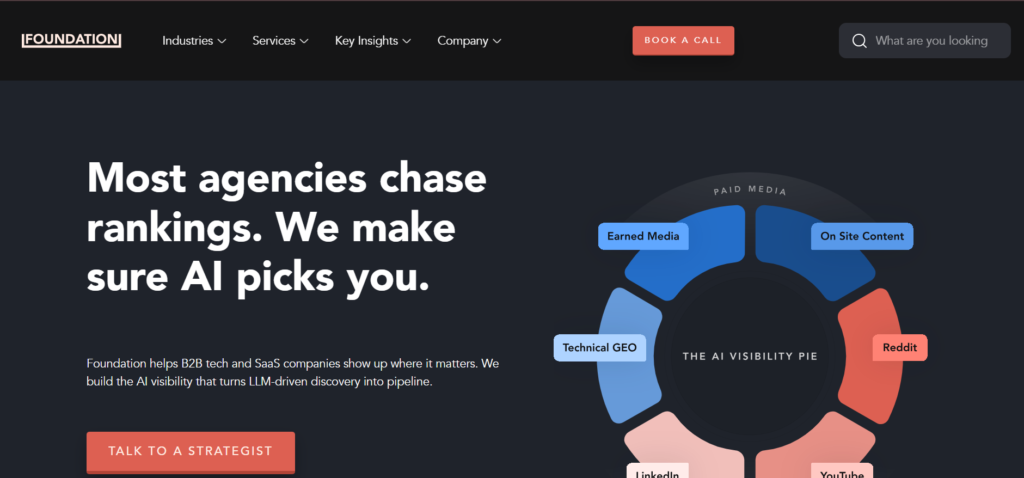
Founded around a simple observation: creating content is only half the job, and distribution, promotion, and amplification are where most B2B content programs actually stall. Foundation pairs content production with a genuine distribution strategy, which is the right call for teams sitting on a backlog of decent content nobody sees.
Skip it if: your problem is a lack of content in the first place rather than distribution of what you already have, since their differentiation lives specifically in the amplification layer.
Flying Cat Marketing
- Best for: Growth-stage SaaS companies that want SEO and content handled together without an enterprise price tag.
- Price: Monthly packages generally run $5,000 to $10,000.
- What you give it: Keyword and competitive context, plus standard content access.
- Time to first result: Standard SEO timelines, months rather than weeks.
Flying Cat runs SEO and content creation as one motion for growth-stage companies that need both but cannot yet justify separate specialist vendors for each. It is a solid mid-market pick for teams graduating out of a freelancer setup but not ready for a $15,000-a-month retainer.
Skip it if: you already have SEO strategy in-house and only need content execution, since the value here is in the combined package.
Do you actually have an Animalz problem?
Animalz did not get sloppy. The agency still writes some of the best long-form thought leadership in B2B, still counts Google, Zendesk, and Amplitude as clients, and still trains an entire generation of content marketers on what a real editorial process looks like.
So the honest question first: do you have an Animalz problem, or do you have a budget problem, a speed problem, or a “my buyers aren’t on Google anymore” problem wearing an Animalz costume?
Most teams that go looking for an alternative do not have a complaint about the writing. They have one of three things going on. Their budget sits well under the $8,000 to $20,000 a month that premium thought-leadership retainers actually cost. Their buyers are technical and generic SaaS prose falls flat with them. Or their pipeline now runs through ChatGPT and Perplexity as much as through Google, and they need an agency built around that shift rather than one that bolted an AEO service page onto an SEO playbook last year.
This list skips the household names you already know how to Google and focuses on the smaller, sharper shops that actually compete for Animalz’s displaced budget.
What “Animalz alternative” actually means
The phrase covers three genuinely different needs, and conflating them is how buyers end up disappointed six months into a contract.
Budget-constrained storytelling. You want Animalz’s editorial bar, the interviews, the point of view, the writing that reads like a person made it, but you cannot justify a five-figure monthly retainer for it. Boutique storytelling shops built for growth-stage budgets solve this.
Technical or developer audiences. Your buyers are engineers, and content written for a generic “VP of Marketing” persona reads as obviously outsourced to them. You need writers who can sit through a technical demo and come out the other side able to write about it correctly.
Pipeline and distribution over prose. You need content tied to signups, SQLs, or LinkedIn reach, not just clean sentences. A beautifully written article that nobody outside your blog subscribers ever sees is not what you are buying content for.
Nearly every agency above leans hard into one of these three lanes. Pick the lane first. The specific agency choice gets much easier once you have.
What B2B SaaS marketers should actually look for
- Who writes the piece, and do they rotate. Ask directly whether the person on the sales call is the person who writes your content, and what happens when that person leaves. High turnover on the writing team is the single most common complaint buried in agency reviews.
- What happens after publish. A finished article that sits on your blog with no distribution plan is only half a deliverable. Ask how the agency handles repurposing, LinkedIn, or outreach.
- Whether AEO is a real capability or a service page. Nearly every agency added “AI search optimization” to their site in the last year. Ask for a named example of content that gets cited in ChatGPT or Perplexity today, not a description of the methodology.
- Contract length and minimums. Some shops lock you into six or twelve months. Know this before you sign, not after the first invoice.
- Reporting that ties to revenue, not just traffic. Sessions and rankings are easy to report. Signups, SQLs, and pipeline influence are harder and more useful. Ask what the monthly report actually contains.
- Fit with your buying committee. Enterprise SaaS with a nine-person buying committee needs different content than a self-serve product with a single decision-maker. An agency built for one rarely serves the other well.
- Whether strategy is separable from production. Some agencies will only sell you the full stack. If you already have a content strategist in-house and just need execution, that mismatch shows up in the invoice.
- Free trial or pilot options. A short paid pilot before a long-term retainer tells you more about fit than any case study will.
The audience playbook
You have a real Animalz budget but want more editorial voice for less spend. Campfire Labs or Beam Content get you close to that same interview-driven, opinionated writing at a fraction of the retainer.
Your buyers are engineers and your current content reads as obviously outsourced. Growth Plays is built specifically for this. Generic SaaS writing is the single most common complaint technical buyers have about outsourced content, and it is the first thing a demo call with any agency should address directly.
You need volume across a large topic map fast. Codeless is built for exactly this, at a lower price point than most full-strategy shops.
You want content and LinkedIn distribution running as one motion. RevenueZen pairs the two in a way most agencies do not, provided someone on your team is willing to be the face of the LinkedIn side.
Your traffic doesn’t convert. Grow and Convert exists specifically to fix this. Don’t hire a volume shop to fix a conversion problem; the two are different diagnoses with different treatments.
You have decent content already and nobody sees it. Foundation’s whole model is built around this exact gap.
You want a lean, senior, strategy-first partner without a rotating cast of junior writers. This is where LymLyt fits, especially for teams that have been burned before by an agency that produced a lot of content and very little result.
Three rules that apply no matter which agency you pick: confirm who actually writes your content and what happens if that person leaves, get one real example of content that shows up inside ChatGPT or Perplexity today rather than a slide about methodology, and start with a single real workflow or content pillar before you hand over your entire content calendar.
How to brief any of these agencies
Whichever agency you choose, arrive at the first call with three things ready: your ICP in one paragraph, three to five customer objections your sales team hears most often, and two or three pieces of your best existing content so the agency can calibrate voice against something real instead of guessing. A brief like this saves weeks of onboarding no matter who is on the other end.
How to choose
- Tight budget, want editorial voice: Campfire Labs or Beam Content.
- Technical, developer buyers: Growth Plays.
- Need volume fast: Codeless.
- Conversion problem, not a traffic problem: Grow and Convert.
- Content plus LinkedIn: RevenueZen.
- Content plus digital PR and video: Grizzle.
- Existing content nobody sees: Foundation.
- Lean, senior, strategy-first partner: LymLyt.
The bottom line
Every agency on this list can produce content. The harder question, the one Animalz built its reputation answering well, is whether that content says anything worth reading and whether it reaches the people who needed to read it. Neither of those is a production problem you solve by paying more per word.
That is the same gap we built LymLyt around. Content blindness is not an AI problem, it is a strategy problem that shows up regardless of who or what is doing the typing. If your team needs blog writing built around that strategy first, see what we do or book a call and we’ll tell you honestly whether we’re the right fit.

Rashmita is content marketer with 8 years of experience building and growing SaaS brands. Now she tests various AI tools for marketers and shares her feedback on this blog, LinkedIn, Instagram, and YouTube.