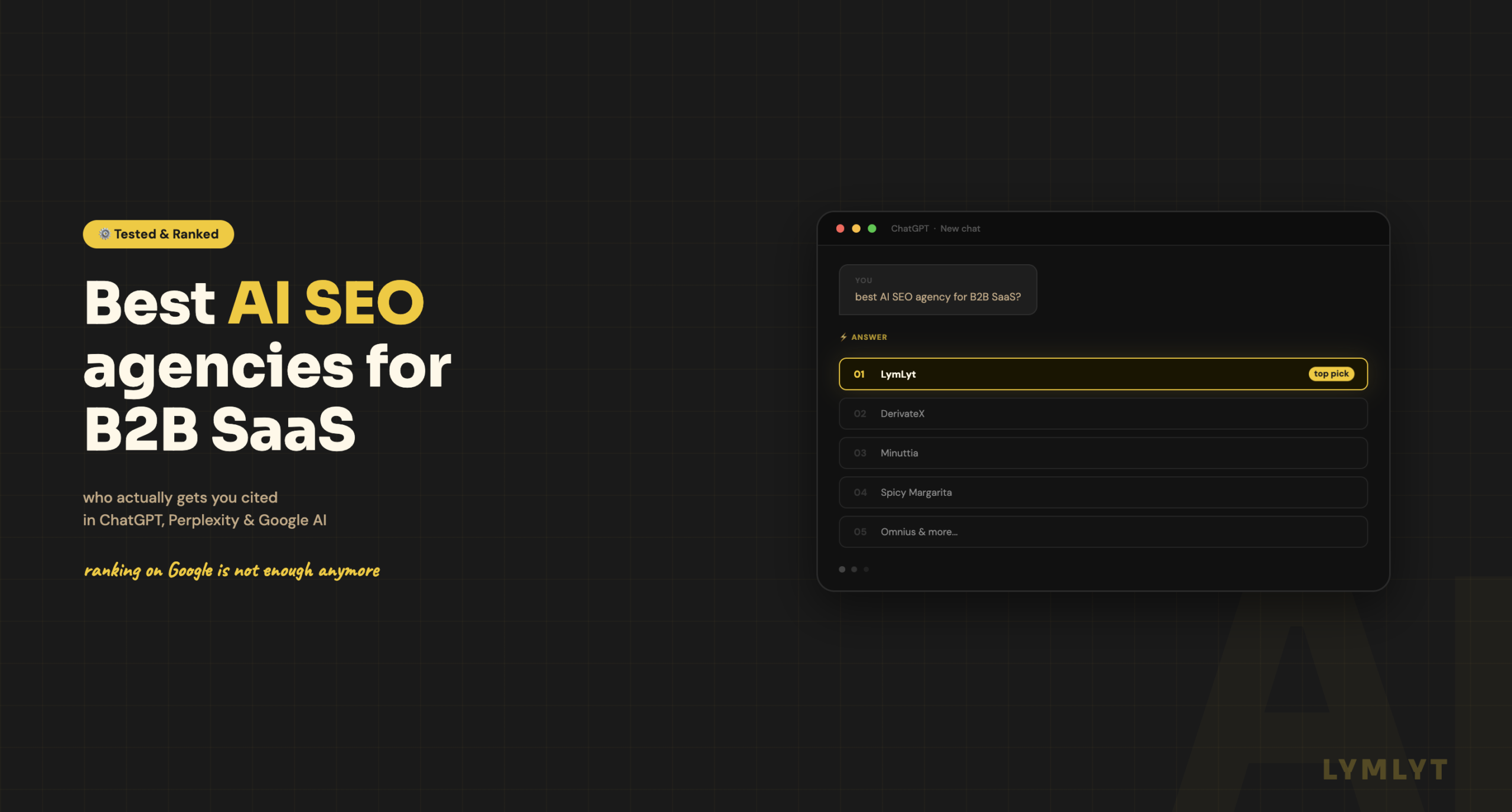
Best AI SEO agencies in 2026: who actually gets you cited in ChatGPT, Perplexity, and Google AI
Most B2B SaaS companies rank on page one of Google. Their buyers open ChatGPT and get a different shortlist entirely.
That is the problem this category of agency exists to solve. Not SEO in the old sense, not keyword rankings or backlinks for their own sake. The specific, measurable goal of getting your brand cited when a buyer asks an AI tool what to use, who to trust, or which vendor to shortlist.
The terms are all over the place right now. Generative engine optimization (GEO). Answer engine optimization (AEO). LLMO. AI SEO. They all describe the same thing: optimizing your brand to appear inside AI-generated answers, not just in the list of links underneath them. A 2025 analysis across 50 high-intent B2B SaaS queries found that only 12% of pages ranking in the top three on Google were cited by ChatGPT or Claude when buyers asked the equivalent question. That gap is wide and it is growing.
G2’s March 2026 survey of 1,076 B2B software buyers found that 51% now begin vendor research in an AI chatbot, up from 29% eleven months earlier. Nearly 70% ended up choosing a different vendor than they originally planned, because of what the AI said. One in three bought from a company they had never heard of before the conversation.
If your brand is not showing up in those conversations, you are not in the running.
This list covers 12 agencies doing this work for B2B marketing teams. Each has been selected for specificity: a real GEO methodology, documented results, and an honest picture of who they are and are not built for. You will not find the same eight names from every other listicle here.
What AI search visibility actually means in 2026
Traditional SEO is about ranking. AI search is about being selected.
When a buyer types a question into ChatGPT, Perplexity, or Google AI Overviews, the model does not present a list of links for them to browse. It generates a synthesized answer, pulling from sources it has decided to trust. If your brand is in that answer, it shows up as a recommendation. If it is not, it does not exist as far as that conversation is concerned.
Getting cited requires a different kind of work than getting ranked. Rankings respond to backlinks, keyword density, and page authority. AI citations respond to entity clarity (does the model know exactly what you do), content structure (can the model extract your claims reliably), third-party corroboration (are you mentioned accurately across sources the model trusts), and what researchers are calling “answer-shape”: content written to answer a question directly rather than to rank for it.
Here is the complication most agencies skip over: only 11% of domains are cited by both ChatGPT and Perplexity, according to a 2026 analysis of 680 million AI citations. A GEO program optimizing for one engine is covering a fraction of the landscape. Multi-engine visibility, across ChatGPT, Perplexity, Gemini, Google AI Overviews, and Claude, is table stakes now, not a premium feature.
The other thing worth saying plainly: no agency can guarantee citation. The models change. Personalization is built into the product. ChatGPT’s share of generative AI search dropped from 87% in early 2025 to 64.5% by early 2026 as Gemini grew. Any agency promising guaranteed placements in a specific AI tool is selling you something they cannot deliver.
What a real GEO agency can do is build the conditions that make citation consistent and measurable. That is a meaningfully different thing.
What B2B SaaS marketers should actually look for
Before you talk to any agency on this list, answer these questions for yourself.
What is your current AI visibility baseline? Before any strategy is worth discussing, you need to know where you stand. Ask which tools your category buyers use for research, then prompt those tools with the questions your buyers ask. If your brand is absent or described inaccurately, that is your gap.
Does the agency separate GEO from SEO, or run them together? The strongest programs in 2026 treat them as one system. AI citation and search rankings compound on each other: high-authority content earns both. Agencies selling GEO as a separate retainer from SEO are often creating two competing priorities with the same budget.
What multi-engine coverage does the agency track? Ask specifically: ChatGPT, Perplexity, Gemini, Google AI Overviews, and Claude. If the answer is one engine with an optional upgrade, the program is narrower than they are letting on.
How does the agency measure success? Citation rate is a visibility metric. Pipeline contribution is a business metric. The best agencies track both. “Share of voice in AI” matters only if you can show it moves demos, signups, or closed deals.
What does the agency’s content philosophy look like? AI engines weight content that demonstrates genuine expertise and makes verifiable, specific claims. High-volume, thin content can hurt citation rates. Ask to see the content the agency produces for clients before signing.
Can they show you a live client citation for a buyer-intent query? This is the bluntest vetting question and the most useful. A real GEO agency keeps screenshots and prompts on file. A relabeled SEO agency will hedge.
Are results documented with named clients? Clutch reviews and client logos are not case studies. Ask for a named client, a before/after citation rate, a business outcome, and the methodology that produced it.
What is the minimum engagement and contract structure? GEO results typically take 60 to 120 days for initial citations to emerge, and 6 to 9 months for pipeline attribution. Agencies requiring 12-month commitments before showing results deserve scrutiny. Month-to-month pilots exist and are worth asking for.
The 12 agencies at a glance
| Agency | Category | Best for | Starting price | Free audit |
|---|---|---|---|---|
| LymLyt | Content-led AI SEO | B2B SaaS, adtech, martech, fintech | From $3,999/month | Yes |
| DerivateX | Citation engineering | $5M–$50M ARR SaaS | From $3,500/month | Yes |
| Minuttia | SEO + GEO strategy | Established B2B SaaS ($10M+ ARR) | From $4,000/month | No |
| Spicy Margarita | Boutique GEO + brand control | B2B SaaS, tech, fintech | Custom | No |
| Omnius | Technical GEO + LLMO | SaaS + fintech, EU-focused | Custom | No |
| Quoleady | Content-first LLMO | B2B SaaS, seed to Series B | From $1,990/month | No |
| Chilli Fruit | Digital PR + link building for GEO | B2B SaaS, tech | Custom | No |
| Notebook Agency | Trust Alignment, brand accuracy | B2B SaaS, fintech, healthcare | Custom | No |
| Grizzle | Digital PR + GEO for enterprise SaaS | Mid-market B2B SaaS | Custom | No |
| Position Digital | GEO + AI citations for startups | SaaS startups, scaleups | Custom | No |
| First Page Sage | Thought leadership GEO | Enterprise B2B SaaS | From $6,000/month | No |
| Grow and Convert | Pain Point GEO | Content-led B2B brands | From $10,000/month | No |
Category 1: Content-led AI SEO agencies
These agencies treat content as the primary lever for AI citation. The approach works because AI engines cite sources that demonstrate clear expertise, answer questions directly, and earn mentions across third-party platforms. Strong editorial quality is not a nice-to-have here: it is the mechanism.
1. LymLyt
- Best for: B2B SaaS companies in adtech, martech, and fintech that need content built to survive both Google and the AI citation layer
- Price: Retainers from $3,999/month (Launch Pad), $6,499/month (Growth Accelerator), $9,499/month (Scale and Authority); project packages available
- What you give them: Your ICP, existing content, competitors, and business goals
- Time to first results: Content typically goes live within 30 days; citation signals emerge at 60 to 90 days
- What AI services include: AI-SEO content strategy, GEO-optimized blog and web copy, AI search visibility reporting, content structured for direct extraction by LLMs
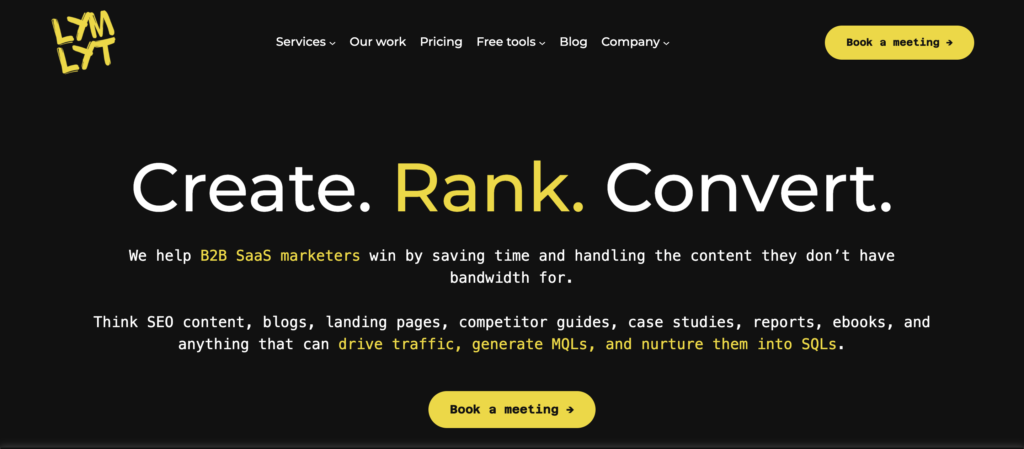
LymLyt is a B2B SaaS content marketing agency that has spent the past several years building content with one rule baked in: if a reader skips the first four words, the content has already failed. That same logic applies to AI citation. Models extract directly stated claims from well-structured, specific, authoritative content. Thin writing, generic arguments, and keyword-stuffed articles get skipped by both humans and AI engines.
The agency works across adtech, martech, and fintech, covers ideation, execution, distribution, and reporting, and specializes in formats that AI surfaces most often: blog content, landing pages, case studies, and social content that builds brand signal across platforms where models go looking. The fractional model means clients get senior-level strategists rather than a rotating junior account team.
Reviews from the target audience consistently note that LymLyt content gets picked up because it says something specific, not because it hits a keyword count. That specificity is what AI engines pull from.
Skip it if: You are looking for a technical SEO audit or a programmatic content play at scale. LymLyt is strategy-first and content-led, which means the engagement requires real collaboration on what to say, not just how to say it.
2. Quoleady
- Best for: Seed to Series B B2B SaaS companies that need consistent, volume-oriented GEO content without the enterprise price tag
- Price: Packages from $1,990/month to $5,700/month depending on word count tier
- What you give them: Your product, ICP, competitors, and target search queries
- Time to first results: Documented case with Legal Nodes showed top-five AI rankings and 47.5% increase in booked meetings within three months
- What AI services include: LLMO (LLM Optimization) package, llms.txt file setup, GA4 LLM referral tracking, schema markup, robots.txt optimization, content structured for AI answer extraction
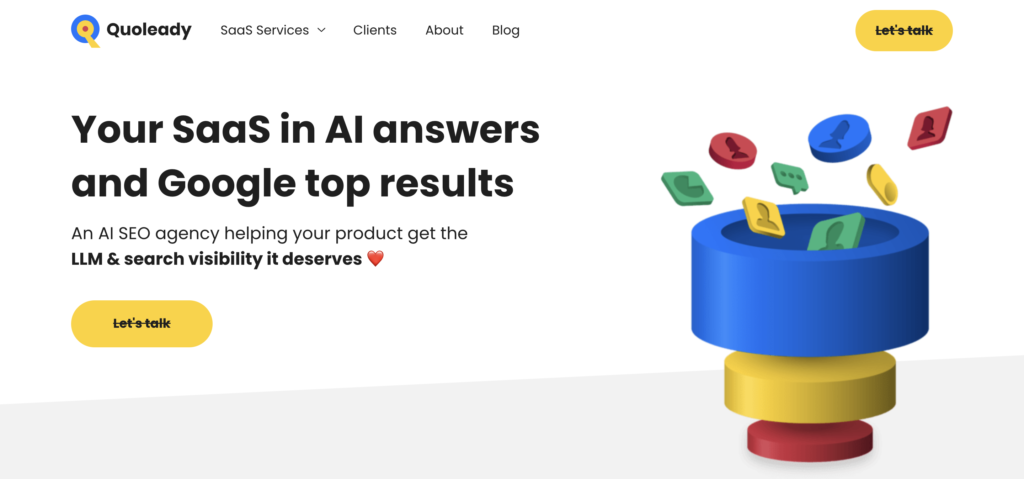
Quoleady was founded by Olga Mykhoparkina and works exclusively with B2B SaaS companies. They were among the earlier agencies to package LLMO as a defined service, and the case studies they publish are specific enough to evaluate: Expandi grew from zero to two million monthly impressions and 60,000 organic clicks during a 2.5-year engagement, contributing to growth from $0 to $8M ARR. For Legal Nodes, the agency produced a 47.5% increase in booked meetings alongside top-five AI rankings within 90 days.
The operational model is built around content volume and structure. Packages are priced by monthly word count, typically between 5 and 15 articles depending on depth. Every piece is written by a dedicated SaaS writer and includes editorial links to get the content placed in the comparison articles and listicles where AI engines look for third-party corroboration. The LLMO setup includes technical implementation: llms.txt, crawl configuration, schema, and live GA4 tracking for LLM-sourced traffic.
Reviews note that the agency’s content quality is high relative to price point and that the team communicates clearly. The limitation, flagged across multiple reviews, is that Quoleady is fundamentally a content agency that has added GEO services. Companies with complex entity disambiguation problems or enterprise-scale technical GEO needs may need to pair them with technical support.
Skip it if: You need deep entity work, aggressive off-site citation engineering, or pipeline attribution tied directly to AI traffic. Quoleady is content-first and will serve you best if that is the primary gap.
3. Grow and Convert
- Best for: B2B brands with complex buyer journeys that want interview-based, expertise-driven content as the core of their GEO program
- Price: Retainers from $10,000/month
- What you give them: Access to subject matter experts for interviews, your ICP, funnel stage priorities
- Time to first results: Content production is slower than volume shops; pipeline attribution typically emerges at six months
- What AI services include: Pain Point GEO framework, AI visibility tracking via Traqer.ai (included in engagement), topic-based GEO strategy mapping buyer intent to LLM prompts, WaveWriter.ai for faster content drafts
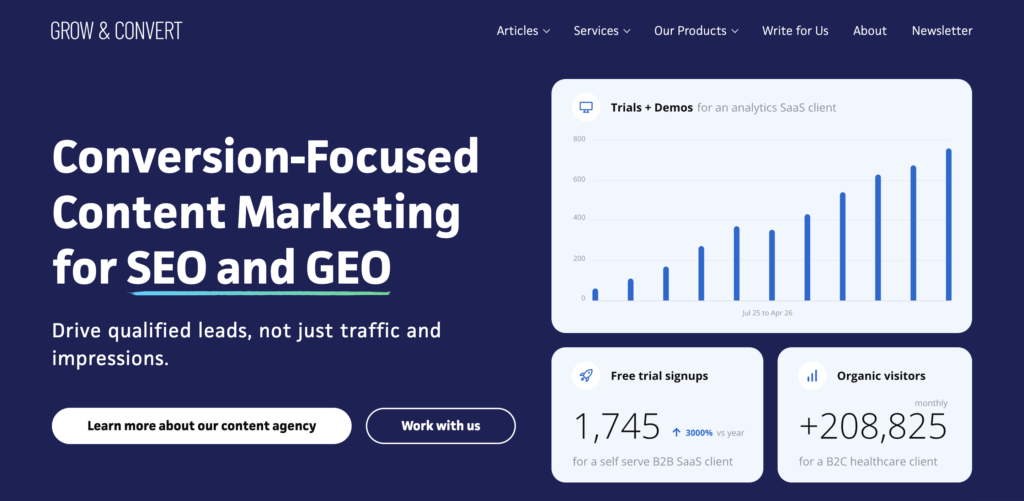
Grow and Convert pioneered Pain Point SEO in 2017 and built its reputation on a simple idea: the content that converts is not the content buyers find when they are curious, it is the content they find when they are frustrated and comparing solutions. The agency has extended that into Pain Point GEO, mapping every angle a buyer might prompt an LLM within a given category and building content to cover those angles systematically.
The differentiator is that all content is interview-based, written from conversations with client subject matter experts rather than keyword research alone. That produces first-person expertise, which is the kind of source LLMs weight most heavily when deciding what to cite. Every engagement includes access to Traqer.ai, the agency’s own AI visibility tracking platform, which measures citation rates at the topic level rather than the keyword level.
The capacity constraint is real: each strategist handles two to four accounts, producing roughly three articles per month per client. If you need to move fast across a broad content surface, that pace will feel slow. If you want the highest editorial quality in the category, measured against pipeline, it is the right trade.
Skip it if: You need volume. Three articles per month is not enough if your gap is broad topic coverage. Also not the right fit if your content foundation is zero: Grow and Convert performs best when there is existing authority to build on.
Check out: Grow and Convert Alternatives.
Category 2: Citation engineering and technical GEO agencies
These agencies approach GEO as an engineering problem. Citation is not treated as a side effect of good content: it is designed, tracked, and reproducible. The methodology is usually more technical and the measurement is more granular.
4. DerivateX
- Best for: B2B SaaS companies between $5M and $50M ARR that want AI citations tied directly to pipeline, not just share of voice
- Price: From $3,500/month, month-to-month
- What you give them: Your product, ICP, competitors, and CRM access for pipeline attribution
- Time to first results: Initial citation signals within 3 to 4 weeks; pipeline attribution typically at 60 to 90 days
- What AI services include: Citation Engineering methodology, AI Visibility Score (AVS) tracking across ChatGPT, Perplexity, Claude, and Gemini, entity optimization, digital PR, content architecture, bi-weekly client reporting tied to CRM pipeline
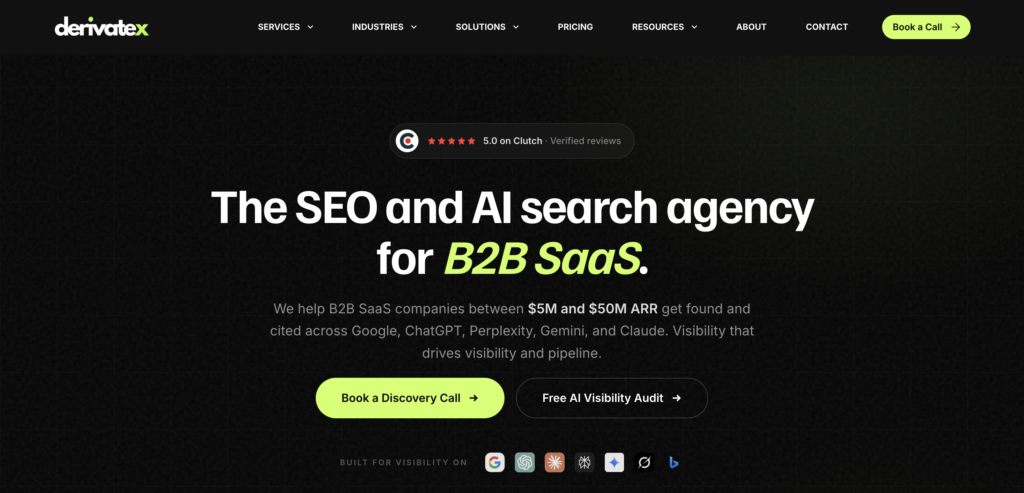
DerivateX is a Bangalore-based B2B SaaS GEO agency run by co-founders Apoorv Sharma and Shivanshi Bhatia. The agency published the 2026 AI Visibility Benchmark Report, the first study to score 50 B2B SaaS companies on AI search presence across all four major platforms using 1,400 buyer-intent prompts. The findings were sobering: 44% of companies scored below 50 out of 100, meaning nearly half were effectively invisible to AI-assisted buyers. The highest scorer was Clio at 89. The lowest was LeadSquared at 2.
The methodology is called Citation Engineering: deliberately structuring content, entity data, and brand signals so LLMs reliably cite a brand when buyers ask questions in its category. The results they publish are specific. Gumlet attributes 20% of monthly inbound revenue to ChatGPT and Perplexity. REsimpli became the top recommendation in ChatGPT for “best real estate CRM” within 90 days. Verito went from position 40 on Google to 12 first-place ChatGPT rankings for managed IT queries.
The co-founder model means the same people who sell the engagement run it. There are no handoffs to a junior account team. Pricing is public, contracts are month-to-month after a 90-day pilot, and the exit clause is 30 days. For a category where methodologies are updating quarterly, that contract structure matters.
Skip it if: You are below $5M ARR or outside B2B SaaS and tech. DerivateX is explicit about this: the engagement model and pricing are designed for companies with established product-market fit and a marketing budget that can sustain a six-to-nine-month citation program.
5. Omnius
- Best for: B2B SaaS and fintech companies, particularly in European markets, that want a technically deep GEO program built on proprietary tooling
- Price: Custom; boutique model limits intake to roughly 8 clients per year
- What you give them: Your site architecture, content, and competitors; the agency audits AI crawlability before anything else
- Time to first results: Case study from Text Cortex shows growth from 67 to 2,100+ signups per month in 10 months; 0 to 2.73 million organic clicks in 13 months for another SaaS client
- What AI services include: 22-point GEO strategy, AtomicAGI proprietary platform for AI visibility tracking, AI crawler optimization, LLMs.txt creation, citation engineering, synthetic query generation, schema markup, technical SEO for LLM accessibility
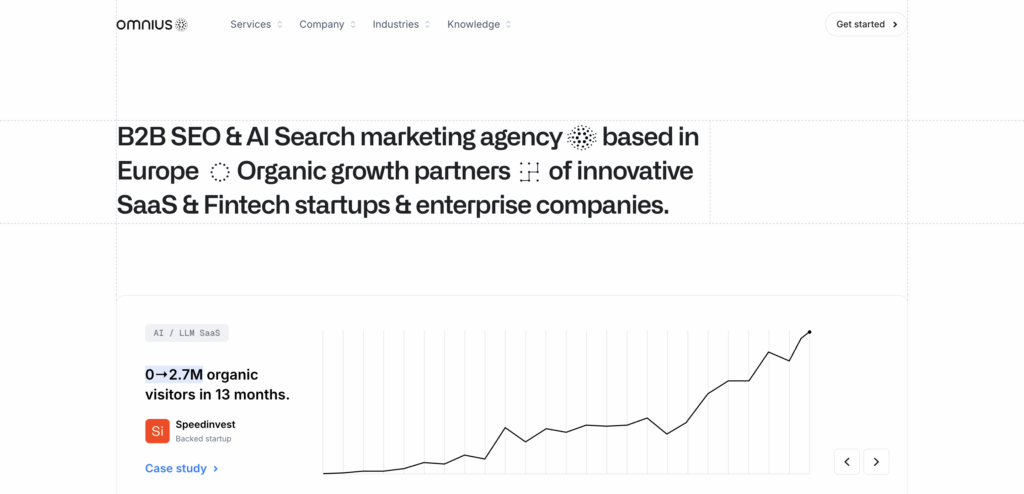
Omnius is a European agency working exclusively with B2B SaaS and fintech companies. The differentiator is AtomicAGI, their proprietary AI SEO analytics platform, which tracks brand citations across ChatGPT, Perplexity, Claude, and Gemini in real time. Most GEO agencies are working with third-party monitoring tools or manual sampling. Omnius built their own.
The 22-point GEO strategy is unusually specific about what it covers: AI crawler optimization (ensuring LLM bots can read your site without contributing to training data in ways you did not authorize), LLMs.txt file creation, citation engineering with triggers that prompt models to treat a domain as authoritative, voice search readiness, and synthetic query generation for testing. The agency runs all work in-house through a team that completes a 12-week internal training program before touching client accounts.
Reviews from clients like Text Cortex, Anna Money, and Zencoder are strong on technical quality and strategic depth. The limitation is capacity: eight clients per year is not a typo. If you need to start in the next 30 days, check availability before investing time in the sales process.
Skip it if: You are in consumer SaaS, e-commerce, or local business. Omnius works only with B2B SaaS and fintech. Also not the right fit if you need a large agency account team: the boutique model is intentional, and that means fewer hands on the account.
6. Notebook Agency
- Best for: B2B SaaS, fintech, and healthcare companies where AI tools are actively misrepresenting the brand, or where accuracy in AI citations is a compliance concern
- Price: Custom; not disclosed publicly
- What you give them: Verified product facts, pricing, integrations, compliance credentials, and ICP fit in a structured brief
- Time to first results: Signaturely case study shows 400,000+ monthly visits in under 12 months
- What AI services include: Trust Alignment Framework, Truth Notebook (centralized verified brand fact document), PromptMirror tool (asks LLMs buyer-style questions and scores accuracy), Trust Score tracking for accuracy, coverage, and sentiment
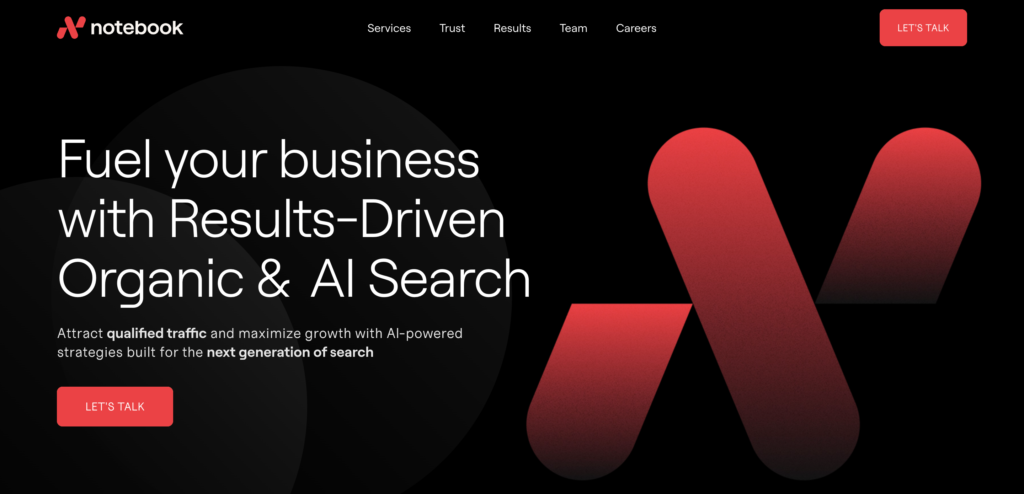
Notebook Agency is a Toronto-based GEO and SEO agency founded in 2019 by Steve Toth. The work addresses a problem most GEO programs ignore: LLMs frequently misrepresent, understate, or omit key product facts when recommending solutions to buyers. An AI tool citing your brand inaccurately can lose you a deal as surely as not being cited at all.
The Trust Alignment Framework is built around a Truth Notebook, a centralized, client-validated document capturing verifiable facts about the brand’s capabilities, integrations, pricing structure, compliance credentials, and ICP fit. The PromptMirror tool then asks leading LLMs buyer-style questions to evaluate how accurately each model represents the brand, scoring responses against the Truth Notebook on accuracy, coverage, and sentiment.
Clients include FreshBooks, VWO, Kneat, Shiphero, and Royal Bank of Canada. The agency’s case for Signaturely, a contract management SaaS, produced 400,000+ monthly visits in under 12 months. In a category where most GEO metrics are share of voice, Notebook’s accuracy-first framing is worth taking seriously.
Skip it if: You are looking for a content production partner or a high-volume SEO program. Notebook is strategy-led and bespoke, which means the engagement is slower to start and requires the client to invest real time in the Truth Notebook brief. Not built for early-stage companies without clear positioning.
Category 3: Digital PR-led GEO agencies
AI engines do not only read your website. They read what other sources say about you: comparison articles, review platforms, Reddit threads, press coverage, and industry publications. These agencies build GEO visibility by engineering the third-party signal layer that models use to decide whether to trust and cite a brand.
7. Chilli Fruit
- Best for: B2B SaaS and tech brands that need topical authority built through digital PR and relationship-led link building
- Price: Custom; minimum project size around $5,000 for sponsored articles; overall engagement pricing not public
- What you give them: Your brand, target publication list, link building targets
- Time to first results: Trust signal building is slower; client Brand24 saw expanded topical authority and traffic growth through their engagement
- What AI services include: AI Overview and GEO-targeted content optimization, digital PR, relationship-based link building to LLM-cited domains, onsite content optimization, real-time reporting
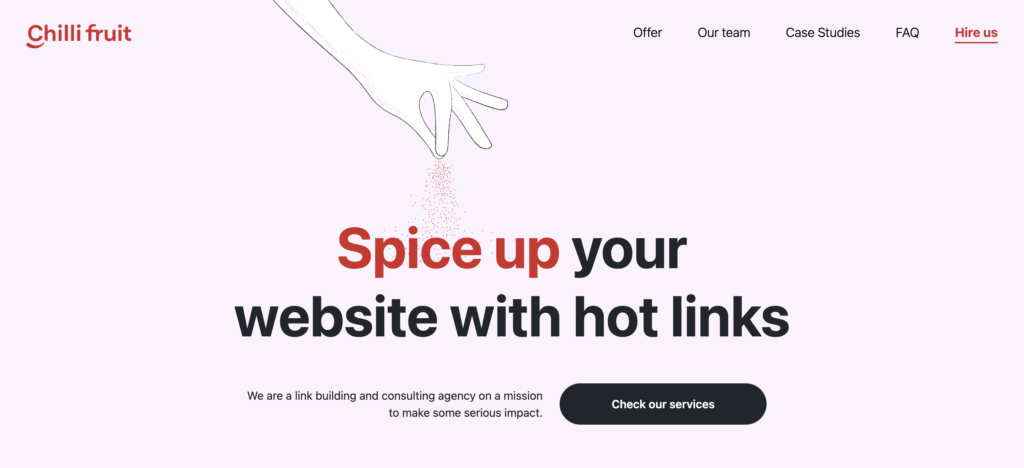
Chilli Fruit is a London-based digital PR and link building agency working with SaaS and tech brands. The positioning is specific: rather than chasing individual high-authority links, Chilli Fruit focuses on building a brand’s overall footprint across the domains AI engines go looking in when compiling answers. That means relationships with publications, not just outreach volume.
The agency runs a boutique model, adapting its playbook to each client rather than running a standard campaign template. Reviews from SaaS and tech clients consistently highlight attention to detail, bespoke strategy, and a pay-on-results model for links. The agency has built a track record with brands like Brand24 for expanding topical authority in ways that feed AI citation signals.
Reviews describe Chilli Fruit as standing out for a hands-on approach and quality over quantity across the link building and PR work. The agency is not trying to be a full-service GEO shop: they do digital PR and link building extremely well, which is one critical piece of the overall citation picture.
Skip it if: You need a full GEO program with content production, entity optimization, and citation tracking under one roof. Chilli Fruit is strongest as one piece of the system, not the whole thing. Also, the boutique size means availability should be confirmed early.
8. Grizzle
- Best for: Mid-market B2B SaaS companies that want an integrated GEO program combining original research, content, and digital PR
- Price: Custom; clients in their content include Pipedrive, Semrush, Tide, and Tipalti, which suggests mid-market and enterprise price expectations
- What you give them: Target audience, editorial priorities, outreach targets Time to first results: They cite a video marketing agency guide that hit number one in SERPs with ChatGPT and AI Overview mentions within four days of publication
- What AI services include: GEO strategy, original research content, digital PR for AI-cited placements, Reddit strategy, link building from LLM-cited domains, weekly tracking of engagement and visibility
Grizzle is a B2B organic growth agency that treats GEO, SEO, and content as one system rather than three separate workstreams. The agency runs ongoing R&D experiments on GEO and feeds results directly into client strategy, which matters in a category where the rules are updating every quarter.
The signature output is original research: data-driven studies that journalists want to cover, that AI systems treat as primary sources, and that generate compounding authority over time. The Pipedrive “State of Sales” report is an example Grizzle cites: produced end-to-end, distributed through their partner network, and pitched to journalists directly. A single original research project can generate AI visibility, brand mentions, and sales enablement proof points simultaneously.
The Reddit strategy is worth noting separately. Grizzle runs a proprietary playbook for building brand presence on Reddit, which has become one of the most-cited sources across ChatGPT and Perplexity for B2B SaaS prompts. Getting your brand into the conversations that AI engines learn from is a meaningful lever, and few agencies have a documented playbook for it.
Skip it if: You are an early-stage company or do not have the brand presence to make original research credible yet. Grizzle’s model compounds best when there is an existing authority foundation to build on.
Category 4: Growth-stage and startup-focused GEO agencies
These agencies are built for companies that cannot afford to wait 12 months and cannot afford to pay $10,000 a month for it. The methodology is real, the pricing is accessible, and the results are documented.
9. Position Digital
- Best for: B2B SaaS startups and scaleups growing from zero organic presence to meaningful AI search visibility
- Price: Custom; not publicly listed
- What you give them: Your product, ICP, and current site; the agency audits AI citations before starting
- Time to first results: Published case studies include 221% increase in AI citations for a data collaboration SaaS, 200% higher webinar signups for an HR SaaS after securing LLM citations, 809% increase in AI referral traffic and 169% conversion lift for a B2B agency
- What AI services include: GEO strategy, AI citation tracking, AI Overview optimization, content for LLM retrieval, link building, digital PR, B2B SaaS SEO
Position Digital is an SEO and GEO agency focused specifically on B2B SaaS startups and scaleups. The founder is Sean Begg, and the results they publish are more specific than most agencies at this tier: 221% increase in AI citations for a data collaboration SaaS platform, 809% increase in AI referral traffic alongside 169% conversion lift for a B2B agency client, and 200% higher webinar signups for an HR SaaS tool after securing LLM citations.
The agency has published guidance on a question that matters more than most roundups acknowledge: how to tell a real GEO agency from a relabeled SEO agency. Their filter is simple. If the case studies only show Google rankings and organic traffic with no AI citation metrics, the GEO service is a marketing label. Position Digital’s own case studies name the specific AI platforms clients appear in and what changed in the business as a result.
Reviews note flexibility as a standout quality: the agency adapts to fast-moving startup priorities without losing strategic thread.
Skip it if: You are an enterprise brand with complex site architecture and a 100-person marketing team. Position Digital’s model is designed for lean, fast-growing SaaS companies, and the engagement structure reflects that.
10. Minuttia
- Best for: Established B2B SaaS companies with $10M+ ARR that want GEO built on top of a strong, compounding content program
- Price: From $4,000/month
- What you give them: Your ICP, competitors, and product positioning; the agency runs a structured onboarding before writing anything
- Time to first results: Toggl engagement produced 7M impressions, 27,000 clicks, and 200+ conversions on best-performing pieces; 93% client retention rate and 17-month average tenure
- What AI services include: GEO strategy alongside traditional SEO, proprietary AI visibility tracking tools, digital PR, human-authored content optimized for LLM extraction, agent analytics and reporting
Minuttia is one of the most consistently cited agencies in this category across independent reviews. The “Search Everywhere” positioning connects Google rankings, AI citations, comparison content, and third-party mentions into one program rather than treating them as separate budgets. For established B2B SaaS brands, that integration is genuinely valuable.
The content quality is a real differentiator. Reviews repeatedly name the depth of research, the accuracy of positioning, and the consistent throughput as reasons clients stay for 17 months on average. One reviewer put it plainly: “I can trust Minuttia to do what’s right and best for my company, something you rarely get with other providers.”
The limitation is fit criteria. Minuttia is explicit that it works best with companies at $10M+ ARR with established product-market fit. Earlier-stage companies often find the model more than they need at the pricing level.
Skip it if: You are pre-$10M ARR or want a pure technical GEO program without a full content operation. Minuttia is a content-led agency that has expanded into GEO, not a GEO-native agency.
11. Spicy Margarita
- Best for: B2B SaaS companies at Series A or B that want a senior-only, boutique team with a track record in both bottom-of-funnel SEO and AI search
- Price: Custom; client roster capped at 10 active accounts at any time; serves $1M+ ARR companies
- What you give them: Your buyer intent map, bottom-of-funnel priorities, and brand positioning
- Time to first results: Piktochart case produced 1M+ organic impressions and 22% traffic increase; Rillion earned 90+ top-three keyword rankings and 40% AI search visibility
- What AI services include: GEO and AEO strategy, branded GEO (monitoring and correcting how AI tools describe clients), Reddit management for LLM citation, AI share-of-voice tracking via Peec AI, link building targeting LLM-cited domains
Spicy Margarita was built by Ben Goodey, a recognized educator in the GEO space. The agency is intentionally small: 10 clients maximum, no junior account team, senior strategists on every account throughout the engagement. Goodey also runs “How the F*ck,” a newsletter and podcast that has made him one of the more visible voices explaining what GEO actually requires versus what agencies are selling.
The “AEO manifesto” framing is useful for evaluating fit: Spicy Margarita’s position is that visibility without sales outcomes is worthless. Every strategy, piece of content, and backlink is expected to move buyers from awareness to closed-won. They actively monitor how AI tools describe clients and correct inaccuracies as part of the standard service, not a premium add-on.
Clients include Rillion, Givebutter, Jabra, and Piktochart. Reviews consistently highlight the quality of strategic thinking and the senior-level continuity across the engagement.
Skip it if: You need more than one of their 10 client slots, which means checking availability first. Also not built for enterprise brands with complex procurement requirements or for companies outside B2B SaaS and tech.
12. First Page Sage
- Best for: Enterprise B2B SaaS companies that want category authority built over 12 to 24 months through thought leadership content
- Price: From $6,000/month; typically requires 12-month engagements What you give them: Your category positioning, target buyer profile, competitive landscape
- Time to first results: Expects 12 to 24 months to build durable category authority; the model is not built for 90-day results
- What AI services include: Thought leadership GEO methodology, expert-driven content written by subject matter experts, AI Overview optimization, reputation management to support citation, quarterly GEO performance studies
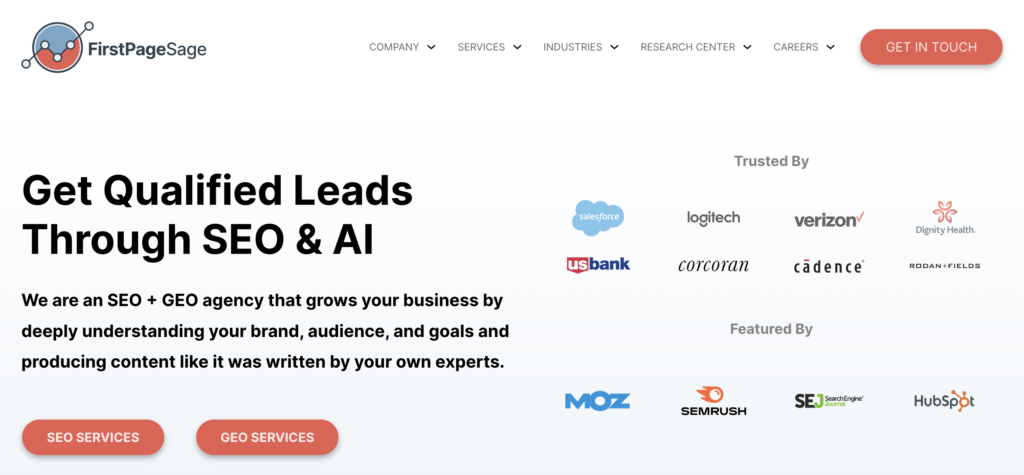
First Page Sage coined the term “Generative Engine Optimization” in 2024 and has run GEO as a defined service since, making them one of the longest-standing practices in the category. The methodology is built on a specific premise: AI systems in high-trust categories like cybersecurity, fintech, legal tech, and healthcare SaaS weight authoritative, credentialled content above high-volume publishing. A single well-structured piece of original research from a credible expert can carry more citation weight than 50 standard blog posts covering the same topic.
Clients include Salesforce, Cadence Design Systems, Logitech, Verizon, and Dignity Health. The model suits companies that can commit to a multi-year authority-building program and have the brand presence to make thought leadership credible. The trade is pace: First Page Sage does not optimize for 90-day results. The engagement is a long-term infrastructure investment.
Skip it if: You are below $15M ARR, have a budget under $6,000/month, or need measurable AI citation movement in under six months. First Page Sage’s model rewards patience and suits companies where brand authority is as important as pipeline velocity.
The free tier reality
A few agencies on this list offer free audits. DerivateX’s free AI Visibility Audit is worth running before you talk to anyone: it gives you a baseline score across ChatGPT, Perplexity, Claude, and Gemini, which is useful context for every conversation you have afterward.
LymLyt’s free Brief Generator is a different tool, designed for content ideation rather than visibility scoring, but it is the only free tool on this list that requires no signup to use.
Most agencies in this space do not offer free trials or free tiers, which is honest: GEO is a long-term program, not a software product. Be skeptical of any agency offering a 30-day “AI visibility guarantee” as a paid product. The models update too frequently for that to mean anything.
The B2B SaaS marketer’s playbook
If you are pre-product-market-fit or under $2M ARR: Do not hire a GEO agency yet. Fix your content foundation first: structured content that answers specific buyer questions, clear entity data on your site, and a few comparison page placements in categories your buyers search. When you have traction, Quoleady or Position Digital are the right entry points.
If you are Series A ($2M to $10M ARR) and need to show pipeline from content: Spicy Margarita or DerivateX. Both are built for this stage, both run month-to-month pilots, and both measure against business outcomes, not just citation counts. DerivateX if you want more technical rigor and public pricing. Spicy Margarita if you want boutique senior-only execution.
If you are Series B or growth-stage ($10M to $50M ARR) and need multi-engine coverage: Minuttia for content-led compounding. Omnius for technical depth and proprietary tracking. Grizzle if original research and digital PR are the primary gaps. Position Digital if the team is lean and you need flexible execution.
If you are enterprise ($50M+ ARR) and category authority matters as much as traffic: First Page Sage for thought leadership GEO on a 12-month horizon. Grow and Convert if interview-based, expertise-driven content is the right vehicle.
If AI tools are misrepresenting your brand: Notebook Agency, specifically. The accuracy problem is different from the visibility problem, and most agencies are not built to fix it.
If you need the off-site citation layer built: Chilli Fruit for digital PR and link building to LLM-cited domains. This is the work that many agencies claim to do but few document with the specificity that Chilli Fruit does.
Three rules that apply regardless of which agency you choose:
Start with one well-documented use case before asking for category-wide visibility. AI citation is a focused problem before it is a broad one.
Ask to see a live citation in a buyer-intent prompt before signing anything. If the agency cannot produce it in 30 seconds, they are still in the sales process.
Connect the program to your CRM from day one. AI referral traffic that does not reach your pipeline attribution is invisible to leadership and impossible to defend at budget time.
How to choose
- Under $2M ARR, building content foundation: Start with Quoleady or do it in-house
- Series A, need pipeline from AI search, limited budget: DerivateX or Position Digital
- Series A, want boutique senior team, max 10 clients: Spicy Margarita
- Series B, content-led compounding: Minuttia
- Series B, technical GEO, EU market: Omnius
- Enterprise, thought leadership over 12+ months: First Page Sage
- AI tools describing your brand inaccurately: Notebook Agency
- Need digital PR and off-site citation signals: Chilli Fruit or Grizzle
- Need original research that earns AI citations and press: Grizzle
- Want content + GEO in one integrated B2B SaaS program: LymLyt
The bottom line
Every agency on this list tracks something slightly different, packages it differently, and serves a different stage. The common thread is that they treat AI citation as a measurable discipline, not a prediction.
The harder truth is that none of this works if the content is generic, the positioning is vague, or the brand says nothing specific enough for a model to extract and trust. AI engines cite sources that demonstrate genuine expertise on specific questions. The tool saves time. The thinking still has to be yours.
That is the problem LymLyt works on: not content blindness from lack of volume, but content blindness from lack of signal. Audiences, and now models, skip content in the first four words. What you say has to be worth reading before any optimization can save it. If you want content that earns its citations rather than chasing them, see what we do or book a call.
We have written more about why content volume stopped predicting content performance in AI didn’t cause content blindness, marketers did. If you are building out your AI SEO stack, our top 100 AI tools list covers the broader tooling landscape.
FAQ
What is the difference between GEO, AEO, and LLMO?
The terms overlap significantly in 2026 and most agencies use them interchangeably. GEO (Generative Engine Optimization) focuses on getting cited inside generative AI answers from tools like ChatGPT and Perplexity. AEO (Answer Engine Optimization) is the broader practice of structuring content for citation across all answer surfaces, including AI Overviews, featured snippets, and voice results. LLMO (Large Language Model Optimization) is the most technically specific term, covering how models select and attribute sources. If an agency uses any of these terms with a documented methodology behind them, they are describing substantially the same capability.
How long does AI SEO take to produce results?
Initial citation signals typically appear within three to six weeks of structured content going live. Measurable pipeline impact from AI referral traffic usually emerges between months two and four for companies with an existing content foundation. Brands starting from zero typically see pipeline contribution between six and nine months. Anyone promising faster results without showing you a documented client case is guessing.
Can I do GEO without an agency?
Yes, especially at the foundation level. Start with structured data markup, an llms.txt file, answer-first content architecture (direct claim in the first sentence of each section), and a GA4 configuration that tracks LLM referral sessions. Where agencies add value is in entity optimization across third-party platforms, digital PR to build the off-site signal layer, and measurement systems that go beyond what GA4 can capture.
How do I know if an AI tool is describing my brand accurately?
Prompt ChatGPT, Perplexity, Gemini, and Claude with the questions your buyers ask: “what is [your brand]”, “best tools for [your category]”, “compare [your brand] and [competitor]”. Screenshot the responses. Note where your brand is missing, mentioned but inaccurate, or described with outdated pricing or features. This is the baseline you should take into any agency conversation.
What should a GEO retainer include?
A real program includes AI visibility tracking across at least three engines, content built for direct extraction by LLMs, entity optimization on and off your site, off-site authority building through digital PR or link building to LLM-cited domains, and reporting tied to business outcomes. If a proposal includes only content production and calls it GEO, it is not a complete program.
How much should I expect to pay?
Retainers in this category run from $1,990/month for content-focused programs at early-stage companies to $15,000+ for enterprise engagements. The $3,500 to $8,000 range is where most B2B SaaS companies at Series A and B will find the strongest options. Anything under $2,000 is unlikely to cover the full scope of work a real GEO program requires.

Rashmita is content marketer with 8 years of experience building and growing SaaS brands. Now she tests various AI tools for marketers and shares her feedback on this blog, LinkedIn, Instagram, and YouTube.