The 12 best Siege Media alternatives for B2B SaaS in 2026
The proposal lands in your inbox. Siege Media, $8,000 a month floor, 12-month contract, 30-day out clause if it goes sideways. You are a Series A SaaS company with a two-person marketing team and a board that wants pipeline by Q3. You read it twice, and the number does not get smaller.
Siege is good. Genuinely good. Founded in 2012 by Ross Hudgens, they have built organic programs for Zillow, Asana, Intuit, Zendesk, Airbnb, and Zapier, and they report generating well over $150 million in annual organic traffic value for clients. Their design-forward content and passive link acquisition are the reason they show up on every list, including this one’s premise. If you have the budget and you want an end-to-end SEO shop with a decade of proof, you should probably just hire Siege.
So most people searching for a Siege alternative do not actually have a Siege problem. They have a stage problem, or a budget problem, or a “we need one specific thing and Siege sells the whole engine” problem.
Siege’s end-to-end content strategy runs $12,000 to $30,000 a month, and their link building alone ranges from $3,000 to $25,000. Reviews also flag a slow sales process and long proposal turnaround, which fast-moving teams feel immediately. None of that makes Siege bad. It makes Siege wrong for a specific set of companies that are still trying to prove content can move revenue at all.
The 12 agencies at a glance
For reference, the tool this list replaces: Siege Media starts around $8,000 per month on a 12-month contract, with full content strategy running $12,000 to $30,000 monthly. Everything below is scoped smaller.
| Agency | Best for | Starting price | Contract | Vertical focus |
|---|---|---|---|---|
| LymLyt | Content and SEO/AI as one pipeline-driving system | From $4,599/mo | Pause or cancel anytime | adtech, martech, fintech, sales-tech |
| Optimist | PLG SaaS chasing organic signups | Custom retainer | Retainer | product-led SaaS |
| Quoleady | Focused content programs without overhead | Custom retainer | Retainer | B2B SaaS |
| Flying Cat Marketing | International SEO and HR tech | Custom retainer | Retainer | HR tech, global SEO |
| Campfire Labs | Editorial, narrative, thought leadership | Custom retainer | Retainer | B2B SaaS, dev tools |
| Block Club | Category authority for fintech and AI-native | Custom | Retainer or project | fintech, martech, AI |
| Beam Content | Overloaded in-house teams needing production | Custom retainer | Retainer | B2B SaaS |
| Draft.dev | Content for developer audiences | Per-piece or retainer | Flexible | developer tools |
| Minuttia | AEO and AI-search visibility | Custom retainer | Retainer | AI search, SaaS |
| Grizzle | Multi-format: SEO, video, YouTube, digital PR | From ~$6,000/mo | Retainer | SaaS, scale-up to enterprise |
| Growth Plays | Full content engine across formats | Custom retainer | Retainer | B2B SaaS |
| Content Visit | Expert content at an affordable price | Custom, lower budget | Flexible | cybersecurity, privacy, tech |
What a Siege Media alternative actually means
The instinct is to look for “Siege but cheaper.” That instinct will get you a worse version of the same thing. The better move is to figure out which slice of what Siege does you actually need, then hire the specialist who does only that slice.
The category has split into a few recognizable shapes. There are agencies that treat content and SEO as one pipeline aimed at pipeline, which is what most B2B SaaS teams think they want when they say “content agency.” There are editorial and narrative shops that build brand authority and original research for complex sales cycles, which matters more the longer your deal takes to close.
There are specialists: developer content for technical products, AI-search and answer-engine optimization for teams watching their citations disappear into ChatGPT and Perplexity, international SEO for companies expanding into new markets, and multi-format shops that turn one article into video, social, and digital PR.
Picking the wrong shape is the expensive mistake, not picking the wrong price. A team that needs bottom-of-funnel content that converts should not hire a programmatic SEO shop, and a developer-tools company should not hire a generalist editorial agency that has never shipped a tutorial. The price difference between agencies is real. The fit difference costs you a quarter.
One more thing worth saying plainly. Agencies almost never publish pricing, and the ones that do usually publish the intro number, not the renewal. Where we have real figures, they are below. Where we do not, “custom” means custom, and you should get the full scope and the renewal terms in writing before you sign anything.
What B2B SaaS marketers should actually look for
Before the list, here is the checklist to run every agency through. These are the criteria that separate an agency that produces content from an agency that produces pipeline.
- Pipeline attribution, not pageviews. Ask how they report. If the answer is traffic and rankings with no mention of signups, MQLs, or influenced pipeline, you are buying a vanity metric. High buying-intent keywords often have low search volume, and an agency that chases volume will fill your blog with traffic that never converts.
- Content and SEO in one pipeline. Writing without SEO is invisible. SEO without good writing ranks and gets ignored. You want one team that does both so nothing falls between two vendors.
- Contract flexibility. Siege’s 12-month lock is the thing you are trying to avoid. Look for month-to-month, pilot projects, or a clean cancellation clause. If an agency wants a year before it has shown you anything, that is their risk tolerance, not yours.
- Stage fit. A seed company and a Series C company need different partners. An agency that serves only enterprise will over-scope you. One built for early stage may not have the depth for a mature program.
- Vertical depth. Adtech, martech, fintech, sales-tech, HR tech, and dev tools each have their own buyer language. An agency that has shipped in your niche writes credible content in week one instead of month three.
- AI-search readiness. More buyers now research inside LLMs. If your content is not structured for direct extraction, you are invisible in the answer layer even when you rank on Google. Ask how they think about AEO and GEO.
- Distribution. A published post that nobody sees is a sunk cost. Ask whether distribution is built into the process or treated as an afterthought.
- Senior people on your account. Some agencies sell you a senior strategist and staff the work with juniors. Ask who actually writes and who you talk to when something breaks.
Content and SEO as one pipeline
This is the category most B2B SaaS teams mean when they go looking for a Siege alternative. You want one team that picks the keyword, writes the piece, structures it to rank, and connects the work to signups. No separate writing vendor, no separate SEO consultant, no gap in the middle where accountability disappears.
1. LymLyt
- Best for: Seed to Series C B2B SaaS teams that want content and SEO run as a single system pointed at pipeline
- Price: From $4,499/month for one topic and all content around it. Compare it with hiring full-time.
- What you give them: your ICP, existing content, competitors, and business goals
- Time to first result: content typically live within 30 days; AI citation signals emerge at 60 to 90 days
- Contract: flexible, pause or cancel once your bills are clear
- Vertical focus: adtech, martech, fintech, sales-tech, open to others
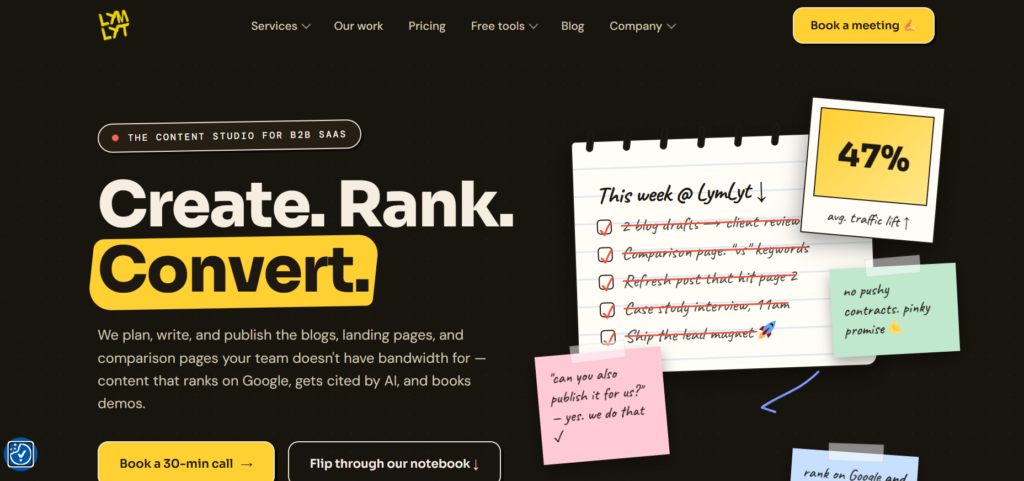
LymLyt is a B2B SaaS content agency built around one rule: if a reader skips the first four words, the content already failed. That sounds like a writing quirk until you realize it is also how AI engines decide what to extract. Content that says something specific in the opening line gets pulled into answers. Content that opens with a keyword-stuffed throat-clear gets skipped by humans and models both.
The thing that separates LymLyt from a per-article writing shop is how they scope work. Instead of selling you ten blog posts a month spread across ten unrelated keywords, they sell topic bundles. You pick a topic you want to own, and each plan builds a content engine around it: a pillar post plus 7 to 13 SEO-mapped supporting blogs on the long-tail keywords around it, a lead-gen asset, social posts, and a newsletter snippet, all aimed at that one topic.
The idea is that you do not want ten posts, you want authority on something. Reviews from their target audience consistently note that the content gets picked up because it says something, not because it hit a word count. The team runs a fractional model, so you get senior strategists rather than a rotating junior account team, and they guarantee an increase in organic traffic while being upfront that nobody can guarantee specific rankings.
Skip it if: you need a technical SEO audit, paid media management, or a programmatic content play at massive scale. LymLyt is strategy-first and content-led, which means the engagement needs real collaboration on what to say.
2. Optimist
- Best for: product-led SaaS companies whose main metric is organic signups
- Price: custom retainer
- What you give them: your product, funnel, and acquisition goals
- Contract: retainer
- Vertical focus: mid-sized product-led SaaS
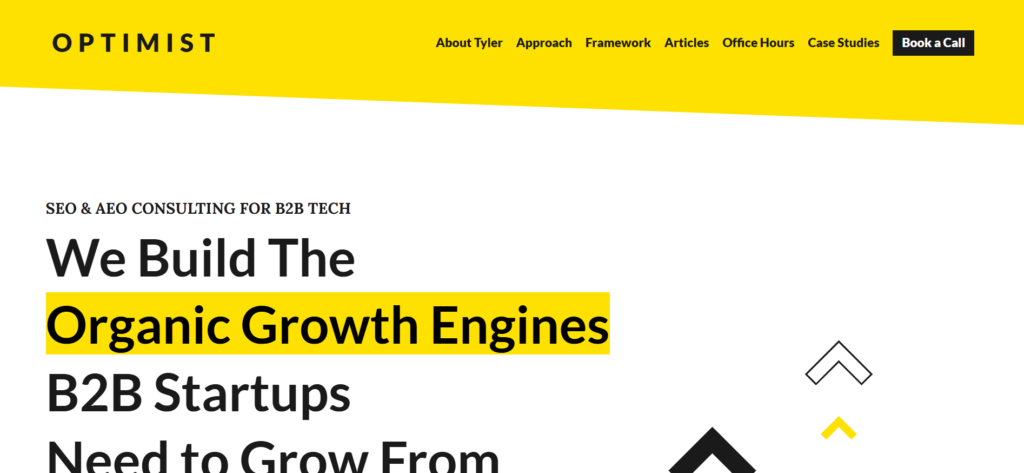
Optimist builds content around product-led growth. Their model blends SEO, content funnels, distribution, and user acquisition with the explicit goal of getting people into the product, not just onto the page. Clients like Contentstack, FairShake, and Glide are the classic PLG shape, where success is measured in signups rather than sessions. If your growth model lives or dies on self-serve conversion, an agency that thinks in funnels instead of pageviews is the right call.
Reviews praise their focus and efficiency, especially for early-stage teams that need consistent publishing tied to a clear acquisition target. The trade-off is that a signups-first shop is less suited to the slow brand-building work that complex enterprise sales cycles need.
Skip it if: your sale is a six-month enterprise cycle where thought leadership and buying-committee trust matter more than fast self-serve signups.
3. Quoleady
- Best for: SaaS teams that want a focused content program without the overhead of a big agency
- Price: custom retainer
- What you give them: target keywords, ICP, and content goals
- Contract: retainer
- Vertical focus: B2B SaaS
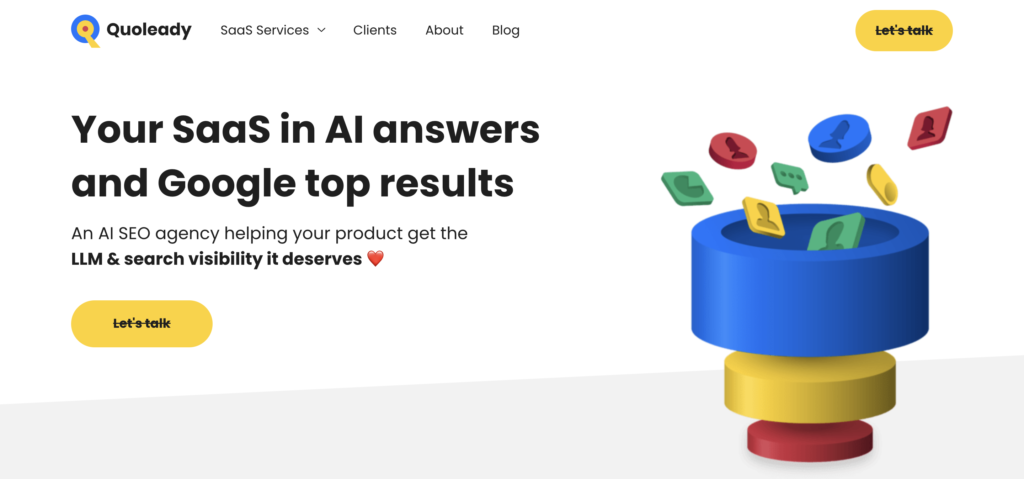
Quoleady is one of the more under-the-radar names that keeps showing up on serious SaaS shortlists. They run focused content programs for growth-stage companies, and their own comparison writing is unusually honest about which agency fits which stage, which is a good sign about how they think. For a team that wants steady, well-researched SEO content without paying for a full-service machine, they are a sensible middle option.
They are less known than the marquee names, which cuts both ways. You get attention and flexibility that a bigger shop cannot offer, and you take on a little more risk that their case-study depth in your exact niche may be thinner. Ask for examples in your vertical before you commit.
Skip it if: you need multi-format production including video and digital PR under one roof.
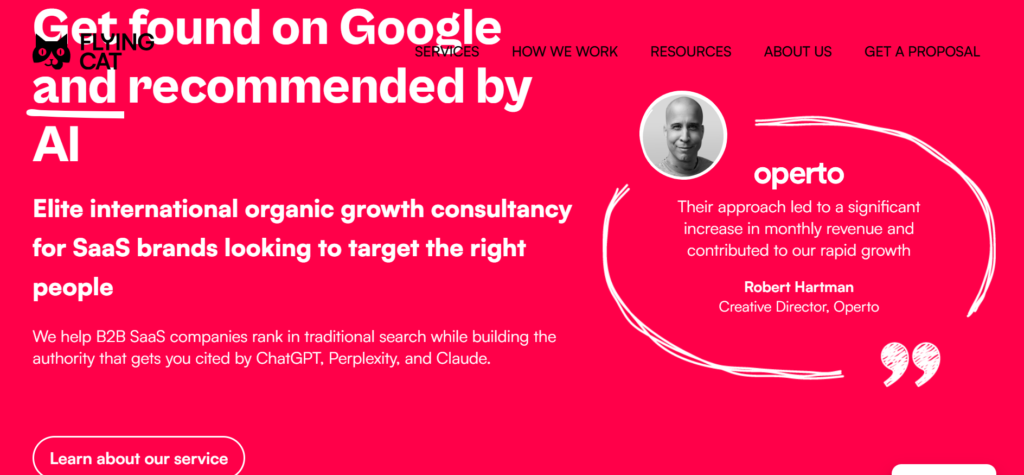
4. Flying Cat Marketing
- Best for: SaaS companies expanding internationally or working in HR tech
- Price: custom retainer
- What you give them: target markets, languages, and SEO goals
- Contract: retainer
- Vertical focus: HR tech, international SEO
Flying Cat Marketing has carved out a specialty in international SEO and full-service content strategy, with notable depth in HR tech. If your growth plan involves ranking in more than one language or market, that is a genuinely hard problem that most generalist agencies fumble, and Flying Cat treats it as a core competency rather than an add-on.
The specialization is the point. A team that has already solved multi-market SEO will save you the expensive lessons of doing it badly the first time. For a single-market, English-only SaaS with no international ambitions, the specialty is less relevant and a domestic-focused shop may be a cleaner fit.
Skip it if: you are a single-market company with no plans to expand, in which case you are paying for expertise you will not use.
Editorial authority and narrative
Some B2B sales do not close on a bottom-of-funnel blog post. They close after months of a buying committee slowly deciding your company knows what it is talking about. That is what this category sells: original research, strong points of view, journalistic depth, and content that shapes how a market thinks about a problem. It takes longer to show results and it is worth more when it lands.
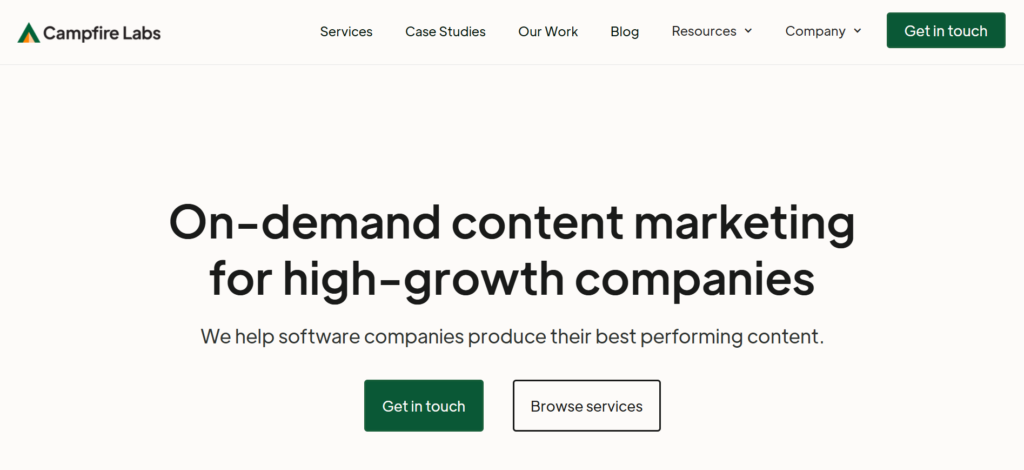
5. Campfire Labs
- Best for: mid-market and enterprise SaaS that need editorial-quality content to influence buying committees
- Price: custom retainer
- What you give them: access to subject-matter experts and customers for interviews
- Contract: retainer
- Vertical focus: B2B SaaS, dev tools
Campfire Labs builds narrative-driven, editorial content backed by original data and expert interviews. Their team came out of journalism and in-house SaaS content roles, and it shows in the work. Clients include Lattice, Gremlin, and Calendly, and they reported a 70% client retention rate in 2025, which for an agency is a strong signal that the work keeps delivering. If your differentiation is a point of view rather than sheer keyword coverage, this is the kind of shop that builds it.
Two honest caveats. Campfire is openly not built for programmatic SEO, technical SEO, or high-volume publishing, so if you need forty posts a month they are the wrong tool. They also run a four-day work week, which clients generally report as a non-issue, though it is worth knowing if your team expects Friday turnarounds. The editorial depth also takes a longer timeline to show search results, which is the nature of authority content.
Skip it if: you need high-volume programmatic content or fast, keyword-driven publishing at scale.
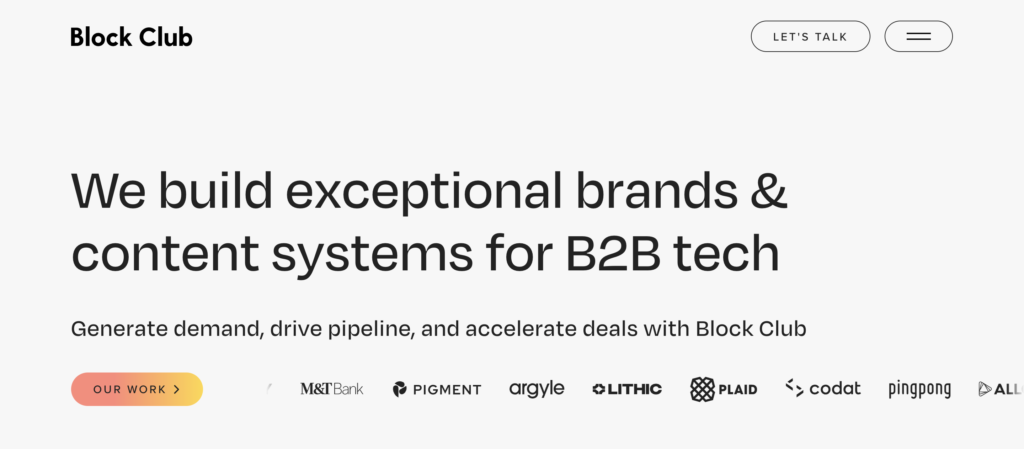
6. Block Club
- Best for: growth-stage fintech, martech, and AI-native platforms that want category authority
- Price: custom
- What you give them: positioning, subject-matter experts, and category goals
- Contract: retainer or project
- Vertical focus: fintech, martech, AI-native SaaS
Block Club is a content and branding agency for growth-stage tech, typically Series A through D, with real depth in fintech, martech, and AI-native products. Their pitch is content that sounds like the company actually wrote it and demonstrates genuine expertise, built through whitespace positioning, editorial strategy, and original research.
For a fintech company where regulatory nuance and credibility are the whole game, a generalist agency will produce content that reads as thin, and that is exactly the gap Block Club fills.
The vertical focus is the selling point and the limit. If you are in their wheelhouse, few agencies will match the specialization. If you are outside it, a broader shop may fit better.
Skip it if: you need pure SEO volume rather than category-defining editorial and positioning work.
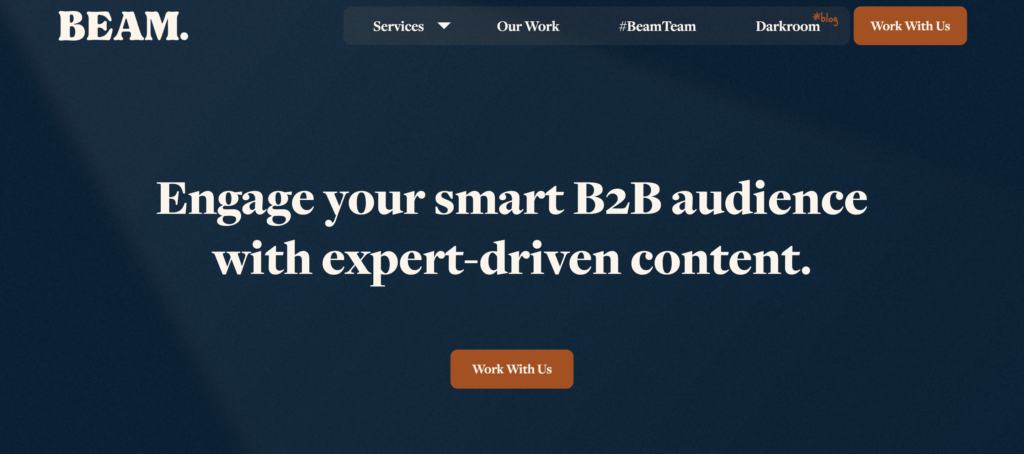
7. Beam Content
- Best for: in-house SaaS marketing teams that are overloaded and need production help
- Price: custom retainer
- What you give them: your content strategy and briefs, or gaps in your existing plan
- Contract: retainer
- Vertical focus: B2B SaaS
Beam Content is built for the specific situation where you already have a content strategy and a marketing team, and you are simply drowning in the volume of work. Rather than replacing your function, they extend it, taking creation off your plate so your in-house people can focus on strategy and distribution. For a team that knows what it wants and just cannot produce fast enough, that is a clean value proposition.
The flip side is that Beam works best when you bring the strategy. If you need an agency to figure out what to write and why, a strategy-led shop earns its fee where a production partner will wait for direction.
Skip it if: you have no content strategy yet and need an agency to build the plan from scratch.
Specialist plays
The last category is where a narrow specialist beats a generalist by a wide margin. Developer content, AI-search visibility, and multi-format programs each require skills a broad content agency usually fakes. If one of these is your actual need, hire the specialist and skip the full-service pitch.
8. Draft.dev
- Best for: developer-tools companies that need content for technical audiences
- Price: per-piece or retainer
- What you give them: your product, docs, and technical topics
- Contract: flexible
- Vertical focus: developer tools, technical SaaS
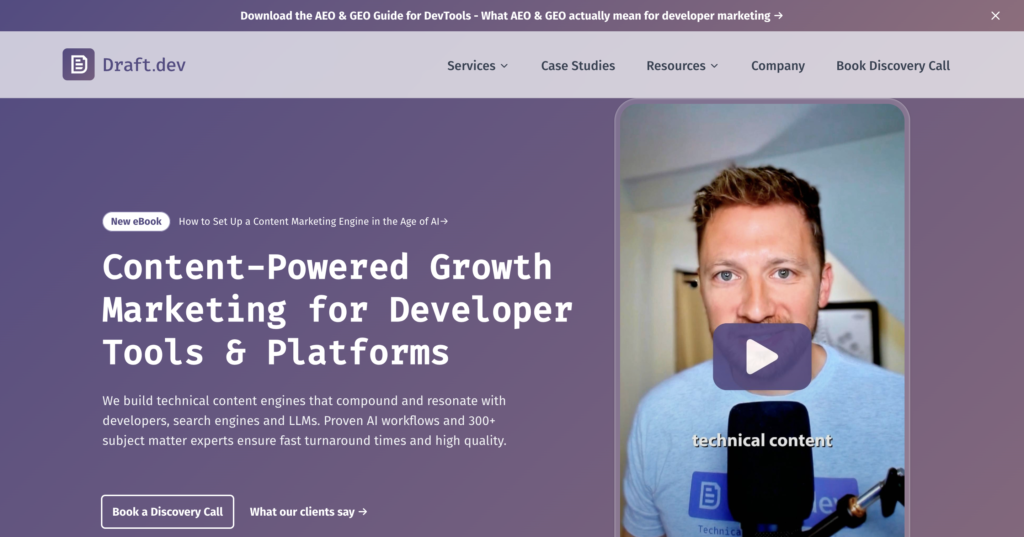
Draft.dev writes for developers, which is a harder job than most content agencies admit. Developer audiences smell marketing fluff instantly and bounce. Draft.dev’s writers are practitioners who can produce tutorials, technical explainers, and code-backed content that engineers actually read and trust. If you sell to developers, this is the difference between content that builds credibility and content that gets you mocked on Hacker News.
The specialization means they are the obvious pick inside their niche and irrelevant outside it. A marketing-ops or sales-tech company selling to business buyers does not need code-level technical writing, and would be overpaying for a skill their audience does not care about.
Skip it if: your buyer is a business user rather than a developer or engineer.
9. Minuttia
- Best for: teams focused on answer-engine optimization and AI-search visibility
- Price: custom retainer
- What you give them: existing content and target queries
- Contract: retainer
- Vertical focus: AI search, AEO, SaaS
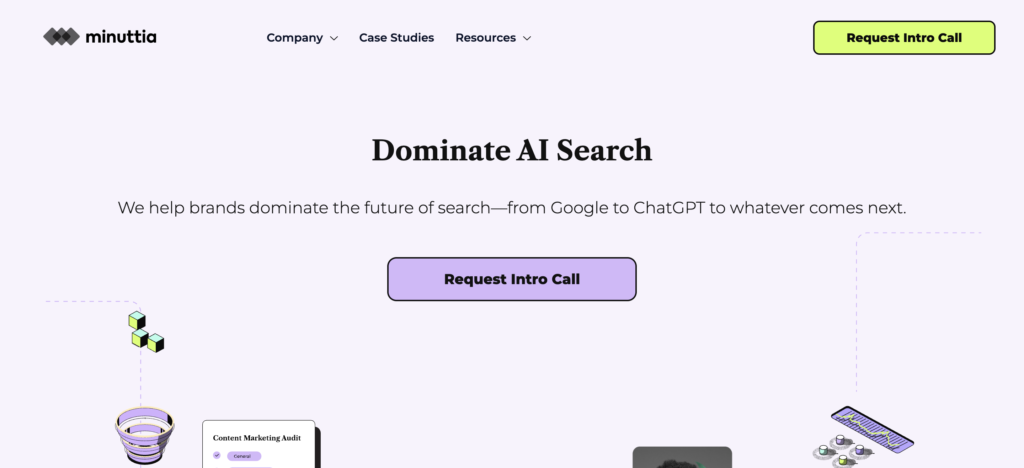
Minuttia works on the problem a lot of teams are only now waking up to: your content can rank on Google and still be invisible inside ChatGPT, Perplexity, and Google’s AI Overviews. Research in early 2026 found that a meaningful share of brands had zero mentions in AI Overviews in some industry snapshots. Minuttia focuses on structuring content so it survives the shift from ten blue links to AI answers, which is quickly becoming table stakes rather than a nice-to-have.
Because AEO is new, the whole category is still proving its methods, and results are harder to benchmark than traditional SEO. That is the reality of an emerging discipline, and it is worth going in with clear expectations about what can be measured today versus in six months.
Skip it if: you need a mature, fully proven playbook with years of benchmarks rather than a discipline still being written.
10. Grizzle
- Best for: SaaS teams that want one article turned into video, YouTube, social, and digital PR
- Price: from roughly $6,000/mo
- What you give them: your topics, product, and channels
- Contract: retainer
- Vertical focus: SaaS, scale-up to enterprise
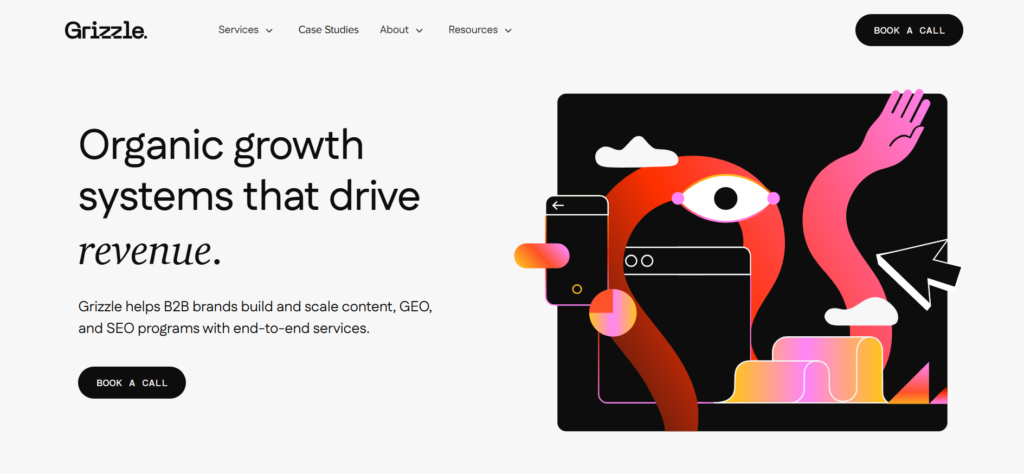
Grizzle blends editorial content, video production, YouTube strategy, digital PR, SEO, and GEO. They are one of the few boutique agencies with YouTube as a core service, which matters more every year as buyers research inside video and LLMs. The logic is simple: one strong article turned into a video, a set of social posts, and an email gets far more mileage than an article left to sit on a blog. Third-party reporting puts full-service engagements at around $6,000 a month to start, and they have worked in SaaS for about a decade.
Covering that many formats is a wide surface for a small team, so the honest question to ask is depth per channel. A multi-format program is powerful when each format is done well and thin when it is spread too far. Ask to see recent work in the specific formats you care about most.
Skip it if: you only need written blog content and have no interest in video or digital PR.
11. Growth Plays
- Best for: SaaS teams that want a full content engine across formats
- Price: custom retainer
- What you give them: your goals and content gaps
- Contract: retainer
- Vertical focus: B2B SaaS
Growth Plays delivers full-stack content programs spanning video, whitepapers, and written work, aimed at teams that want a complete engine instead of a single channel. For a company that needs several content formats working together and does not want to manage multiple vendors, that breadth is useful.
As a newer player, they may not yet match the depth of SaaS case studies that longer-established agencies showcase. That is not a knock on the work, just a reason to ask for the most relevant examples and to weight a pilot before a long commitment.
Skip it if: you want a partner with a decade-long case-study track record in your exact vertical.
12. Content Visit
- Best for: SaaS and technical companies that want expert content at a lower price point
- Price: custom, positioned as affordable
- What you give them: your topics and technical requirements
- Contract: flexible
- Vertical focus: cybersecurity, privacy, technical SaaS
Content Visit positions itself around expert content at an affordable price, with strength in cybersecurity, privacy, and technical topics. For a budget-conscious team in a technical niche that still needs writers who understand the subject, that combination is genuinely hard to find, since expertise and low price usually do not travel together.
The affordable positioning means you should be clear-eyed about scope. Verify who writes, how much strategy is included, and whether SEO and distribution are part of the deal or extra. Affordable content that comes without strategy can turn into cheap articles that do nothing, which is the trap the whole category is trying to escape.
Skip it if: you need heavy strategic direction and full-funnel program management rather than expert writing at volume.
The trial and pilot reality
Agencies do not offer free tiers, so the honest version of “which free plan is real” is “which agency lets you test before you commit.” This is where the 12-month Siege contract stings most, and where the smaller shops have a real edge.
The most flexible options are the ones that let you start small. LymLyt lets you pause or cancel once your bills are clear, which removes the year-long bet entirely. Draft.dev’s per-piece model means you can buy one article and judge the work before scaling. Content Visit and Growth Plays are worth asking about pilot projects given their positioning. On the other end, the editorial shops like Campfire Labs and Block Club usually want a retainer relationship because the work compounds over months, so a single-piece test tells you less about the value they deliver.
The rule of thumb: if an agency will not show you the quality of its work before a long contract, and it is not doing compounding editorial work that genuinely needs runway, treat the reluctance as information. A confident production shop will let you buy a test.
The marketer’s playbook
Here is how to actually choose, organized by what you are trying to do rather than by which agency ranked highest.
You need signups and your product is self-serve. Optimist thinks in funnels and measures signups, which is the right lens for product-led growth. LymLyt works too if you also want SEO and content run as one pipeline with pipeline attribution built in.
You need content and SEO under one roof, scoped for your stage. LymLyt is the most focused option for Series A to C teams that want content and SEO treated as a single system, with flexible contracts instead of a year-long lock. Quoleady is a solid alternative if you want a focused program with less overhead.
Your sale is long and trust-driven. Campfire Labs for narrative and original research, Block Club if you are in fintech, martech, or AI-native and need category authority. These pay off over quarters, so budget the patience along with the retainer.
You sell to developers. Draft.dev, full stop. This is the one category where a generalist will actively hurt you.
You are watching your AI citations disappear. Minuttia specializes in AEO and AI-search visibility. LymLyt also structures content for AI extraction as a default, so if you want AI-search readiness bundled into a broader content program rather than as a standalone service, that works too.
You expand internationally. Flying Cat Marketing for multi-market SEO, which is a hard problem worth paying a specialist to solve.
You want more than blog posts. Grizzle for the article-plus-video-plus-YouTube-plus-PR model, Growth Plays for a full multi-format engine. Ask hard about depth per channel before signing.
Your team is drowning in production. Beam Content extends an in-house team that already has a strategy. Content Visit if budget is tight and your topics are technical.
Three rules that apply no matter who you pick. Choose by the specific job you need done, since a specialist that matches your situation almost always beats a bigger brand name doing everything. Start with one real workflow or one topic you want to own instead of buying the full agency tour. And confirm the agency can connect its work to pipeline before you sign, because in 2026, content that cannot show its contribution to revenue is content you cannot defend to your board.
How to brief a content agency
Most agency relationships go sideways because the brief was vague, not because the agency was bad. Whichever shop you pick, send something like this before the first call so you are buying against a clear target instead of a hopeful one.
Company: [one line on what you sell and to whom]
ICP: [the exact job title and company profile you are chasing]
Stage and goal: [ARR range, and the single metric this content is supposed to move: signups, MQLs, influenced pipeline]
What content we already have: [link to your blog, note what has worked and what has not]
Topic we want to own: [one topic cluster, not ten scattered keywords]
Competitors ranking for it: [two or three URLs]
What we can give you: [access to experts, customers for interviews, product time]
Contract preference: [pilot, month-to-month, or retainer, and why]
How we will judge success in 90 days: [the specific number]
The agencies that respond to that brief with sharper questions rather than a generic proposal are the ones worth talking to. If the reply skips your success metric entirely and pitches you a content volume, you have your answer.
How to choose, in one screen
- Content and SEO as one pipeline, flexible contract, Series A to C: LymLyt
- Product-led growth, signups-first: Optimist
- Focused program, low overhead: Quoleady
- International or HR tech SEO: Flying Cat Marketing
- Editorial authority and original research: Campfire Labs
- Fintech, martech, or AI-native category authority: Block Club
- Overloaded in-house team needing production: Beam Content
- Developer audience: Draft.dev
- AI-search and answer-engine visibility: Minuttia
- Multi-format, video and digital PR: Grizzle
- Full content engine across formats: Growth Plays
- Expert technical content on a budget: Content Visit
The bottom line
Every agency on this list can save you the doing. None of them can save you the thinking. The keyword pick, the point of view, the reason a buyer should care, that is still work someone has to get right, and the agencies that pretend otherwise are the ones producing the exact content nobody reads. We wrote about why AI did not cause content blindness, marketers did, and it applies here. Cheaper production without sharper thinking just gets you more forgettable content faster.
So the real question is not which Siege alternative is cheapest. It is which agency will treat your content as a system pointed at pipeline instead of a pile of articles pointed at a keyword. For B2B SaaS teams at the stage where Siege’s $8,000 floor and 12-month lock do not fit yet, that is a solvable problem, and it does not require a year-long bet to start.
If content and SEO run as one pipeline is the shape you need, that is exactly what LymLyt is built for. See our blog writing for B2B SaaS and SEO content writing services, or book a call. No pitch deck, no pressure.
More from us: the best SaaS content marketing agencies, the best B2B SEO agencies, and the best AI SEO agencies.

Rashmita is content marketer with 8 years of experience building and growing SaaS brands. Now she tests various AI tools for marketers and shares her feedback on this blog, LinkedIn, Instagram, and YouTube.