
Why Every Business Needs a Blog in 2026 (And How to Do It Right)
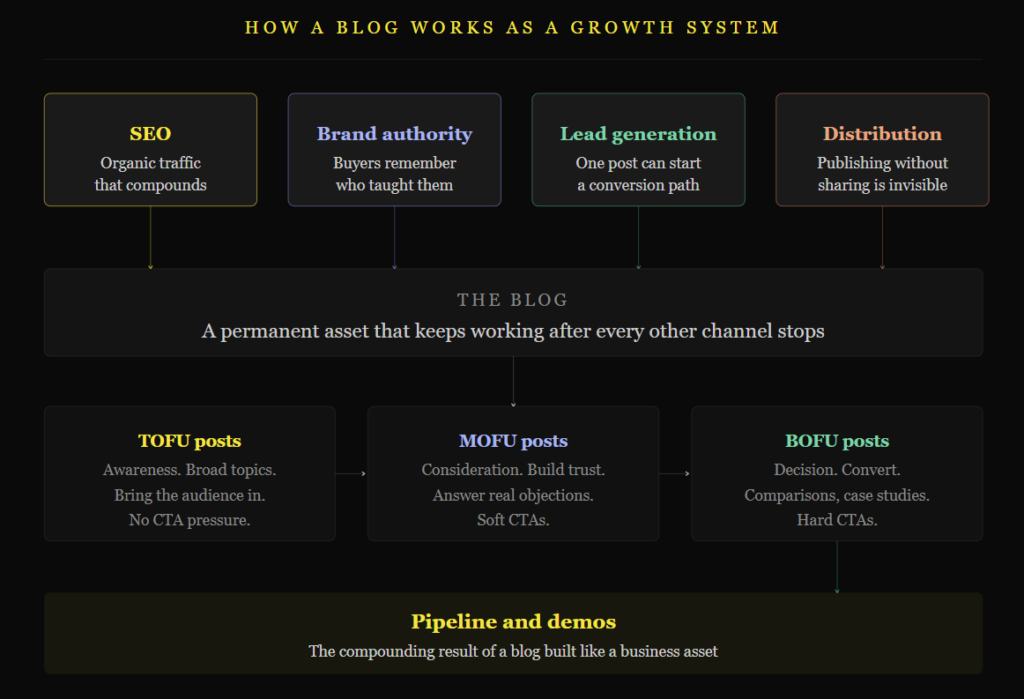
A blog is not a marketing nice-to-have. For most B2B SaaS companies, it is the only owned channel that compounds over time. One that keeps working after the ad budget runs out, the LinkedIn post falls off the feed, and the newsletter gets buried in someone’s inbox.
But most business blogs are not doing any of that. They publish posts nobody reads, rank for keywords nobody searches, and convert nobody into anything. The blog exists. The results don’t.
The problem is not blogging. It is how it is being done.
Here is why a blog is still one of the highest-leverage growth tools available in 2026, and what separates the ones that work from the ones that waste everyone’s time.
1. SEO: The Only Marketing Channel That Gets Cheaper Over Time
Every blog post you publish is a permanent asset. A paid ad stops working the moment you stop paying. A blog post ranked on page one keeps bringing in traffic for months, sometimes years, without additional spend.
This is what makes blogging the backbone of any serious SaaS content engine. Not because it is easy. But because the returns compound in a way no other channel does.
A well-structured blog does four things for SEO:
It gives Google something to crawl. Search engines index fresh, relevant content. Every new post is an opportunity to appear for a new query your buyer is already searching.
It builds topical authority. Google does not just rank pages. It ranks sites that demonstrably know a topic. A blog with 20 interconnected posts on B2B SaaS content marketing signals authority in a way a single homepage never can. This is why topic clusters outperform random keyword lists every single time.
It creates internal linking opportunities. Every post links to related posts, passing authority across the site and helping Google understand your content structure. This is one of the most underused SEO levers on most business websites.
It targets long-tail keywords your buyers actually use. The best keyword research tools will show you that high-volume generic terms are competitive and expensive. The specific, intent-driven queries your actual buyers type are where blogs consistently win.
2. Brand Authority: Being the Source, Not Just a Result
In B2B SaaS, the purchase decision rarely happens in one visit. Buyers research for weeks. They read, compare, ask colleagues, and come back. The brand they remember when they are ready to buy is usually the one that taught them something useful.
A blog is how you become that brand.
Not by publishing trend roundups and “Top 10 Tips” posts that say nothing new. But by writing posts with a clear point of view that take a position, challenge a common assumption, or explain something the reader actually needed explained.
This is also why most B2B blogs fail to build any real authority despite publishing consistently. Volume without voice is noise. The companies that win on content are not the ones publishing the most. They are the ones publishing posts their readers remember and share.
There is also the question of who is writing. Founders who write their own blog posts often spend time they do not have producing content that does not convert, because writing well for SEO and writing well for buyers are two different skills. Getting that right early saves months of wasted effort.
3. Lead Generation: The Blog as a Pipeline Asset
A blog post is not just content. In the right hands, it is the first touchpoint in a conversion sequence.
Someone searches for “how to brief a content agency.” They find your post. They read it, find it useful, click through to your pricing page, and book a meeting. That is a lead generated by one well-written blog post, not a paid ad, not a cold outreach sequence, not a trade show booth.
This is how the content funnel maps to actual demos and pipeline. TOFU posts bring in the audience. MOFU posts build trust. BOFU posts, including competitor comparison pages, case studies, and specific use-case content, convert. A blog that covers all three stages is a pipeline asset. A blog that only publishes TOFU content is a traffic generator with no conversion path.
The mechanics of making it work:
Every post needs a CTA. Not a generic “contact us” banner but a specific, contextually relevant next step that matches where the reader is in their journey.
Posts should link to each other so readers go deeper instead of bouncing. This is the internal linking structure that separates a content strategy from a collection of disconnected articles.
The posts closest to purchase intent deserve the most attention and the most promotion. Avoiding the most common SaaS content mistakes means knowing which posts to prioritise and which to deprioritise.
4. Distribution: A Blog Nobody Reads Does Nothing
Publishing is not distributing. This is the mistake most teams make. They write a post, hit publish, and move on. Then they wonder why the traffic is not coming.
The SaaS content distribution playbook is what separates a blog that compounds from one that flatlines. Every post needs to go somewhere after it is published. LinkedIn, email, relevant communities, and internal sales enablement are all distribution channels that cost nothing except attention and consistency.
A B2B newsletter is one of the highest-leverage distribution tools available because it turns one-time visitors into repeat readers. Every post you publish becomes newsletter content. Every newsletter drives people back to the blog. The compounding effect builds over months, not days.
How to Blog Right in 2026
Know exactly who you are writing for. Not “B2B SaaS marketers.” One specific person with a specific role, a specific company size, and a specific frustration they are trying to solve right now. Writing for your ICP rather than a broad audience is the single biggest lever on content performance.
Write for intent, not just keywords. SEO writing that actually ranks starts with understanding what the searcher is trying to figure out, not just what words they typed. Get the intent wrong and you will rank briefly and convert nobody.
Use a content brief for every post. The most common reason content comes back wrong is a brief that transferred keywords but not decisions. A proper content brief includes the reader, the argument, the funnel stage, the CTA, and the internal links before the writer types a single word.
Publish with a strategy, not just a calendar. Posting twice a week with no topic logic is worse than posting once a week with a clear cluster plan. Each post should connect to others, build topical authority, and serve a defined reader at a defined stage. This is the difference between a blog and a content marketing strategy that actually drives growth for SaaS companies.
Understand what SEO and content writing each do. They are related but not the same. The difference between SEO and content writing matters when you are deciding who writes what and what success looks like for each piece.
Track what matters. Traffic is vanity. What matters is whether people are reading all the way through, clicking internal links, and converting into leads. Use Google Analytics and Search Console to track engagement and behaviour, not just sessions.
The Bottom Line
A blog works when it is built like a business asset, with strategy, specificity, and consistency. It fails when it is treated as a content checkbox where you publish, move on, and wonder why nothing happened.
The companies winning on organic in 2026 started building two years ago and did not stop. The second-best time to start is now, but only if you are willing to do it right.
If you are not sure where to start, book a call and we will tell you exactly what your blog needs.

Rashmita is content marketer with 8 years of experience building and growing SaaS brands. Now she tests various AI tools for marketers and shares her feedback on this blog, LinkedIn, Instagram, and YouTube.