The best white label website builders in 2026
A real white label platform means your client never sees the vendor’s name. Not on the login screen. Not in the support emails. Not in the mobile app icon. Not in the footer. Not in the URL. If a client asks “what tool is this built on,” the answer is “ours,” because the vendor’s brand is completely invisible. That is the actual definition.
“Agency partner programs,” “workspaces,” “reseller discounts,” and “co-branded” plans are not the same thing. Webflow has a great Workspace. Squarespace has its Circle program. Framer has agency seats. All useful for the agency running the account. None of them hide the underlying platform from your clients. Your clients are still on Webflow. They know it. They can leave you and keep the site.
This guide separates the two. Eleven tools in total, sorted into true white label platforms, white label specialists for specific niches, and agency-friendly tools that are not actually white label but get mistaken for it. Current pricing verified May 2026, “skip it if” lines on every one, and a dedicated agency playbook at the end. If your search started elsewhere, we also have roundups for AI website builders, AI tools for PPT, and a Top 100 AI Tools list.
What white label actually means
The simplest test: open the login page in an incognito window and ask, “would a client know what tool this is?” If yes, it is not white label. If no, it is.
A true white label platform gives you control over:
- The login URL (app.youragency.com, not app.vendor.com)
- The platform name and logo everywhere a client sees
- Outgoing emails sent under your brand
- Mobile app, if there is one (sometimes a separate paid add-on)
- Support documentation and help center, under your domain
- The client billing interface, if you bill through the platform
Most “agency plans” give you the first one or two and stop. That is fine for an agency that wants its own dashboard and discount, but it is not what a marketer means when they say “I want to resell websites under my brand.”
The other thing worth clearing up upfront: white label is a business model, not a feature. It only makes sense if you have enough clients to make the platform cost worth it. One client, do not white label, just use Wix or Webflow under their account. Three to ten clients, it starts being worth the math. Ten or more, white label is the right answer. Almost every tool in this list breaks even somewhere between the first and fifth client. Plan for that, not for the marketing page promise.
What agencies and marketers should actually look for
The criteria that matter once you actually run a client book on one of these:
True branding control. Use the incognito test above. Some tools market “white label” but keep their logo in the mobile app, on outgoing emails, or in the help center. Test every client-facing surface before committing.
Per-site cost vs flat platform fee. Duda charges per site. GoHighLevel charges a flat platform fee no matter how many clients. At 10 clients, that math is wildly different. At 100 clients, it is the whole business model.
Client management built in. Sub-accounts, role-based permissions, client billing access, separate logins for client team members. This is the difference between a website builder and an agency platform. The agency platforms have it. The website builders mostly do not.
What is actually included. Some platforms sell websites only. Some bundle websites with CRM, funnels, email, SMS, and reputation management. The bundle is more powerful and more expensive. Decide whether you want a website tool or a full agency operating system before you compare prices.
The setup time. Real white label setup is not “click a button, done.” Plan for 7 to 14 days for a tool like GoHighLevel to be production-ready (subdomain, branded mobile app, snapshots, client templates). Duda’s setup is shorter but still real work. Vendasta has a mandatory onboarding fee specifically because the setup is heavy.
Mobile app. If your clients expect a mobile app (most service businesses do), check whether the platform includes a white label mobile app, and if it costs extra. The mobile app is often the biggest perceived-value add, and the easiest way for clients to see the underlying vendor if it is not properly branded.
Support model. When a client has a problem, who fixes it? Most white label platforms expect you, the agency, to be tier-one support, with the platform only handling deeper issues you escalate. Build that into your pricing and your team capacity.
The exit cost. When you switch off a white label platform, what happens to your clients’ sites? Duda exports cleanly. GoHighLevel data exports are partial. WordPress through 10Web is the most portable because the underlying site is just WordPress. Owning the exit path matters more than the entry promo.
Compliance and data control. For European clients, the platform’s data processing terms matter. You are the data controller, the platform is the processor, and that distinction shows up in GDPR contracts.
The 11 tools at a glance
| Tool | Type | Best for | White label price | Setup time |
|---|---|---|---|---|
| Duda | True white label | Pure website agencies at scale | ~$149/month, 4 sites included | Hours to days |
| GoHighLevel | True white label | Full agency SaaS (sites + CRM + funnels) | $297/month Unlimited; $497/month SaaS Pro | 7-14 days |
| 10Web | True white label | WordPress agencies | Custom (from ~$30/site/month) | Days |
| Wix Studio | Partial white label | Design-led agencies on Wix | From $19/month per site | Hours |
| Vendasta | True white label | Multi-product agencies (digital marketing marketplace) | $399/month + onboarding $500-$1,500 | Weeks |
| Simvoly | True white label | Funnel-focused agencies | $497/month for full white label SaaS | Days |
| Pixpa | True white label | Photography and creative agencies | From higher tiers, ~$16/month and up | Hours |
| B12 | Partial white label | Service business agencies wanting AI + human | From $42/month, full service from $399/month | Days |
| Webflow Workspace | Not white label | Designer-led web agencies | From $19/month per seat | Hours |
| Squarespace Circle | Not white label | Solo designers on Squarespace | Free to join, discounts on plans | Minutes |
| Framer Workspace | Not white label | Design-forward small agencies | Team from $25/month per seat | Hours |
True white label platforms
These are the actual answer for an agency that wants to run a branded client experience. The vendor is invisible to your clients, you control the brand surface, and the platforms are built specifically for the agency business model.
1. Duda
Quick facts
- Best for: pure web design agencies and freelancers managing 4 to 50 client sites
- White label price: White Label plan around $149/month for 4 sites, Custom plans for higher volumes; additional sites cost extra
- What you give it: business inputs and templates; sites are built in Duda’s visual editor
- Setup time: hours to a few days for a fully branded environment
- Learning curve: medium, the editor is capable but the workflow tools take time to learn
- What it includes: websites only (no CRM or funnels)
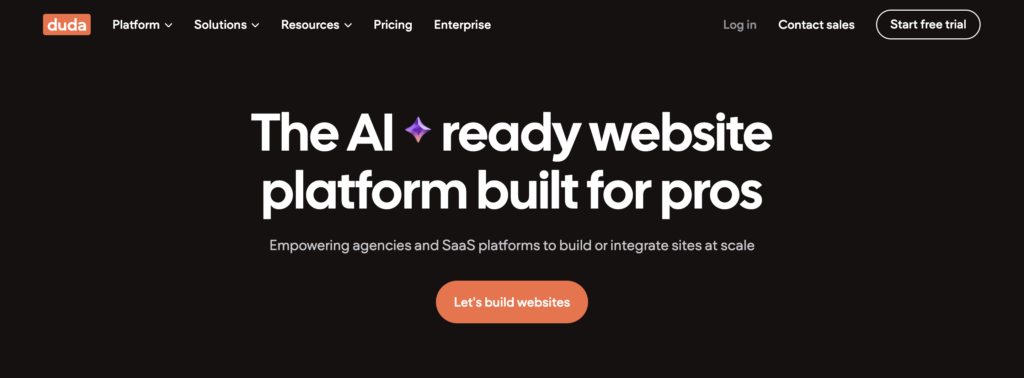
Duda is the platform agencies actually run at scale, with reportedly over 18,000 agencies and hosting companies using it. The white label dashboard is fully rebrandable: your logo, your colors, your domain, your client login screen, your outgoing emails. Sites consistently score 90+ on Google PageSpeed, which matters for SEO-led agencies, and the content injection API lets you push the same update across hundreds of sites at once, which is real leverage at scale.
Reviews from agencies credit the client management tools and the speed of building similar sites quickly. Honest complaints note that the per-site pricing adds up fast, the template library is smaller than Wix (around 100 templates vs Wix’s 900+), and that for highly custom or unusual designs, Duda’s editor is less flexible than Webflow.
Skip it if: you want more than just websites, or you are managing fewer than three to four clients. Duda is built for website-only agencies, and the math works against you below that volume.
2. GoHighLevel
Quick facts
- Best for: full-service marketing agencies that want to resell an agency operating system, not just sites
- White label price: Starter $97/month (no white label), Unlimited $297/month (visual white label, custom domain), SaaS Pro $497/month (full SaaS Mode with client billing and custom pricing tiers)
- What you give it: snapshots (pre-built workflows, funnels, automations) you build once and roll out per client
- Setup time: 7 to 14 days for a production-ready, fully branded environment
- Learning curve: high, this is a real platform with a real learning investment
- What it includes: websites, funnels, CRM, email and SMS, automation, appointment booking, reputation management, mobile app
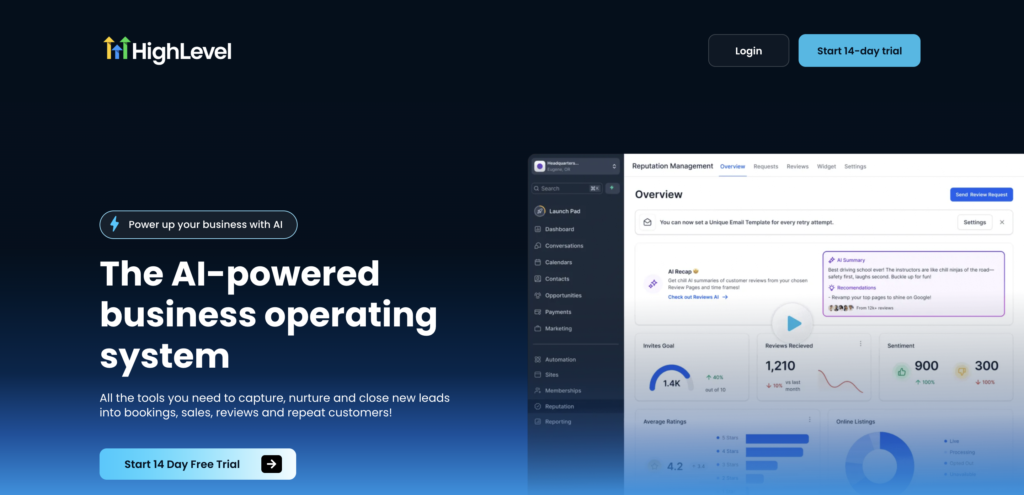
GoHighLevel is the biggest name in agency white label software, and the platform that turned thousands of agencies into mini SaaS businesses. The pitch is straightforward: instead of selling website services, you sell access to a branded software platform that costs you a flat $297 or $497 per month no matter how many clients you have. At three clients paying $297 a month, you have recouped the platform cost. At ten clients, you are running an 80%+ gross margin SaaS business.
The white label is genuinely deep. SaaS Mode (on the Pro plan) lets you set your own pricing tiers, automate client provisioning, run a fully branded mobile app, and bill clients through Stripe. Reviews from agencies who have ramped to 10+ clients credit the unit economics and the platform breadth. Honest complaints note that the learning curve is real (plan for two weeks of setup and another month of refining your snapshots), the interface can feel busy, and the websites built inside GoHighLevel are functional rather than design-forward.
Skip it if: design quality is your differentiator, you only need websites, or you are not committed to a real two-week setup. GoHighLevel rewards agencies willing to invest in becoming a software company. For everyone else, it is overbuilt.
3. 10Web
Quick facts
- Best for: agencies whose clients want or need WordPress underneath
- White label price: custom, typically from around $30 to $50 per site per month including managed hosting and the white label reseller dashboard
- What you give it: a business description; the AI generates a WordPress + Elementor site
- Setup time: days for a fully branded reseller dashboard
- Learning curve: medium if you know WordPress, harder if you do not
- What it includes: AI-generated WordPress sites with managed hosting, white label reseller dashboard, billing integrations
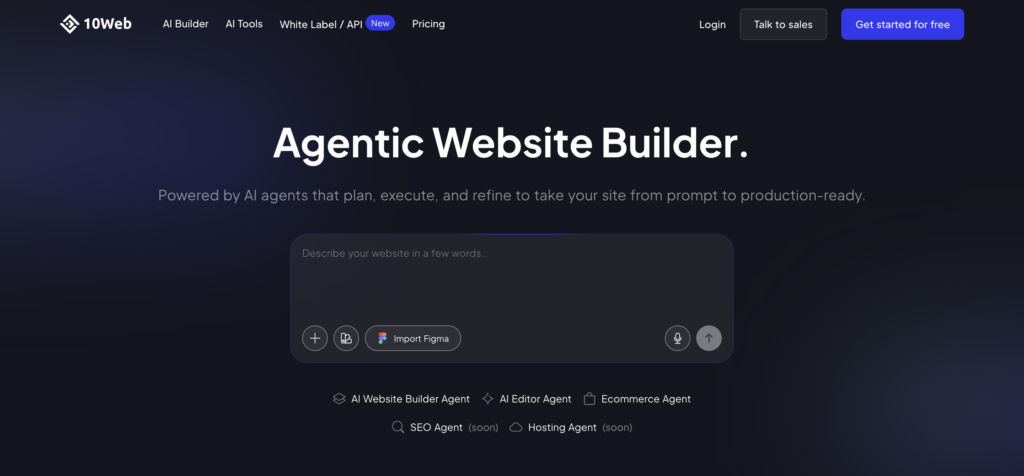
10Web is the white label answer for the large share of the market that has decided their clients’ sites need to be WordPress. The reseller dashboard gives you full brand control: your logo, your domain, your pricing plans, your billing. Sites are AI-generated and run on top of WordPress + Elementor, which means you get the full WordPress plugin ecosystem (Yoast, RankMath, WooCommerce, WP Forms) underneath, plus managed AWS hosting. For an agency that wants AI speed at the start and WordPress flexibility for the long term, this is the cleanest combination.
Reviews from WordPress shops credit the speed and the SEO plugin ecosystem. Honest complaints note that the design output is good rather than great, the pricing is opaque (you negotiate with sales rather than seeing public reseller rates), and the WordPress underneath, while powerful, is also more to maintain than a pure hosted builder.
Skip it if: your clients have no reason to be on WordPress. The WordPress underneath is 10Web’s whole value proposition. Without that need, Duda or GoHighLevel will move faster.
4. Wix Studio
Quick facts
- Best for: design-led agencies that already know and like the Wix ecosystem
- Price: from $19/month per site, scaling with site count; agency workspace included
- What you give it: Studio’s visual editor or AI prompts; full design control
- Setup time: hours to set up the workspace; per-site work is normal design work
- Learning curve: medium, easier than Webflow but takes time
- What it includes: advanced design tools, Figma integration, agency workspace, client handoff, mobile app
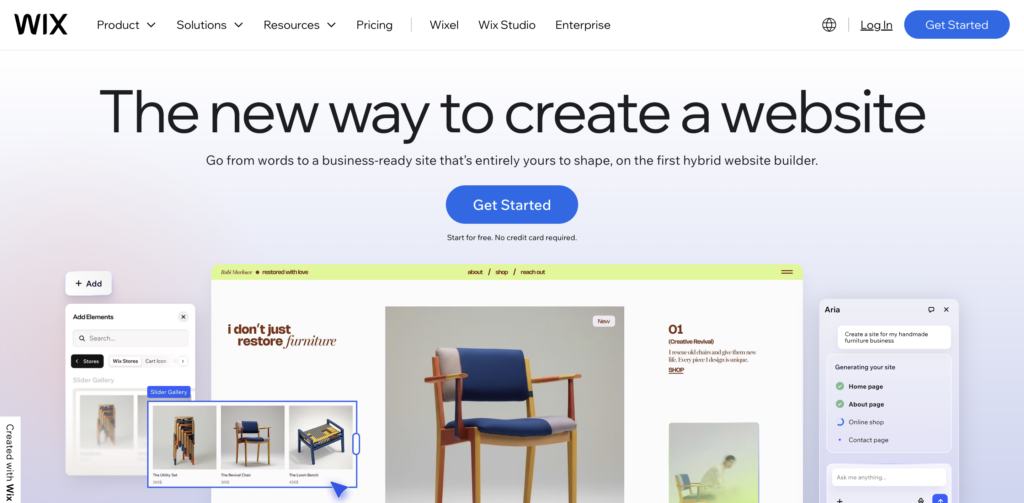
Wix Studio is Wix’s platform built specifically for agencies and freelancers. It replaced the older Editor X and now offers genuine agency workflows: centralized workspace, role-based team permissions, client handoff with custom permissions, and Figma integration for designers used to working there. The white label is partial. The agency dashboard can be branded, but the underlying Wix branding shows up in some client-facing places (notably the published-site footer on lower plans, removable with a custom domain and paid plan), so it is not the deep white label Duda or GoHighLevel offer. For a Wix-shop agency, it is the right tool. For an agency that wants the vendor invisible end-to-end, it is not.
Reviews from agencies credit the design power and the Figma workflow. Honest complaints note that the white label is partial rather than full, and that Wix’s reputation among some technical audiences works against the sites for certain client segments.
Skip it if: you need clients to never see the vendor’s name. Wix Studio is excellent for the agency. It is not full white label for the clients.
5. Vendasta
Quick facts
- Best for: digital marketing agencies that want to resell a marketplace of tools, not just websites
- Price: Professional from around $399/month plus a mandatory onboarding fee of $500 to $1,500; usage charges on marketplace apps add up per client
- What you give it: product selections from a marketplace, configured under your brand
- Setup time: weeks for the full marketplace to be configured and ready to sell
- Learning curve: high, this is a business platform decision more than a software setup
- What it includes: white label marketplace of website builder, listings, reviews, SEO, social media, advertising tools
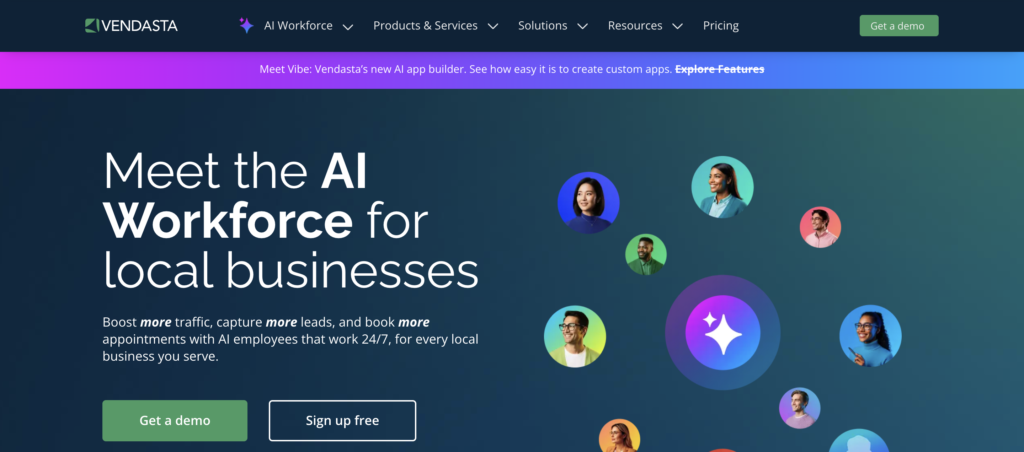
Vendasta takes a different angle than the others. Instead of giving you one platform to resell, it gives you a marketplace of digital marketing products (website builder, local SEO tools, review management, social posting, advertising) that you wrap in your brand and resell to local businesses. For an agency selling a portfolio of services to small and mid-size businesses, Vendasta becomes the back end for the whole operation. It is a real commitment, both in price and in setup.
Reviews from larger agencies credit the breadth and the ability to scale to hundreds of clients. Honest complaints flag the onboarding fee, the per-product usage charges that stack up, and the price point that excludes smaller agencies.
Skip it if: you only want to sell websites, or you are at the scale where one platform fee is already a stretch. Vendasta is built for established multi-product agencies and priced accordingly.
White label specialists for specific niches
This middle group is for agencies serving specific industries or use cases. The platforms here are narrower than Duda or GoHighLevel, but if your agency lives in their niche, they are often the better fit.
6. Simvoly
Quick facts
- Best for: marketing agencies focused on funnels and conversion, not brochure sites
- White label price: $497/month for the full white label SaaS plan with unlimited sub-accounts
- What you give it: a funnel template; Simvoly’s editor lets you build sites and funnels from one tool
- Setup time: days for a branded environment
- Learning curve: medium, the funnel-first approach is a different mental model
- What it includes: website builder, sales funnels, ecommerce, courses, communities, white label SaaS
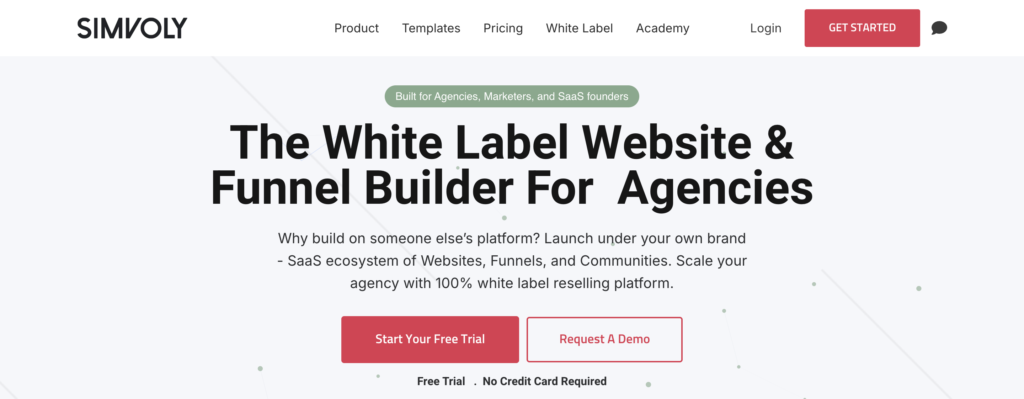
Simvoly competes directly with GoHighLevel on the SaaS-for-agencies angle, but the funnel and conversion side is the focus rather than the CRM and automation side. At $497 per month with unlimited sub-accounts and zero per-site costs, the unit economics at scale (50, 100, 500 clients) get genuinely interesting. For a marketing agency whose service is conversion funnels, courses, or membership communities rather than informational websites, Simvoly’s product set fits the work better than a pure website builder.
Reviews credit the unlimited sub-account model and the funnel tooling. Honest complaints note that brand awareness is lower than GoHighLevel, the ecosystem (snapshots, third-party trainings, community) is smaller, and that the website-only feature set is thinner than Duda’s.
Skip it if: your service is brochure websites or you need the GoHighLevel-scale ecosystem of training and snapshots. Simvoly is excellent inside its niche and lighter outside it.
7. Pixpa
Quick facts
- Best for: white label for photographers, designers, and creative service businesses
- Price: plans from around $7 to $16/month per site; white label features available on higher tiers
- What you give it: portfolios and content; Pixpa’s templates are creative-focused
- Setup time: hours
- Learning curve: low
- What it includes: portfolio websites, client galleries, ecommerce for prints, blog, white label client galleries
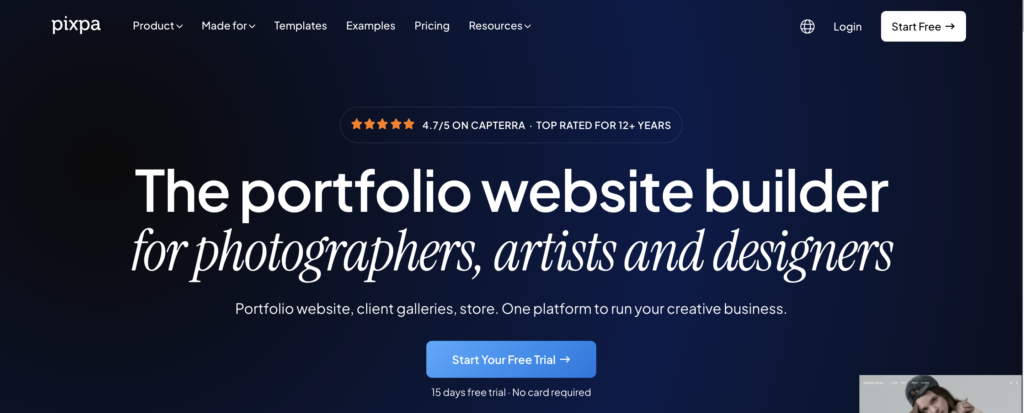
Pixpa is the white label answer for an agency serving photographers, artists, and creative service businesses. The platform’s whole design vocabulary is built for creative portfolios, client proofing galleries, and selling prints or services, which is a real fit for that niche and a real mismatch for any other. If your agency works with photographers, the platform fits the clients’ needs natively, which beats trying to make Duda or GoHighLevel feel right for that audience.
Reviews from photography agencies credit the niche fit. Honest complaints note that the platform’s narrowness is also its limit, and that the white label depth is lighter than the dedicated agency platforms.
Skip it if: your clients are not creatives. Pixpa is built for a specific buyer and the value disappears outside that.
8. B12
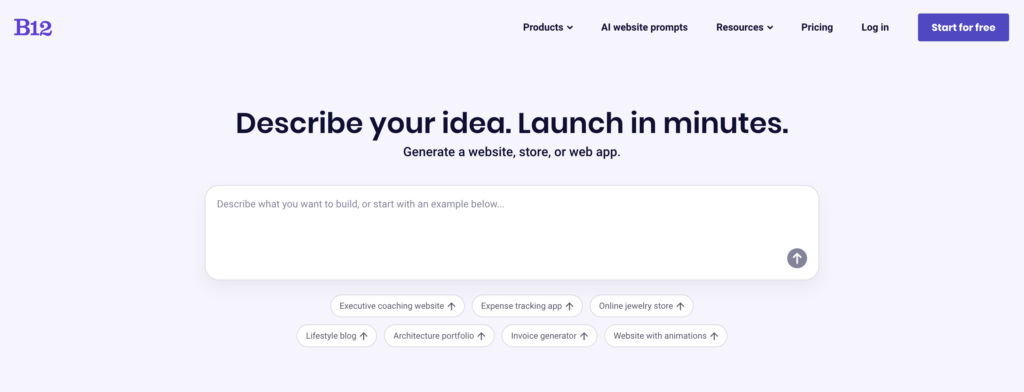
Quick facts
- Best for: white label sites for professional services (law, accounting, consulting) with human review built in
- Price: from around $42/month per site for AI-only plans; full AI-plus-human service tiers from around $399/month
- What you give it: business type and industry inputs; B12’s templates are industry-specific
- Setup time: days
- Learning curve: low
- What it includes: AI-built sites with optional human designer review, ongoing maintenance, industry-specific templates
B12 sits in an interesting spot. It is positioned mainly as a direct-to-business AI website service, but it also has white label and reseller relationships for agencies serving professional services niches. The differentiator is the human-review layer on top of the AI generation, which removes the design risk for industries (law, accounting, consulting) where the website’s polish actually affects client trust. For an agency that wants to sell professional services websites without managing the design or ongoing maintenance themselves, the AI-plus-human service model removes the operational burden.
Reviews from professional services credit the hands-off model. Honest complaints note that the price is high relative to alternatives, the white label depth is partial rather than full, and the platform is genuinely narrow outside professional services.
Skip it if: you want to control the design and maintenance yourself, or your clients are not in professional services. B12’s pricing only makes sense for the hands-off, industry-specific use case.
Agency-friendly but not actually white label
This last group is in the article for an important reason: agencies regularly mistake these for white label and then discover, mid-client-conversation, that they are not. Each has real value for the agency running them, but none hides the underlying platform from the client. Use them with eyes open.
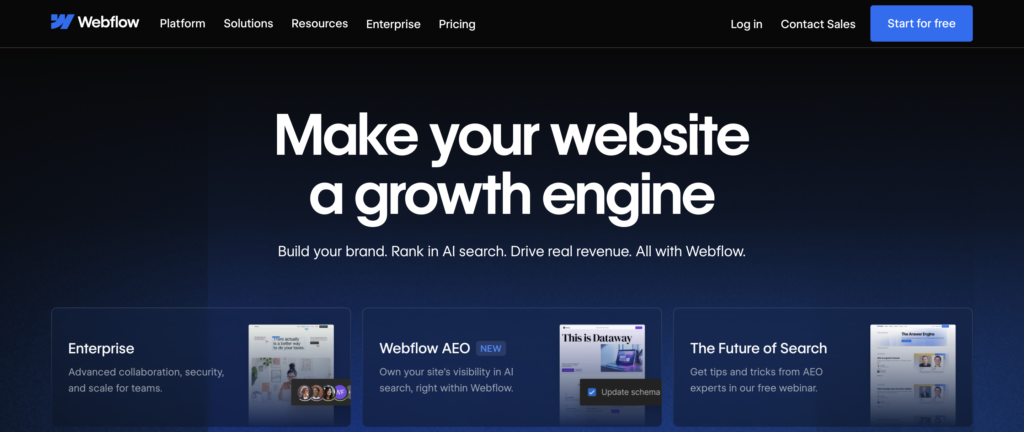
9. Webflow Workspace and Partner Program
Quick facts
- Best for: designer-led agencies committed to Webflow for their build process
- Price: Workspace from $19/month per seat; Partner Program is free to join with billing perks and partner-only features
- What you give it: Webflow design work
- Setup time: hours for the workspace
- Learning curve: Webflow is hard; the workspace itself is easy
- What it includes: centralized workspace, team collaboration, client billing transfer, partner discounts and badges
- White label: no, your clients log into Webflow and see Webflow’s brand
Webflow is one of the best design platforms in the world for marketing sites, and the Workspace and Partner Program are real improvements for agencies who use it. You can centralize client sites, manage team access, transfer billing to clients cleanly, and earn partner status with badges and discounts. None of that is white label. Your clients still log into Webflow at webflow.com and see Webflow’s branding. Some agencies treat this as a feature (“here is our recommended platform”) rather than a problem, and for design-led shops that is a defensible position. Just do not call it white label.
Skip it if: you need clients to not know what platform their site is on. That is not what Webflow Workspace is for.
10. Squarespace Circle
Quick facts
- Best for: solo designers and small agencies who build on Squarespace
- Price: free to join; members get plan discounts and partner-only resources
- What you give it: existing Squarespace work
- Setup time: minutes (apply to the program)
- Learning curve: none for the program itself
- What it includes: discounted plans, extended trials, dedicated support, community access, partner badge
- White label: no, sites still say Squarespace everywhere
Squarespace Circle is a partner program, not a white label platform. It is included here because Squarespace builders consistently get asked “is Squarespace white label” and the honest answer is no, but Circle is the actual thing being thought about. For a solo designer who builds on Squarespace, joining Circle is free, gives you discounts, extends trial periods on client projects, and adds a partner badge that some clients find reassuring. None of that is white label.
Skip it if: you expected white label. Circle is a discount and benefits program for Squarespace builders, full stop.
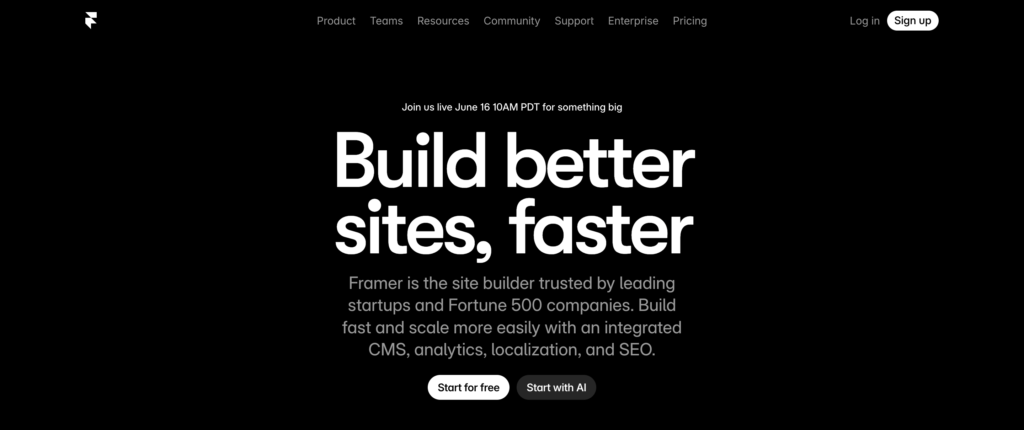
11. Framer Workspace
Quick facts
- Best for: small design-forward agencies building polished marketing sites in Framer
- Price: Workspace plans from around $25/month per seat for Teams; Enterprise custom
- What you give it: Framer design work
- Setup time: hours
- Learning curve: Framer itself is a real learning investment; the workspace is easy
- What it includes: team collaboration, shared assets, role permissions, central billing
- White label: no, Framer’s branding remains in client-facing surfaces
Framer is in the same boat as Webflow. The workspace makes agency life easier (collaboration, billing, asset libraries), but it is not white label. Your clients log into Framer and see Framer. For a small design-forward agency where the polish of the build is the differentiator, the partner approach is fine, the client knows you used a good tool, and that is part of the pitch. For an agency wanting to look like a software company to its clients, this is not the answer.
Skip it if: you want full client-side invisibility of the platform.
The free tier reality for white label
White label, by its nature, is paid software. Free white label is almost a contradiction in terms, because the model assumes you are reselling for margin, which means paying for the underlying platform. The honest exceptions:
Genuinely useful free starts. Squarespace Circle is free to join for the partner program, though Squarespace plans themselves are paid. Webflow Workspace has a free starter tier for the workspace (one project, one seat), useful for testing the agency dashboard. Wix has a free tier for individual sites, though Wix Studio’s agency workspace and white label features sit on paid plans. Mobirise is the unusual one: a free desktop application with a paid one-time white label add-on (no monthly fee), which works for a freelancer building a small number of static sites for clients.
Free trials that mean something. Duda has a 14-day free trial that includes the agency dashboard. GoHighLevel has a 30-day trial that gives you enough time to test the SaaS Mode setup. 10Web has a trial. Wix Studio plans can be trialed before paying.
Not really free. Vendasta requires onboarding fees of $500 to $1,500 just to start. B12’s free draft is not publishable. Simvoly’s lower tiers are not white label.
The honest rule: do not pick a white label platform on the free tier. Pick on the trial, run real work through it for two weeks, then commit. The platforms that survive the trial period are the ones worth paying for.
The agency and marketer playbook
This is the section to read if you skipped to the end. Marketers and agencies were the audience this article was written for, so the picks are organized by what you actually do, not by alphabetical ranking.
For a pure web design agency (websites are the whole product). Duda. Built for exactly this use case. The math works at four clients, the workflow tools are unmatched, and the design quality is good enough for most markets even if not as creative as Webflow.
For a full-service marketing agency (websites plus marketing, plus CRM). GoHighLevel. The platform fee is flat regardless of client count, the bundle (sites + CRM + funnels + email + SMS + automation + reputation) covers what most local business clients need, and the SaaS Mode pricing model is the most lucrative if you can support it.
For a WordPress-shop agency. 10Web. WordPress underneath gives you the SEO and plugin ecosystem your clients may need, and the white label dashboard on top handles the agency side cleanly.
For a funnel-focused agency. Simvoly. The unlimited sub-accounts at a flat $497 a month is the best unit economics in this list, and the funnel and community tools fit the work.
For a digital marketing agency selling a portfolio of services. Vendasta. The marketplace model and the breadth of products (reviews, listings, social, ads, sites) match the multi-service agency offering.
For a photography or creative-focused agency. Pixpa. The niche fit is the whole reason to be there.
For a professional services agency (law, accounting, consulting clients). B12 at the full service tier, if you want hands-off, or Duda if you want full control.
For a design-forward, small agency where Webflow or Framer is your platform of choice. Be honest with your clients that you build on Webflow or Framer (not white label), and use their workspaces to make agency life better. Pricing yourself on the design quality you deliver, not the platform you hide.
For a solo designer just starting. Squarespace Circle for the discounts, then graduate to a real white label platform when you have 3+ clients. Do not pay for Duda’s $149 plan to manage one client.
Three rules that apply regardless of which tool:
- Run the breakeven math before committing. $149 Duda needs 3 clients at $200 a month to make sense. $497 GoHighLevel Pro needs 3 clients at $200 or 2 at $300. Do that math before you sign up, not after.
- Buy the domain for your platform separately. Your white label platform sits at app.youragency.com. Own that domain through Cloudflare or Namecheap, not through the vendor. If you switch platforms, you take the domain with you.
- Decide your support model on day one. Most white label platforms expect you to be tier-one support. Build that into your pricing and your team time, or you will get squeezed when clients have problems.
How to actually set this up
White label setup is real work. The honest plan:
Week one: pick and trial. Trial two or three platforms in parallel. Build one real client site (or one real test workflow) in each. Decide which one your team can actually work in day to day.
Week two: brand the platform. Logo, colors, custom domain, outgoing email setup, mobile app branding (if applicable), help center setup. Most teams underestimate this and end up half-branded for months.
Week three: build snapshots and templates. For GoHighLevel and Simvoly, this is workflow snapshots. For Duda and 10Web, this is site templates and content blocks. For all of them, the goal is that the per-client build is fast because the heavy lifting is reusable.
Week four: onboard your first client. Real client, real money. Not a friend. The onboarding experience teaches you what is missing, and your first client’s feedback is more useful than another month of internal testing.
For learning resources, every platform here has official docs and academies that are better than third-party tutorials. Duda Academy, GoHighLevel’s learning portal (and the large external community of agency trainers), 10Web Help Center, Wix Studio Academy, and Vendasta Academy all cover the setup and ongoing operation in real detail.
How to choose
The shortest version of all of the above:
- Cheapest credible white label: Duda’s $149/month plan (4 sites).
- Best unit economics at scale: GoHighLevel SaaS Pro ($497 flat, unlimited clients).
- Best for WordPress shops: 10Web.
- Best for design-led agencies in the Wix ecosystem: Wix Studio.
- Best multi-product marketplace: Vendasta.
- Best for funnel-focused agencies: Simvoly.
- Best for creative/photography niches: Pixpa.
- Best for professional services: B12.
- Best partner program (not white label): Squarespace Circle (free) or Webflow Workspace.
Then test before you commit. Almost everything here has a trial. Build one real client site (or one real workflow) in your top two picks and see how the team actually feels after two weeks. The trial is for testing the platform. The first paying client is for testing your business model on top of it.
The bottom line
White label is a business model decision before it is a software decision. If you have one or two clients, do not white label, just use the right tool under their account and price your service well. If you have three to ten, start trialing. Past ten, white label is the right answer and the difference between the platforms above shows up in margin.
The tools are real and the unit economics can be excellent. The honest part most articles skip is that the platform is the easy bit. The hard parts are still the same as any agency business: finding clients, pricing right, delivering work that converts, and writing a client-facing pitch that actually says something instead of sounding like every other agency. AI tools and white label platforms reduce the build cost. They do not solve the marketing and sales problem.
That is the same point we keep coming back to in our writing on content blindness, the idea that audiences (and clients) stop noticing because there is too much sameness. Use these tools to ship cleaner, faster, and at higher margins, then put that saved time into the positioning and the proof that makes a client pick you over another agency with the same software stack.
If you want help with the writing and positioning side of your agency, see what we do or book a call.

Rashmita is content marketer with 8 years of experience building and growing SaaS brands. Now she tests various AI tools for marketers and shares her feedback on this blog, LinkedIn, Instagram, and YouTube.